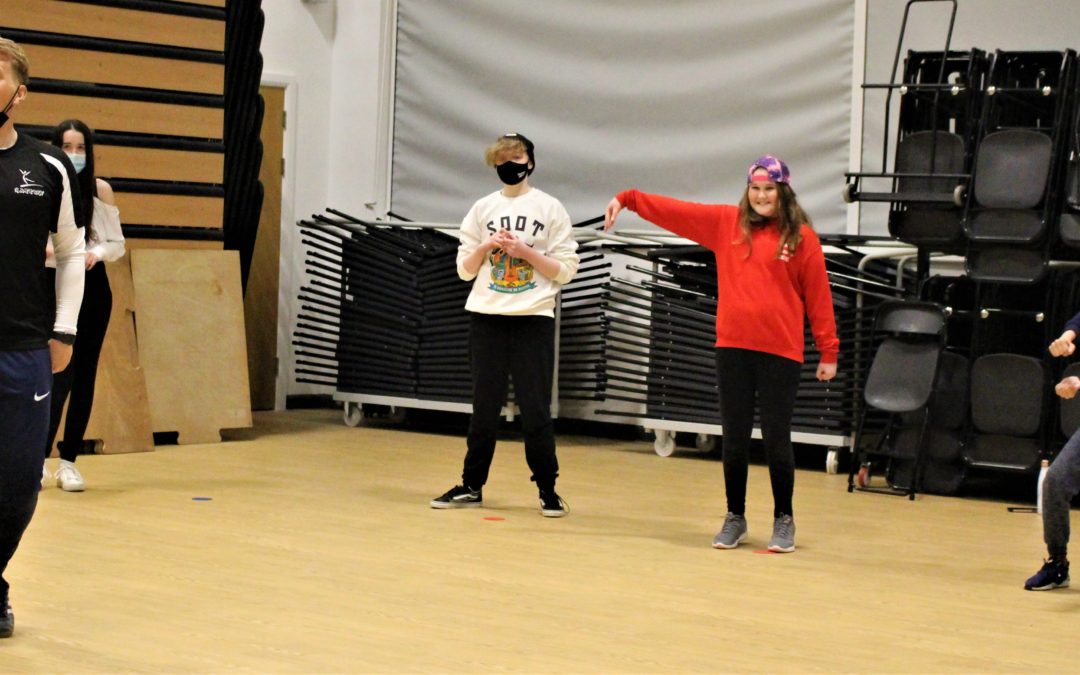
OVER 300 YOUNG PERFORMERS PRESENT THEIR ‘ACTS OF KINDNESS’ PRODUCTION THIS WEEKEND
One of the South West’s leading performing arts companies for children and young people is releasing a live-stream film featuring thirty acts of kindness. All taken from images, poems, music and stories they’ve gathered during the pandemic.
Fi Da Silva Adams, Founder of Revolution Performing Arts (RPA), based in Swindon, said: “This is the first time we have ever done something like this. Our film, Acts of Kindness, will be live-streamed at 6pm on Saturday June 12. It features around 300 talented young people.’
From four to fourteen
The youngsters, from as young as four up to aged seventeen, will cover all aspects of the performance from:
1. Singing 2. Song writing 3. Dancing 4. Acting 5. Make-up and costume and getting involved in the technical side of film making.
Local film maker, Henry Meredith and his team from OT House are filming the acts of kindness pieces and facilitating the live-stream.
A difficult year
Two 14 year old boys, David Hunt and William Cottell, are studying the techie side of theatre alongside OT House and assisting with lighting and sound.
In a year when official work experience is difficult to come by, these young people are travelling to venues throughout Swindon, Wiltshire, Gloucestershire and Oxfordshire to be assistant technicians in this unique experience.
Other young participants of the live-stream film have written their own songs, laid down their own soundtracks created their own choreography. They’ve also:
written and directed their own theatre pieces
adapted to new technologies,
mastered circus theatre skills and …
… found real resilience in making changes for Covid-secure ways to be expressive in both physical and visual ways.
Some of the acts of kindness featured are:
special anniversary meals
NHS workers and other events or actions brought to light during a time of darkness.
The youngsters are portraying them all via songs, drama and dance. They use them as a stimulus for the young performers to ‘magically’ turn into their own superheroes!
The RPA circus theatre arts group are creating their own performance work with the same stimulus. The media make up & costume team have been providing mood boards to the RPA leaders and helping with costume requirements. They’ve also given advice on make up for film, which is very different to r live theatre.
Recording started last month. And the young people have taken part in 29 filming sessions all over the RPA area and with one completed on Zoom. There have been approximately 50 hours of filming involving four film makers, four technicians and fifteen RPA leaders.
Making possible the filming and live-streaming of Acts of Kindness is a £25,000 grant from the government’s culture recovery fund.
The live-stream starts at 6pm on Saturday 12th June and costs £11.37 per family (includes booking fee and a copy of the recording).
Meeting the Great Bustard. Giant of Salisbury Plain by Rebecca Davies BSc (Hons).
Introduction
Meeting the Great Bustard This is the Wiltshire flag:
The green and white stripes represent the chalk downland, and the segmented circle, henge monuments. But the bird is a strange creature; it is a big, powerful legged avian. It may be a fabulous Heraldic bird. But then again, it may actually exist. This is Otis tarda: the Great Bustard.
The name `Bustard` is derived from the Latin, Avis Tarda, (Slow bird). You’ll find Great Bustards in a scattered belt from Spain through to Asia.
The woodcut you see below is by Thomas Bewick (1753-1828).
They prefer running to flying. But they certainly can fly even though they are the worlds heaviest flying bird. Bustards have been measured at over 20kg.
Great Bustard (Otis tarda) Salisbury Plain part of a reintroduction project with birds imported under DEFRA licence from Russia.
A collective noun
A group of Great Bustards is known as a Drove. This may contain from 20-40 birds. They eat pretty much anything they can pick up, from beans and grapes to insects and small mice. Bustards attract and mate during a process known as a lek. The male bustard chooses his ground and fluffs out his white under feathers until he looks like a big pompom.
The mating ritual
Later on the females will show an interest in the male’s big dance. Female Bustards are much smaller than the males. Their hein plumage is much more cryptic.
Bustards do not pair as such but the female will visit several males before she chooses one. They mate and disperse to nest and the cock takes no further part in the proceedings.
Nesting habits
Bustards are ground nesting birds. She does not lay many eggs, two being the average clutch. This is a problem if she has nested in a crop with an early harvest date. If harvesting machinery comes around she will sit rigid and be destroyed by the machinery along with her eggs. This is a double disaster, eggs can be replaced but not adult females. Hence, Bustard conservation hinges around making sure she has a safe place to raise her family in. It must also be fairly secure against predators.
After a month the eggs hatch. The chicks are beautifully mottled. They are precocious little creatures and can run around soon. However they are dependent on their mother to teach them what they can eat.
The bustard in Britain
Great bustards have a close association with sheep farming. Yet they seem to have an association with areas of mixed agricultural activity these days. This distinct bird is part of British culture.
The bustard features in heraldry. It is also the symbol of the Wiltshire branch of the Guides.
Cambridge County council coat of arms
There are two pubs going by the name of the Great Bustard – one indeed upon Salisbury plain. The other a coaching inn near Shrewton on the old Devizes to Salisbury road but it closed some years ago
As the famed bird of Wiltshire, the Wiltshire Archaeology and Natural History Magazine printed several accounts of the last of these birds in the county. Most of these were memories of downsmen and shepherds encountering the increasingly scarce birds in their youth.
Agricultural changes got the blame for the bustard’s decline. But invariably the last specimens fell prey to collectors. One such being ahapless female who, in 1871, became the last bustard served up at a feast. This particular bird’s skin is now stuffed and on display in Salisbury museum.
The Re-Introduction of the Great Bustard
In 2004, after an over 150 year absence, the Great Bustard saw introducing back into this country. This is David Waters pet project. He encountered bustards on birdwatching tours in the ex-Soviet Union in the 1990s.
My visit
I was fortunate enough to get a chance to see the reserve and (hopefully) the birds at the end of Covid lockdown in May of 2021. Isn’t it exciting to get out and about again?
I travelled to some place on Salisbury plain – I can’t quite identify the location of. Anywhere south of Pewsey is terra incognita to me. A land of rolling patchwork fields, thatched cottages interspersed with gentle river valleys and the odd tank crossing sign.
Meeting with David on the farm we set off along the byway in the project Land Rover. He explained that the Bustards don’t like to see people as they’re shy but aren’t t bothered by vehicles or horses. As David explained, pretty much all land in Britain has been under human influence for a very long time. With my experience of archaeology in some very remote areas, I could not help but agree with that.
At length we got to the hide.
Examining the reserve
Then we settled to examine the reserve. An area planted variably. The reserve has an area surrounded by a fox and badger proof fence. (But stoats and birds of prey can still get in) The bustards can go out, and indeed most hens nest outside the reserve. And there they are. What is that fawn blotch? This is the male bustard. Isn’t he huge?
Which is the best I could do even with a good zoom and anti-shake camera. The bird was on the other side of the valley! Getting close to a wild bustard is not an easy task.
David had his very powerful monocular which gave a good view of the male. You could see his moustache blow in the breeze. I was also shown the nesting hen. She was almost impossible to see even when she put up her head to peer around. An impossible shot for my camera.
Most downland birds are in decline in this country. Not here! We saw ravens, yellowhammers, stonechats, red tailed kite and a quail, I also saw a Roe deer and a Hare. This land is full of wildlife as well as being busy with agriculture and abundant archaeological remains, all less than a kilometre away from one of the roads of Salisbury Plain, and noisy artillery.
Conclusion
According to DEFRA bustards are not a native species! What have we been talking about all this article? Here is a bird that is exotic…yet very British.
The project has been successful, and now these birds are striking awe into the people of Wiltshire again. And the Heraldic bird is no longer a mystery.
Many thanks to David Waters for taking the time to show me his birds.
A Swindon Oasis SOS People of Swindon, please come down to the front of the Oasis Leisure Centre on Saturday 19th June from 2pm, to protest to help save our treasured Oasis Leisure Centre complex.
It would be great to have a fantastic turnout to show the town’s decision maker’s that the people of Swindon demand the Oasis be refurbished and reopened as soon as possible, NOT demolished and replaced.
The people of Swindon will not accept the demolition of our famous landmark. It is a place that our children and families heavily used and enjoyed. We must all stand up if we want to preserve it for our future generations. This is the last chance to do so. So come on Swindon! We must save the Oasis NOW before it is too late and past the point of no return. It is part of Swindon’s heritage and identity.
Let’s have some Oasis fun
We hope to have some fun at the protest – please design your own Save the Oasis banners, flags and placards.
If you want, why not come down with beach and pool inflatables, or wear sports kit etc? Bring all your family and friends, spread the word and share this event.
We will get the media involved so the Oasis issue continues to get national attention. We want the Council to fully understand that Swindon wants the Oasis refurbished and made viable in its current iconic form. The Oasis is irreplaceable! We will also be playing Oasis music outside the Oasis, as a reminder of the building’s significance to produce some atmosphere, along with a megaphone and a large campaign flag.
Support from Acorn
The protest has the support of local campaign group Swindon Acorn, who will also be there. We are now at a critical stage of the campaign, and we must keep our foot on the pedal.
We need your support and we look forward to seeing you all outside the front of the Oasis on Saturday, 19th June from 2pm.
What’s the story morning glory?
The much loved Oasis Leisure Centre, which opened in 1976, has suffered neglected and poor maintenance for years. Swindon Borough Council had a maintenance backlog dating back to 2011 when it rented it out for 99 years to property developer Seven Capital. Seven charged Greenwich Leisure Limited (GLL) high rent that made the Centre unviable for GLL so it handed back its lease to Seven in spring 2021. SBC does not seem to have a take-back clause in its 99 year lease to Seven.
They then outsourced the Oasis to property developer Seven Capital, charging GLL high rent and making the centre unviable, so that they had to give up the Oasis.
The current Oasis closure is not down to COVID-19. Covid has been used as a contributory excuse to get rid of the Oasis. It is claimed that the iconic dome has reached the end of its life, but was fitted with replacement panels in 2015.
The significance of the Oasis
The Oasis, is of cultural and architectural significance to Swindon. It;s the last remaining example of its unique type in the UK. The others have been demolished already.
Historic England is expected to announce its decision by the end of June 2021. We’ll know then whether the Oasis gets ‘Listed Building’ status which may be some help in saving it. Clearly no one wants the Oasis to become another neglected Mechanics’ Institute, Locarno Corn Exchange or perhaps Milton Road Baths.
Swindon is a continuously growing town, and has been left with a gaping hole without the Oasis. It needs the Oasis as an accessible, affordable, exciting leisure pool with dry-side sports and cultural events alongside.
The Oasis is not only a Swimming Pool. It is – or it was – a beating heart of Swindon.
The last of a typology
The Oasis, which is of cultural and architectural significance, is the last of its typology. A listing application with Historic England is nearing the final stages, and we should know by the end of June if it becomes a listed building. Seven Capital want to knock down the Oasis and build a fresh new centre. However the Oasis is an iconic building, It is only 45 years old, which is nothing when you compare it to the Milton Road Swimming Baths.
Swindon is a rapidly growing town, and has been left with a gaping hole without the Oasis. It needs the Oasis more than ever. The Oasis is more than a swimming pool – it’s also an events and concert venue. People travel from miles around to visit the facility – from places like Bristol, Oxford and Cheltenham.
The Stratton Peace Memorial Swindon So yesterday, together with two friends and two dogs, I strolled round Stratton following a Stratton history trail.
One of the things this trail takes in, is the Stratton Peace memorial, the main focus of this post. But I’ll come back to that in a bit. First a bit of info about the Stratton treasure/history trail.
The Friends of Grange Schools in Stratton put this trail together during lockdown last year. As the leaflet says:
‘we hope you enjoy this treasure trail. … developed by volunteers for Friends of Grange Schools. Our aim is to give your local walk a bit of a focus and we hope you learn something new about our area.’
I can’t say too much more about the trail because FOGS has written it as a fund raising activity: ‘Contact us at fogsstrattontrail@gmail.comif you’d like to buy a copy of the trail.’
And I recommend you do! It’s really cool. We learnt a lot – and we didn’t quite do the whole thing.
I will though take this opportunity to mention my own Born Again Swindonian’s guide bookbecause the aim of that matches the aim of the FOGS trail. That being, to get you to learn more about your area with a bit of urban exploration. My #lookdownlookaroundlookup is as applicable there as it is to my own writings. And my book offers something for all the family. You’ll find within its pages two kids’ quiz trails with answers in the back of the book. On those trails is around Old Town and the other features New Swindon. Amongst many other things of course!
And for a grown-up version of Stratton History go here. And also here in the Swindon Advertiser. Indeed, as that article says: ‘You will be surprised just how interesting Stratton can be once you know a little more about its history, where key landmarks used to be, and also which of the ancient pathways and streets to look along to find old interesting buildings and structures.’ And they’re right – walk around it and you do get the sense of the village it once was.
The Stratton Peace Memorial
They sure seem big on memorials in Stratton – that’s an observation not a criticism. As this Swindon Advertiser article observes: ‘Despite having two memorials in Stratton – one in St Margaret’s Church and the other outside the Royal British Legion in St Philips Road – residents approached the parish council in 2011 for a central memorial to mark the centenary.’ Not to mention of course the TWO spots that commemorate the Canadian pilot.
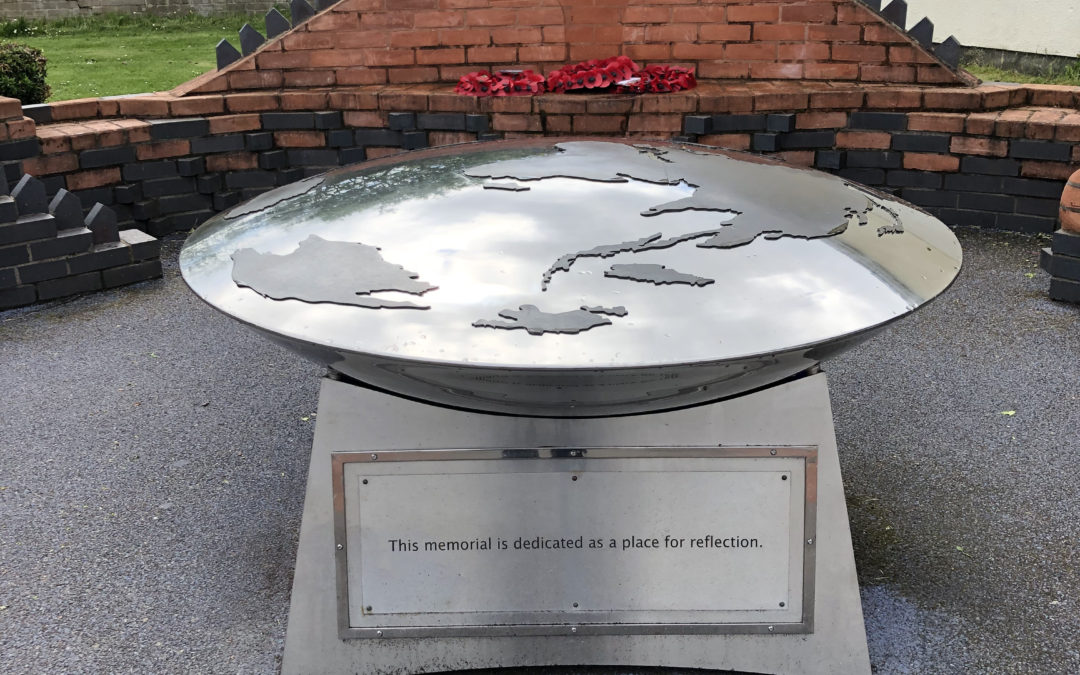
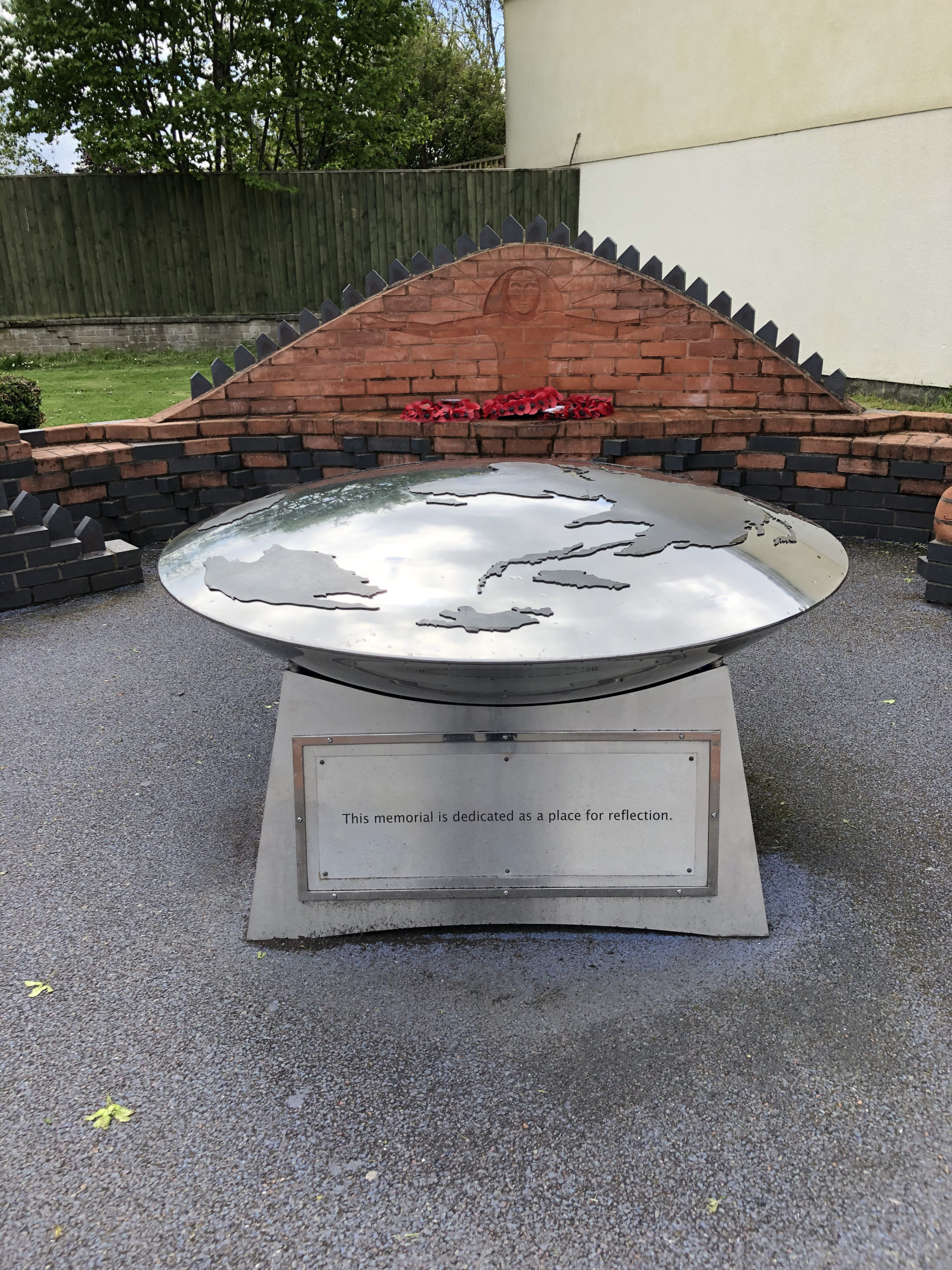
Sitting on a corner of Grange Drive and Ermin Street, The peace memorial, installed in 2014, commemorates the centenary of WWI. Children at Ruskin Junior school took part in a competition to design it. Ethan Carter’s design involving mirrors and called A Place to Reflect, was chosen.
Tony Currivan, an architect with Swindon council, designed the whole memorial area. It comprises three elements, including a zig-zag path, a grail sculpture for focus and reflection, and a brick structure representing Stratton St Margaret and the dragon protecting the grail.
A Commercial Rd Photo Essay There’s no denying that something bad ails the high street. Not only in Swindon but in general. From January 2021, this Guardian article, Retail is at death’s door – and tinkering with business rates won’t save it, tackles at least part of the problem. The pandemic hasn’t helped of course, but problems have been apparent for a while.
‘Around 25,000 people are likely to lose their jobs as a result of the failure of Arcadia and Debenhams. And while online groups are expanding – Boohoo is opening a warehouse in Wellingborough with 1,000 jobs – the online model requires far fewer employees than do sprawling department stores.’
And, as the article points out, all these closed stores leave physical scars too. For sure Swindon has scars right up its thorax. What with Debenhams gone along with Morrisons and most of the restaurants in the Regent Circus development. It’s a worry.
It’s a not such a new thing though
The high street is dead – long live the high street.
This blog from Just Clear states that the problem isn’t new and has been a prevalent issue for some years. Further, that this past year has simply pressed fast forward on a tape already running. They go onto say: ‘We are not seeing the death of the Highstreet. We’re seeing a change in the high street with shops looking to downsize, become more boutique and focus on the experience of the visitor.
Green shoots in Swindon
As I said earlier, Swindon isn’t without problems. But an interesting thing is happening on Commercial Road in the town. Once, as the name implies, the street was the location for solicitors, insurance and numerous job agencies. And indeed some of that still exists. But now, it’s reinventing itself as a world food – as Asda irritatingly insists on grouping particular food stuffs – shopping centre.
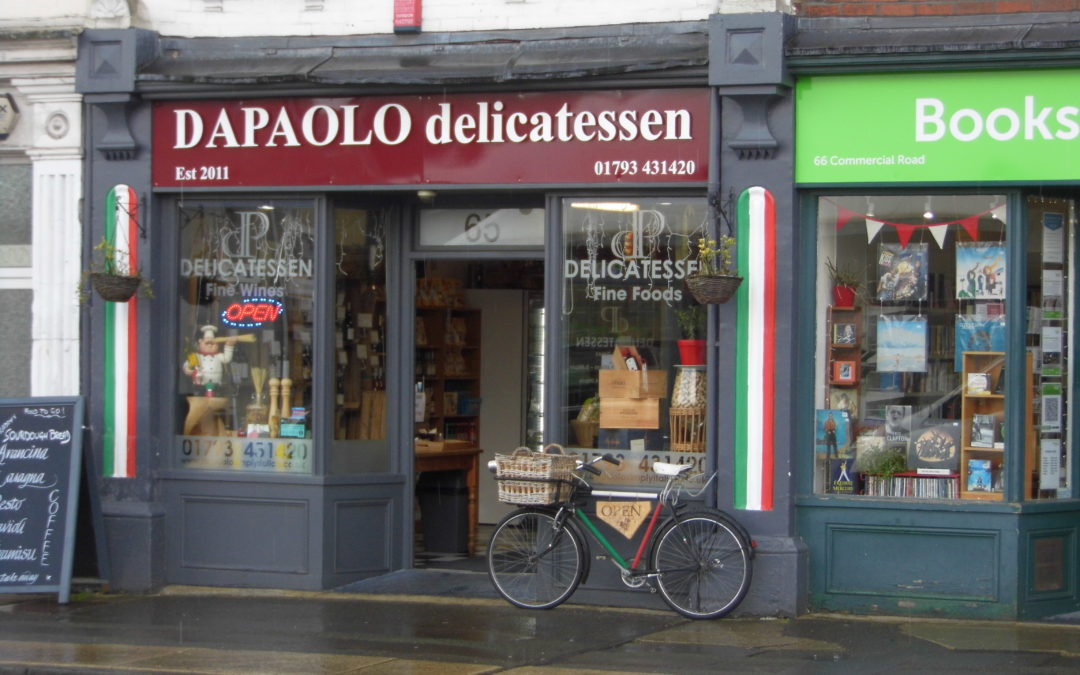
The lovelyDaPaolo Italian delicatessen at the bottom end, by near the Rolleston and the Prospect charity shops, has been there for some time now. And often frequented by yours truly. But now there’s a whole range of most everything imaginable up and down the street. Now this is interesting – of tradition Manchester Road and the Broadgreen area was the place to go for this sort of thing. I’ve not been to that part of town for ages. #obvs But I daresay this is an addition rather than a supplanting. All of which is as you’d expect in such a multi-cultural and diverse town.
And here, thanks to my chum Chris Eley, here’s a photographic tour of them all. I may not necessarily have got them in the right order – but you get the idea.