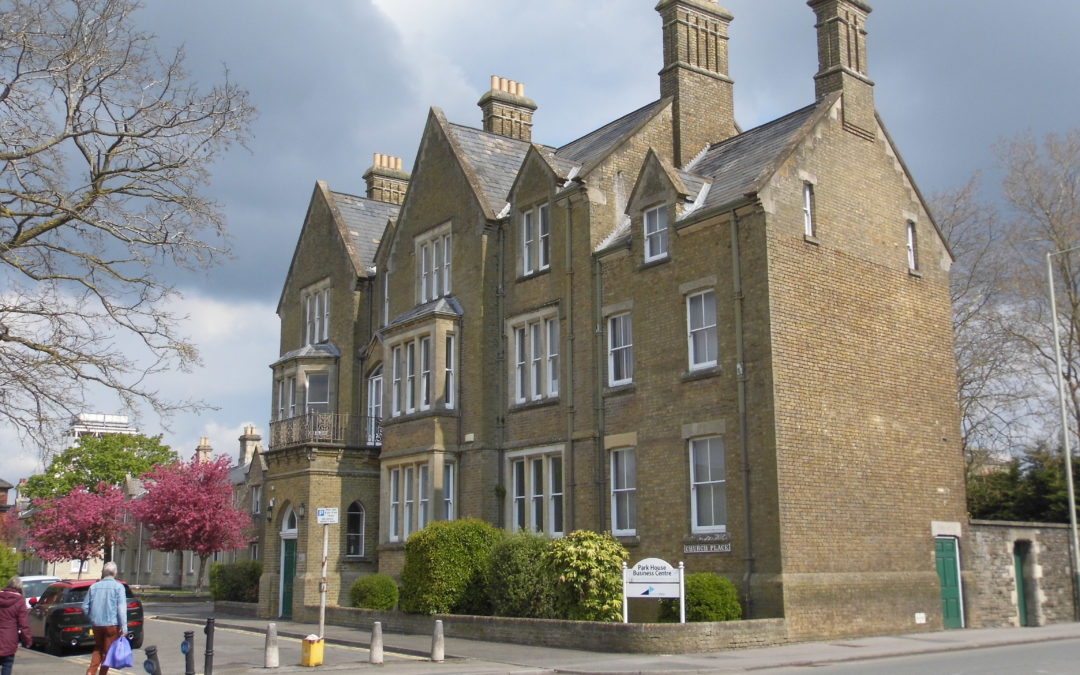
1876 saw the GWR directors agree to build a house and surgery combined. The house, Park House, was for the company’s chief medical officer and his family. Thus, that year saw a substantial yellow brick house erected on the south side of Taunton Street.
Park House then became home and consulting room and treatment rooms for the company’s then chief medical officer, GM Swinhoe. Later, it became familiar to generations of GWR men. They had to go to Park House for their medical examinations before they could secure employment. Either in the Works themselves or as footplate staff.
A precarious position
Before this building’s arrival though, Swindon’s medical officer endured a more precarious position.
*For more on the Medical Fund Society and the MFS hospital – now central community centre – I refer you to Secret Swindon and Swindon in 50 Buildings respectively.
SWINDON NIGHT SHELTER OFFERS ACTIVITY SESSIONS TO HELP THE HOMELESS UPSKILL
Swindon Night Shelter Activity Sessions GUESTS at Swindon Night Shelter will get the opportunity to take part in activity sessions from next week (May 11) to support them with life skills.
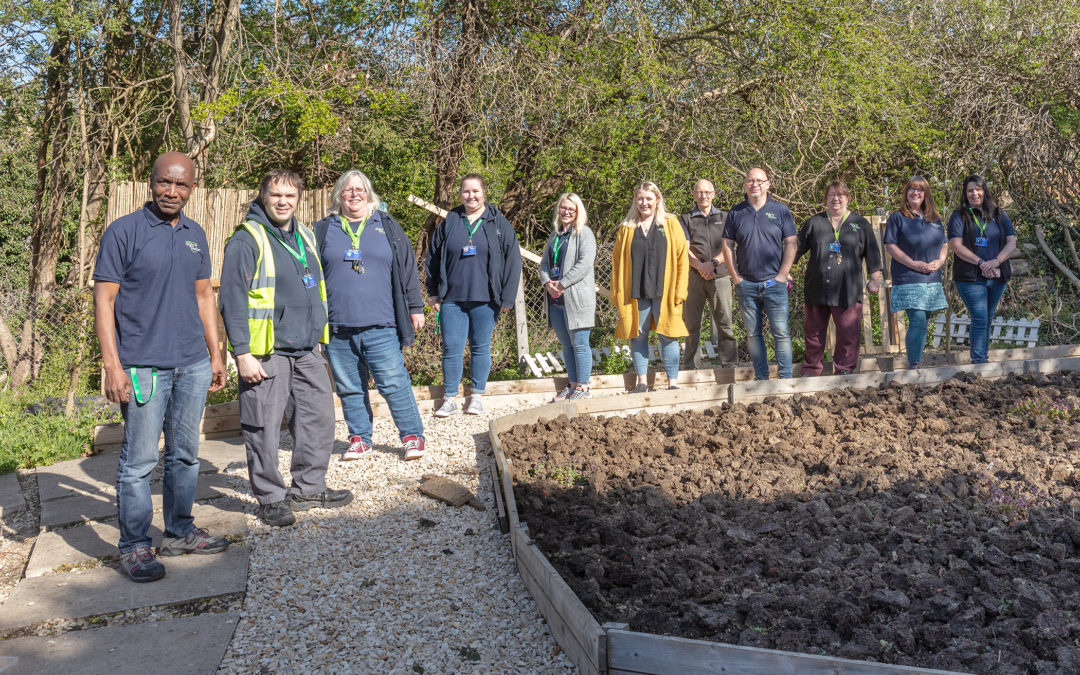
The invitation only classes will include cooking, gardening, painting and decorating. Their aim is to help those who’ve found themselves living chaotic lifestyles or who are in vulnerable housing.
Manager Ian McCarthy said: ‘We’re hoping to build up these activity sessions weekly. Then, over time, we’ll help our guests to get into a routine along with the opportunity to learn and develop new skills . We’ve realised that, as we start to come out of the pandemic, there is a need to give our guests opportunities to engage with everyday skills. Skills that they may have either lost touch with or been unable to engage in due to their housing circumstances.’
Diversification
During the pandemic, Swindon Night Shelter diversified its activities during the UK lockdown. During this time the local authority housed many rough sleepers. Now the organisation is powering up again to provide day-to-day support to rough sleepers in the town. And also for those who live in precarious housing situations.
Most people know that a rough sleeper is someone who sleeps on the street and has no roof over their head,” Ian said. “Yet there are other people in our town without secure housing. They may live in temporary accommodation, or be sleeping on a friend or relative’s sofa. These are people on the margins of society. It’s not our role to judge anyone, it’s our mission to try and support people and help them when they want help. We’re a Christian centred ministry. Thus, alongside the vital practical day-to-day support provided we also want to share the abundance of God’s love and provision to those in need’
Staff and volunteers will run the activity sessions, starting with cooking and woodworking. We’ll introduce other sessions, including ardening, upcycling, painting and decorating, arts and crafts at length. We hope to offer one-to-one support for those who don’r have English as a first language – a barrier to integration.
A safe haven
Swindon Night Shelter runs The Haven centre on Queen’s Drive. The organisation also has two shops: Clive Parade and Freshbrook and several key food collection location points. All are now gearing up to operate in a post pandemic situation.
There are plans to increase their services during 2021 and to take an even greater role in supporting the vulnerable in the town.
APPEAL FOR ‘SHEDDERS’ AS RENEW MEN’S SHED OPENS ITS DOORS
Shedders needed for Swindon Renew TheSwindon Renew Men’s Shed projectis seeking ‘shedders’ to come along and take part in activities when it opens up again on May 11th.
Renew is an organisationwhich has been most successful in the town over the last three years. It’s part of the UK Men’s Shed Association, which has 600 projects across the UK.
The aim of Renew
The aim of Renew is to help men and women with their mental well-being. How? By providing welcoming, supportive social spaces for them to pursue practical activities. make friends, reduce isolation and feel valued.Kevin Prosser runs the Swindon group.
Kevin said: ‘Like many organisations, the pandemic stopped all our sessions. We focused instead in providing food parcels in conjunction with Swindon Night Shelter and selling the award-winning Frenchic Furniture paint. That helps us with the finance to keep going. It’s taken a while to plan and prepare a safe return to work. There will be some changes to what we but I’m proud to say we’re almost ready to go.’
One of the changes will be that the ‘shedders’ will be helping other community groups across the town. They’ll do that by creating new furniture or upcycling existing pieces. This month ‘shedders’ will be working on a bench and some woodwork and upcycling projects for Swindon Hub. They’re planning a new creative and community hub in the town centre.
Learning a new skill or sharing a skill with others or working on projects for the community or an individual can help those we serve gain a renewed sense of purpose and belonging,” explained Kevin.
Re-opening
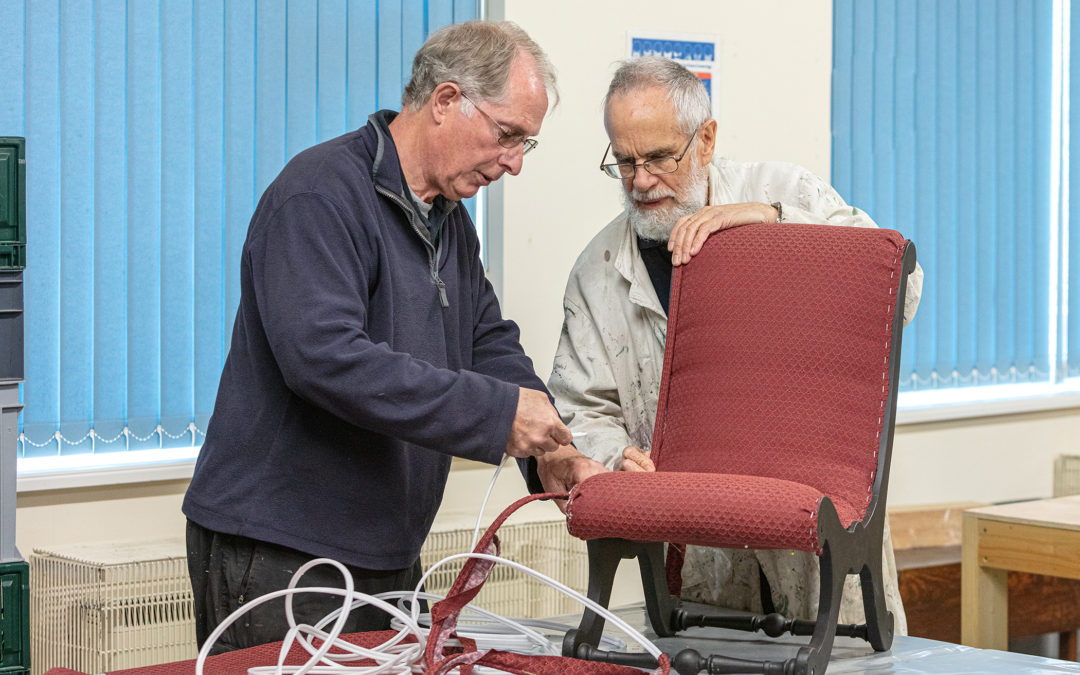
The project will be open again from Tuesday May 11 at its premises at Chippenham Close Community Centre in Penhill. They’ll run men’s woodwork sessions on a Tuesday morning and upholstery sessions on a Thursday morning led by professional upholsterer, Erica Sawdon. She donates half a day a week to the project. The upholstery session is open to male and female ‘shedders’.
This month there’ll also be the opportunity for some one-off upcycling and woodwork workshops for the general public on a Saturday. That means everyone can get involved in helping with the community projects whilst learning or sharing a skill at the same time.
In the next few months, the plan is to offer a ladies’ craft club, sewing and art workshops. And also Christians Against Poverty Life Skills and Fresh Start courses.
Anyone interested in becoming a ‘shedder’ or wants to attend one of their Saturday workshops must book in advance due to Covid19 restrictions.
To find out more visit their Facebook page Renewswindon or call Kevin Prosser on 07540 726432.
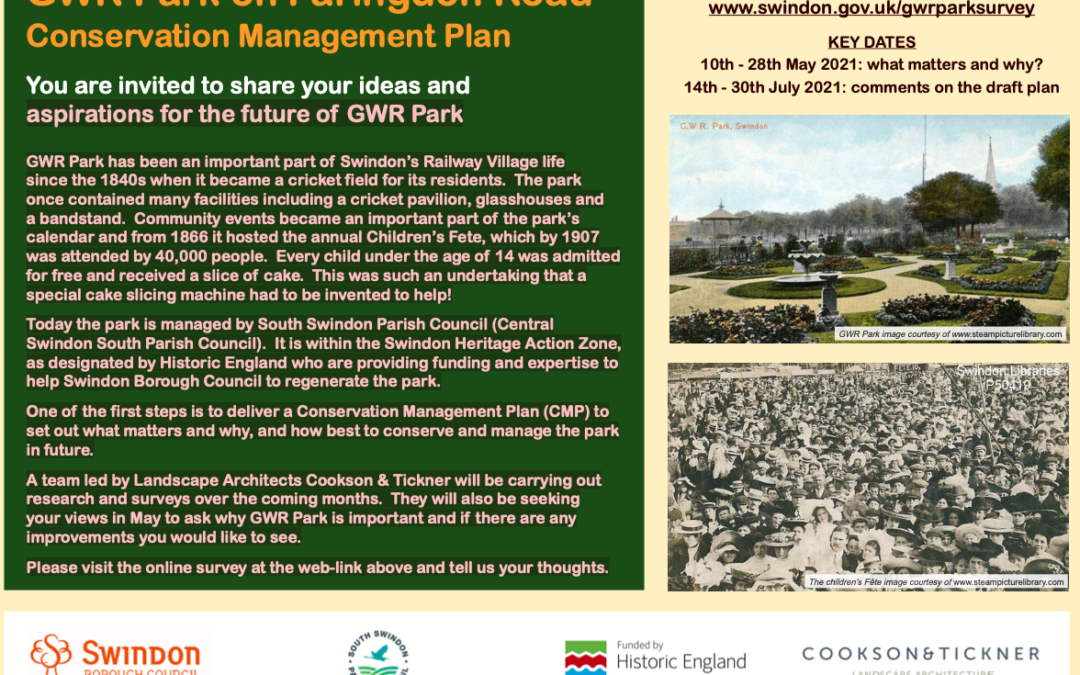
The GWR Park, in the GWR railway village, is a fabulous green space. It’s one that’s been much-loved and much-used by Swindon residents for over 170 years. Here it was, that the famous cricket hero, DR WG Grace, playing for Bedminster, suffered an infamous 1870 defeat by the New Swindon cricket team.
Along with the cricket pitch, the park once boasted extensive formal flower beds and greenhouses. Not unlike the wonderful Town Gardens in Old Town.
Sources estimate that, in 1904, some 38,000 people somehow crammed into the park for the annual Childrens’ Fete. Frankly, that sounds horrific – worse than a bank holiday in Bournemouth!
We want to know what you value about the park. And how you want to see it develop in the future. Tell us what you think by completing this short survey for this Swindon GWR Park Consultation.
If you‘d like to tell us what you value about GWR Park. And how you would like to see it developed, complete the short online survey below by no later than Friday, 28 May 2021:
We’ll use your views to form a conservation management plan that Cookson & Tickner are preparing. They’ve researched the park’s long history. Click on the survey link above and you’ll see some the wonderful photos, maps and information that they’ve amassed.
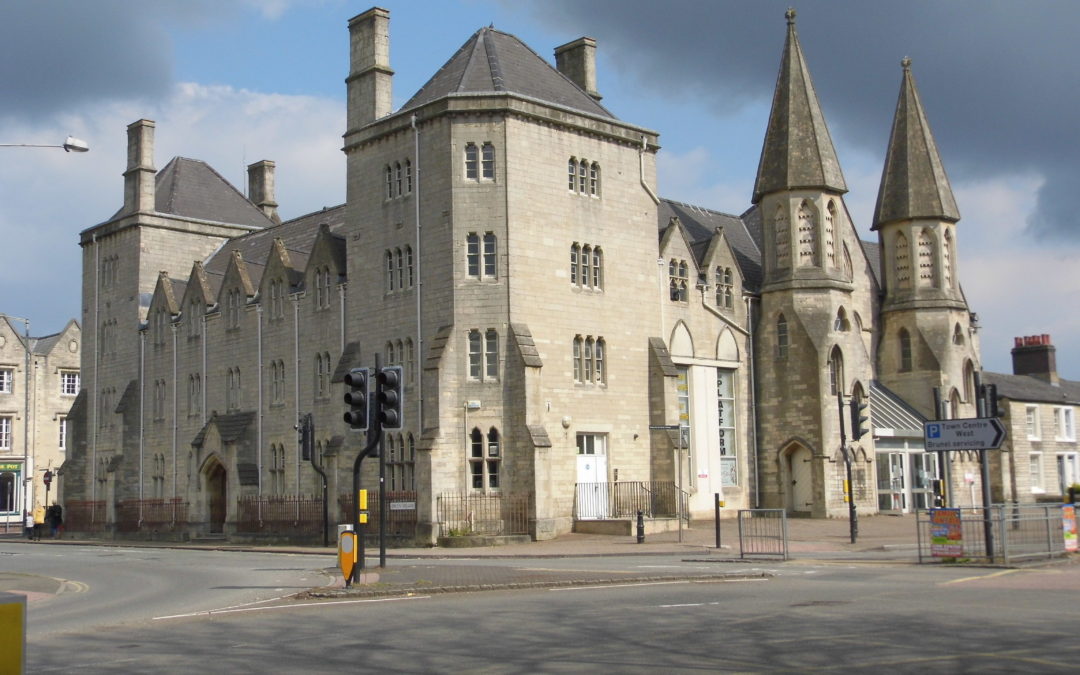
I sometimes think this fine building is a bit of a stone-work lost soul. It started life as accommodation for single railway men. It didn’t work well as that so became a chapel. Then later it housed Swindon’s railway museum before STEAM opened upby the Outlet Centre. And now, as The Platform, it’s used for education and performance – but not that much it appears?
The building as a lodging house
Grade II listed by Historic England, this building came into being as a communal lodging house for single men working on the GWR, drawn from across the country.
Isambard Kingdom Brunel himself drew up plans for an extensive, three-storey building in a Tudor-Gothic style. Construction began in 1847. But a recession between 1847 and 1849 forced abandonment of the building with only the ground-floor started on. As finances picked up work began again on the lodging house but to revised plans. In 1853-1855 the still Gothic style was intended to match the shop blocks in the railway village surroundings.
Large corner towers and smaller windows than those proposed by Brunel, put a more institutional look on the building. And thus perhaps gave rise to its local name of the Barracks. The lodgings had over 100 rooms, each with a bed, chest of drawers and chair. There were also kitchens, a bakery and day rooms with day and night porters overseeing proceedings. But it was never popular and the men preferred to lodge with a family even though that meant cramped conditions and hot-bedding. When the day shift went to work the night shift returned and got into the still warm beds.
The listing entry on the Historic England website tells us that the building seems to have remained more or less empty until 1861. That year saw it converted into two and three room units to house ironworkers arriving from Wales. They came to Swindon to staff the new rolling mills at the GWR works.
At length, the barracks became overcrowded and insanitary. Thus, in 1863, a new development of cottages arose on Cambria Place.
By 1866 the building was condemned as a living space. Frances Bevan’s Radnor Street cemetery blog recounts inspector Henry Haynes as writing to the New Swindon Local Board on 2nd August 1866. He said: ‘I consider this building in its present state quite unfit for human habitation and dangerous to the health of the district.’
At length, in 1867, the Wesleyan Chapel trustees bought it for £1,600 to convert into a Methodist chapel. It was in use as such until 1959 and saw the wedding of many a railway worker there is no doubt.
Big enough to accommodate 1100 worshippers, it further boasted Sunday school rooms large enough for 500 children.
In 1962, the chapel became converted into the GWR museum by removing the gallery and laying the chapel with rail tracks to get locomotives in and out. Large glazed openings created in the south elevation gave access.
The millennium saw the museum moved to its current incarnation as STEAM and location within the former railway works.
Reasons for listing designation
Taken from the Historic England entry:
Architectural interest: 1. For its origins as a relatively rare building type as a communal lodging house for workers at the GWR railway works.
2. For the recognisable GWR house style of the original west range, reflecting the style of the rows of workers’ family houses and cottages. And also the taller corner buildings which punctuate the streets of the railway village.
Historic interest: 1. For its evolution through several significant phases from lodging house to chapel to railway museum. In that it reflects the changing needs of the railway company and its staff.
2. As an integral component in the extensive provision of accommodation, leisure and health and welfare facilities for workers at the GWR Works from the 1840s to the later C20.
Group value:
* with the neighbouring Mechanics’ Institution (Grade II*), the Central Community Centre (listed Grade II), formerly the GWR Medical Fund hospital, the Health Hydro, which was built as a swimming baths and dispensary for the GWR Medical Fund (Grade II*), the rows of workers’ cottages, and the other listed buildings forming the GWR railway village.
The Heritage Action Zone
The railway village conservation area is a Historic England heritage action zone – and that’s a fabulous thing.