Among the doom and gloom of Covid and Brexit and town centre shop closures there’s some good local news in the restoration of The Watchers.
The Watchers form part of the West Swindon sculpture walk. These sculptures are a culturally significant part of the West Swindon landscape, installed in the late 1970s/early 1980s. Roger Ogle has done much to champion them – then much later than him – so have I. I’ve featuredThe Watchers and the rest of the trail on this blog and in my new guide book.
Despite the fact that they’ve been shamefully neglected by our town’s leaders for decades now, they remain things of enjoyment and an untapped resource I’m sure. If the powers that be did but know it.
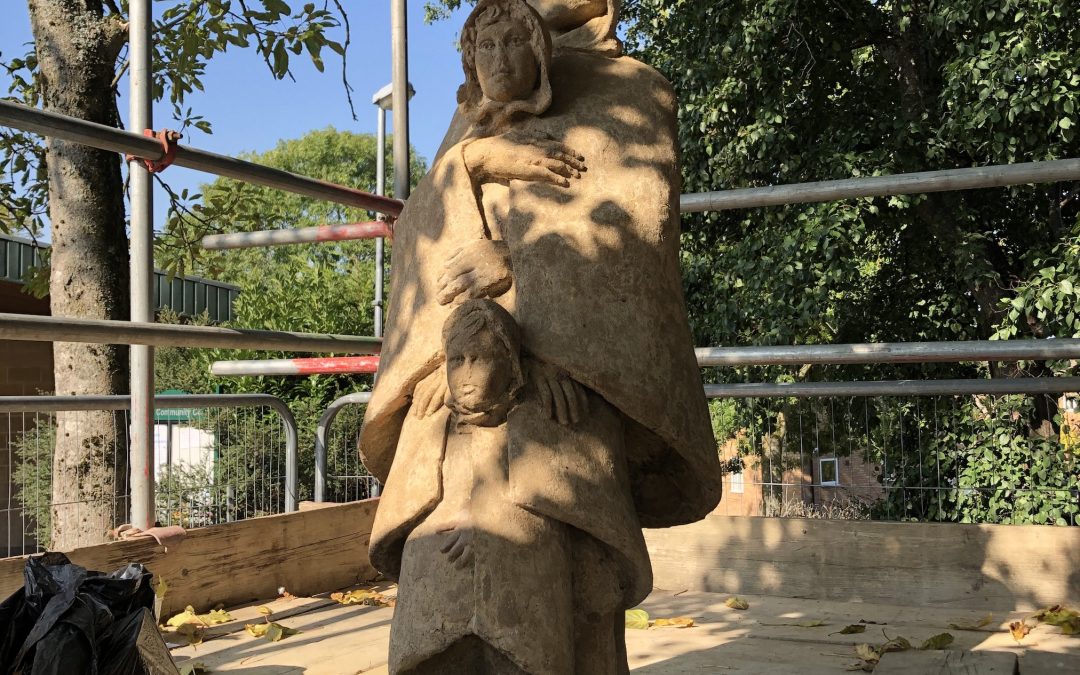
Anyhoo! Last year the chap on this sculpture sadly suffered decapitation. But rejoice! For, thanks to Swindon stonemason Toby Robson,The Watchers are Restored. But more on that in a bit!
The Watchers at Toothill – prior to restoration
‘Artist: Carleton Attwood. Material: Cement Fondue. Project details: Funded by R.S. McColl and E.H.Bradley Building Projects Ltd. The sculpture represents guardian figures looking over the community.’
‘The Watchers, 1982, by Carleton Attwood (1908 to 1985) at Toothill Village Centre. The first sculpture in West Swindon, cast in ferro-concrete at Swindon’s town hall studios, is one of Carleton’s last works. Sculptor Pat Elmore had to complete the piece as Carleton suffered ill-health. Thanks to Carleton’s ill-health.
The work represents the guardians of the new community.’
The story goes that Carleton got the idea for this piece of public art from a family he observed at a Swindon town football match.
The day was a rainy one and the father was holding his raincoat around his wife. She in turn shielded their child with their raincoat and the child the dog.
The restoration of The Watchers
Now back to the resoration. There’s a nice piece here inThe Swindon Advertiser about the restoration. Said Toby: ‘… it’s a big challenge because the sculpture is more than 40 years old. And nobody knows what materials went into it originally in terms of sand and the cement mix used. Nobody remembers.
I chatted to Toby just yesterday and he told me that the community had been so supportive and interested in what he was doing and how heart-warming he’d found that.
Photo from Toby Robson.
Some photos from Toby of the work in progress:
And now the finished product. Ta da!The Watchers are Restored!
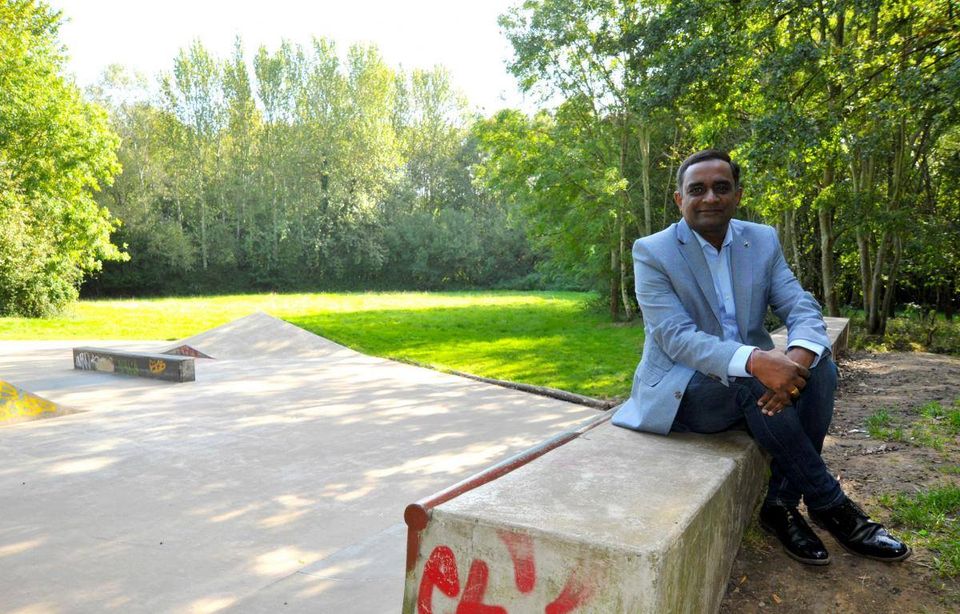
On 10th October 2010 parish councillor, Suresh Gattapur is doing a walk for BMX park Swindon. He intends to walk 26.1 miles around Swindon. It’s his aim to raise awareness and achieve funding for local youth engagement. That’s quite a walk –he could do it with my guide book in his back pocket! 😉 Suresh does have a copy.
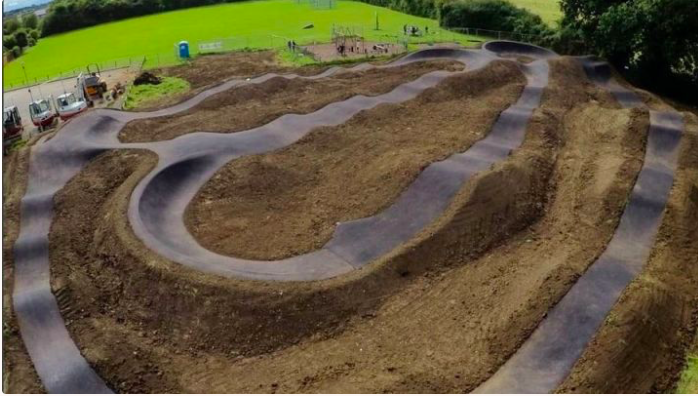
Suresh hopes to raise £5,000 out of an estimated budget of £70,000 to £90,000 to build a BMX track in Westlea, in Swindon. It’s Suresh’s belief that championing youth projects is a transformative approach that can encourage urban youth engagement in local communities.
Says Suresh: Parks and public spaces are often built with small children and adults in mind. There’s often an emphasis on playgrounds for the children and benches for the adults watching them.
On the other hand, some public spaces are simply devoid of activity or amenities. This is fine for picnicking or maybe playing ball but offers little else for young people. And they use public spaces as much as anyone else. If not more.
Exclusion of young people from place making
And yet, too often young people, or young adults between the ages of 13 to 21, are not included in the process of place making. But, with active engagement in youth-friendly spaces, young people can feel like they have investment in their community. And from that they can develop a strong sense of ownership in these places.
I believe identifying the interests of local young people, or issues in the community around young people is a key part of building a relationship with them. I have myself conducted extensive research on youth engagement and their interests. I’ve identified the demand and need for a solid BMX track and how it would be a significant contributing factor to positive youth engagement.
In a world of virtual gaming platforms, bike parks are fun, challenging, and healthy places for young people to get their exercise in. As bike parks get built and maintained then riders frequent the parks on a regular basis.
Compared to more traditional parks and playgrounds, bike parks offer an incredible value vs the budget spent on them.
Well built facilities also have the potential to become tourist draws. Attracting events leads to benefits to the local economy. People spend money locally on amenities, food, repairs and new equipment.
It’s one thing to build a bike park. But a bike park helps build something larger for a community. It helps build healthy, happy, outdoor lifestyle choices.
Freshbrook gets performing arts class – so children in West Swindon who love singing, dancing and acting can try out a new class which starts in Freshbrook on Wednesday September 30.
One of the town’s leading performing arts groups, Revolution Performing Arts, is offering Covid-safe, socially distanced small group classes at Freshbrook Community Centre. The classes are every week, on Wednesday, from 5.30pm to 6.30pm.
Founder Fi Da Silva Adams said: “We’re starting the Freshbrook All Stars at the community centre for children aged between four and 11 years old.
“Our classes are a safe space for children to express themselves. We have an ethos of empowering children who can sing their favourite music, create their own dramatic scene, share their own dance moves and feel safe and secure in doing so. If they don’t want to perform they don’t have to. We want to create a fantastic, relaxing and fun experience for them.”
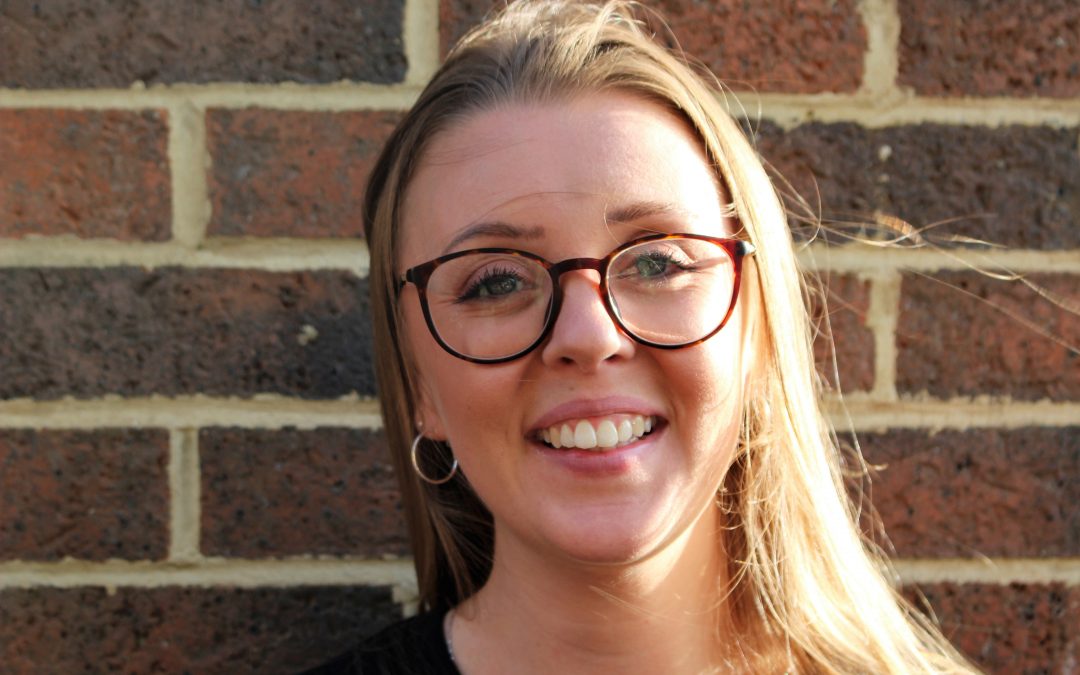
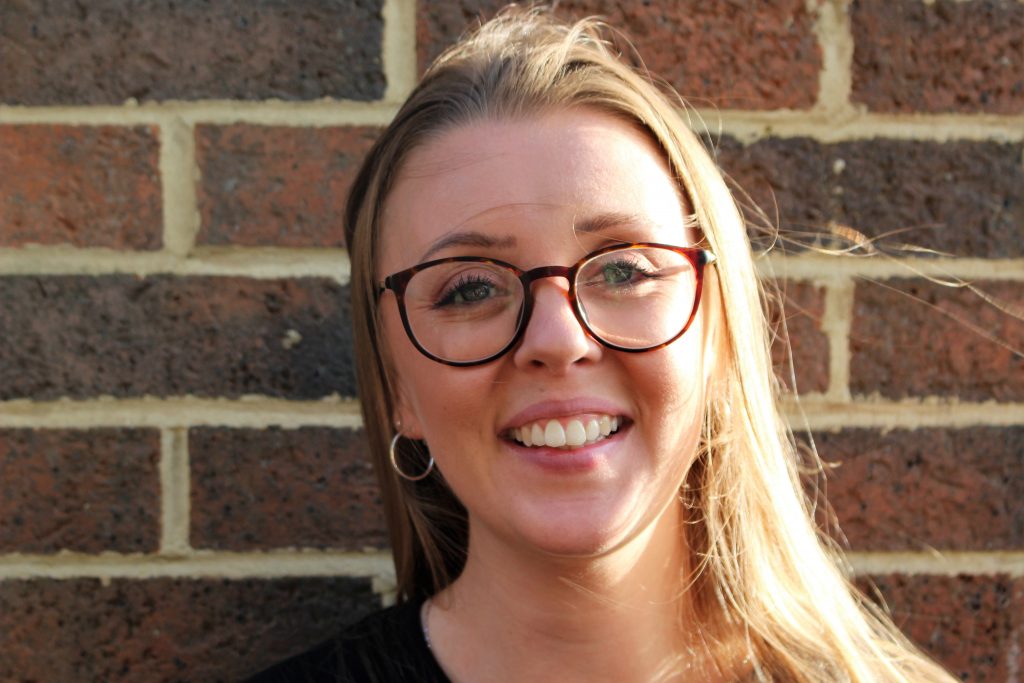
Jade Carroll
RPA leader Jade Carroll will run the Freshbrook group. She has thirteen years’ experience of dance and has worked with RPA for two years.
Jade said: “I’m excited to be starting this new class and look forward to meeting the children and their parents. We do ask that everyone books in advance though. That’s so we can ensure safe social distancing measures. That said everyone’s first session is free of charge!”
Jade Carroll – photograph taken by Laura Barnes
Fiona Di Silva Adams founded Revolution Performing Arts in 2007. Her team have run online sessions throughout lockdown.
They’re now getting back to some in-person classes across Swindon. The organisation received a grant from Arts Council England through the Covid19 Emergency Fund. This allowed them to continue supporting children in Swindon.
Revolution Performing Arts runs sessions in after school clubs and also open classes in other community venues. All their teachers are DBS checked, trained in first aid and receive full training in safeguarding protocols.
RPA specialises in empowering young people to celebrate their individuality through the power of performing arts. To enrol for the new Freshbrook class visit www.revolutionpa.co.uk/enrol
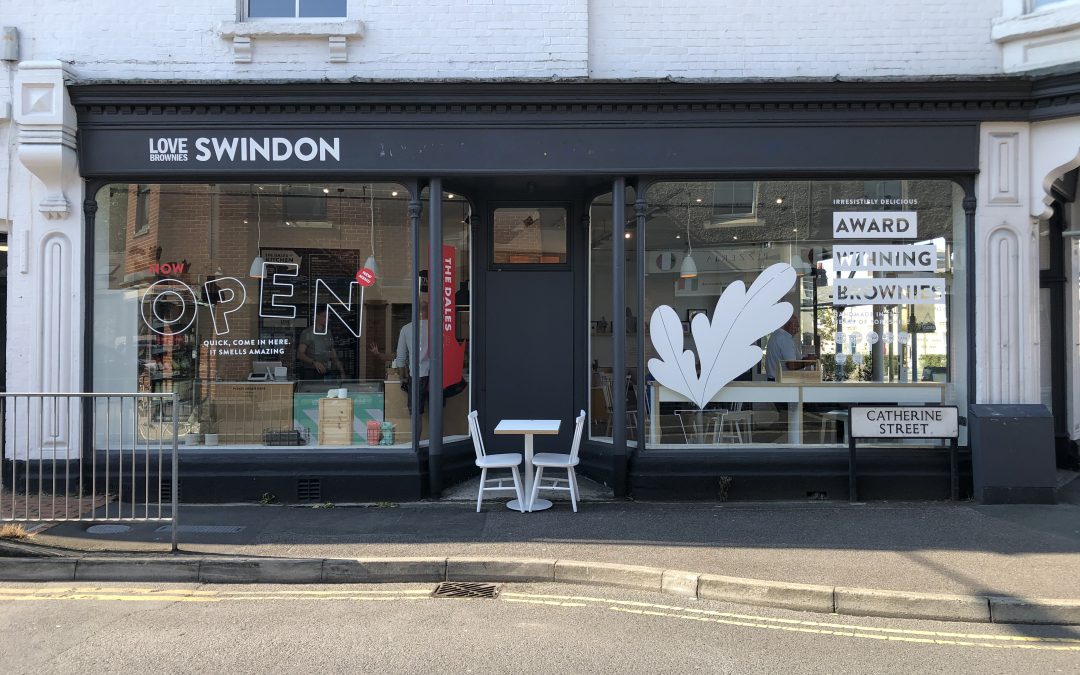
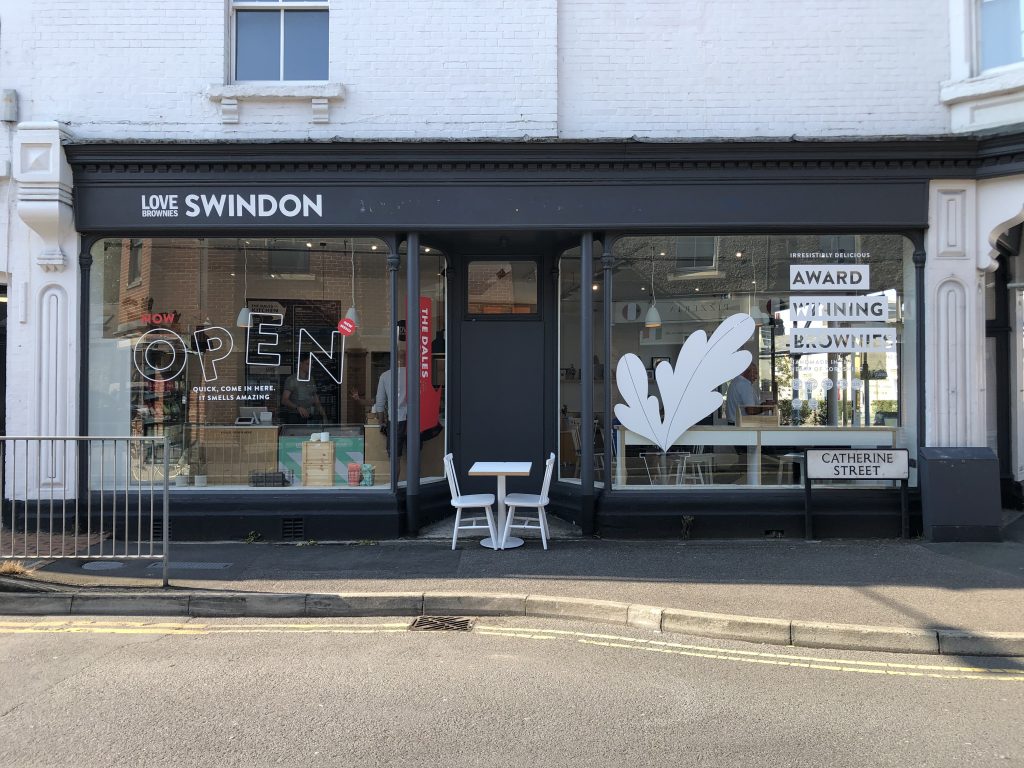
So! This week saw me in Swindon town centre for the first time since March. It felt very odd I have to tell you. But in a good way. Meeting someone over lunchtime to make an exchange of my new guidebook for the requisite sum of money, said person suggested we meet up at Love Brownies Swindon. Loving a new coffee shop/cafe/eatery I agreed. Indeed, should you be following either the GWR heritage trail or the New Swindon exploration in said guide book, this place would make for a good pit-stop.
Having been shielding since the Covid induced lockdown – and emerging into my family bubble in Surrey not long back – I had no idea about this place.
Side view of Love Brownies Swindon
The people behind the baked goods
Love Brownies is a franchise with a small number of shops across the country. Running the Swindon branch are Adam Clarke and Amy Elmer, Swindon residents of 15 years standing.
‘Not only do we have the most amazing brownies, but we pride ourselves on our service. So if you’re looking for an experience that’s just that little bit different then we’d love to see you. The shop serves up award-winning chocolate brownies, brownie milkshakes, gifts, and a range of premium, freshly-brewed coffees, as well as a breakfast and lunch menu.’
Very Scandi!
I loved the decor. It felt like walking into an Ikea catalogue. It’s super Scandi with a mix of white and light wood tables and chairs, sofas and long bench seating with colourful cushions. I love where it is too. It’s on Faringdon Road – on the corner of Catherine Street with a view to the ever-so-lovely GWR Railway Village. It’s perfect.
Whether you want somewhere to meet a friend as I did, or somewhere for a spot of remote working the place is well worth a try.
YOUNGSTERS PUT ON THEIR DANCING SHOES AS THEY GET BACK TOGETHER – SAFELY
Latest news from Revolution Performing Arts
16th September 2020
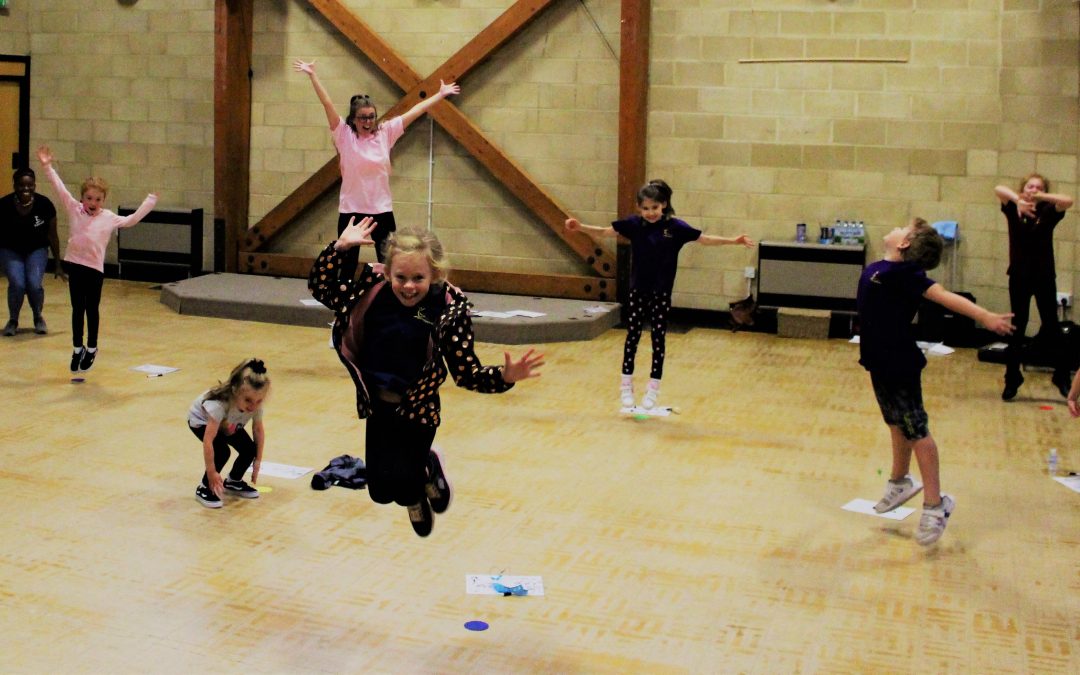
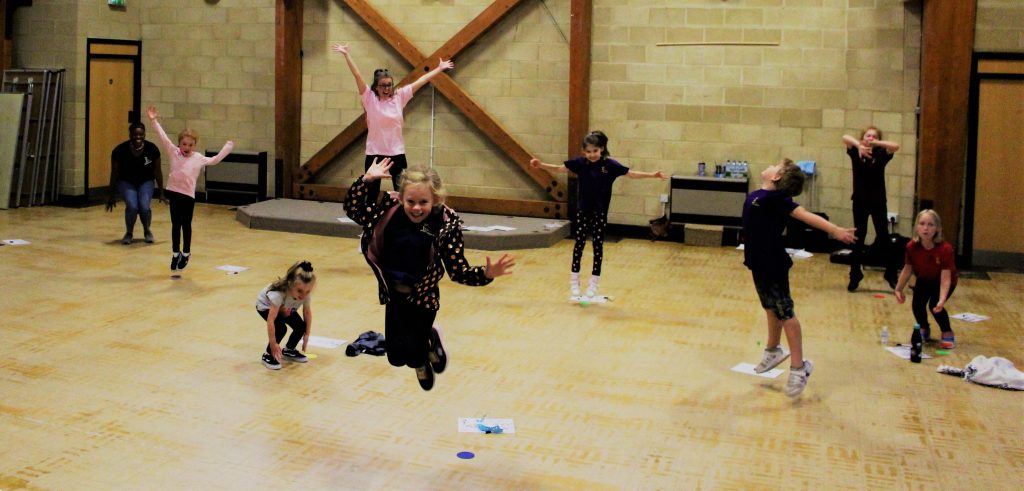
RPA Youngsters Don Dancing Shoes. And young people in Swindon who love singing, dancing and acting are getting back to the studio after many months of online classes.
One of the town’s leading voices in performing arts, Fi Da Silva Adams, worked hard with her team to return to socially-distanced performing arts classes last week.
“Our online classes were a life line for many young people during lockdown,” said Fi. Fi is the MD and founder of Revolution Performing Arts which, as a rule,supports around 350 young people on a weekly basis.
“Young people still had an outlet and an opportunity to experience our empowerment through the arts experience. So they got a thrill from seeing their friends, even if it in the virtual world.
“Now we are doing a phased, Covid-safe return to classes so that children can get back together in a mindful manner and it’s been wonderful.”
In-Person Session – RPA Youngsters Don Dancing Shoes
One of the first parents to attend an ‘in-person’ session at Shaw Church in West Swindon was Emma King. Her daughter Darcy felt excited to attend a real-world class. RPA are soon to launch classes are in Freshbrook and Shrivenham too.
Emma said: “What a return! First class back after summer and lockdown and it was amazing! The measures to ensure the safety and happiness of the children and us parents was outstanding, from entering the building to leaving. You could see the smiles from the children and they were so excited to be back.”
Revolution Performing Arts, founded in 2007, has felt the effect of lockdown with half of the business based in schools. Fi knew she’d have to innovate. So her team offered online classes and now a phased return to distanced classes.
She said: “As schools are still reluctant to have external clubs in I had to diversify. So we decided to launch a programme of new sessions. These new session include more performing arts open classes, circus theatre arts, musical theatre, ballet for fun, RPA Sing, RPA Dance, RPA Street and RPA Act. We’re now offering some of these classes in person at venues around Swindon.
“It’s so exciting. I’m so grateful for the Covid19 Emergency Fund Grant from Arts Council England. And the hundreds of parents who stood by us and kept us going all through lockdown.”
Revolution Performing Arts
Revolution Performing Arts runs sessions in after school clubs and also open classes in church halls.
It specialises in empowering young people to celebrate their individuality through the power of performing arts.