It began when civil engineer Isambard Kingdom Brunel and mechanical engineer Daniel Gooch put their railway works at the foot of Swindon Hill. Without that, Swindon as we know it wouldn’t exist.
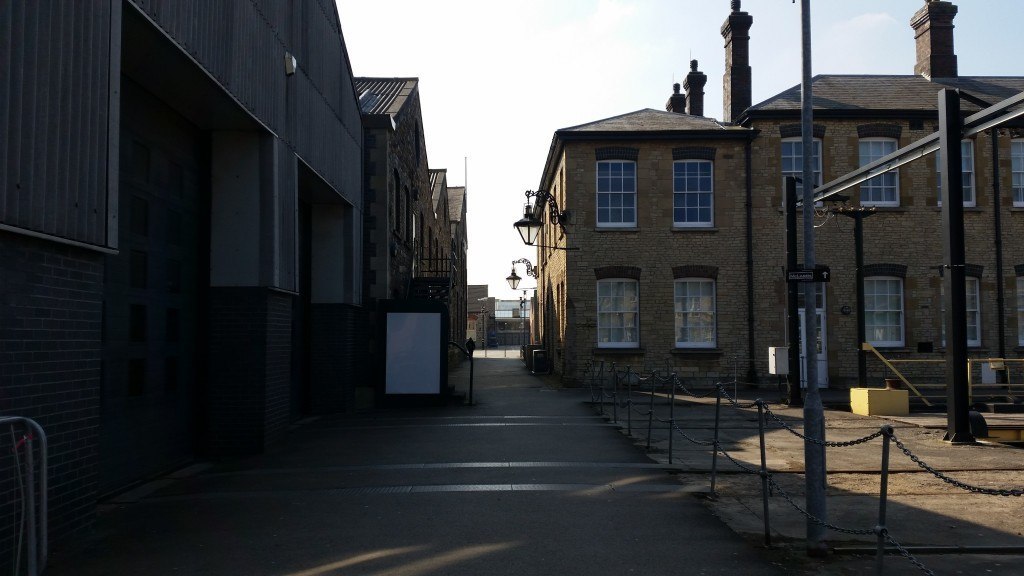
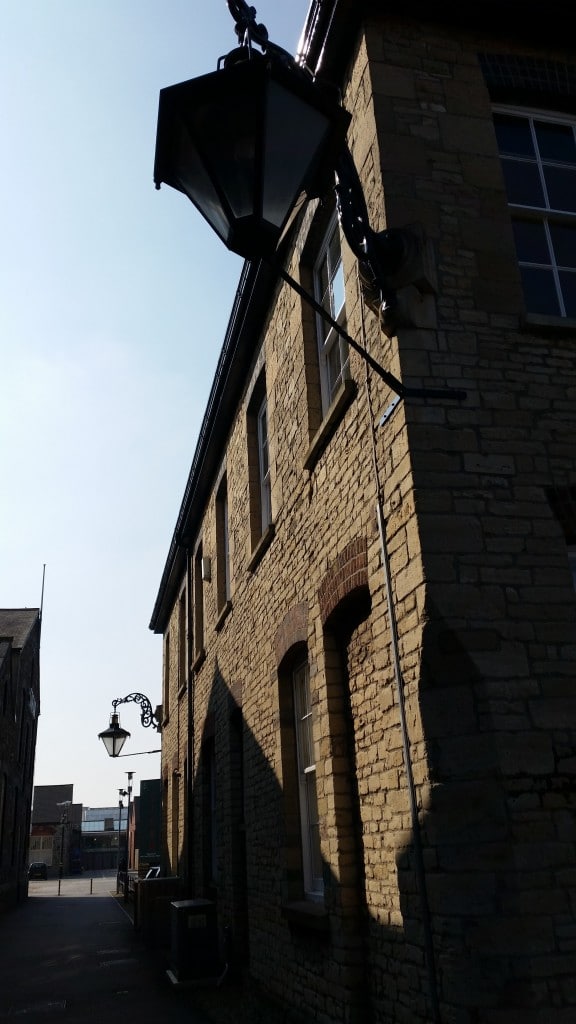
The GWR Railway Village Conservation Area – Photo credit Martin Parry
Brunel’s design
On 19 March 1842, Brunel presented to the directors of the GWR, plans and drawings for the first 300 cottages. These were to sit parallel to the main line. Separated by open ground from the main line and the new workshops, these first dwellings were visible to passing trains. Thus, Brunel dressed them to impress passengers, with Elizabethan and Jacobean motifs on the stone-built façades. Think now of the aphorism ‘all fur coat and no knickers’. For the cottage’s dashing exteriors belied humble dwellings with rudimentary accommodation, no water and cesspits in the yards.
Basically, Brunel blew the budget on the Jacobethan dressings, thus forcing him to economise elsewhere.
Model by name but not by nature
A model village in name, the settlement was far from model in other aspects.
Thanks to overcrowding and suspect sanitation, a workers’ utopia it was not. Yet, squalid living conditions aside, the GWR built houses of notable architectural dignity and planning sophistication. Superior to most contemporary artisans’ dwellings, they set a standard for later Swindon estates. They never offered the back-to-backs familiar in other British industrial settlements.
By November 1845 the need for more housing became acute. Gooch stated in correspondence that ‘ten or twelve people were living in two rooms. And, when the night men got up the day men went to bed…’ You’ve heard of hot-desking? Well, it was ‘hot-bedding’ here!
Today it remains the last, and best, example of nineteenth-century railway workers’ housing. The railway village stands as one Britain’s best-preserved and architecturally most ambitious railway settlements.
In 2018, the GWR Railway Village Conservation Area achieved the accolade of being voted England’s favourite. That arose from a competition organised by the national civic voice movement.
The Glue Pot pub in the Railway VillageThe backsies in the GWR railway village
‘ … Betjeman was a lover of, and passionate advocate for, Victorian architecture. Thank goodness for that. Otherwise the nation and the world would have lost the glory that is Gilbert Scott Thomas’ St Pancras station in London and other edifices saved by Betjemen. We also have him to thank for the continued existence of our Railway Village. As a 2017 article from the Swindon Advertiser points out, the 1960s saw plans to raze the area. Only a campaign by Betjeman saved it. ..’
Brunel’s 1840 layout drawings show a grid layout similar to the final plan of twelve terraces, in six blocks, on either side of the High Street. From 1893 the High Street became Emlyn Square.
Construction began in 1842 with most of the buildings finished by 1855. Brunel himself designed only the first block.
The contractors, JD & C Rigby, assigned the job of building the 300 cottages fell into financial difficulties. Thus they only completed 130. That problem put back the village’s completion to the 1850s.
First to hit the finish line, 1842-1843, were the cottages to the west of Emlyn Square. Those in the east came between 1845 and 1847. 1845-1847 saw the end blocks towards Emlyn Square built, while the remainder, mostly end blocks on the outer ends of the streets were built in 1853-1855.
In 1966, the local authority acquired the cottages from British Rail and restored them.
From the Mechanics’ Institution Trust – The origins of the Railway Village
In 1841 the Great Western Railway Company began construction work on a major new engineering works which would become, in their heyday, one of the largest industrial complexes in the world. The chosen location was open farmland some two miles from the small hilltop market town of Swindon. The lack of existing housing in the vicinity of the works meant that it quickly became necessary to provide accommodation for the influx of workers. More on that here.
The railway village now?
The Mechanics’ Institution Trust has a keen interest in the Railway Village community today. They’ve undertaken a range of activities and projects in the area. They’r a key stakeholder for both those living there and the physical environment of the Conservation Area.
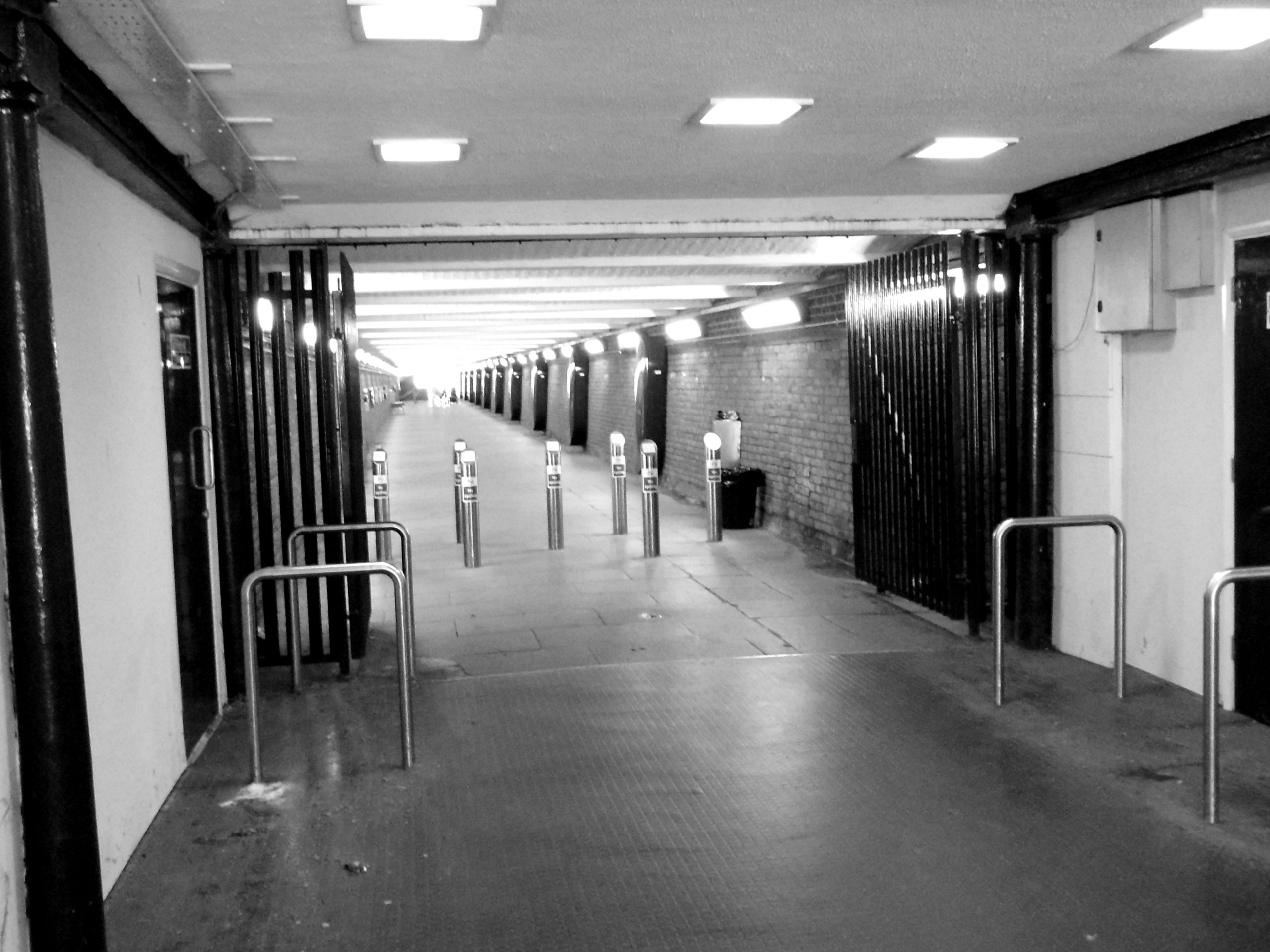
Now Grade II listed and built in 1870, 380 ft (1115.8m), 15ft (4.6m) wide and 7ft (2-1m) high, the GWR Workers’ tunnel still provides the main pedestrian access from the railway village to the Works’ site. Now that’s the home of STEAM museum, Isambard House, Churchward House and the residential apartments now on the site. Not forgetting of course Heelis, the National Trust HQ and the outlet centre.
The tunnel emerges north of the railway line at the western end of the general offices building. Until 1922, an early 20th century extension of the subway continued northwards under the office block to an open junction in the yard behind. From there it continued, by tunnel, to the general stores building beyond the Gloucester line.
*sourced from Swindon: The Legacy of a Railway Town from the Royal Commission of Historical Monuments of England.
A danger to life and limb
Before the building of this tunnel, Swindon’s railway men risked life and limb in getting to the Works’ site. As thelisting entry on the Historic England websitedescribes, the 1860s saw GWR workers suffer a number of serious accidents. In a single month in 1869, there were three deaths of workers struck by trains as they crossed the railway line.
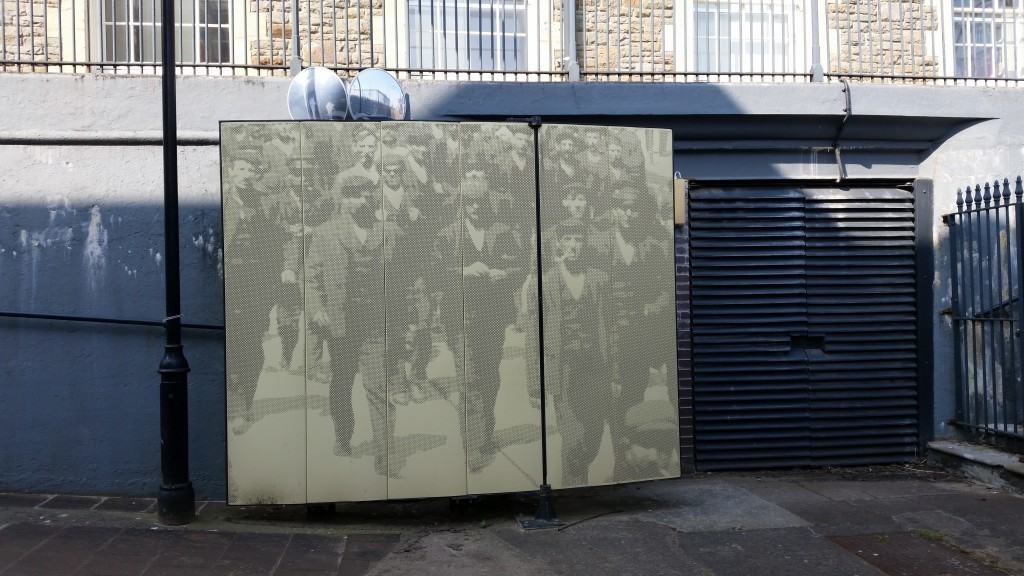
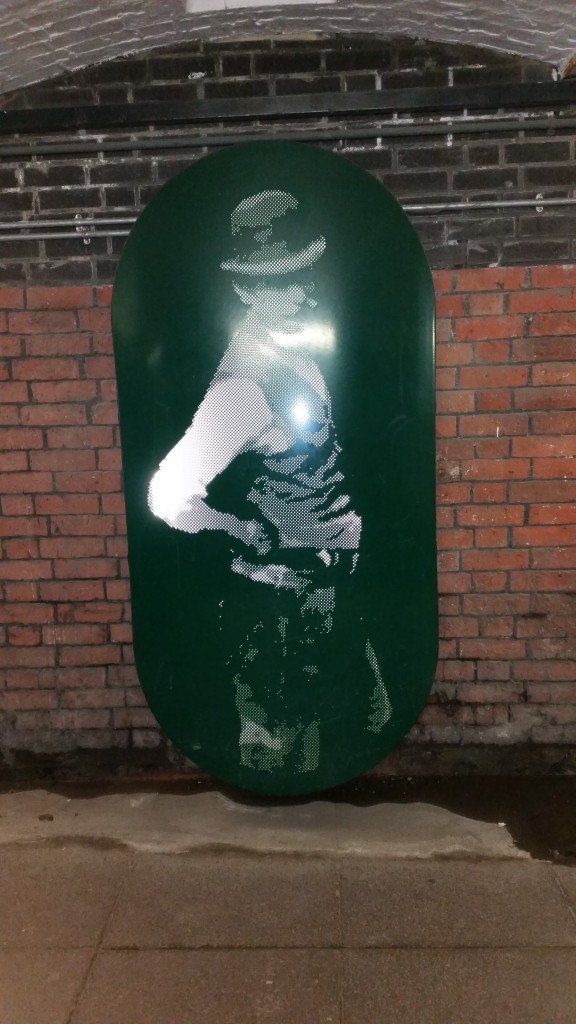
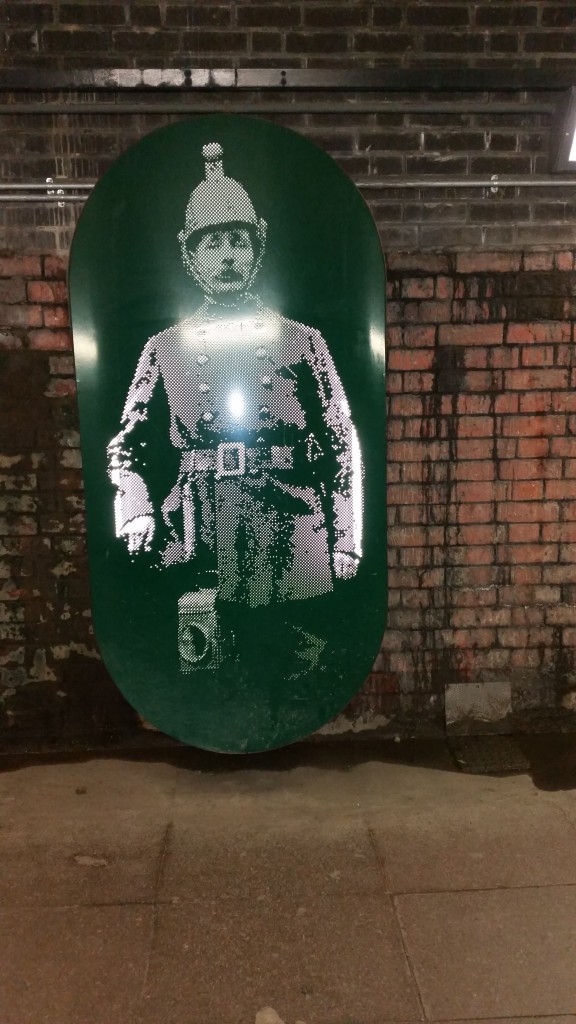
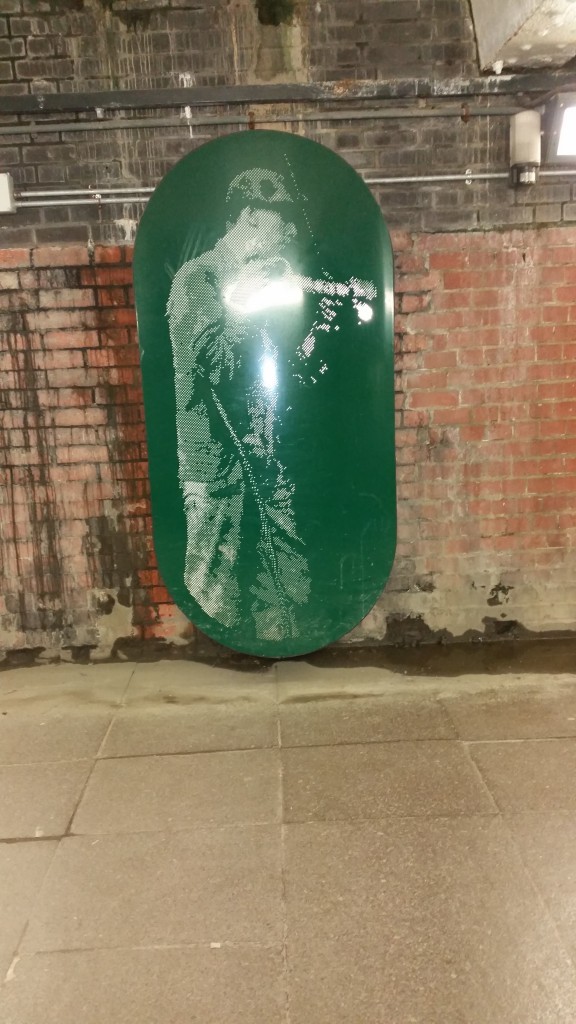
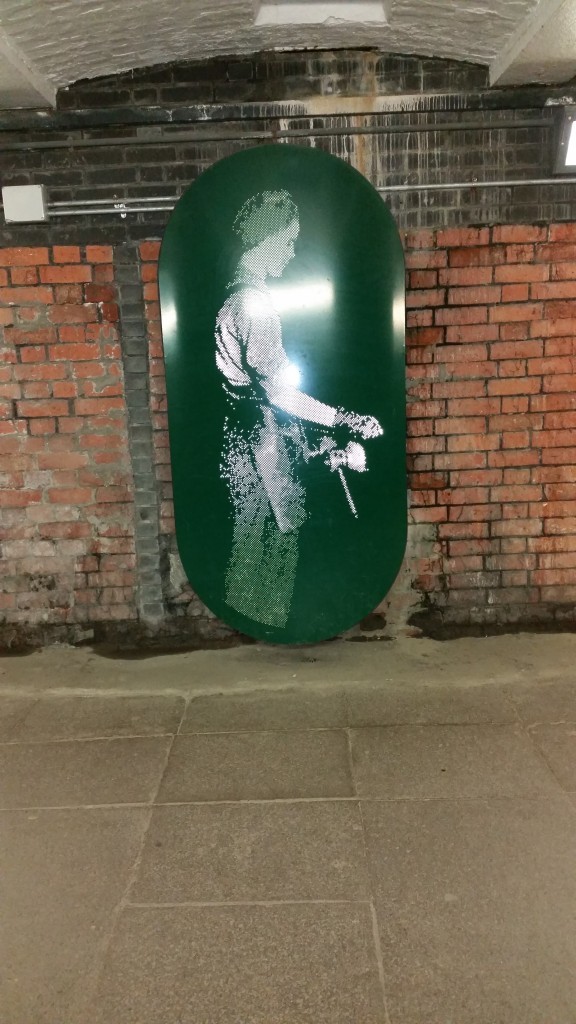
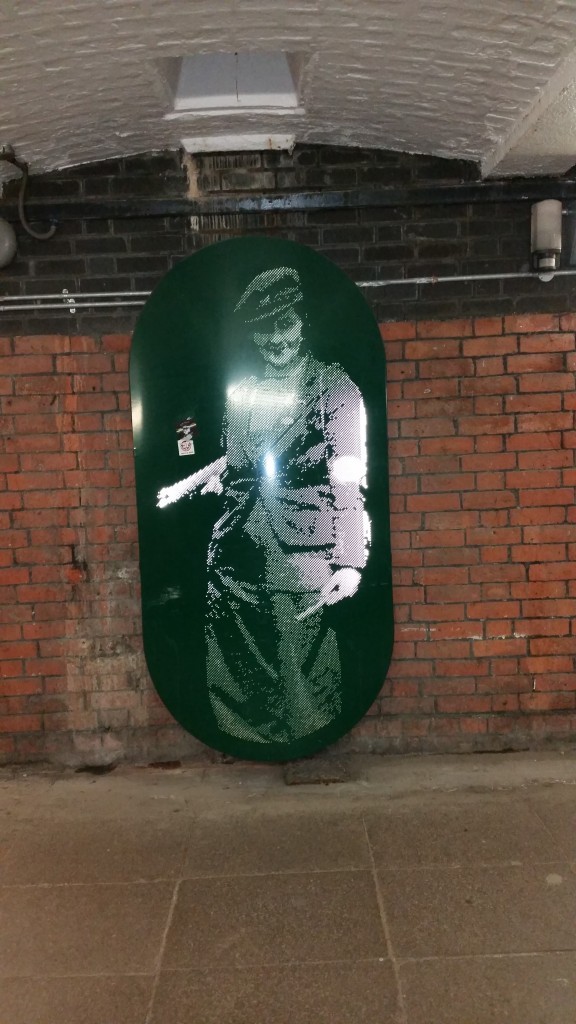
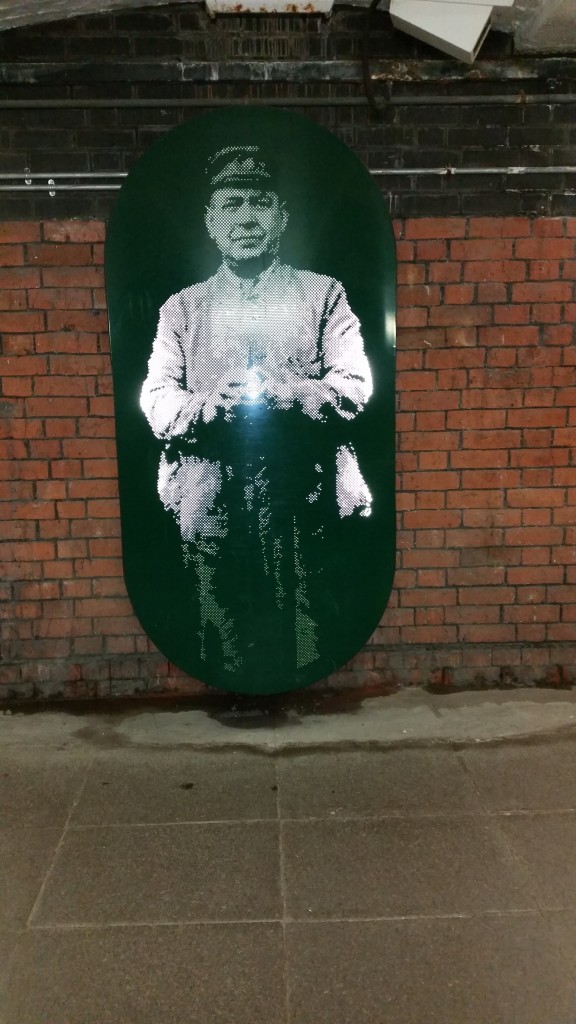
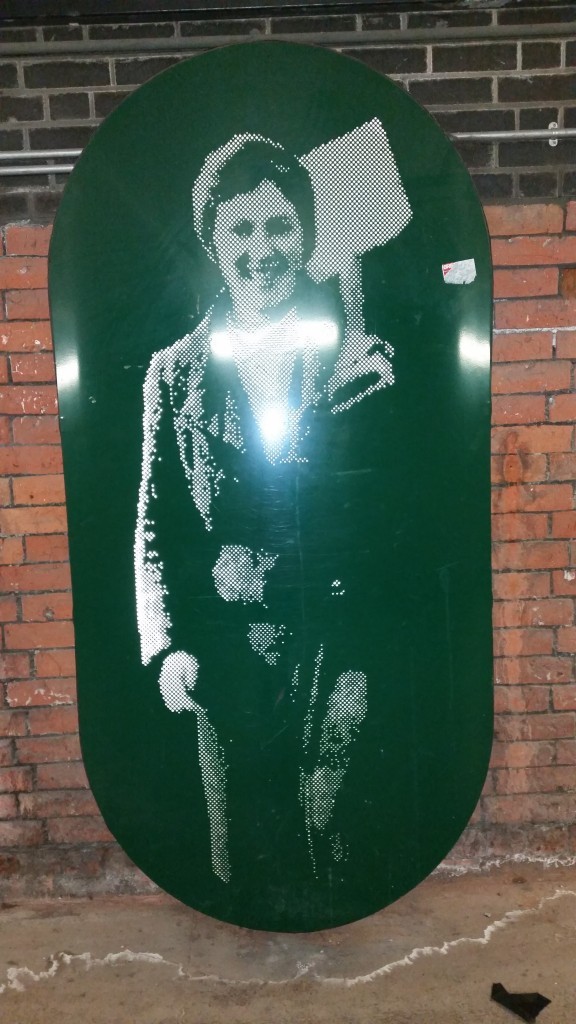
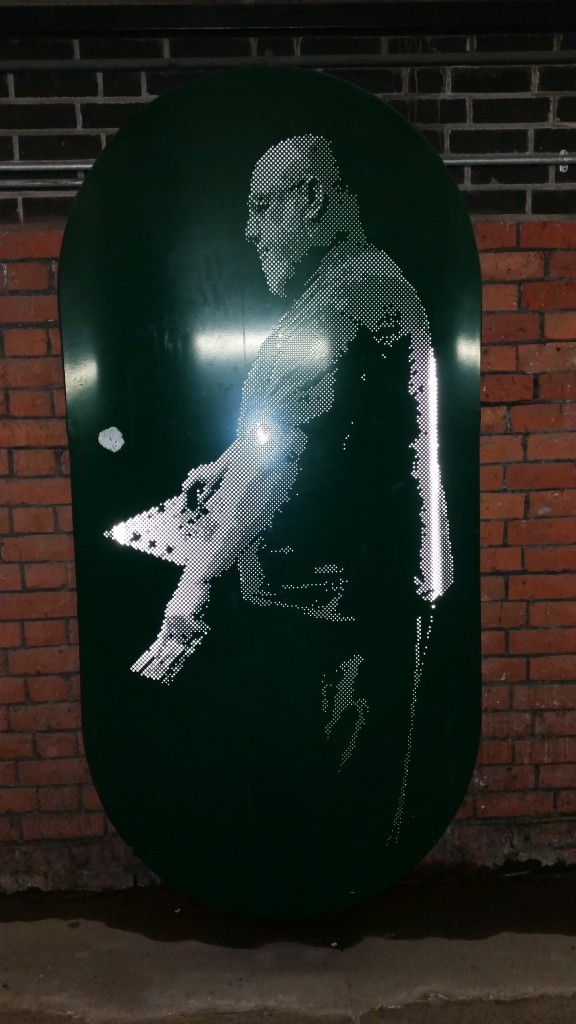
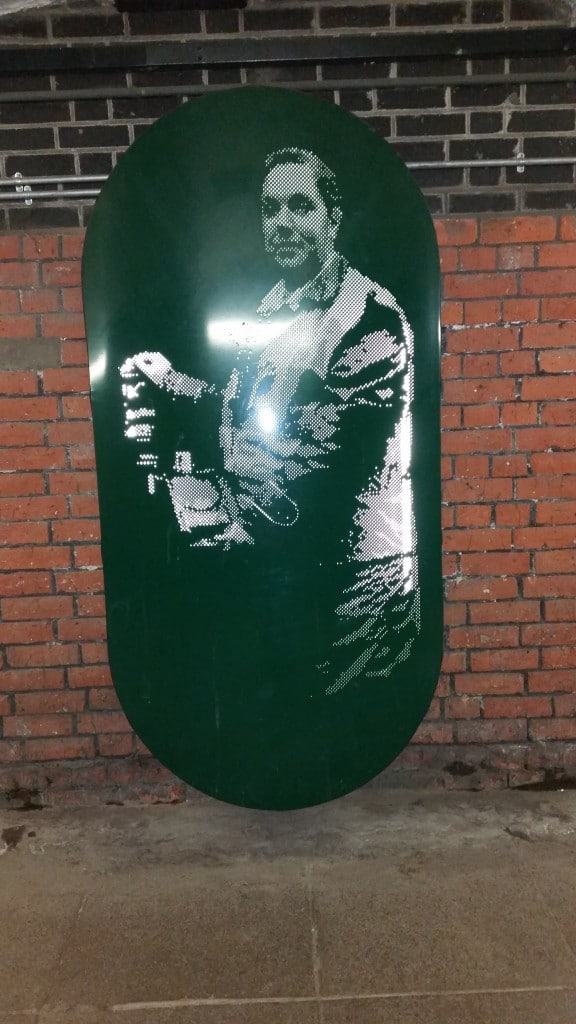
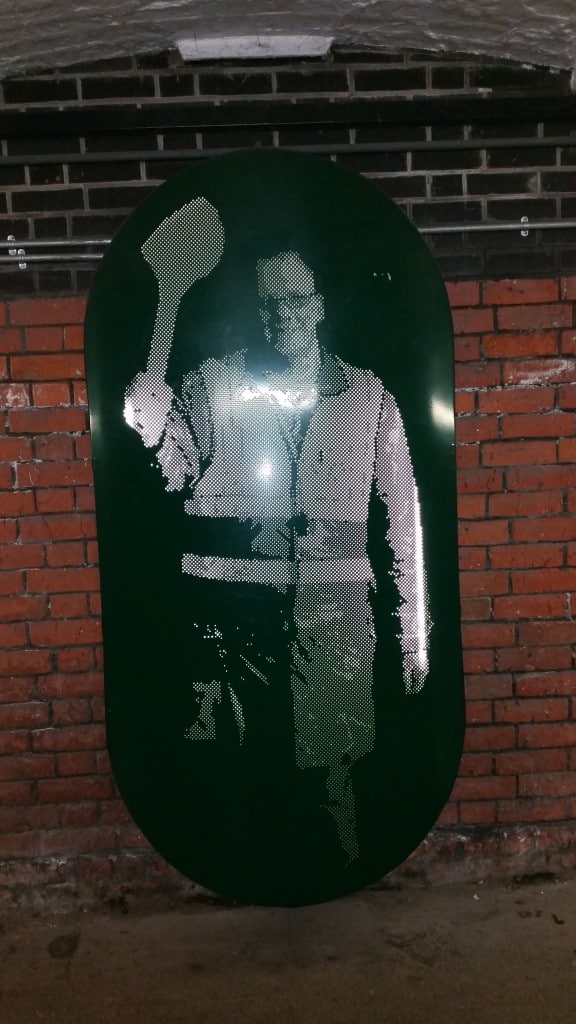
And this light picture installation, put in, in 2012, are a fabulous addition to it. The installation depicts, in green metal light images, railway workers past and present. As I look at them, I think of the men and women, across the years, who used this tunnel to go to work ‘inside’ – as they referred to it.
As you walk through the tunnel towards the town centre this is the order in which they appear – I think …
The artist
The artist responsible, Bruce Williams, said:
‘The characters you can see used the route under the tracks themselves on their way to and from work. These are regular men and women, who worked on the trains through war and peace and in all weathers. There are riveters, train drivers and look-out people.
On the opposite walls in gleaming letters read the words Swindon Works. That’s the name of the site yes. But one could also read it as a hopeful slogan for the future.’
In the lead up to Christmas you may have seen and heard the phrases shop small and shop local all over the place on social media. If so, did you wonder what they meant?
Well, in this blog I’ll explain what they mean to me. I’ll also show what a real difference you can make with where and how you spend your hard earned pennies, especially during this pandemic period – and our emergence from lockdown.
Shopping small and local matters as much now as it did at Christmas.
What makes your high street unique
What makes your high street yours, unique and memorable? It’s the independent shops, cafes and hairdressers where you get personalised service. Where they know your name and you can find that gift that you can’t get anywhere else. They make customer service a priority. Such businesses arranged click and collect during the lockdowns. They adapt to situations because they listen to their customers every day.
Who remembers heading to Da Paolo’s deli for dried pasta during the first lockdown because you knew they would always have some? Or grabbing a take-away coffee from Baristocats because it tastes so good. And you always have a little chat too even with your mask on.
DaPaolo Italian Del on Commercial Road
Well, these wonderful places also use local suppliers whose own business relies on the sales generated through these high street outlets. They may be home-based makers. Or they might have a small workshop somewhere and supplying a box or two of products on a regular basis enables their business to develop and expand in new directions.
From little acorns …
All sorts of things can build up from these small beginnings.My own business, dona B drawings, has benefitted from the support of the Central Library Shop in Swindon.
Since closing for the first lockdown they have been unable to order any more stock from me. It’s been quite a blow. But I’ve concentrated on increasing my online profile and have been lucky to get through last year with reasonable success.
Speaking of little acorns, for independent businesses in general, but for artists in particular, a big shop small-shop local mantra grew from the Just a Card movement. JUST A CARD is a grassroots campaign on a mission to encourage people to support, value and buy from artists, makers, independent shops and small businesses. Every sale, even just a card, is vital to their prosperity and survival.
Avoiding Amazon if you can
We all know that Amazon is there and wants to solve all our shopping needs – and sometimes needs must for us all. But, if you spend a little extra time you can find wonderful independent things online during the lockdown and often cheaper than you think. These are the sorts of gifts that people will remember receiving because they’ll never have seen them before.
So, shopping small and shopping local has wide-reaching benefits – for you as a customer, the local economy, the community, the local high street and more. Every sale, even a mere a card, is vital to someone’s prosperity and survival.
Top tips for shopping local
Find your locals When you’re out and about take notice of the tiny shops you often walk past and look them up online when you get home. If you can do pop along to local markets and community events. Check out any local Facebook pages or friends feeds as there will often be some suggested gems there. Use Not on the High Street or Etsy as a replacement for Google. These sites are great but do charge fees to the makers so look them up on there and then go to their own websites where they make more from your purchase.
2. Shop early Avoid pinch points in demand and delivery, reducing stress for you and the seller. So if you have a birthday coming up don’t leave things too late and shop from September for Christmas if you can.
3. Contact them If you’re not sure of the process or the options or delivery times get in touch and you’ll get all the information you need.
4. Shop often If you can please do return to shop with them again. That will make a real difference to their business and confidence. Build a shopping relationship with them which you definitely won’t find on Amazon.
5. Follow them Find them on social media and follow them, like and comment on their posts and share the ones you can. Put product reviews online and share the secret amongst your friends and family. If they have a Google listing leave feedback on there too. Or drop them a message to say how happy you were with their service. All that is a huge help and makes you feel good too.
6. Join them There’ll often be special offers or early access to new products or event bookings.
To get you started
And finally, to get you started, why not check out all the artists on the Swindon Open Studios website. They would love to hear from you having missed out on the open studios event last year. Fingers crossed for 2021!
And there’s more. There’s a Swindon Gift Market on Facebook too where you can reach out to lots of local creatives who can produce customised things just for you.
I’m hoping there might be a chance to arrange a Christmas pop-up shop in Swindon this year to enable you to find lots of lovely local things all in one place.
So then – making a woody wild rumpus – this one is for all you nature lovers out there. Not so much yours truly then. I like the idea that nature is there – but am much less keen on engaging with it. As I often say – had I wanted to swab my decking so much (to get the bird poo of it) I’d have joined the navy. Anyway … moving on …
Wild Rumpus CIC is a social enterprise producing large scale outdoor arts events, most often in wild natural landscapes. We believe that when audiences engage together in the highest quality arts in the great outdoors, something quite amazing can happen.
… Further, we believe that arts and culture have a unique role to play in helping people to gain new perspectives on the existential threat posed to civilisation by the loss of biodiversity on a level never witnessed before.
Celebrate England’s Urban Forests With #YourForest
A new, exciting project about urban forests, woodlands and parks has just launched across England.
And Swindon is one of the areas the project is looking at. It’s brought together a network of community radio stations throughout England to broadcast a special series about urban forests and trees. All looking at how important these green areas to communities living in and around towns and cities.
You can listen to the series as it goes out, via their website – https://wildrumpus.org.uk/yourforest/. Or tune into your local radio station, Swindon 105.5, for more info.
As part of the project, Wild Rumpus are creating a unique sound map of recordings from local parks, woods or forests.
And they’re inviting YOU to get involved. They want you to go to your local area of trees, record a minute of sounds on your phone and then submit it to be part of the map.
‘Be transported into the heart of urban forests and woodlands in England through sounds recorded by the communities who live in and around them.
What does your local woodland, forest or tree-lined park sound like? What do you love about it? Go to your favourite spot – or discover a new one. And use your phone to record a minute of the sounds you hear.
Research shows that even just listening to the sounds of nature can have a positive effect on well-being and mood. Explore the sounds of nature from the comfort of home by clicking on a pin on the map.’
Data blogger makes daily sense of Covid for Swindon residents
Swindonian Clarifying Covid Data
The stream of numbers and graphs related to the Covid-19 pandemichas been confusing. But members of three Swindon Facebook groups have benefitted from Swindonian Craig’s efforts to clarify Covid data for them.
For almost 12 months, Craig Alexander’s updates have attracted an increasing following amongst those keen to make sense of the data soup and flood of commentary served up by different mass media sources.
Italian resident, but Swindon-born and raised, Craig attended Ferndale Infants and Juniors. He then went to Moredon Secondary and Hreod Burna Senior High schools. Craig is putting to excellent use his university background in economics, statistics and quantitative archaeology. With it he turns Covid infection rates into maps, tables and graphs. With those graphs he tracks the level of virus infections. And that gets a better picture of the local situation.
Craig has posted his contributions daily on the West Swindon Community Facebook page since early April 2020. And also, in more recent months, on Facebook’s Swindon Community Notice Board and the new Swindon Social Society Page.
Craig Alexander
The Italian job
Covid-19 hit Italy hard in February and March 2020. They went into lockdown weeks earlier than Britain. That meant Craig had time on his hands to apply his data and mapping skills in a new direction.
He said: ‘I’ve been living in Brescia for about a decade. During the early phases of the pandemic it was easy, through friends in Italian local government, to get access to data about new cases. I’ve been analysing and mapping data for 30 years. Pandemics are inherently spatial so it seemed sensible to map the spread of the virus”. Craig then discovered similar spatial data on the pandemic for England at coronavirus.data.gov.uk.
So he set about mapping the spread both for national and local levels.
A chance encounter
Through a chance online meeting with Roger Ogle, founder of Swindon Link magazine, Craig found an opportunity to share his pandemic analyses with other Swindonians.
He currently provides daily charts of new cases and cumulative cases for Swindon local authority. And, alongside that, more granular maps of data on moving seven-day windows of cases at the Middle Layer Super Output Area (MSOA). That’s an area of land defined for Census purposes that tends to house about 7,200 people.
Roger Ogle, who set up the West Swindon Community Facebook page more than four years ago, said: Craig’s voluntary commitment to helping people understand local levels of infection has been remarkable. During a confusing and stressful year it’s been even more so. His maps, graphs and tables, along with short analytical commentary, have enlightened group members. To do this every day since early April last year has been amazing.’
To interview Craig Alexander for press, radio, TV and online, contact him at: ArchaeoDataCam@gmail.com