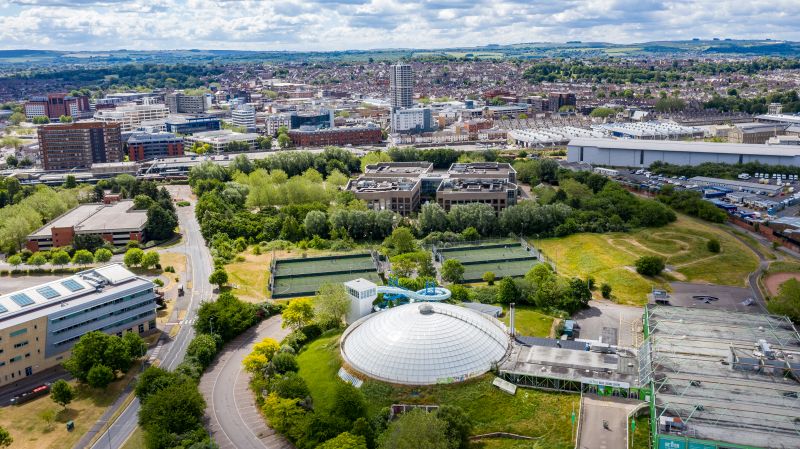
Photography competition focuses on Swindon’s architectural gems
Visit Swindon is inviting photographers to focus on Swindon’s architectural gems in its 2021 photography competition.
The Architecture photo challenge follows the success of 2020’s Hidden Gems photography competition. That saw almost 500 images of the town uploaded to the organisation’s Instagram feed.
The competition is a fun way for amateur photographers to get back out into their local environment. All the while following social distancing guidelines. The Visit Swindon team will share selected images on their own social media channels.
As the town’s businesses emerge from lockdown, one lucky photographer will win a £300 prize bundle sponsored by businesses in Swindon’s Old Town. The bundle will comprise £50 vouchers to spend in the following businesses:
1. Food Magpie 2. Magnum Wine Shop 3. Contemporary art and furniture gallery Oink 4. Lifestyle store Kapada Vintage 5. Willoby’s Furniture 6. The Wood Street Foodhall
There’s also a Sunday roast for two at The Bank restaurant and bar in Wood Street.
* A great bundle of prizes for sure. But what a pity and an opportunity missed by the competition organiser not to show some support for other independent business in the town. There’s enough of them. It’s almost like the rest of the town doesn’t exist. Such a shame.
Old Town-based branding agency Jazzbones is coordinating the competition. It’s MD Nathan Sandhu said: ‘Swindon is steeped in architectural history. And that history is a photographer’s dream.
Swindon boasts:
1. The GWR Railway Village conservation area 2. Victorian houses aplenty in Old Town including Vilett’s House – much-loved by Sir John Betjeman. 3. The Mechanics’ Institution and the Corn Exchange/Locarno and of course … 4. Our GWR Works reimagined as the Designer Outlet centre.
Indeed, what Swindon offers is a giant history book waiting for you to capture with your camera or smartphone.
Not only about old buildings
But it’s not only about the historic buildings. Swindon also boasts plenty of photogenic modern buildings.
Such buildings as the skyscraping David Murray John towert that casts a dramatic shadow over the Swindon skyline. And of course the Brunel shopping centre itself.
And for something left field, consider the Hongxin Chinese Restaurant at Peatmoor Lagoon – AKA the Chinese Experience. Or the futuristic Whale Bridge Car Park in Swindon’s town centre.’
Saving the Oasis – the story so far The Save the Oasis campaign has picked up many followers of late and gathered more traction on social media. So, I figured I’d post an update on who they are and the story so far.
The key figures spearheading the Save the Oasis campaign are Neil Robinson, Emma Williams and Helena Bowie. Though there are many others helping in many ways.
Neil and Emma were regular users of the Oasis, right up to its closing in November 2020. Helena Finch became involved with concern for the loss of the Oasis as a tourist attraction and as a vital facility for families and the disabled. So their passion for saving the Oasis is born of wanting to save a facility that they either used themselves or wish to see preserved for others whose needs only this facility can meet.
Said Neil: ‘I learnt to swim at the Oasis. What’s more I took my toddler daughter swimming there just before it closed. We were one of the last people to use it. This is the best facility for people with young families for miles around. Its loss will be tragic.’ While regular Oasis swimmer Emma Williams, who has knee and hip problems thanks to sports injuries, finds the centre a Godsend because she simply walk into the water, whereas she finds getting into a regular pool with ladder access difficult and painful.
About the listing application
Almost the moment the Oasis closed, Historic England received a listing application from an unknown individual. The SOS campaign does not know who this person is. They’ve tried to find out but data protection prevents.
The20th Century Societyalso put in a listing application – but they were turned down as someone else had got there before them.
How the campaign has unfolded
In the first instance the SOS campaign didn’t support the idea of listing the Oasis fearing it would impede renovation. They changed their minds on it as they understood that there how funding streams available ONLY for listed buildings. The Save Grange Lido campaign tweeted the group late March to give them information about funding streams for listed buildings.
Before that though, article from the 25th February edition of the Swindon Advertiser, reported that Cllr Heenan had written to Historic England asking them not to list the Oasis. He/Heenan said:
‘People are passionate about the Oasis Leisure Centre and its emotional connection to families learning to swim, but this building does not have special architectural or historic interest, and no part should be listed.’
‘Oasis dome is at the end of its life – it’s time for a modern leisure centre’ and ‘I for one, will be keeping my fingers crossed Historic England does not grant it listed status because it is time to give the Oasis a new lease of life and many more families treasured memories.‘ And you can read my rather furious and impassioned response to that here.
All that was in response to a considerable amount of flak that SBC got on releasing this:
IN THE MEANTIME
While all this was happening the SOS campaign didn’t sit on their laurels. They carried out extensive digging and researching to find ways to renovate the dome so it could be sustainable.
Towards the end of March the group had contact from two engineering companies, Studio Octopi and the Iceni Project. Both are experienced in restoring heritage swimming pools. And both were firm that the Oasis dome could be renovated by placing the roof panels with EFTE pillows.
Around this time the team also made contact with Mike Kirkman, director of Sports at Aston University and also involved with Historic Pools of Britain. It’s his belief that refurbishment is possible. Further, the fact that the Oasis has excellent access for the disabled, makes its renovation and saving vital.
In addition, the team’s diligent research and social media use brought to their Twitter door, Robert Guy and Otto Suarez.
‘The loss of the Oasis would represent the loss of an entire building type which is both culturally and architecturally important,’ says Robert Guy, a partner at Bristol-based Arturus Architects.
At every step of the way the team have passed everything they’ve learned and discovered to Cllr Renard. They’ve also tried, many times, without success thus far, to contact Seven Capital – the lease-holders of the Oasis site.
Indeed, the team have tried – hard – to engage with the current administration about the Oasis but with very little response and no noticeable cooperation.
Security and maintenance of the site
Between their own site visits and the ‘work’ of urban explorers and community litter pickers it became sadly clear that both security and maintenance on the site were less than adequate. Break-ins began to happen. This despite the team quite literally begging SBC/Seven Capital to do something about security.
Back in January the team asked for heating and ventilation to be operational to prevent structural damage. All fell on stony ground.
The team have seen many photographs of the dire condition the Oasis is in now.
NB: The contents of this blog are a condensed record of a great deal of tweeting and emailing and Internet research etc, etc, etc undertaken by the SOS team. I couldn’t put every single item into this blog or it would have even longer than it is now. If you want to know more then I urge you to contact the team via their Facebook page or on Twitter: https://twitter.com/SaveOasis
To conclude … for the moment …
Given all the above and given that GLL, who operate the Oasis, ripped out lighting and all the gym equipment when the announcement came that the Oasis would remain closed after lockdown, there’s no way it could re-open now.
Irrespective of the listing application currently in place.
That’s all for now – we wait with bated breath for Historic Engjand’s decision.
Why do the council hate the Oasis? Indeed, DO the council hate the Oasis?
I confess I’d not considered these questions at all until more than one person gave voice to them on Twitter in recent conversations about the Oasis. And the more I ponder, the more I’m forced to confront the possibility. Let’s look at the evidence for the prosecution.
In the first instance that action, I assume sanctioned by the Council leader, raises many questions. 1. Is it an appropriate thing for a Cllr to do? 2. Does such an action best serve the residents they’ve been elected to serve – many of whom do not want to lose the Oasis for a not-very-lovely, definitely-not-iconic gasometer look-a-like. And many others of a similar ilk.
I don’t know – I’m merely putting out there that maybe this is not something a councillor ought to do.
But putting all that to one side for a moment, isn’t such a thing an overt act of hostility to the Oasis? At the very least it feels like a petty action to take. One that smacks of a mystifying desperation to demolish something deserving of the term iconic. Something interesting, something significant and replace it with something about which, the word bland is the most positive spin I can find.
*Why wouldn’t a town’s administration want to do their damnedest to keep a heritage building? And let’s be clear – the Oasis is equally as much a heritage building as the Mechanics’ Institution, the GWR Railway Village, the town hall and many more.
*There are answers to that question for sure but I’ll leave it there for now.
The aforementioned Adver article quotes Cllr Heenan as saying: ‘People are passionate about the Oasis Leisure Centre and its emotional connection to families learning to swim, but this building does not have special architectural or historic interest, and no part should be listed.’ Cllr Heenan speaks there with both breath-taking arrogance and an authority on architecture I didn’t realise he possessed. Who knew?
Note – since the publication of that piece the Save the Oasis campaign have amassed a great deal of evidence to refute that statement.
Is this or is this not an act of hostility towards the Oasis? And indeed, I will argue, Swindon itself:
I for one, will be keeping my fingers crossed Historic England does not grant it listed status because it is time to give the Oasis a new lease of life and many more families treasured memories.’
Yet again, so many questions raised. How is it appropriate for a Council leader to actively and openly wish for the demolition of a heritage building? That’s an astonishing thing to say and surely wrong on so many levels?! For a start – how are we meant to have any trust in a Council leader with such an approach to heritage assets?
‘Oasis dome is at the end of its life – it’s time for a modern leisure centre’ screamed the Adver headline.
In the first instance there’s no such thing as a building lifespan – only lack of maintenance. And again the Save Oasis campaign have evidence to support that assertion. Apart from that, what gives Cllr Renard the authority to tell Swindonians that it’s ‘it’s time for a modern leisure centre’. Yet more breath-taking, paternalistic arrogance. Whether Swindonians want a new leisure centre or not, is for them to decide – not the council to dictate.
The Oasis as a tourist attraction
The Oasis used to be a huge draw. As Barry Leighton wrote in the Swindon Advertiser in 2015, it was a bigger attraction than Stonehenge! And it could be again! With vision and the right management. Whereas, ‘let’s go to Swindon to swim in a leisure centre that looks like a gasometer’ no-one will say ever!
Anyone would think that our current Conservative administration don’t want people to come to Swindon and spend their money here. Certainly, demolish the Oasis and you’ve got a gaping hole on the Visit Swindon website. #awkward
Have they thought this through AT ALL?
And another point to be clear on there. Any replacement leisure centre that doesn’t feature:
The dome
A freeform lagoon pool that offers easy-access for the less mobile and for small children the like of which nothing else in Swindon offers.
… a tropical themed interior …
… isn’t the Oasis. It’s a North Star Leisure centre.
Thus, dressing that hastily-shoved out CGI as ‘saving the iconic Oasis’ is a misrepresentation at best. And woeful ignorance of what the word iconic does in fact mean. Unless they were being ironic …?
And aside from the swimming, there was football, live music, roller-skating, martial arts, gymnastics and more. I could go on for hours.
But instead, I’ll return to my original questions: Why does SBC hate the Oasis? DO SBC hate the Oasis?
Answers on a postcard! Preferably to the Swindon Advertiser Office!
DANCING IS RIGHT UP HER STREET SAYS TALENTED DANCER AS SHE JOINS SOUTH WEST’S LEADING PERFORMING ARTS COMPANY
Swindon dancer joins RPA A young Swindon dancer, Beth Cooper, is soon to join one of the South West’s leading performing arts companies to create and run more street dance classes.
Beth (24), who lives in Rodbourne with her boyfriend, Jamie and their little dog, Rou, said that joining Revolution Performing Arts (RPA) is her dream job.
Beth Cooper
Dance and performing arts are such amazing ways to express yourself,” said Beth. “I have found true joy in dancing and would love other people to do the same.’
Champion!
Beth was a mere four years old when she joined a ballet class and then, at the age of six, found her niche in Irish dancing. Belonging to a large Irish family, she went to classes with her cousin. She loved them and became a South West champion!
When she won a performing arts scholarship in Wiltshire, she learned many different styles of dance, contemporary, hip hop, jazz and tap. Alongside all that she undertook drama and singing lessons. She soon picked up how to tap dance thanks to her Irish dancing lessons. But then she had her first ever street dance class and knew she had found her calling.
Beth explained: ‘I was 13 years old at the time and I haven’t stopped with the street-style of dance since. I knew then that this was what I wanted to do. I just knew!’
Validation!
She had those feelings validated recently when won first place in a street dance competition. She said it made her so proud of herself, as it was her first and only time competing.
In 2020, Beth was lucky enough to have a job throughout all the lockdowns and even moved house twice! Yet, she very much struggled with not being able to see her family, with whom she is very close.
My family mean everything to me,” Beth confessed. “Dancing saved my sanity throughout the pandemic. Dancing is something you can enjoy anywhere. In your own home or garden and is a healthy distraction from the Covid restrictions.’
With Revolution Performing Arts, Beth will be working with children aged six all the way through to adults. She is a firm believer dance should be uplifting. Beth wants her classes to be a place of complete freedom for students to have fun and learn a few cool steps. She also stresses the importance of teaching dance styles correctly with a historical background. Because the origins of each dance style are so interesting.
Beth is also a strong advocate of judging people for their effort, hard work and talent. And not on the way they look, their hair or skin colour or their weight.
She said: ‘I have noticed that things are already changing in the dance industry. I am very excited for the future and thrilled to be joining Swindon’s Revolution Performing Arts.’
About RPA
Fiona Da Silva founded Revolution Performing Arts in 2007. The company pecialises in empowering young people to celebrate their individuality through the power of performing arts.
RPA has its base in Swindon, but operates in North Wiltshire, Oxfordshire and Gloucestershire. It’s recently received a £25,000 grant from the Government’s Culture Recovery Fund.
Fi said: ‘I knew I had to diversify during the pandemic. So I am launching a programme of new sessions including more performing arts open classes, circus theatre arts, musical theatre, ballet for fun and, of course, street dance. Beth will be creating and running the street dance classes in accordance with Government safety guidelines as soon as we get a suitable venue. I am so delighted to be welcoming her to our talented team of RPA leaders.’
Swindon’s Oasis – the Last of Its Kind The ongoing Campaign to not only reopen, but preserve the iconic aesthetics of Swindon’s Oasis Leisure Centre continues.
This week a practising architect with links to the original 1970s Oasis architects, contacted Save Oasis Swindon via social media. Robert Guy, of Bristol-based Arturus Architects, has thrown his full support behind the ongoing listing application with Historic England. He has personally written to them, urging for the Oasis to received listed status.
As an undergraduate Mr Guy visited the Oasis on a project. That visit that inspired him to work in leisure architecture. Indeed, he went on to design Bracknell’s Coral Reef complex.
Letter to Historic England
In his letter to HE, Robert spoke of the proposals made to replace the Oasis dome.
‘It’s my belief that there must be a way to retain this unique feature. We have more lightweight materials available than when it was built. And, if it is structurally sound, it can be clad to give a much better thermal performance than it had.
The type of material used for the Eden project would be a most suitable material as it’s lightweight and easy to use. I would think that polycarbonate would also be suitable and can’t see why it didn’t give an uplift in the thermal performance when used six years ago. I suspect that the budget set aside to replace the original panels was too little. I’m sure there will be other materials which would need some research. From recollection the original panels were custom formed to each row.
‘At a time where keeping and reusing is being promoted as the best way of preserving the embodied carbon within a building, it would make sense to keep this building. I understand that the building is at risk of demolition without the listing.‘
The pool too
Mr Guy went on to say in his later that the pool is also worthy of listed status. ‘There are fewer examples of wave pools in operation and again they may disappear entirely.’
‘Because most local authorities have to use outside companies to run the facilities of this type and they are principally set up to operate as fitness centres, the operation of leisure pools is regarded as being too expensive and outside their core business. This has led to the closure of many of buildings of this type and a loss of facilities much appreciated by the general public. The few that remain have become centres which serve a wide catchment. The Oasis is such a building.
He added: ‘The Oasis is the last remaining example of a leisure pool from the 70s – all others have suffered demolishment or substantial changes. It also happens to be the best example that embodies the aims of the originators and is unique in its form. If this building is not retained, then the whole building type will have disappeared.’
Working hard to save the Oasis
Save Oasis Swindon have worked hard to keep the Oasis issue in the spotlight. The building has suffered numerous break-ins recently, and the campaign has conducted its own regular patrols of the site.
The outcome of the listing will determine if the Oasis is preservable in its current form, as the last surviving example of a major pioneering British Leisure Centre.
In a recent article for the Swindon Advertiser, the head of Swindon Borough Council, Councillor David Renard stated:
‘I for one, will be keeping my fingers crossed Historic England does not grant it listed status because it is time to give the Oasis a new lease of life.’
Yet, both Historic England and the 20th Century Society have refuted that statement, assuring our campaign that listing would not hinder refurbishment. Indeed, on the contrary, listed buildings can access funding sources that exist only for such structures.
The Oasis is Swindon’s heritage. Further it’s the last of its kind.
Thus demolishment of this structure will constitute cultural vandalism comparable to killing the last butterfly.
Demolish the dome and you wipe out an entire typography of building!
See also my Swindon in 50 More Buildings post that I keep updating as the campaign finds new information: