When I say ‘chilly lunch’ I refer to the temperature/weather and not that we were served cold food! I know all about the vagaries of the British weather of course. Even so a T-Shirt, two layers of cashmere, a duvet coat and fingerless gloves felt a bit ridiculous as we go into May.
Jo & Marilyn
Angela Atkinson – Born Again Swindonian
The reason for the visit
You can’t have failed to notice that the world has spent the past year in the grip of the Covid-19 pandemic. With the vaccination programme rolling on almost at the speed of light, we in the UK are slowly emerging from lockdown. Thus, for now, we can meet outside.
Nothing about this situation has been fun for anyone of course. But it’s fair to say that hospitality and events has been hit harder than most things. Ergo, now we can socialise outside, restaurants and cafes such establishments are seeking ways to maximise the opportunity. Which brings us to the shiny new dining deck at the Swindon DoubleTree Hilton Hotel.
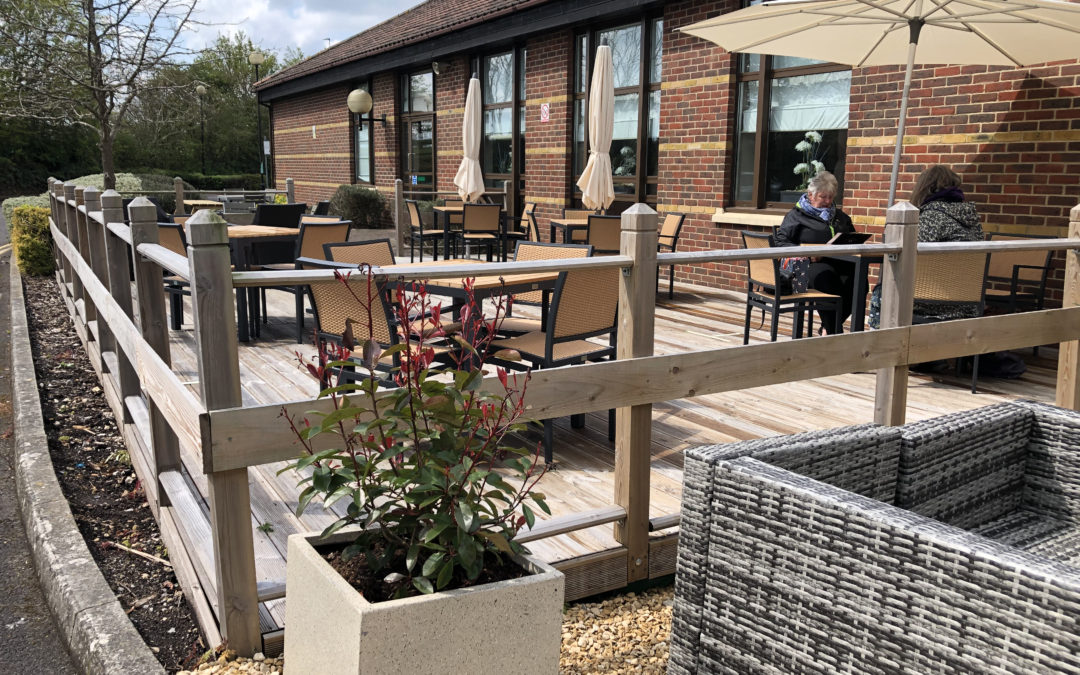
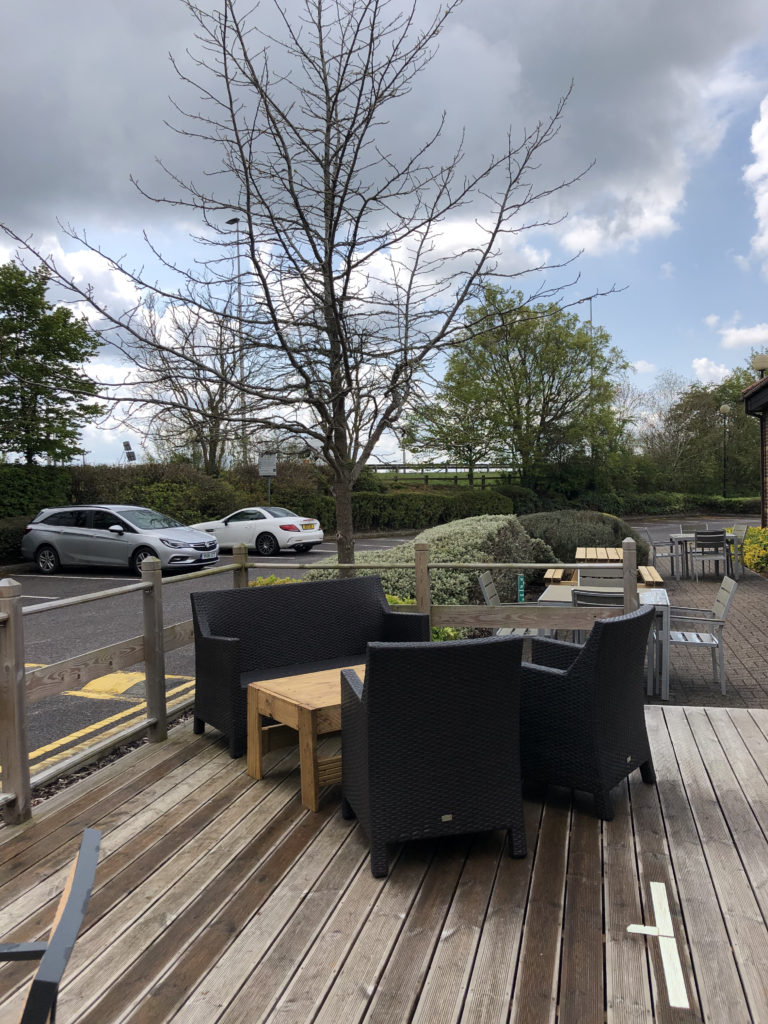
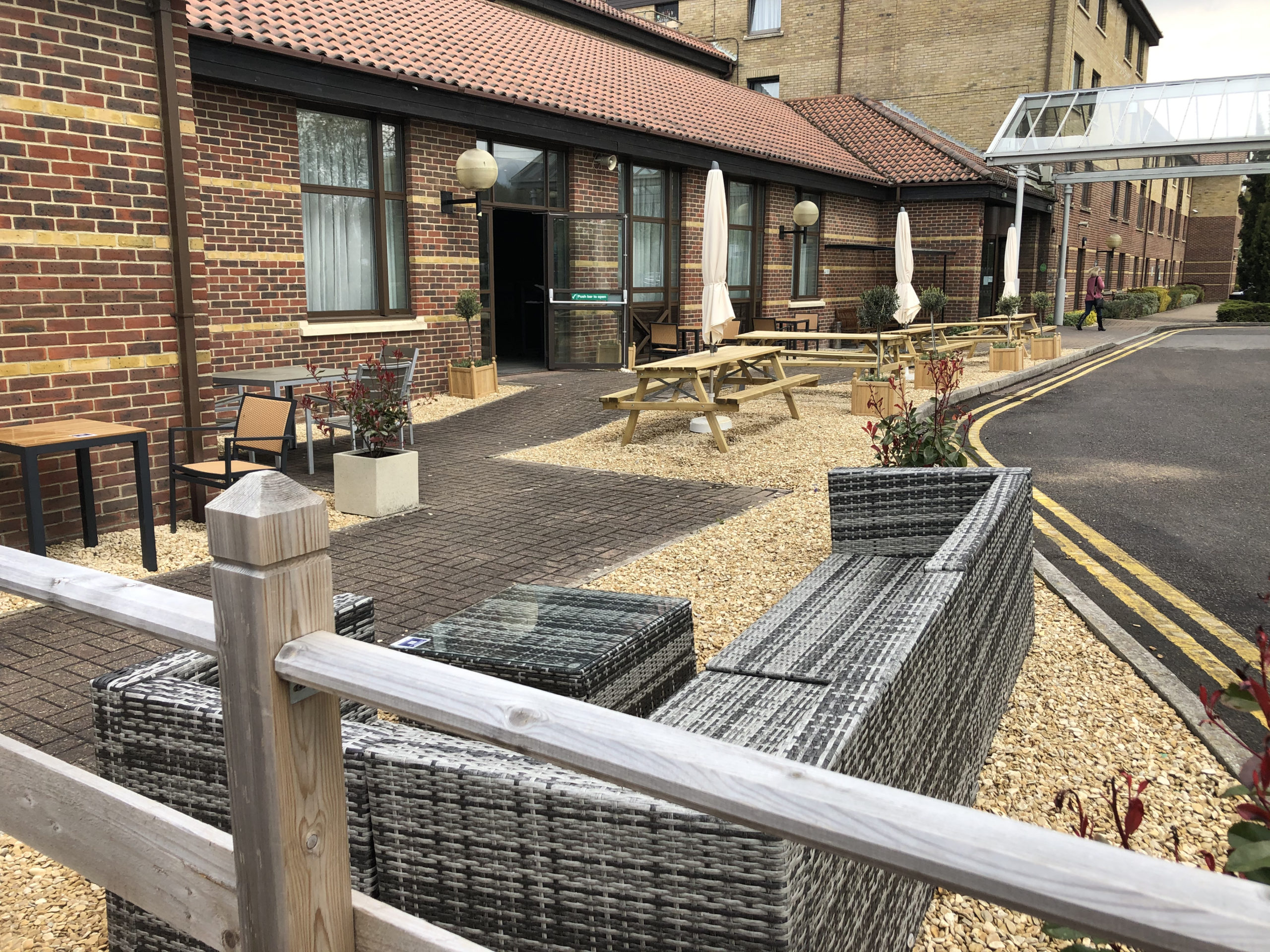
Seeking to capitalise on our new freedoms to dine outside, the hotel has installed a sizeable deck area with tables, chairs and parasols and a further gravelled area with picnic bench seating. So there’s a good amount of seating available.
So myself and two chums, Jo Garton and Marilyn Trew toddled along today to try it, and the food, out.
Swindon DoubleTree Hilton Dining Deck
Onto the food
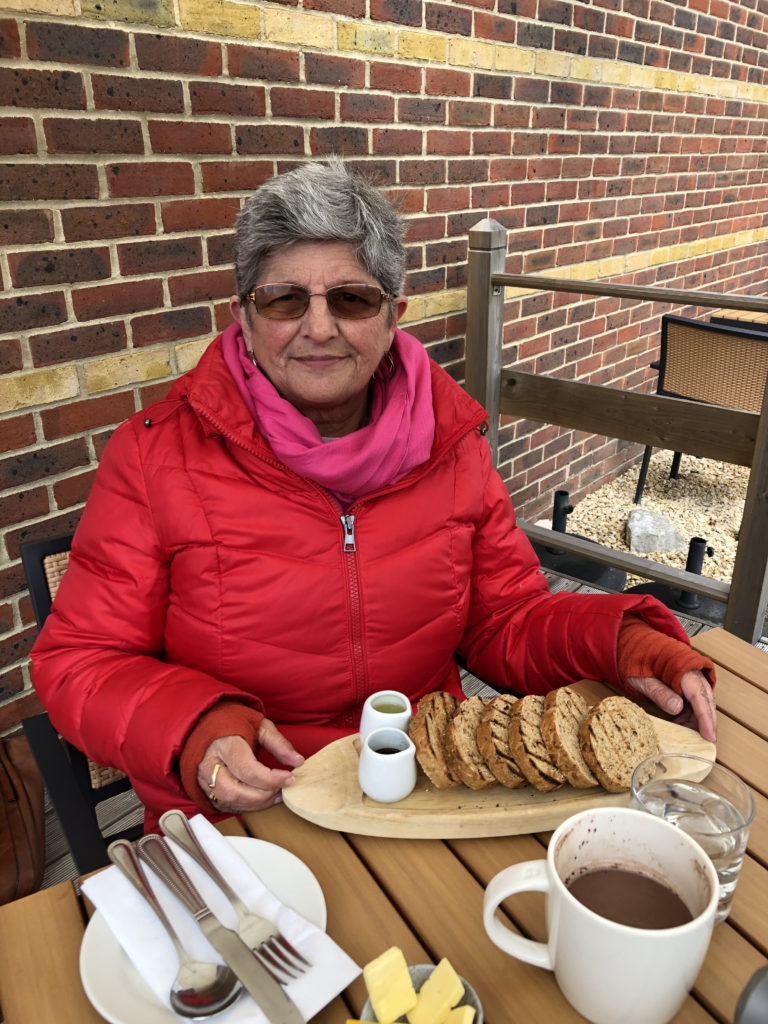
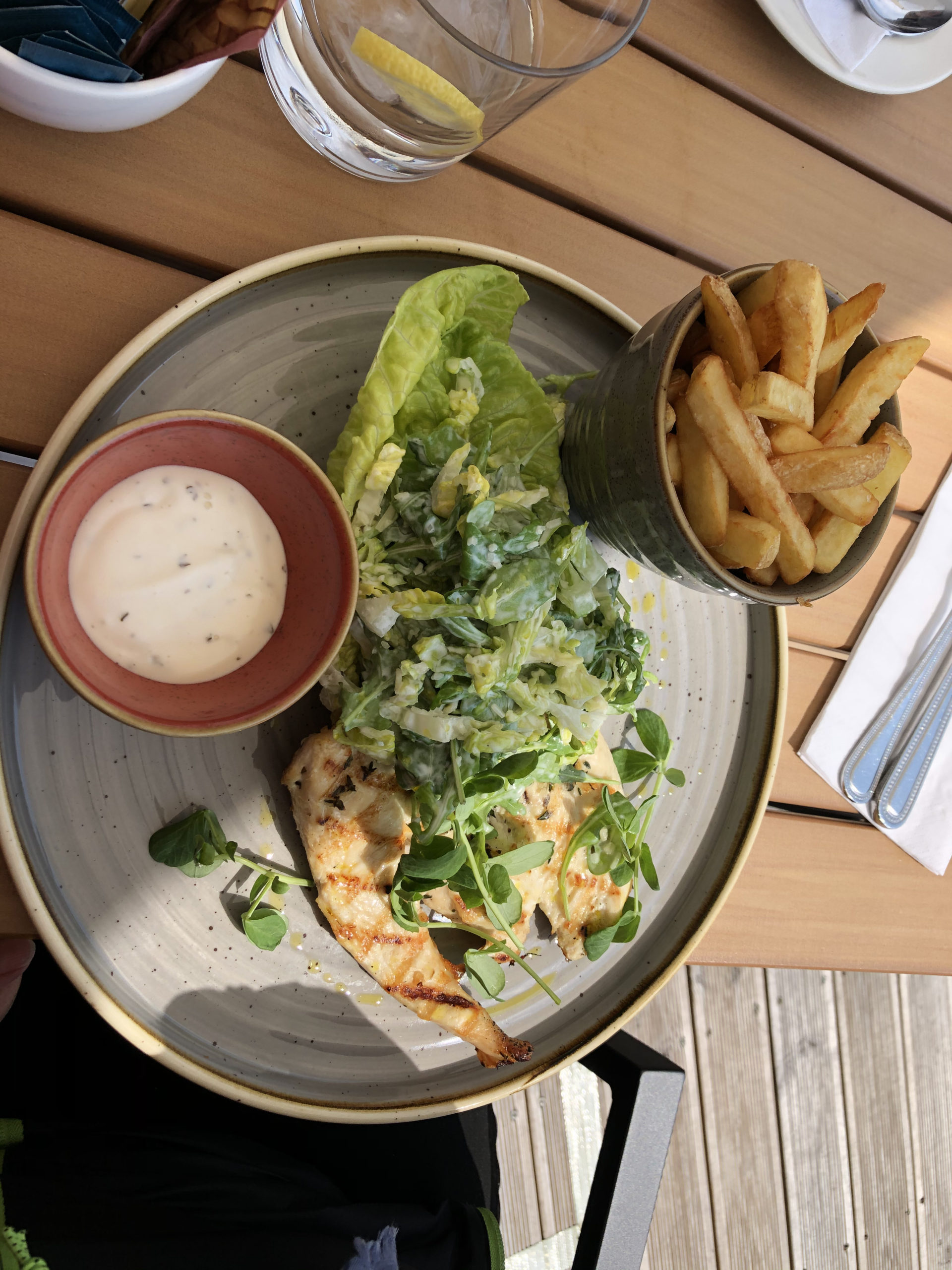
I think perhaps the best way to talk about the food is to show it. There were no surprises on the menu – it was all the standard sort of stuff that you’d expect to find in such an establishment. But that’s not a bad thing by any means and isn’t meant as a negative.
It was all very tasty and served on a range of wonderful crockery. If I can’t have a white tablecloth *sigh* then the least I expect is decent crockery! And, particularly pleasing, the butter came in pats in an actual dish. As opposed to in those nasty, pesky little peel-back things that one is so often subjected to. Those things are bad for the environment and a messy fiddle to use. And they’re not … stylish. It’s the little things. So a big tick to the Hilton from me for proper presentation of the butter.
And, we didn’t think the prices were bad either – as things go.
Any negatives?
Only one. Not particular to this establishment and a personal dislike. But I have to get it off my chest. What? Starbucks!
I hate, loathe and detest Starbucks with the white hot intensity of a thousand burning suns. I’m afraid I hate the thick, massive mugs big enough to float a battleship in. And I loathe how much they, and other large coffee retailers for that matter, charge for a black coffee – frankly it’s stealing. But worse still – I don’t even find it nice. In essence, I’ve yet to find a coffee in Starbucks.
A very personal prejudice I accept. And I’m well aware that many people love Starbucks. And if you’re one of them – happy days at the Hilton.
Would I go again?
Despite the Starbucks, yes absolutely! When the clouds finally parted we could see that it’s a super sunny spot. They’ve got patio heaters and all-encompassing giant umbrellas arriving soon – so you could well enjoy a warmer meal than we did!
And a big plus point for me is that it’s within striking distance. And of course it’s all about location, location, location isn’t it?
So, in short, if you’re looking for an outside socialising and dining area in Swindon for work or pleasure – dash to the DoubleTree and hurry to the Hilton! With its location just off the motorway junction there, it is in an ideal spot with plenty of parking.
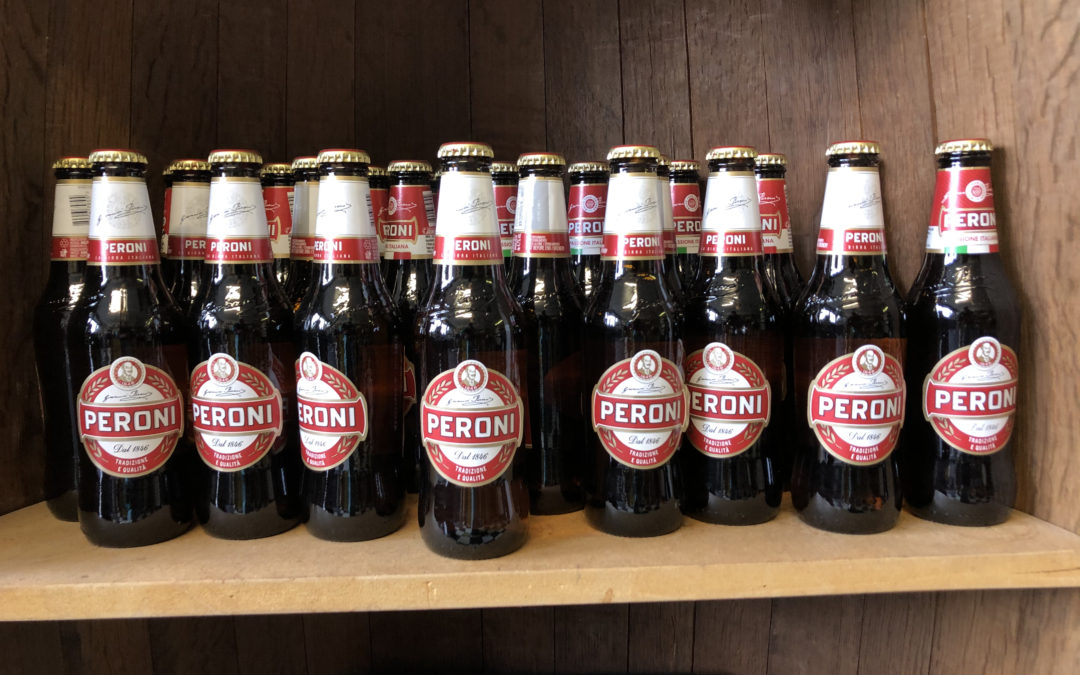
Peroni Red Label Beer I guess this one is a bit of a cheat in that I’ve already done a generic Italian beer post in thisSwindon in 50 drinks blog series. But here I’m taking the top off Peroni Red Label beer,
In that post I covered the ubiquitous Peroni Nastro Azzuro and Birra Moretti. But then, in my defence, I didn’t know of the existence of Peroni Red Label. Not that is until I happened to pop into DaPaolo’s Italian delicatessen on Commercial Road for a coffee the other day and saw some on his shelves.
To refresh – ha! – your memories
On the subject of Peroni Nastro Azzuro:
‘From the Peroni official website we learn that the Peroni family conceived this beer in 1963. A beer to embody Italian values of quality and craftsmanship. They describe the beer as being brewed through three generations of master brewers. According to them: ‘Peroni Nastro Azzurro uses only the finest ingredients, including our exclusive Nostrano dell’Isola maize.’
Thus, they say, they deliver a beer that is crisp and refreshing with a delicate balance of bitterness, citrus and spicy aromas with a fast, clean finish. I have no sense of smell so can’t comment on the aroma part.’
So now onto Peroni Red Label Beer – brewed since 1846. ABV 4.7%
Difford’s Guide tells us that Peroni is the original brand of the Peroni company. According to them it’s the most popular beer in the Italian peninsula. A bold claim.
Vinissimo meanwhile tells us that: ‘Peroni Red is Italy’s number one beer! Unlike the more famous Peroni Nastro Azzurro, the red labelled Peroni Red offers a slightly darker colour with more pronounced malty and hoppy characteristics.
The Peroni Brewery was established in 1846 in Vigevano, Lombardia. From then, Peroni has grown to become Italy’s most recognised beer and furthermore, Peroni red is the most widely consumed beer throughout the Italian Peninsula.’
So corroboration there then.
Now all that remains is for me to try it. I bought a couple of bottles of course! Now I would have got more but it was the carrying it. I do like a malty beer so I rather suspect I will enjoy it.
Dr Desmond Morris artist and anthropologist Born on the 24th January 1928 is a zoologist, ethologist and popular author on the topic of socio-biology. He is also a son of Swindon! Well – Purton – but that’s close enough for government work. His parents were Marjorie (née Hunt) and children’s fiction author, Henry Morris.
Aged five, Morris moved to Victoria Road in Swindon and attended the now-long-gone Swindon high school on Bath Road. There he displayed an obsession for art.
At the age of 20, Morris held his first one-man show of his own paintings at the Swindon Arts Centre and created a furore. Some forty-four years later he returned to Swindon for a major retrospective. Desmond, whose surrealist works have been exhibited all over the world, said at the time: ‘People think my painting is a hobby, but it isn’t. I was doing it long before the other stuff and it’s more important to me than anything else.’
In 2002, Swindon council acquired – with £1,000 each from the Friends of the Museum and Art Gallery and the Victoria and Albert Museum – a Morris original. Girl Selling Flowers is a collage of colourful imagery with a gorgeous pair of ruby red lips at its heart. Desmond painted it when he was eighteen after returning to Swindon from London’s Petticoat Lane market. Said Morris of this work: ‘I wanted to capture the colour and noise from hundreds of market stalls. Diana, who was a couple of years younger than me, was my girlfriend at the time. ‘I decided to incorporate her into the painting. Those big red lips symbolised Diana – they were her logo. These days stars have surgical treatment to get lips like that but Diana’s were natural.’ He added: ‘I have very vivid memories of Diana’s lips.’ Indeed, who wouldn’t!?
Come 1950, he held a surrealist art exhibition with Joan Miró at the London Gallery. Also, in 1950, Desmond Morris wrote and directed two surrealist films, Time Flower and The Butterfly and the Pin.
Going ape – Morris the zoologist
Meanwhile, back with this anthropology interests, in 1951 Morris began a doctorate at the Department of Zoology, University of Oxford in animal behaviour.
In 1954, he earned a Doctor of Philosophy for his work on the reproductive behaviour of the ten-spined stickleback.
Come 1956 Morris moved to London as Head of the Granada TV and Film Unit for the Zoological Society of London where he studied the picture-making abilities of apes. The work included creating programmes for film and television on animal behaviour and other zoology topics. He hosted Granada TV’s weekly Zoo Time programme until 1959 where he hosted and scripted 500 programmes. He also made 100 episodes of the show Life in the Animal World for BBC2.
By 1959 he’d left Zoo Time to become the Zoological Society’s Curator of Mammals. In 1964 he delivered the Royal Institution Christmas Lecture on Animal Behaviour.
Publications and more TV
Morris’s books include The Naked Ape: A Zoologist’s Study of the Human Animal, published in 1967. Anyone of a certain age is familiar with that title! This study of human behaviour from a zoologist’s perspective became a huge, international bestseller.
The book sold well enough for Morris to move to Malta in 1968 to write a sequel and other books. In 1979 he undertook a television series for Thames TV, The Human Race, followed in 1982 by Man Watching in Japan, The Animals Road Show in 1986 and then several other series.
National Life Stories conducted an oral history interview (C1672/16) with Desmond Morris in 2015 for its Science and Religion collection held by the British Library.
His grandfather William Morris, an enthusiastic Victorian naturalist certainly had much influence on him during his time living in Swindon.
In that capacity, during Covid, Desmond gave the group a terrific talk via the magic of Zoom during which he shared so many wonderful anecdotes about his great grandfather, William Morris, and the founding of the Swindon Evening Advertiser, Diana Dors, Queen’s Park lake, Jimmy Bomford and lots more.
And here is a Zoom link to the fab talk from Dr Morris:
Buy Desmond Morris books via my Amazon affiliate link and I get some unicorn snot!
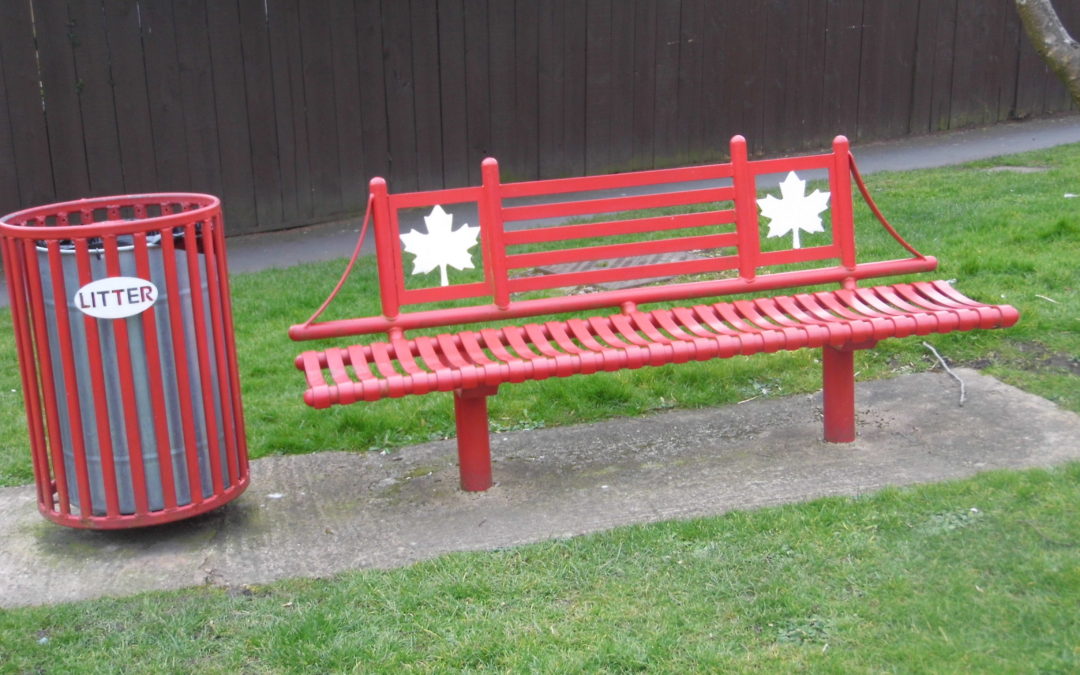
Canadian Spitfire Pilot Memorial Swindon On a corner of Ermin Street in the Stratton area of Swindon there sits this bench. What follows explains why it’s there.
Canadian Airman Memorial Swindon – Ermin Street, Stratton
The bench you see above serves as a memorial to a Canadian airman killed when his Spitfire hit a tree on Ermin Street – the scars from which you can still see on the tree’s trunk.
The Canadian in question was one Sergeant Norman W. Barbeau, aged 20. He was one of six boys in his family, four of whom served in WWII. Two of them in the Royal Canadian Air Force. He left behind a widow, Florence Marguerite Louise Barbeau, of Montreal, Quebec.
On the 7th December 1941, at around 10:10 am as some of Stratton’s youngsters waited to go to Sunday school, Sergeant Barbeau crashed his Mark 1a Spitfire X4354 in Ermin Street cutting in half the Lime tree at Church Street junction. This Canadian veterans’ website has a virtual memorial to the young pilot. There you can see a picture of the plaque erected by Stratton parish council in 2005.
Barbeau’s plane had struck a petrol tanker on take off. Then, when in flight, the port became detached causing the aircraft to go down.
‘Ken Head was just a teenager when he witnessed the aftermath of a dramatic Spitfire crash in Stratton St Margaret. The plane landed on the lime tree at the intersection of Church Street and Ermin Street. The tree split down the middle but is still standing 63 years later.
‘All the kids used to come out on their bikes to the crash scenes’, Ken recalls. ‘We used to try and get there before the RAF Police to collect souvenirs.’
It was 7th December 1941 and Sergeant Pilot Norman William Barbeau had left Aston Down in Gloucestershire on a Spitfire training flight. Flying over Swindon, the 20-year old Canadian pilot lost control and nose-dived. He died instantly.
Visiting the scene, Ken remembers the day vividly. ‘I can see it. The wheels. The engine. The tailplane. There was parts of him laid on the ground and by the gutter a knee joint. I pushed it with my foot.’
It appears that people passed buckets of water to each other to douse the fire where the plane hit the tree.
The plane was seen to break up before it crashed, and one wing landed in a nearby street just missing resident who had been hanging out her washing. The local bobby P.C. Phillamore did his best to keep local children from getting too close, two boys, Reuben Scarrott and his mate saw the crash. Bill Taylor helped to cover the body with a hessian sack.
Sgt Barbeau rests in the churchyard of Holy Trinity in Minchinhampton, Gloucestershire.
On 23rd April 2004, the Parish Council erected a plaque in Sgt Barbeau’s memory in a memorial garden.
Memorial plaque in Stratton for the Canadian airman
Memorial garden in Swindon’s Stratton area for the Canadian airman
And not far away … is this peace garden
Flower bed Stratton peace garden
Bench Stratton Peace garden
Flagpole Stratton Peace garden
Public art Stratton Peace garden
Related: A Swindon-born Battle of Britain pilot killed in action
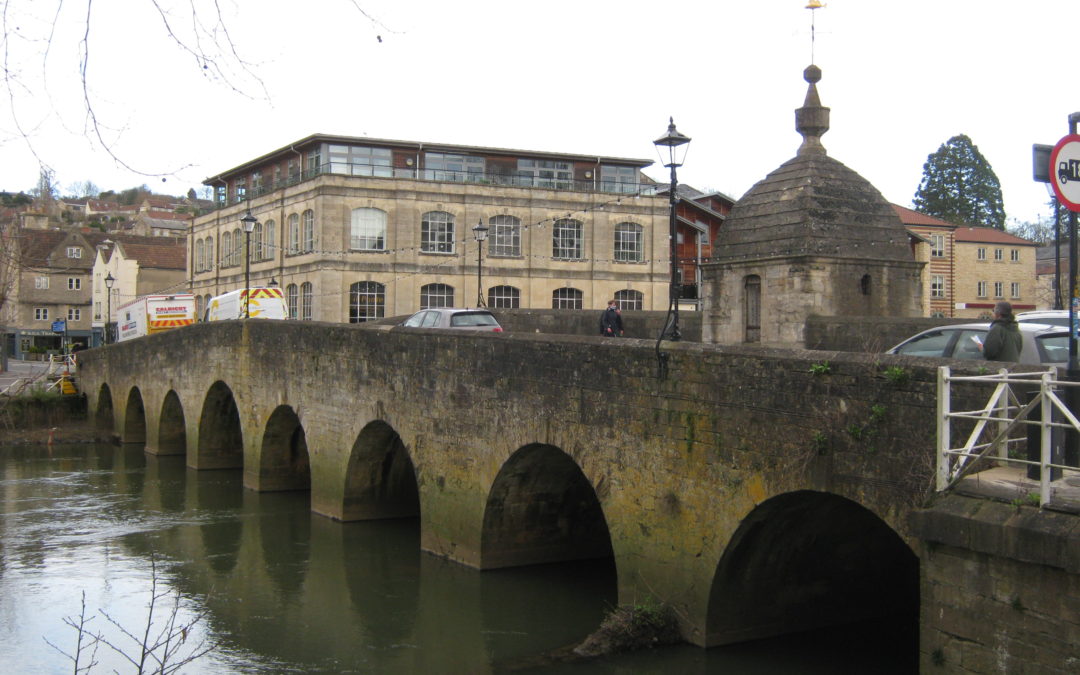
‘One of the most compelling features about Bradford on Avon is its unique position on the edge of the Cotswolds facing the River Avon. The ancient bridge in the centre of the town remains its natural focus and the bridge still retains two of its original 13th-century arches. The historical view from the main bridge incorporates the hill above the town which is dotted with the old weavers’ cottages and the river bank flanked with the 19th-century former cloth mills.‘
The local building stone is the famed Bath stone – a mild yellow limestone with great architectural potential.
The shambles in Bradford upon Avon
Ravellos
And woollen mills, now converted into flats.
Woollen mills in Bradford upon Avon
An Anglo-Saxon church
And, on top of all these interesting buildings the town boasts an Anglo Saxon church. And the people of Bradford upon Avon don’t beat about the bush, they have an Anglo-Saxon church and they sure want you to see it.
History of St Laurence’s church
In a previous blog I described the Anglo Saxon art in Wiltshire. (Romilly Allen). Though there are some churches here that have the carvings, and elements of the architecture. St Laurence’s though is the only mostly complete building of this period in the county. Thus, it is well worth examining.
St Laurence from the south
William of Malmesbury says this church was standing in the 1120s, but he thought it dated to the time of St Aldhelm who died in 709 AD. It is thought to be early eleventh century, for the nuns at Shaftsbury to house the relics of King Edward the Martyr.
For many centuries the tiny church of St Laurence’s lay forgotten, hidden away behind further random building and ivy growth. Canon Jones, vicar and historian, rediscovered it in 1857 after it had been pressed into use as a cottage and schoolroom.
Later generations have often accused the Victorians of over-enthusiasm in their restoration of old churches. But what we must bear in mind is that most our mediaeval churches were in a poor state following long neglect and sectarian turmoil.
Empathetic restoration
The work at St Laurence’s was undertaken with great sympathy. The only thing you see here that you could call modern are the buttresses, used to hold up the walls following the removal of a supporting cottage. During this work they discovered the carvings of two beautiful angels but sad to sat they are too high in the wall to see with ease.
Architectural features
The first thing you notice with this church is how tall it is, compared to its small size. This is a typical feature of an Anglo Saxon church.
St Laurence’ Church Bradford upon Avon – looking toward the east
The church has distinctive albeit narrow doors. Likewise the windows. Notice the Roman arches on both doors and windows.
And last but not least of course, is the arched arcading. A lot of effort has gone into this church.
Anglo Saxon Art
The Angels are not the only examples of Anglo Saxon Art in the church.
The altar saw reconstruction from a fragmentary piece of contemporary art. It’s interesting that this consists of two designs unique in the county, spirals and tessellated patterns. Unfortunately it is rather battered and Romilly Allen’s reconstruction may well be the best way to visualise the design. (Romilly Allen).
I don’t know what the carver was trying to do, making such a big block of design elements. In insular art, it is the practice to use them as mere fillers. Maybe they were attempting a decorated but minimalist effect? Or they wanted to use a more unusual design element and so turned them into a big feature?
Above it is a fragment of an Anglo Saxon grave slab. (St Laurence’s).
Altar frontal cloth
In a frame on the south wall is the altar frontal.
This is a somewhat modern piece, designed by the church architect Sir John Ninian Comper and worked by Lucy Bucknall, of the Sisters of Bethany School of Embroidery. It is goldwork on a red rose brocade. It spent many years in storage and was not in the best condition. Thus it saw restoration in 1999 by Flo Beith of the Sarum group of Embroiderers who restore ecclesiastical embroideries.
close up of altar frontal cloth St Laurence church Bradford upon Avon
In conclusion
To my mind, the interesting thing about St Laurence’s is that although it is clear that the architect was familiar with Roman ideas, and must have seen ruined examples in Bath (pretty much the other side of the river), they do not use actual examples of Roman stonework.
This is a Roman carving of a deity – likely Aesculapius, which has been re used on the 12th century church in Tockenham, a little south of Royal Wootton Bassett. We call it architectural salvage. But the Romans themselves had a word for it, Spoila. It was common in all societies and at all periods of history.
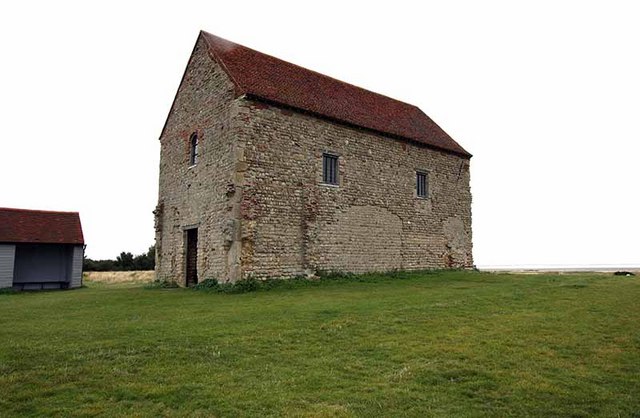
Some churches of this period do indeed re-use Roman material. The church of St Peter in the Wall, near Bradwell on sea, in Essex is a good example – a little church built on the remains of the Roman shore fort called Othona. (St Peter).
St Peter on the Wall
It includes the thin Roman bricks – more like tiles in fact. Though the Anglo-Saxons were capable builders in stone, as far as we know, there were no secular buildings in anything but timber. It was not a media they were too confident in.
At any rate, next time you are in Bradford on Avon, will you pay a visit to this tiny church that is over a thousand years old?
Thank you very much to Christopher Tanfield who opened up the church for me for an hour.
NB: All Photos by the Author except the Altar drawing (Romilly Allen), and the St Peter on the Wall. Photo: St Peter).
Bibliography
The Church of St Laurence, Bradford on Avon. A short guide. Trustees of the Anglo Saxon Church 2018. A leaflet.