Mythos Hellenic Beer at the Greek Olive in Swindon Over the years I’ve sunk a fair few bottles of Hellenic Mythos beer on sunny holidays on the Greek island of Samos. Oh and Corfu too.
But if you can’t get to Greece, then the very next best thing has to be a visit to The Greek Olive restaurant on Faringdon Road. I’ll grant you the view from the restaurant of the GWR Park, while pleasant enough, isn’t quite the same as looking at the Aegean or the Mediterranean. But it’s a lovely substitute. The people are lovely and the food is consistently good. I love the mixed mezze platter – gotta love a gigante!
According to Brewery International the Mythos Brewery Ltd originated from Henninger Hellas S.A. They being the local Greek importer of German beer, Henninger, established in 1968.
1992 saw an acquisition of the company and 1994 brought a name change to the Nothern Greece Brewery Ltd. A genuine Greek beer company it’s alleged. 1997 saw the introduction of Mythos. And the millennium saw a name change to Mythos Brewery Ltd – by then the main product. The Carlsberg group brought Mythos into their stable in 2008.
Mythos beer bears a rich head, a bright blonde colour and, apparently, a distinctive fruit aroma with 4.7% ABV. I put that caveat on the aroma as I wouldn’t know, not having a sense of smell.
One of the most popular lagers in Greece, Mythos was an award-winner at the 2001 Interbeer International Beer & Whisky Competition.
So really, all that remains to say is: Yammas! And onto the Ouzo or the Metaxa brandy. It’s Metaxa for me as I’m not that fond of Ouzo. Even so –it features here in Swindon in 50 Drinks:
GO TRAVEL FOR BONUS POINTS IN SWINDON’S BEAT THE STREET CHALLENGE THIS WEEK
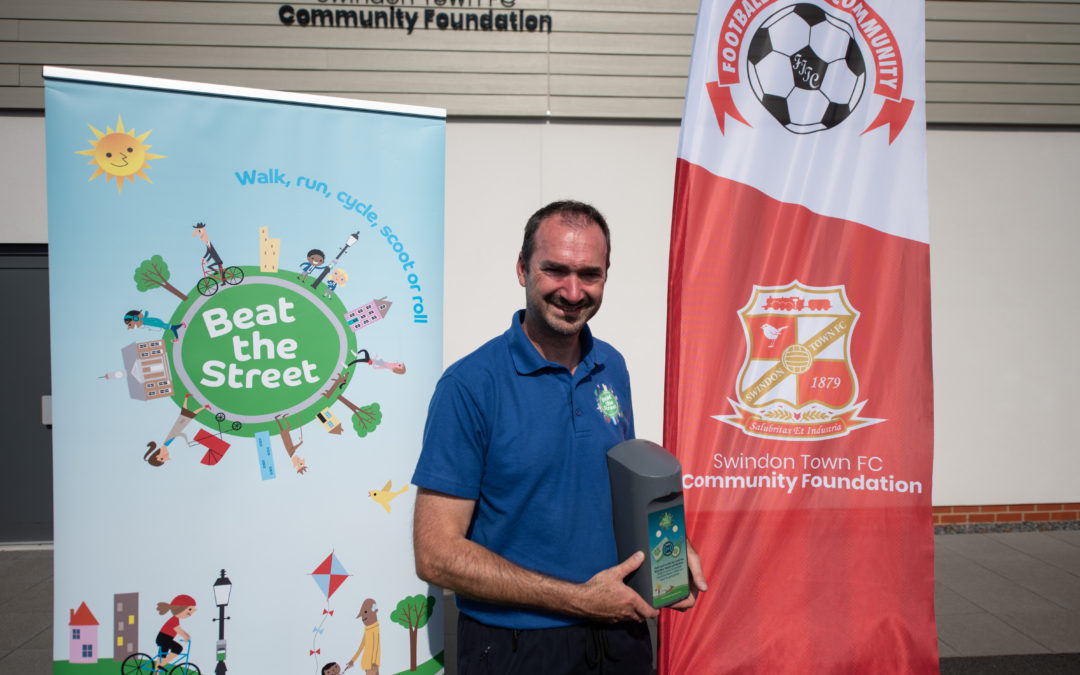
News from Beat the Street Swindon More than 27,000 people have signed up to play Beat the Street Swindon 2021. That’s more than the total number of players in the 2019 game!
This week, the game enters its Go Travel themed week. Here players can clock up double points on Beat Boxes around traditional commuting hours.
Go Travel Week
From Wednesday, 29th September, it’s ‘Go Travel’ week. In this one, BTS encourages people to think about walking or cycling to work or school rather than taking the car. For those working at home you can ‘commute’ around your local area to start and finish your day with extra activity.
Participants in Beat the Street Swindon have already racked up almost 150,000 active travel miles. And there’d still time to get involved!
Stuart Arthur, engagement co-ordinator for Beat the Street Swindon
About Beat the Street
Beat the Street invites players of all ages to take part in the free game that encourages people to get active in return for prizes. The game encourages local residents to ditch the car, and walk, scoot, wheel, cycle or run instead. The teams that travel the furthest can win book vouchers or trophies. And there are individual spot prizes simply for taking part.
Collect a card and map from one of the distribution points listed on www.beatthestreet.me/swindon Then join a team and start playing!
The scores on the doors
There are total and average points leaderboards for schools, community teams and charities with vouchers for the teams that travel the furthest.
Haydonleigh Primary School leads the total points leaderboard, with St Francis Primary School and Orchid Vale in second and third place.
Jenny Hulse from Bridlewood Primary School said: ‘The children are very excited to be playing Beat the Street once more. We’ve started our Tuesday night Beat the Street Club, where 45 children have been busy tapping Beat Boxes for an hour after school.’
Taking place until Wednesday, 27th October, Beat the Street is transforming Swindon into a real-life game. Players are busy tapping special sensors called Beat Boxes dotted across the town.
Councillor Brian Ford, Swindon Borough Council’s Cabinet Member for Adults and Health said: “We’re so enjoying seeing people getting out and playing the game. It’s great to see people of all ages making the most of Beat the Street and incorporating an hour of exercise into their daily routines.
As well as having a positive benefit on our health,it has a positive impact on our environment.’
Dementia Café Returns To Wyvern Theatre The easing of government restrictions means the welcome return of the town’s theatres, bringing a variety of shows and events back to our social calendars. Now locals can get their fix of comedy, drama, music and more.
Further, the re-opening of the Wyvern Theatre also means the return of the theatre’s community projects. Such projects as the popular and much-needed Wyvern memory café.
Since 2014
Set up in 2014, the Wyvern memory café offers a relaxed monthly get-together for those living with dementia. It’s also of huge service to their carers, friends and family. Sponsored by Home Instead, the service is completely free to attend and has previously entertained visitors with such activities as quizzes, therapy pets, cheese tasting and cupcake decorating, as well as the extra special Christmas sessions known for their festive fun (and food!).
The memory café returns on Monday 4th October from 10.30am – 12 noon. It will take place in the lower foyer of the Wyvern Theatre, allowing access through the venue’s accessible entrance.
‘We’re thrilled to bring the monthly memory café back to the Wyvern Theatre,” tells Community and Education Officer, Kate Claxton. ‘It’s been fantastic opening our doors to our audiences once more. But we’ve also missed the regular sense of community and wellbeing that services like our memory café offered, before lockdowns and social distancing restrictions. Our first session back will give us a gentle ease in. We’ll have a quiz, cake and plenty of chatter as we reacquaint ourselves with familiar faces and welcome anyone new to the fold.’
The supporting act
With support from the Swindon Dementia Action Allianceand sponsorship from Home Instead, the memory café will offer guests the opportunity to enjoy activities such as flower arranging, poetry, music and movement. All in a dementia supportive environment. ‘We’re thrilled that the memory café at the Wyvern Theatre is recommencing physically’ explains Home Instead’s Toby Kirk. ‘It was always very well attended and formed a key engagement in people’s calendars each month. Over the past year it’s become ever clearer that the get-togethers and cafés matter to the local community.
This has been a year where people haven’t been able to get out to see friends and family as much as they would wish. So it thrills us to help the Wyvern Theatre bring the community back together with monthly cafés jam-packed with entertainment. We can’t wait to get back!’
If you would like to find out more about the Wyvern Memory Café or register your or a friend/family member’s place at a session, you can email Kate Claxton at Kate@wyverntheatre.org.uk
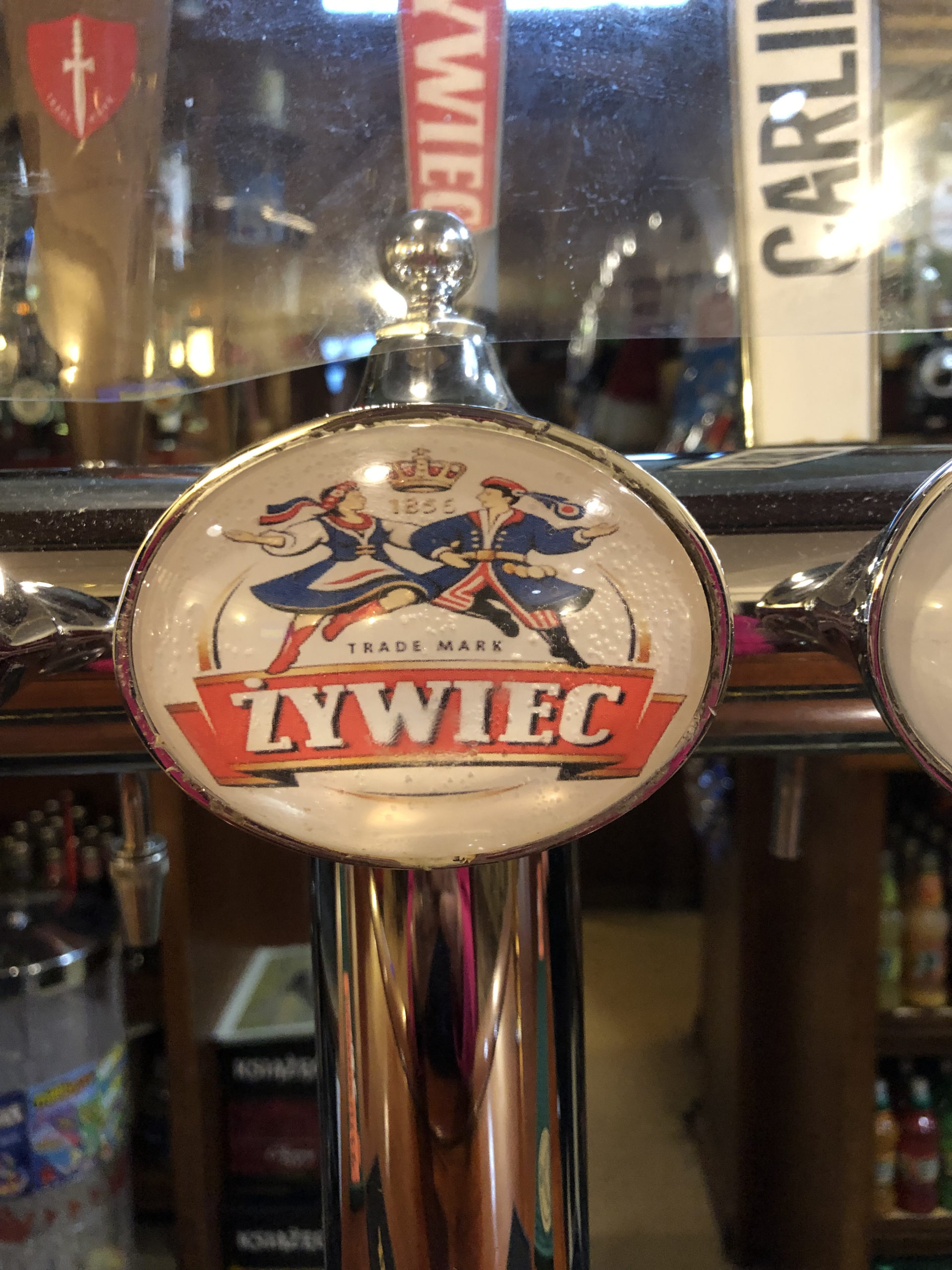
żywiec Polish Pilsner Beer Recent weeks have seen me make two visits toDo Syta (AKA the Bear Restaurant) in the Polish Club in Park South. Thus arises an opportunity for a Swindon in 50 Drinks post! This time we raise a glass to żywiec Polish pilsner beer.
The Żywiec Brewery
According to that font of all knowledge, sometimes, Wikipedia – the Żywiec Brewery (pronounced Zhi-vietz; Polish pronunciation: [ˈʐɨvjɛt͡s]) is one of the largest breweries and beer producers in Poland.
Founded in 1856 in the town of Żywiec, the brewery manufactures pale lager with a 5.6% alcohol volume. Grupa Żywiec S.A. consists of five main breweries: 1. Żywiec Brewery 2. Elbrewery 3. Leżajsk 4. Warka Brewery and 6. Browar Namysłów.
Currently, the Dutch Heineken Group (Heineken International Beheer B.V.), with a 65% shareholding, has control over its major operations. Harbin B.V. has 35% shareholding. The brewery has the capacity of producing 5 million hls a year, making it the largest brewery in Grupa Żywiec.
About the brewery
The brewery began life in 1856 in the eponymous town – then part of Austrian Poland. The Habsburg Imperial family owned it until the post-WWII Communist government of Poland confiscated it. The beginning of the 1990s saw a court case started by the descendants of the original owners. It seems they sued the Polish government for compensation to the tune of 77 million dollars and rights to use the Habsburg family name and coat of arms for marketing purposes. There followed an out-of-court settlement on undisclosed terms in December 2005.
The Żywiec Brewery began distribution to other towns of the Austro-Hungarian Empire in 1913. In the 1990s, Heineken acquired and modernized Żywiec.
Tasting notes
According to Beer Advocate, Zywiec carries a bright, pale gold, transparent countenance. The beer smells of dry grasses, green apples and corn syrup – on this I wouldn’t know as I have no sense of smell. Now, I DO smell but that’s another thing altogether!
Anyway, Beer Advocate describes the taste thus: Sweet, and malty with green apple tartness and grassy flavours dominating it. As to its feel: light and dry, with a round softness that plays at the front and sides of the tongue.
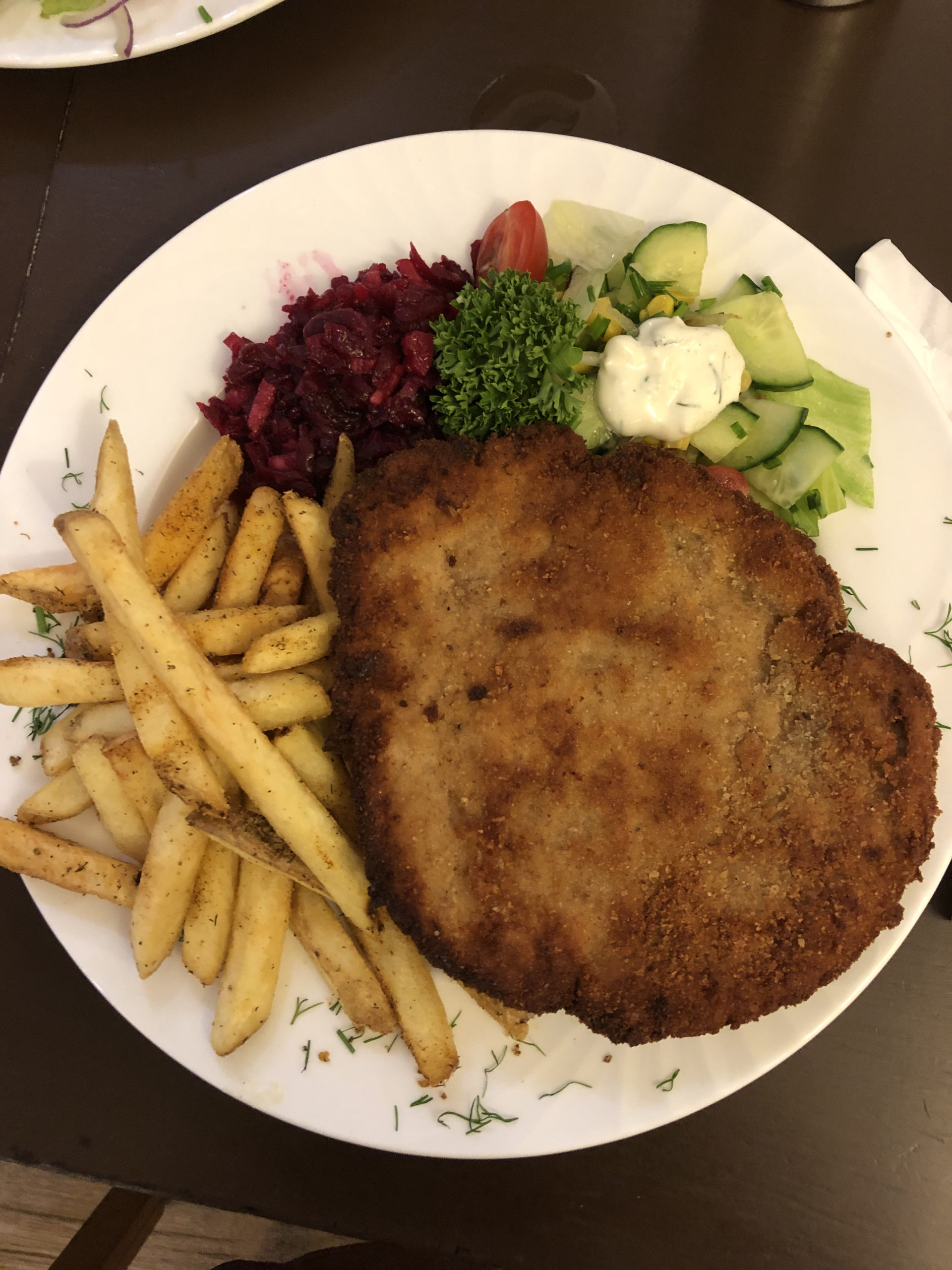
So there you have it – a pleasant pilsner with which to wash down the schniztel or the perogi in Do Syta.
Okay, so a few words about the charming Do Syta, otherwise known as the Bear Restuarant in the Polish Club.
I’ve enjoyed two lovely occasions in this delightful little place, with fellowHobnob Press author, David Bradshaw. As you can see in the images below we did book swaps.
David Bradshaw and Angela Atkinson with respective copies of Growing up Barefoot and Swindon in 50 Buildings
Swimming without mangoes
From the Hobnob Press website:
Second volume of memoirs by a Montserrat-born author who grew up in Swindon during the 1960s and 1970s, and went on to become a successful lawyer and law lecturer. This volume describes his arrival at the age of 8 in the Wiltshire railways town, how he survived (‘swam for his life’) in unfamiliar surroundings, and how he flourished in his studies, sports and friendships at St Joseph’s School in Swindon.
A bit about the food
It’s good and the portions are huge. The pierogi are super scrummy, the chips are delicious and the schnitzel is not half bad. I’ve not yet tried the soups but they look fabulous too so must get round to that!
Swindon’s new new town-centre community hub has launched a kick-off crowd-funder appeal.
The Hub, aiming to provide a welcoming and affordable town-centre venue for classes, meetings, exhibitions and concerts, is asking Swindon residents to chip in. Whatever they can manage makes a difference.
The crowdfunding appeal has a target of three thousand pounds. The funds will cover: 1. Start-up costs including insurance 2. Servicing the customer lift and well as vital updates to fire, safety and security systems.
Volunteers at the Hub have produced a video as part of their crowdfunding page. As a sign of how long it’s taken to get to this stage, the volunteers in the video below mostly appear wearing winter clothes.
Natalie North, one of the volunteers behind the project, said “We have arrived at an exciting point. Now we’ve signed the lease we’re ready to turn this empty building into an amazing Hub in Swindon’s town centre’
Calling Swindon residents and businesses
‘We’re calling out to all Swindon residents to support this charitable project. We’re all volunteers and it’s all not for profit’, Natalie added.
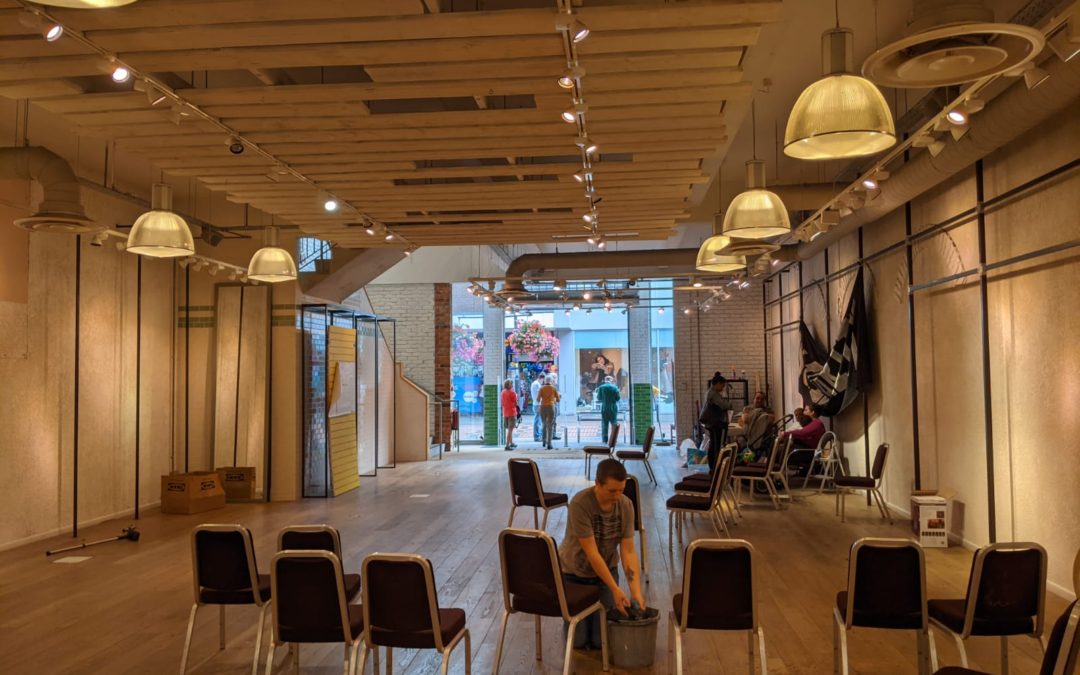
The Hub opened its doors for the first time last Saturday, offering a sneak preview and a chance to get involved. Volunteers welcomed shoppers and passers-by inside the former River Island store. They aim to make the new Swindon Hub a vibrant venue in the heart of Swindon.
Some of the over 100 visitors to the Hub picked up a cloth or a broom, lending a hand to the big job of cleaning and dusting. Almost two years since the last tenants moved out, plenty of dust had accumulated.
‘It was a big job’ said Mark Page, one of the Hub volunteers. “But it’s going to be well worth it when all the events and activities start happening’, he added.
The gang encourged everyone who visited to pick up a felt pen and put their ideas down on the Dream Board. In other words a huge sheet of paper where people could suggest what they would like to do or see in the new community centre.
‘We’ve had so many great ideas” says Jol Rose, one of the organisers on the day. “Our next step is to start making those dreams real. The Crowd-funder is key to getting the place ready’ Jol said.