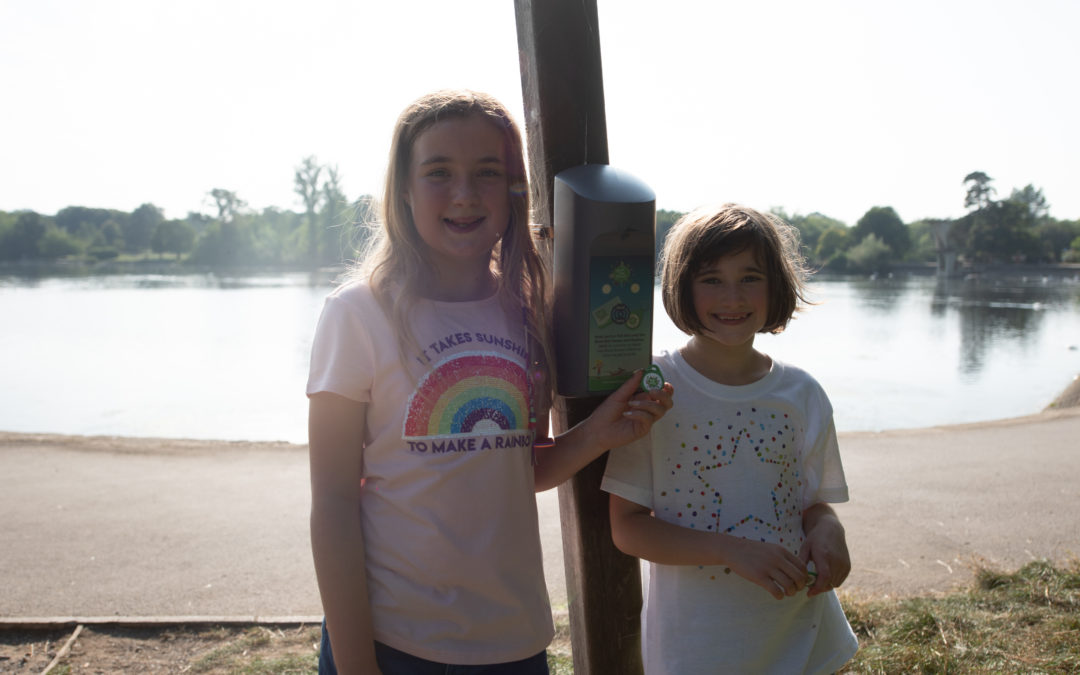
The Beat the Street Swindon game is set to enter its Go Explore week. The point here is to encourage participants to find the area’s best heritage and cultural gems.
So far, 23,700 participants have signed up and have together walked, cycled, run, scooted and wheeled 76,000 miles across Swindon.
Teams are in with a chance of winning vouchers for books or sports equipment. All they have do is walk, cycle or roll as far as possible between the beat boxes and hover their fobs or cards over the beat boxes to score points.
The further players travel, the more points they score for their community or school team. The first Beat Box you hover your card over marks the start of your journey. Walk, cycle or roll to the next one and you score 10 points. Then keep going!
Beat the Street enters its go explore week
Leaderboards
There are leaderboards for schools, community teams and charity teams Jessie May and The Harbour Project.Each is divided into total and average points to ensure that smaller teams are in with an equal chance of winning.
Currently, Haydonleigh Primary School leads the total points leaderboard and Stratton Team Ministry leads the average points leaderboard. But it’s still all to play for!
This week is Go Explore. Events include a Swindon Town Centre Story Trail on Saturday, 25th September from 11am to 3pm. In that players can locate 10 missing scrolls around the town. And participants can also score double points on Beat Boxes 143 and 144.
Councillor Brian Ford, Swindon Borough Council’s Cabinet Member for Adults and Health said: ‘It’s great to see people embracing the Beat the Street game and clocking up an impressive number of miles. There are bonus points on offer on some Beat Boxes to help you get out and about and to find new routes to school or work, plus other local areas you may not have known about.’
Looking Good Dead at the Wyvern Theatre It’s been a long time listeners. I simply can’t remember when I was last at the theatre. But we’re back! For now at least …
So, my for my first visit to the auditorium since the BC days, I got a good dose of deadly drama in Peter James’ stage play.Oh it felt good to see something three-dimensional again. I mean Netflix is brilliant right – but it IS good to see something live. I was starting to forget.
From the blurb on the official website: ‘The thrilling Roy Grace series from multi-million No.1 best-selling author Peter James returns with the world premiere stage production of Looking Good Dead, starring award-winning actor and EastEnders icon, Adam Woodyatt and star of stage and screen Gaynor Faye (Emmerdale, Coronation Street, The Syndicate) …’
What you can expect
I’m ever impressed with the staging of plays and the clever use of set design. And this one was very nifty. In the image below the action the audience sees behind that domestic blind, is what the characters are viewing on their laptop from their perch on the sofa. Then there’s one other piece of set that slides on and off.
Nice room set I thought – very Ikea!
The stage of Looking good dead at the Wyvern
The action is pacy – there’s ne’er a dull moment – and obvs, as the title of the play suggests, it’s about murder. But not a cosy crime a la Agatha Christie or Father Brown. Far from it. I can’t say too much for fear of spoilers so will say only that it has a rather dark subject matter at its core so be prepared for that.
There’s a few humorous moments here and there but on the whole it’s gripping, edge-of-seat stuff. Oh – and there’s a twist right at the end of course. I didn’t see it coming – but then I never do!
So go and see it. If you don’t you’ll be dead sorry! See link above to book tickets.
The cast
Headlining is Adam Woodyatt of Eastenders fame – whom I barely recognised so much weight has he lost! He is always good value – I’ve seen him twice in panto at the Wyvern. His Captain Hook was glorious! Opposite him is Gaynor Faye – unknown to me I fear but I’m many of you will be familiar with her excellent work.
New Swindon Community Hub An innovative new community hub with café will open soon in Swindon Town Centre. Swindon Hub will provide a welcoming café and community arts space. There’ll also be meeting and event spaces for community groups and small businesses to hire.
The plan is to open the Hub at the start of October. But organisers are opening the doors for a special viewing and Big Clean-up Party this Saturday, 18 September. All are welcome to come along between 10am and 3pm to get inspiration and to share ideas. And help with a spot of cleaning if they can! Donations of cleaning products welcomed.
‘This will be a great chance for Swindon residents to get a sneak preview inside the new Hub’ said Ed Colton, one of the organisers. “We’re planning the Big Clean-up Party so people can meet each other and have some fun. All whilst helping with the important work of getting the building ready’ Ed added.
‘We want the local community to be at the heart of deciding what happens at the Hub. The clean-up event will be a nice chance to get together and start planning’ said Natalie North, another of the volunteers behind the project.
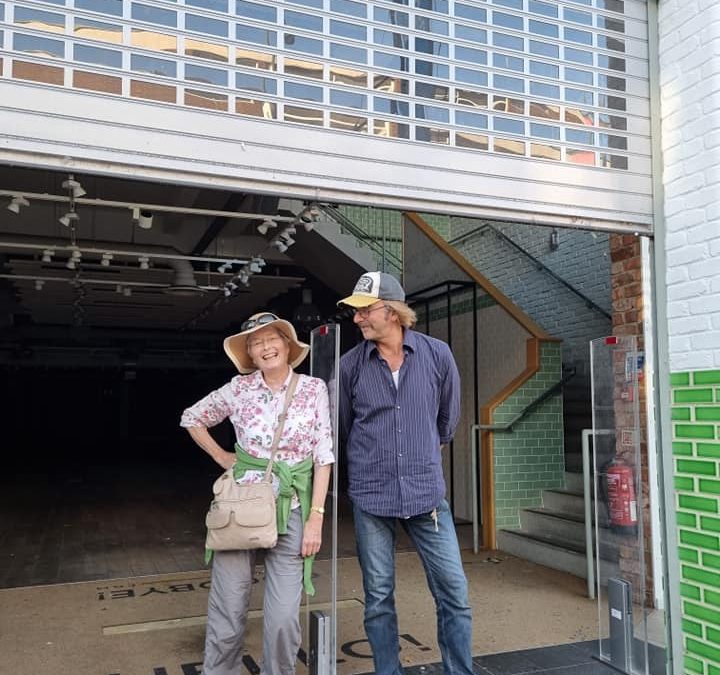
New Swindon Community Hub – Helen Holly and Jol Rose
Location, location, location!
The new cultural hub sits in the heart of the town centre, making use of the empty River Island shop in The Parade. An inclusive social enterprise powered by volunteers, more than twenty of Swindon’s community groups support the Hub. It aims to be a welcoming, accessible, affordable and sustainable place for everyone in Swindon.
Project hopes
The project hopes to support the regeneration of Swindon’s town centre by targeting the problem of empty shops and the need for a community space. One where groups and individuals can interact, exchange ideas, and share resources in a sustainable, low cost venue.
The Hub has a strong environmental ethos. It’ll run in a sustainable and ethical way with involvement from local environmental organisations and upcycled furniture provided by Renew Men’s Shed.
As well as providing a social space where people can meet, eat, learn and create, the Hub provides spaces where small businesses and community and cultural organisations can have a base, run events and share ideas and resources. The arts space will host a busy programme of exhibitions, workshops and events.
‘There is so much energy and potential in Swindon. The Hub will be a place where people can connect and make things happen’ said Jol Rose, another of the volunteers involved. ‘We’re super keen to involve anyone interested in building a positive community in Swindon.’
People can find more information about Swindon Hub on Facebook, Twitter and Instagram (@hubswindon). Or at www.swindonhub.org.uk
Walk your way to supporting two local charities in the Beat the Street Swindon game!
Beat the Street Swindon Supports Charities The mayor’s two chosen charities will be among the winners when the popular walking, cycling and rolling game Beat the Street returns to Swindon from next week.
Organisers have selected Mayor of Swindon Councillor Garry Perkins’s two chosen charities for his year in office:
1. The Jessie May Children’s Hospice at Home 2. The Harbour Project
Participants can join a school, community or workplace team, or can join one of the two charity teams. These will their own designated leaderboard and can win £350 for first place and £150 for second place.
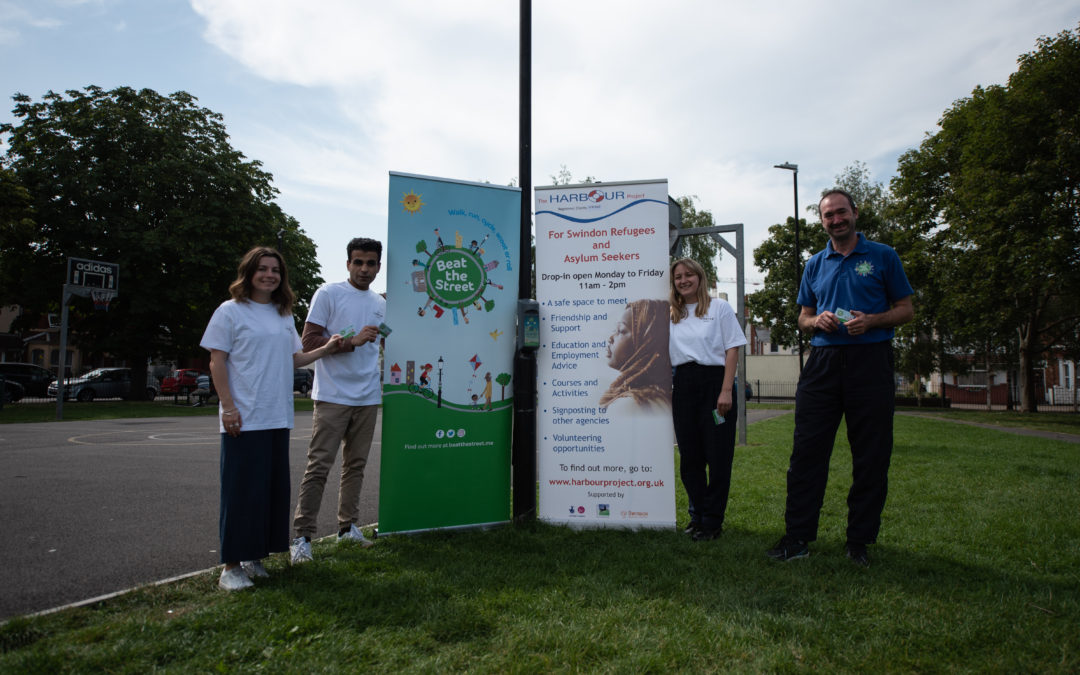
The Harbour Project is one of the selected charities for Beat the Street Swindon 2021. From left, Holly Grey, Faisal Mayed and Mia O’Sullivan from the Harbour Project pictured with Stuart Arthur from Wiltshire and Swindon Sport
Jessie May
Jessie Mayprovides nursing care at home for children and young people with life-limiting conditions, not expected to live beyond the age of 19.
Chris and Philippa Purrington established Jessie May in September 1996 after the death of their daughter, Jessica May. Jessica died from a genetic condition known as severe Spinal Muscular Atrophy when only four months old. Since the founding of Jessie May, the charity has supported more than 300 children and their families.
The Harbour Project
The Harbour Project helps families and individuals who are seeking asylum in Swindon. It helps them to rebuild their lives by providing advice, support, practical help and friendship. Since starting their work in 2000, with a focus on Kosovan refugees, The Harbour Project now works with people from more than 50 countries. It provides daily English classes, weekly women’s and youth groups and a Steps2Work programme.
Beat the Street
Beat the Street Swindon takes place from Wednesday, 15th September to 27th October. The game encourages friends and families to get active together.
More than 200 Beat Boxes are being installed in locations around the area. Players will use them to score points as they travel as far as possible on foot or by bike.
Players will simply need to hover their Beat the Street game cards over a Beat Box to start their journey. They can score points for themselves and their team for each Beat Box they swipe in the next hour.
Primary children get a fob and a map plus a card for their grown up.
Swindon Borough Council in partnership with Wiltshire and Swindon Sport (WASP), and Swindon Healthy School have brought Beat the Street to you. Intelligent Health are the deliverers of the game.
For more information about where to collect your free Beat the Street card and how to play, visit www.beatthestreet.me/swindon
Following another shocking attack on Swindon Hindu Temple last weekend, the Swindon Equality Coalition has released a statement of solidarity and support
Thieves Target Swindon Hindu Temple We’re shocked and saddened to hear thatSwindon Hindu Temple has again been the target of thieves and vandals.
As a network of people and groups from across Swindon, the Swindon Equality Coalition works to build a town of inclusion and diversity. We stand with our friends in the Hindu community and our message is clear. Swindon will not accept this treatment of one of our important communities.
The number of recent break-ins at the Temple is as shocking as the current attack. The Temple, located in Cheney Manor, has suffered attack five times in the last five months.
Since the first incident in May, when thieves stole copper cables that supplied the power to the council-owned property, the Temple has been without mains electricity. That loss left CCTV, fire and intruder alarms as well as heating and emergency lighting out of action.
Thieves came back less than a month later and stole the entire sub-station. Further attacks have seen doors and furniture destroyed and cash stolen. And, last weekend, the holy altar ransacked with religious items either damaged or stolen.
The significant damage caused during the break-ins has made the premises unfit for purpose until urgent repairs reach completion.
Lack of support
Members of the Hindu community are now sleeping overnight at the Temple to provide some basic security. This is an appalling reflection of the support offered by Swindon’s local authorities.
In support of the Swindon Hindu community:
We urge the Council to arrange for the restoration of the full electricity supply without further delay. The police are appealing for witnesses to the crime. Meanwhile we ask that all measures get taken to:
support the Hindu community and …
… to ensure the safety of the Temple and the people who use it.
We invite the police and local authority to offer effective engagement with the Hindu Community. Engagement to find acceptable solutions for both the immediate situation as well as the long-term. An alternative safe and appropriate site is an urgent priority.
Swindon Equality Coalition
Chair of Swindon Equality Coalition, Michelle Howard, added ‘It is so upsetting that the Hindu community suffer this targeting. We are working to make Swindon a beacon of inclusion and diversity. Thus we will not accept this kind of behaviour.’
‘We stand in solidarity with the Hindu community. And we urge our partners in the police, local authority and other agencies to act with urgency to provide confidence and security to the Hindu community’ Michelle added.
The Swindon Equality Coalition promotes and supports equality, diversity, and inclusion throughout the Borough. We will highlight positive change and good practice. And we will question and challenge, to ensure Swindon becomes a beacon for equality of access and opportunity for all.