New single from Swindon songwriter a sign of green shoots in local music scene
New Single from Jol Rose Today sees the release of the new single from Swindon songwriter Jol Rose. ‘Yesterday’s Waltz‘ tells the tale of a relationship that danced through disaster. It’s the the first track to get released from the performer’s forthcoming – and so far untitled – album.
‘I recorded my first album, My Nebraska, at Earthworm Studios, and I know what a great set-up they have there’ Jol says. ‘It’s amazing to have this kind of recording facility on our doorstep. Jon is the consummate professional – both at the mixing desk as well as playing the keys’ he added.
Buckett also played piano on Bangalore Boogie and featured on Jol’s most recent ‘Welcome to Zombieland’ album. Says Jon: times were tough over recent lockdowns, but remote work kept the studio ticking over. And, more recently, musicians are pressing on with recording and releasing new music.
‘It’s been a tough time for local musicians, and that had a knock-on effect on the recording business,” said Buckett. ‘It’s great to see local performers like Jol back to recording and gigging – it’s something we all want to see’.
Yesterday’s Waltz drew inspiration from what Jol describes as ‘a series of sad stories’. ‘It’s not exactly auto-biographical’ he says, “but as a songwriter you learn to dig into your own experiences as well as seeing and imagining what’s happening around you.’
The London-born singer-songwriter fan of ‘rough-edged Americana’ has based himself in Swindon for the last five years, and is a big fan of the local music scene.
It’s been a pleasure to listen to and work with so many local musicians over the past years” says Jol. ‘We’re so lucky to have such a great network of performers, producers and engineers. And of course the great variety of live music venues across the town. You can do anything here’ he added.
The new single as well as his previous two albums are available on Spotify, iTunes and Jol’s website www.jolrose.com
2016 marked one hundred years since we first changed our clocks in this manner. One hundred years of messing about – not only with physical clocks but our body clocks too.
I don’t know about you but I loathe the entire process. Every year, whichever way the clocks are going, I find it takes me ages to adjust. And the older I get the worse it gets.
When did it start and whose bright idea was it?
I long laboured under the belief that all this messing about with the clocks started in WWII to give farmers longer summer days for harvesting. Not quite true it seems. So who’s to blame?
It seems that Benjamin Franklinfirst came up with the idea back in 1784. He proffered the suggestion that if people got up earlier, when it was lighter, it would save on candles. But it was a while before the idea made its way to the UK. **
1. In 1895, George Hudson, an entomologist from New Zealand, came up with the modern concept of daylight saving time. He proposed a two-hour time shift so he’d have more after-work hours of sunshine to go bug hunting in the summer.
2. Then, seven years later, in 1907 the great-great-grandfather of Coldplay’s Chris Martin, one William Willett became one that we can blame/thank for introducing the concept of BST to the nation.
He hit on the idea while out horseback riding and proposed it to England’s Parliament as a way to prevent the nation from wasting daylight. Both Winston Churchill and Sir Arthur Conan Doyle championed Willet’s idea but faced rejection by the British government. Yet Willett fought the good fight for the concept until his 1915 death.
A fresh air fiend and keen golfer, Willett observed that people remained asleep when the sun was up. It became his mission to stop snoozing Britons wasting valuable hours of daylight. Besides which, Mr Willett was no doubt peeved at having his putting curtailed. So there’s a good reason to dislike golf – if there aren’t enough already!
Willet’s pamphlet ‘The Waste of Daylight’ urged the nation to fling back the bed sheets earlier with his motion to change the clocks. He argued it would improve health and happiness and save the country £2.5 million. I’m sure him getting longer on the golf course was nothing to do with anything.
A sundial, on a permanent Daylight Saving Time (DST) setting, is a fitting commemoration to Willett’s efforts. It’s in Petts Wood, near his home in Bromley, Kent.
The British kept talking about it – the Germans got on with it. They seized the day(light) – as it were.
Before long, England and pretty much every other country embroiled in WWI followed suit. And the USA did also. Thus on March 9,1918, Congress enacted its first daylight saving law. The Standard Time Act also defined time zones in the USA.
These were the days when coal power ruled so people really did save energy – and contributed to the war effort – by changing their clocks. Anything able to ease the pressure on the economy and save fuel had to be worth a shot. A bullet free one at that.
World War II
1940, the start of the WWII, saw British clocks staying put at the end of BST. Then, the rest of the war years saw the clocks advanced by one hour in the spring and put back an hour each autumn. This went on until July 1945. This put Britain two hours ahead of GMT and operating on British Double Summer Time (BDST).
BDST happened again in 1947. Severe fuel shortages deemed it necessary to advance the clocks by one hour twice during the spring. And they were put back by one hour on two occasions in the autumn.
But is it necessary now?
On a personal level, I’d love to stop this malarkey. It winds me up! See what I did there? I can’t think it benefits anyone but the electricity companies that we’re having to put lights on at 3pm in the depths of winter. I’m of the opinion it’s the worst of all worlds as we go to work in the dark and come home in the dark.
Back when I were a lass a three-year experiment ran (1968-1971) to keep BST all year round. I remember it well. It didn’t get light until about 9am but the evenings were much longer. The effects were striking. From Brake – the UK road safety charity:
From 1968 to 1971, the UK ran an experiment whereby we stayed on British Summer Time (GMT+1) all year round. The clocks went forward as usual in March 1968 and not put back until October 1971.
Analysis of crash data during this period showed that keeping BST during the winter months resulted in an 11% reduction in casualties in England and Wales during the hours affected by the time change. In Scotland, there was a 17% reduction in casualties. Although casualties in the morning increased slightly, the decrease in casualties in the evening more than outweighed this.
Overall, about 2,500 fewer people were killed or seriously injured during the first two winters of the experiment. The experiment coincided with the introduction of roadside breath tests and the 70mph speed limit. That might also had an impact on the casualty reduction figures.
Despite the reduction in casualties, the House of Commons blocked a continuation of BST past the trial period.
In 1989, researchers analysed casualty data from winter 1969/70, in the middle of the experimental period, and concluded that BST had resulted in 232 fewer deaths and serious injuries and 2,342 fewer overall casualties during that one winter. All that taking into account wider trends and other road safety factors like roadside breath testing.
The study concluded that BST was effective in reducing casualties, particularly among children, pedestrians, and people in central England and southern Scotland.
So why are we still doing it?
Good question. One that it’s possible to answer in one word: Scotland. Alex Salmond referred to campaigns to ditch DST as an attempt to ‘plunge Scotland into morning darkness.’ Might a separate time zone for Scotland be a compromise? SST – Scottish Summer Time anyone? #justsaying
Since all this began, we’ve had double summer time (GMT + 2 hours) during WWII to permanent British Summer Time (GMT + 1 hour) during the late 1960s. The current system of changing the clocks at the end of March and October has been in place since 1972.
Time for a change then?
Something fore the golfing fraternity
Here’s something to thrill the golfing fraternity. In the 1980s, the golf industry suggested that up to $400 million (£246.6 million) in sales and fees could generate in one month of daylight saving.
Despite not being the biggest fan of sport I always wanted to represent it on this blog. Just because a thing doesn’t interest me doesn’t mean it won’t interest someone else eh? For sure, when writing Swindon in 50 Buildings I made sure that I covered the Country Ground. A book telling Swindon’s story via an eclectic range of buildings had to include its football ground. After all the club’s social and sporting historyis an interesting one. And the County Ground Hotel tells a story or two also.
The coming of Clem Morfuni
As I’ve mentioned earlier, I’m not what you’d call a dedicated sport follower. But yet, the fan’s disquiet about the state of things at STFC hadn’t completely passed me by. Nor too the general consensus that the coming of Clem Morfuni represented a positive move for STFC. Reading the aforementioned Swindon Advertiser column one can get a sense of why. Here’s an extract from Clem’s statement:
‘Firstly, I would like to say how excited, relieved and proud I am to be the new owner and chairman of this fantastic Swindon Town football club. I hope that – under my tenure as custodian of this club – the day I leave the club, it’s in a much better place than it is today.
Before I map out my intentions and my plans for the club, I want to tell the fans that you’ve got your club back. A football club should be the heartbeat of the town and the local community. It should be something that the whole town and surrounding communities takes great pride in. Without fans you don’t have a club. And I want to thank every supporter (many of whom I have got to know personally) who has fought for their club and helped me to gain control.
I know I am indebted to you and will work hard to make this club a club all our fans can be proud of. Last season, we came last in the football league in terms of fan engagement. This season I aim to come first.’
He sounds a great guy and I hope this new owner for STFC succeeds in his fan engagement aims and that STFC can shine again both on and off the pitch. Come on you Robins!
See also for some pics of STFC memorabiliaand some personal memories of the club:
A Swindon Radical Visits Venus There’s been rather a lot of hobnobbing happening of late. By which I mean activities involving authors of the Hobnob Press stable. In the first instance, I’ve twice in recent weeks, dined at the Polish Club with David Bradshaw, author of Hobnob Press book Swimming without Mangoes. At those delightful dinners we swapped our respective titles. And there’s more about that in this Swindon in 50 Drinks post about żywiec Polish Pilsner Beer.
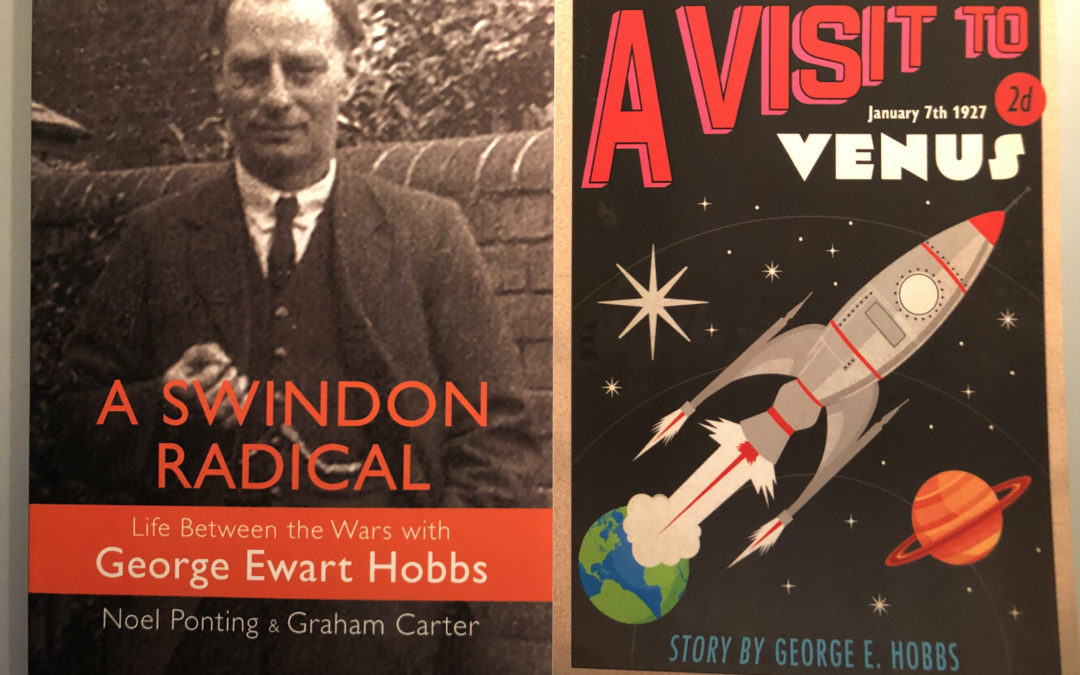
But the focus of this post is not one but two new Hobnob Press publications – both being collaborative efforts from Graham Carter and Noel Ponting.
You can buy both these books from Hobnob Press and the library shop in Swindon central library.
A Visit to Venus – a story by George Ewart Hobbs
I’ve got to admit, I’m very much looking forward to reading this special interplanetary issue of A Visit to Venus. I LOVE the cover – love a retro rocket! It’s all a bit Flash Gordon! Awesome! And on that I now have the Queen Flash Gordon theme in my head!
The Hobnob Press website explains how this book results from the remarkable vision and creativity of Swindon writer, George Ewart Hobbs 1883-1946.
Hobbs worked full-times as a GWR engineer for over half a century. During that time he was a prolific writer across a dazzling range of both fiction and non-fiction subjects.
In the first instance, A Visit to Venus was serialised in the Swindon Advertiser. Although it’s not his only work of fiction, it’s the longest and most ambitious. Further, it’s made all the more remarkable for being written in 1927 when the SciFi genre was a mere babe. The tale features believable characters and raises philosophical and theological questions. In so doing, the book sits alongside other, much later, quality examples of the genre in its purest form. Most notable of those being Star Trek, boldly dealing with what lies at the core of science fiction: the solitude of man. Because this is a story seeking not only what’s out there, but rather what’s inside us.
Edited by Noel Ponting and Graham Carter, published in association with Swindon Heritage. September 2021, 132pp, illustrated paperback, £9.95, ISBN 978-1-914407-22-2.
A Swindon Radical
Back in 2019, before we were consumed by Covid, Graham and Noel published A Swindon Wordsmith. More on that one below:
But now here we are with the never-intended second volume: A Swindon Radical: Life between the Wars with George Ewart Hobbs. Edited by Noel Ponting and Graham Carter.
When Graham and Noel published A Swindon Wordsmith in 2019, they felt satisfied that it achieved their two main aims:
1. To showcase the work of someone forgotten since his 1946 death. 2. `And also to open a fascinating window on Swindon past.
But! The surprise discovery of more of George’s writings made a a second volume unavoidable. This book then samples some of the articles he wrote and published in the 1920s and 1930s – in the main for the Swindon Advertiser.
Like the first one, this new tome covers George’s wide-ranging interests. From religion to philosophy to engineering and more. As George came to terms with a changing world at home and as the world spiralled towards the second declaration of world conflict in his lifetime, it chronicles the views of a radical thinker, always ahead of his time.
Along with a simultaneously published companion book, A Visit to Venus (George’s 1927 science fiction tale), A Swindon Radical completes the story of this fascinating wordsmith and free-thinker.
Published in association with Swindon Heritage. September 2021, 427pp, illustrated paperback, £14.95, ISBN 978-1-914407-21-5.
Mythos Hellenic Beer at the Greek Olive in Swindon Over the years I’ve sunk a fair few bottles of Hellenic Mythos beer on sunny holidays on the Greek island of Samos. Oh and Corfu too.
But if you can’t get to Greece, then the very next best thing has to be a visit to The Greek Olive restaurant on Faringdon Road. I’ll grant you the view from the restaurant of the GWR Park, while pleasant enough, isn’t quite the same as looking at the Aegean or the Mediterranean. But it’s a lovely substitute. The people are lovely and the food is consistently good. I love the mixed mezze platter – gotta love a gigante!
According to Brewery International the Mythos Brewery Ltd originated from Henninger Hellas S.A. They being the local Greek importer of German beer, Henninger, established in 1968.
1992 saw an acquisition of the company and 1994 brought a name change to the Nothern Greece Brewery Ltd. A genuine Greek beer company it’s alleged. 1997 saw the introduction of Mythos. And the millennium saw a name change to Mythos Brewery Ltd – by then the main product. The Carlsberg group brought Mythos into their stable in 2008.
Mythos beer bears a rich head, a bright blonde colour and, apparently, a distinctive fruit aroma with 4.7% ABV. I put that caveat on the aroma as I wouldn’t know, not having a sense of smell.
One of the most popular lagers in Greece, Mythos was an award-winner at the 2001 Interbeer International Beer & Whisky Competition.
So really, all that remains to say is: Yammas! And onto the Ouzo or the Metaxa brandy. It’s Metaxa for me as I’m not that fond of Ouzo. Even so –it features here in Swindon in 50 Drinks: