Does Xmas make you cross? What am I talking about? I’m referring here to Xmas the abbreviation of Christmas rather than the event itself. Though you might also find that irksome too – for any number of reasons.
I’m sure you won’t be at all surprised to know that that the usage of Xmas, like so many other linguistic derivations/abbreviations, goes back a long way. At least 1000 years. I’m pretty sure I’ve read somewhere that the famed ancient Greek philosopher and polymath, Aristotle, once opined on there being nothing new under the sun. And if that was true then – it’s surely true now?
This 2004 BBC article,Why get Cross about Xmas?, takes a look at why this particular four-letter word gets people so hot under the collar.
Many people, and I fell into this camp, believe Xmas to be a relatively modern, lazy shorthand born on the high street. After all, as the article points out, Xmas fits neatly onto shop sale signs and into news headlines. Thus, it’s beloved of journalists and store managers. But that’s a mistaken view and we’ll see why shortly.
At the time that article was written the style guides followed by The Times, The Guardian and the BBC website itself ruled out its use where ever possible.
Champion Christian Credentials
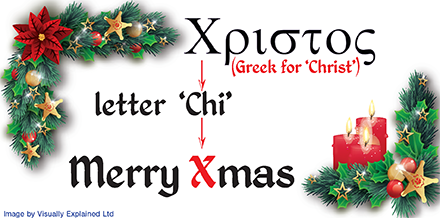
Besides all this, there’s a common belief that ‘xmas’ (pronounced /ˈɛksməs/) is a secular attempt to remove the ‘Christ’ from Christmas. But it’s neither. In fact, as the article points out, far from being an irreligious abbreviation the term appears to have impeccable Christian credentials. And that’s because it’s thought that the ‘X’ represents the Greek letter ‘Chi’ – the first letter of the Greek word for Christ: Christos.
Supporting this view is/was Bill Purdue – an Open University lecturer and author of The Making of the Modern Christmas. Said Bill: ‘I suppose to us it will always look like an abbreviation. But it would first seem to be an abbreviation used by clerics with a good knowledge of ancient languages.’
‘A lot of people disapprove of it or think of it as blasphemous because they think the X stands for anonymity – the ‘Mr X’ sort of idea.’
So – stated earlier that Christmas has been abbreviated for the best part of 1,000 years. Indeed, before Xmas we had XPmas. That’s according to Inge Milfull, assistant editor of etymology at Oxford English Dictionaries (OED). Inge found refences in the Anglo-Saxon Chronicle as far back as 1021. She says it’s probable that the P got dropped later. Further, there may even have been religious reasons for abbreviating Christ as Jehovah was abbreviated in Hebrew.
Whatever – it’s all Greek to me.
A parchment space saver
All the above apart, the term was also a space saver. In a gospel manuscript the word ‘Christ’ would feature a lot. Given that parchment was an expensive commodity anything that saved space on the precious material would be welcome.
But, whatever the ins and outs of the origins of Xmas it was apparently good enough for the poet Samuel Taylor Coleridge who wrote in 1801: ‘On Xmas Day I breakfasted with Davy’. Whoever he was.
A now-retired Diocesan spokesman, Martyn Halsall said that Xmas remained a talking point, among older people in particular and regardless of its Greek meaning. ‘I think that’s a subtlety lost on most of the population,’ he said.
Staying in style
As mentioned earlier, the term has been long unpopular with many editorial style guides. Indeed, on this point, the 1948 Vogue book of etiquette stated that Xmas should never be used in greetings cards. So, if your wish is to be in vogue – then Christmas it must be.
A conversation with friends triggered this seasonal blog post. It transpired that there some people who are confused about just what constitutes the 12 days of Christmas. Though my knowledge ran that far I thought a bit of digging around the period and the eponymous song might be interesting. I learnt a lot.
The 12 days of Christmas
So! Hands up. Who thought that the 12 days of Christmas referred only to a Christmas song? You know – the one about an over-generous lover showering his paramour with a cummulation of grandiose gifts? Me too.
Turns out though there’s an underpinning religious significance – both to the gifts given in the song and to the 12 days of Christmas itself. Which, when you think about it, shouldn’t be surprising at all. Well certainly not in the latter case at any rate.
But before we get to all that let’s first establish what these eponymous days of the festive season are. The Twelve Days of Christmas start with Christmas Day and end with Epiphany on January 6th. They are NOT, as I’ve been hearing recently, the 12 days running up to Christmas Day. Noooooo!
The real dozen days of the festive season
It’s perhaps not surprising that confusion has arisen about what these days comprise. As this article on Christianity Todaypoints out, the Christmas season starts earlier and earlier each year. What with mince pies appearing on the supermarket shelves just after the Crème Eggs. They’ll catch each other up one of these years.
So, by the time December 25th arrives we’re all Xmased out. Christmas is over, the new year kicks off and we all go back to our daily routines.
But the traditional Christian Christmas celebration is quite the opposite. You know the one – it’s the one that, with a bit of Saturnalia mixed in, that’s ostensibly the reason for all the December festive frivolity.
The Advent season starts on the 4th Sunday before Christmas. For almost a month, Christians wait for the coming of Christ in a period of longing. THEN, on December 25th, Christmas Day heralds 12 days of celebrations culminating on 6th January with the feast of Epiphany – known also as Twelfth Night.
The ‘real’ 12 days of Christmas matter then. Well at least to the non-secular. Not simply as a way of rejecting the secular notions of the ‘Christmas season’ but also as a commemoration of the moment that God entered the world in the form of a baby. Something I reckon it does us no harm to remember – even if secular.
Feasting
Integral to the celebration of the birth of Christ, and the 12 days of Christmas, is a whole lot of feasting.
As Christianity Today explains, 3 different feasts, dating back to the late 5th century, follow Christmas and reflect the different ways the incarnation mystery took place.
1. The Feast of Stephen – on December 26th. By tradition a day for giving leftovers to the poor – as in the Carol, Good King Wenceslas. Stephen was an early deacon and a forerunner of all who show their love of Christ by kindness to the needy. Stephen was also a martyr – the first of the New Covenant.
2. Next up, on December 27th, is the feast of St. John the Evangelist.
3. On December 28th comes the feast of the Holy Innocents – the children murdered by Herod.
4. Finally, comes Epiphany, (January 6th) and the Christmas celebration comes to an end.
I’m just relieved not to have to do all that feasting. Otherwise the spare tyre would be swiftly pluralised! Not to mention all the washing up. *Shudders*
Now back to the song
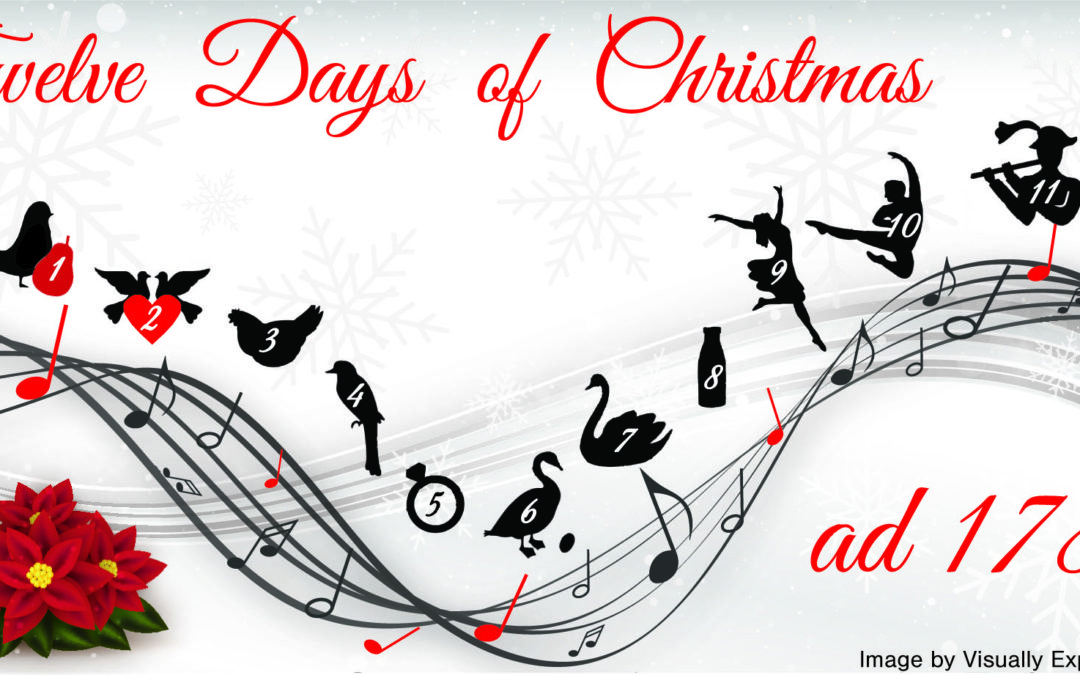
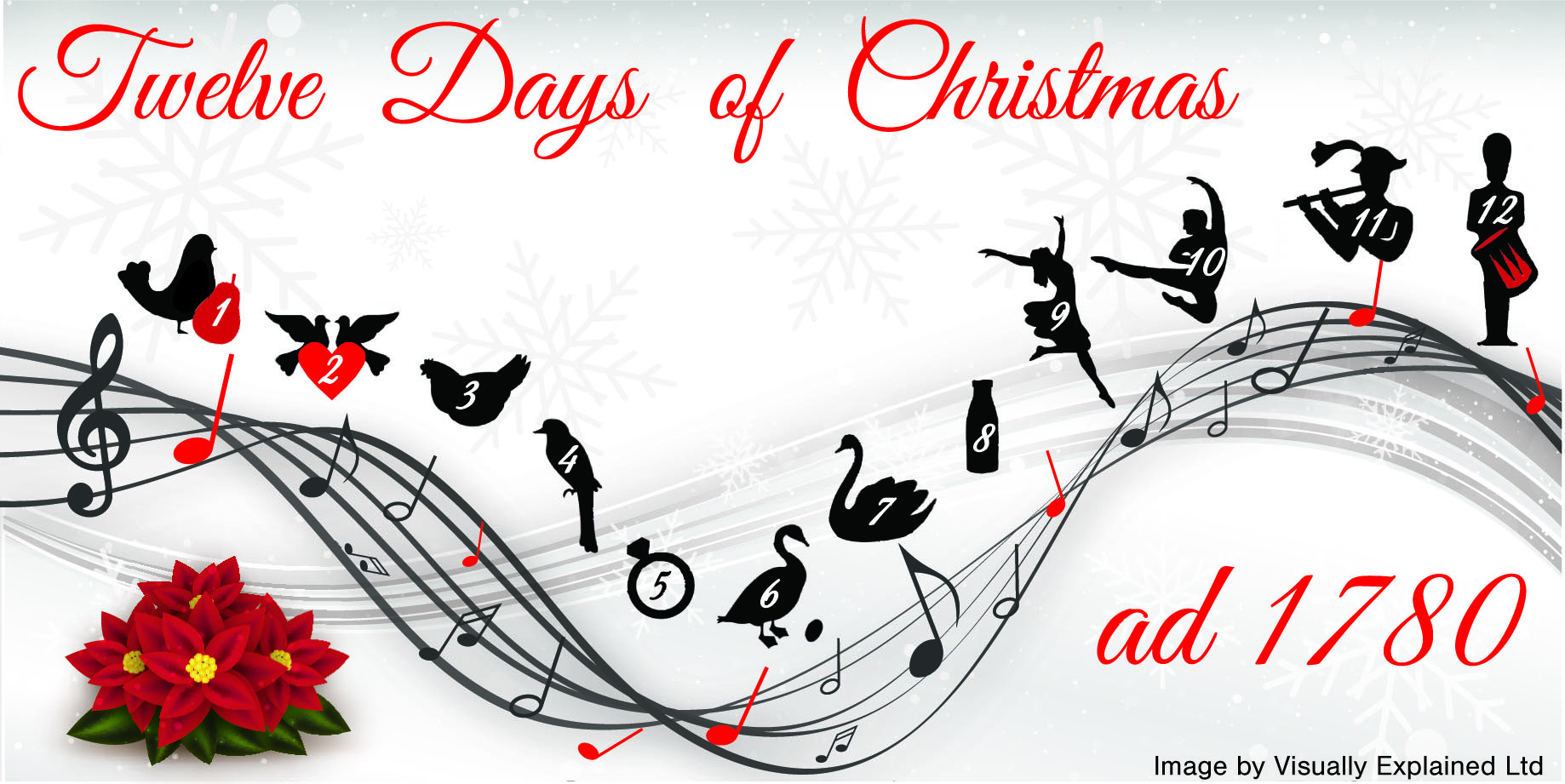
Wikipedia describes it as: ‘an English Christmas carol that enumerates in the manner of a cumulative song a series of increasingly grand gifts given on each of the twelve days of Christmas (the twelve days after Christmas). The song, published in England in 1780 without music as a chant or rhyme, is thought to be French in origin.’
According to 12days.com the specific origins of the song aren’t known. It possibly began as a Twelfth Night “memory-and-forfeits” game in which the leader recited a verse, each of the players repeated the verse, the leader added another verse, and so on until one of the players made a mistake, with the player who erred having to pay a penalty, such as offering up a kiss or a sweet.’
This article goes on to suggest that there’s a likelihood of ‘The Twelve Days of Christmas’ being either confused or transformed from a song called ‘A New Dial’ (known also as ‘In Those Twelve Days’). Dating back to at least 1625 that song assigns religious meanings to each of the twelve days of Christmas.
There are various versions of these attributions. This is just one:
1. True Love refers to God 2. Turtle Doves refers to the Old and New Testaments 3. French Hens refers to Faith, Hope and Charity, the Theological Virtues 4. Calling (more traditionally ‘Colly’) Birds refers to the Four Gospels and/or the Four Evangelists 5. Golden Rings refers to the first Five Books of the Old Testament, the “Pentateuch”, which gives the history of man’s fall from grace. 6. Geese A-laying refers to the six days of creation. 7. Swans A-swimming refers to the seven gifts of the Holy Spirit, the seven sacraments. 8. Maids A-milking refers to the eight beatitudes. 9. Ladies Dancing refers to the nine Fruits of the Holy Spirit. 10. Lords A-leaping refers to the ten commandments 11. Pipers Piping refers to the eleven faithful apostles 12. Drummers Drumming refers to the twelve points of doctrine in the Apostle’s Creed.
So there we have it. An exposé of the meaning behind a jolly Christmas carol.
Advent, the period of preparation for Christmas and the celebration of the birth of Jesus, begins on the Sunday nearest to 30th November.
We know that the Advent period focuses on expectation and imagine it to serve as an anticipation of Christ’s birth in the period running up to Christmas. And indeed this is so – but there’s more to it than that. Isn’t there always? As this article about Advent on Christianity.comexplains:
The History of Advent
The word Advent comes from the Latin adventus meaning coming. This is turn is a translation of the Greek word ‘parousia’. Scholars believe that, during the 4th and 5th centuries, in Spain and Gaul, Advent was a season of preparation. Preparations for the baptism of new Christians during the January feast of Epiphany – ‘the celebration of God’s incarnation represented by the visit of the Magi to the baby Jesus his baptism in the Jordan River by John the Baptist and his first miracle at Cana.
During this time Christians experienced a penitential season similar to Lent in order to prepare for this celebration. There wasn’t originally any connection between Advent and Christmas. his had changed by the 6th century when Roman Christians associated Advent with the coming of Christ – but not his first ‘coming’ in the manger in Bethlehem but his second coming as the judge of the world. It took until the Middle Ages for the Advent season to form an explicit link to Christ’s first coming at Christmas.
And today
Advent as we know it now comprises the four Sundays leading up to Christmas. That’s when the new Christian year begins with the twelve-day Christmas celebration that runs from Christmas Eve to Epiphany on January 6th.
Nor it does it include any requirement to fast. It’s more a case of the opposite really – what with office parties and Christmas lunches and general over-indulgence.
Symbols
The typical colours of Christmas are red, green, white, silver and gold. Yet it might surprise you to know that Advent features purple or dark blue and pink as well as a white central candle.
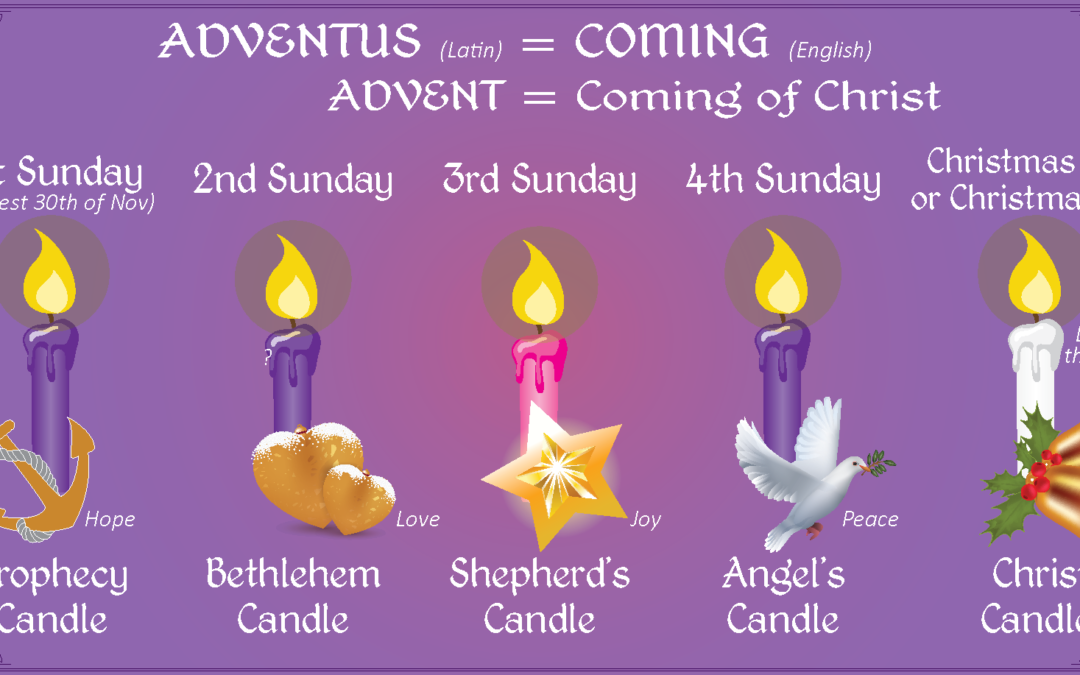
The first Sunday of the season sees the lighting of the first purple candle. In remembrance of the prophets who foretold the birth of Christ, this candle often is called the Prophecy Candle. This candle represents hope or expectation in anticipation of the coming Messiah. Then each subsequent Sunday, sees an additional candle lit.
The second Advent Sunday is the day for lighting the second purple candle – typically representing love. Some traditions call this the ‘Bethlehem Candle,’ symbolizing Christ’smanger.
On the third Sunday the pink candle, often referred to as the Sheperd’s Candle, is lit. The fourth and last purple candle, often called the ‘Angel’s Candle‘ represents peace and that’s lit on the fourth Sunday of Advent.
Christams Eve or Christmas Day is the time for lighting the white centre candle. Called the Christ Candle this one represents the life of Christ coming into the world.
And here’s one we made earlier
Those of us of a certain age here in the UK will have fond memories of the annual Advent crown they made on Blue Peter out of wire coat hangers covered in tinsel. I suspect the health and safety brigade long ago put a stop to that activity.
Wishing peace to all in this Advent season – whatever your beliefs.
Save Oasis Swindon Campaign Steering Group Media Statement on the Grade Two Listing of Oasis Dome and Pool
SOS view on Oasis Listing While the SOS campaign didn’t apply to have the Oasis listed, it has both supported and fought for its listing. Ergo, the campaign welcomes the 1 December 2021 decision to Grade II list the Oasis Dome and lagoon pool.
For the record, there were several months of virtual radio silence from both SBC and Seven Capital immediately after the Oasis closure. Communication by these key stakeholders improved in recent months, resulting in some actions. Yet, there remains on the table, several unresolved issues which we are keen to explore further.
We would draw stakeholders’, including members of the public, attention to the offer of support by Historic England to work through managing the listing requirements. We’re sure that this will include clarifying appropriate grant and funding sources earmarked for listed buildings.
SOS’ hopes
SOS hopes that, after the waves have calmed of what may be ill-informed knee-jerk, negative reactions from several quarters, that a positive way forward will emerge for generations of Swindonians to come. A way forward that will allow us all to enjoy a quality, reopened, accessible, affordable, domed Oasis leisure centre.
It occurs that Seven Capital might now resubmit a refreshed planning application with the dome included. In a key development this week, SOS has heard from Seven Capital thatt they’re researching whether there is after all a way to make the Oasis viable with a refurbished dome. Of course the campaign feels this is the right thing to do.
We look forward to working alongside SBC and Seven Capital. Thus we hope for an early initial meeting to share opportunities and challenges resulting from this Listing decision.
Our campaign is far from over. The focus is not only on restoring and reopening the Oasis, but campaigning to preserve the number of facilities a reopened Oasis will offer. People from across the UK are watching the Oasis developments closely. So the pressure is on SBC to formulate a restoration plan with Seven Capital.
SOS Steering Group
Contact:
saveoasisswindon@gmail.com or steering group members Neil Robinson on 07900073175 or Tony Hillier on 07404526340
WASSAILER VISITS WILTSHIRE TO SHARE THE HISTORY OF WASSAILING
Wassailer Sharing Wassailing History Ace, wassailer Robin Burton will entertain guests in Malmesbury this month by sharing the history of a practice commonplace in the South West until the early 20th century.
Robin, who lives in Stroud and is chair of the Stroud wassail Group, will run a Wiltshire session about the wassailing and its relationship with Christmas on Wednesday December 15. He’ll illustrate the talk, which will last for between 40-50 minutes, with pictures and song.
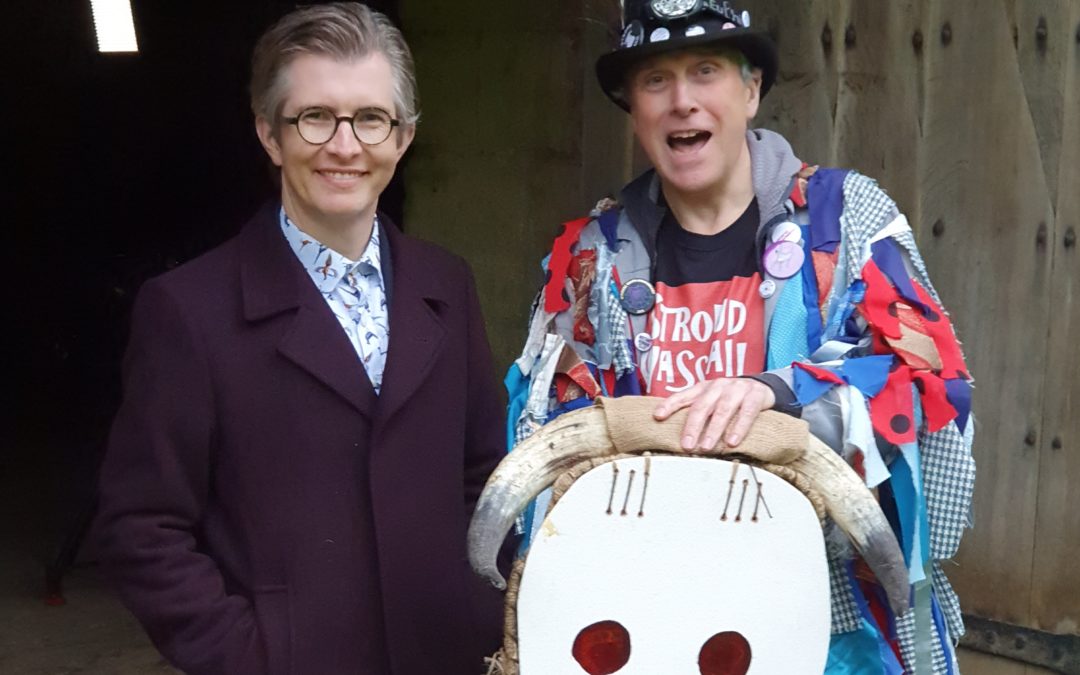
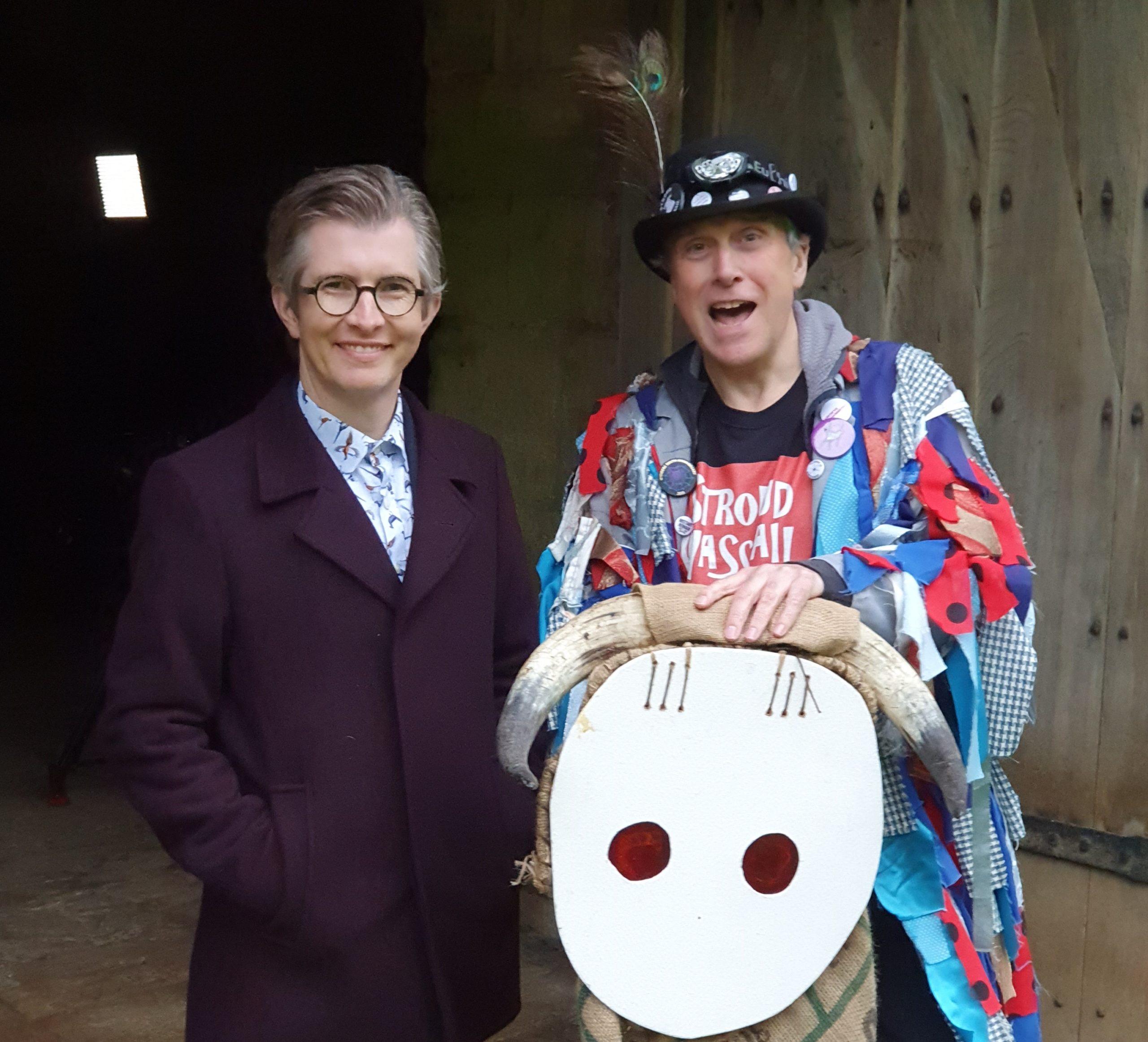
Robin, and Gareth Malone
The Stroud Wassail Group
The Stroud wassail group began as a modest gathering of around a dozen people in 2014. It’s now grown and has attracted several hundred participants. They include Morris dancers and mummers, dance groups, actors and singing groups. They all perform in fourteen different locations around Gloucestershire and beyond.
Robin said: ‘The most common wassailing, which was widespread in Gloucestershire, dates back to pagan times and was the ‘apple orchard wassail’. In that, followers sing to the oldest apple tree in the orchard. They then bless the trees, make sacrifices to the gods and pour mulled cider round the base of the tree to ensure a good harvest.’
But Robin will explain during his talk how most wassails feature door-to-door entertainers. They play music, sing and wish everyone good health and good fortune around the time of the New Year. This in exchange for food and drink or sometimes some money.
The word ‘wassail’ came from the Anglo Saxon greeting ‘Waes Heal’ meaning ‘be whole’ or ‘be healthy’.
The Stroud wassailers keep the tradition alive from early December through to the second week of January. During this period they visit pubs, hotels, private parties and other venues throughout the area.
They perform various songs and present Mummers’ plays. Then, on the second Saturday of the New Year – by tradition Wassail Day – the Wassail itself takes place in Stroud.
One claim to fame came when the production company of the BBC series Britain’s Christmas Story, contacted Robin. They invited him to take part in the series with Gareth Malone OBE, choirmaster, presenter and broadcaster. The series followed the history of Christmas revealing some of the legends behind the festive season’s traditions. And, with the use of music, explored what Britain has sung at this time of year across the centuries.
About Robin’s talk
Robin’s talk for the Athelstan Museum will be live on Wednesday December 15 at 7pm in the Rausing Building – the old Moravian Church). The address is: Oxford Street, Malmesbury SN16 9AX subject to Covid regulations.
The Athelstan Museum runs with volunteer help. It’s recently acquired its own Turner of Malmesbury Abbey. You can view it free of charge during its opening hours.