“We’ve always said we’ll support the conversion of the first floor of the Civic Offices to a museum and art gallery. But on the proviso it’s funded as it should be to provide appropriate gallery and exhibition space. The collections, which we Swindon residents own, include art of international significance and objects and artefacts. And all need appropriate conditions and engaging interpretation and displays.
SBC still have no budget allocated beyond making the space available. Ergo their plans amount to no more than accessible storage.
March 2019
“In March 2019 officers presented Cabinet with five options for SMAG. And the most expensive one at £1,864,000 was the conversion of PART of the first floor of the Civic Offices. Cabinet rejected that option.
But this new paper estimates that it will now, as if by magic, cost £150,000 to convert THE ENTIRE first floor to a museum/gallery space. And further, an extra £250,000 to improve the lift so it’s suitable for carrying people, rather than goods. So the cost of converting a larger space has fallen by £1,464,000 in the past two and a half years.
Yet there is no explanation of how that could be possible or how SBC have arrvied at this new “estimate”.
‘The option that Cabinet actually accepted in 2019 was to do some work on Apsley House – including ensuring a working lift. Those costs were estimated to be £400,000. This paper’s current estimate for necessary reparations etc is now £450,000. So while the costs of converting the Civic Offices have plummeted, the cost of converting Apsley House has increased by a leap.
The only conclusion we can draw is that SBC are plucking numbers from the air to suit a particular line of argument. Rather than reaching an evidence-based decision.
“Finally, something else doesn’t add up financially. This report says they can’t allow Swindon South Parish Council to run Apsley House until the building of the new cultural quarter. The reason given being, that Swindon Borough Council needs to sell Apsley House pronto to put the funds towards the cultural quarter.
In fact, the parish council has proposed leasing Apsley House from SBC and returning it when they’re in a position to commission construction of the new museum/gallery.
“So to sell Apsley House in the near future, when the Cultural Quarter is years or decades away – and remember, there is no funding in place for this aspirational project yet – seems indefensible.
Property values tend to rise far faster than cash in the bank over the longer term. So it’s almost inevitable that the real value of the sale will fall, the sooner SBC disposes of it.
£5000 donation made to Athelstan Museum thanks to famous codebreaker Alan Turing
Malmesbury Museum Gets Codebreaking Donation The family behind a well-known Wiltshire company has donated £5,000 to the Athelstan Museum in Malmesbury. The donation came after they auctioned a rare private letter from codebreaker Alan Turing to the founder of the Linolite brand.
In 2019, Athelstan Museum Council commissioned volunteer Bill Reed to collect interviews from past employees for the Museum’s ‘Malmesbury Voices‘ collection. This resulted in around fifty recordings. From these recordings, Mr Reed compiled a book, ‘Linolite – The Inside Story’.
In the book’s foreword, Peter Beuttell, Alfred’s grandson, wrote: ‘This book reminds me why I’ve felt, for several decades, that my family owed the people of Malmesbury a great debt of gratitude.’ That gratitude now takes a tangible form in a donation to the museum.
Peter said that the donation was partly ‘in recognition of the work by Bill, Barry Dent and Sarah Pettigrew on Linolite The Inside Story.’
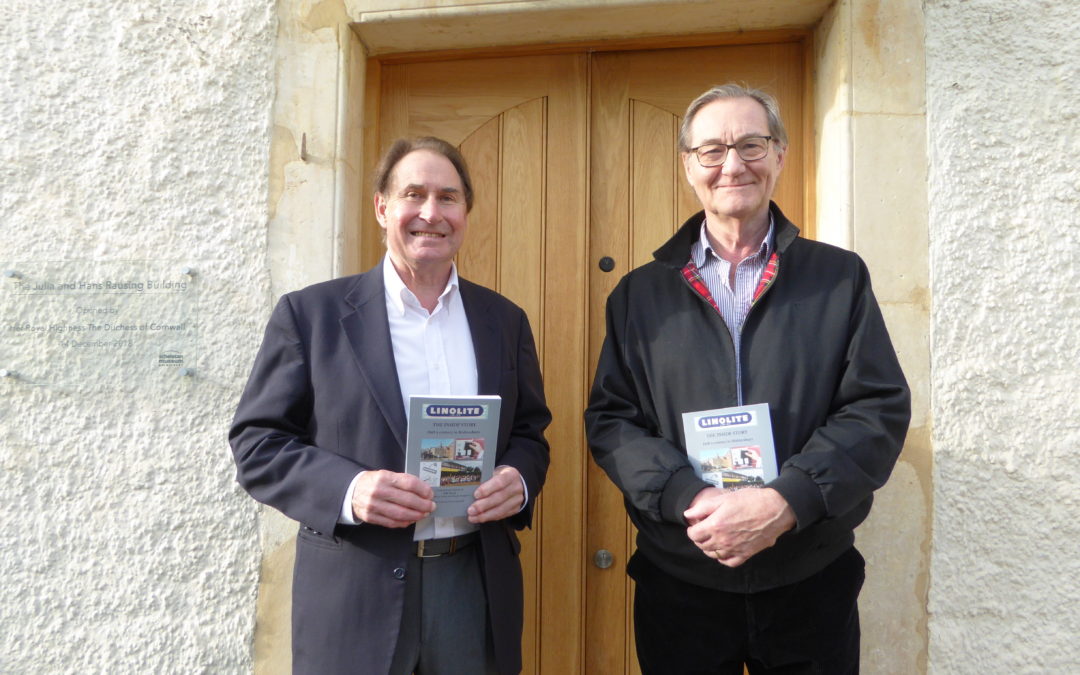
The image shows writer and Athelstan Museum Volunteer Bill Reed with Peter Beuttell who recently donated £5,000 to the museum after his family auctioned a private letter by code breaker Alan Turning to his grandfather Alfred William Beuttell, the founder of Linolite.
Linolite
Linolite was a well known Wiltshire employer for over forty years. The company first came to Wiltshire in 1941 when the Ministry of Aircraft Production asked the the founder, Alfred, to leave their London Pimlico site for somewhere safer. They were one of the few producers of an important part of the electrical wiring in wartime bombers.
Inventor Alfred (1880 – 1965) became quite wealthy at a young age after selling the patent to his invention, the carbon filament strip lamp, the first of its kind – to Edison and Swan. An example, lent by Peter, is currently on display in the museum.
Alfred’s son Victor went to school in Sherborne with Alan Turing. Due to shared personal tragedies, he became a friend of the family. He often stayed at their home, especially during school holidays.
Around 1910, Alfred spent several months in Monte Carlo, where he developed a ‘complicated and successful gambling system’. Alfred spent a further month there, living on the profits.
Much later he discussed this system with Alan Turing, by then an undergraduate at King’s College, Cambridge, during a visit to the family home in Norbury in South London. Turing afterwards wrote an assessment, saying the system wasn’t sustainable long term. Further he inferred the chance that the winnings were more luck than judgment. Turing’s handwritten reply remained in the family for many years before going to auction at Bonham’s earlier this year.
The Wiltshire company employed at one point over 150 people. First at the Mill Works site in Burnivale. And then, from 1985, in a purpose-built factory on Tetbury Hill, which now forms part of the Dyson complex.
The Museum
Sharon Nolan, chairman of the Athelstan Museum Council, said: ‘We’re so grateful to Peter and his family for this generous donation. We don’t charge an entrance fee and rely on donations, subscriptions and grants.
‘We’d also like to thank Bill for his hard work as a volunteer to make the people of Malmesbury, and their voices, part of our living history.’
The Athelstan Museum showcases the history of the ancient town. Recently it’s become home to the ‘Wiltshire ‘Turner’ of Malmesbury Abbey. The museum acquired that painting with funding from the National Lottery Heritage Fund and the Arts Council.
Two books support the Linolite collection at the museum. They are:
1. Linolite – The Inside Story by Bill Reed – available from the museum shop for £10.00 and 2. The Man Who Made Linolite – a biography of AW Beuttell by Kenneth Hudson.
Copies signed by Peter Beuttell are also available from the museum shop for £10. To find out more visit https://www.athelstanmuseum.org.uk
Revolution Performing Arts receives £25,000 from third round of the Government’s Culture Recovery Fund
Culture Fund Award to RPA Swindon’s RPA, is one of 925 organisations receiving a share of more than £100 million awarded to cultural organisations across the country.
The support comes from the third round of funding announced by the culture secretary Nadine Dorries on Friday November 19.
Fi Da Silva Adams, said: “We’re thrilled and humbled to get this funding. Getting this money allows us to continue supporting young people who’ve had such a terrible time in the last couple of years.
‘The performing arts is a vital part of our society and culture. And for our young people it allows them to express themselves through drama, singing and dance in a safe and happy environment.
Fiona Da Silva-Adams owner of Revolution Performing Arts based in Swindon, Wiltshire. Image taken by Barbara Leatham Photography
Arts for all
Nadine Dorries said: ‘Culture is for everyone and should be accessible to everyone, no matter who they are and where they’re from.
‘Through unprecedented government financial support, the culture recovery fund is supporting arts and cultural organisations. With this support they can continue bringing culture to communities up and down the country. In so doing, such organisations support jobs, boost local economies and inspire people.’
The fund has already awarded over £1.2 billion to date, supporting around 5,000 individual organisations and sites across the country. They range from local museums to West End theatres and everything inbetweeen. Not forgetting organisations in the cultural and heritage supply chains.
Darren Henley, CE of Arts Council England, said: ‘This continued government investment means our cultural spaces can carry on playing their part in bringing visitors back to our high streets. And thus they help to drive economic growth, boosting community pride and promoting good health.
‘It’s a massive vote of confidence in the role our cultural organisations play in helping us all to lead happier lives.’
Revolution Performing Arts came into being in 2007. All the teachers are DBS checked, trained in first aid and safeguarding protocols.
RPA specialises in empowering young people to celebrate their individuality through the power of performing arts.
Richard Jefferies Wild Life So, last weekend saw me in the delightful company of many familiar faces for the launch of this book, by Mike Pringle, at the Christ Church community centre:
And the back cover:
Back cover of Richard Jefferies wildlife by Mike Pringle
Richard Jefferies entered this world at the farmhouse at Coate on on the 6th November 1848 – 173 years ago. So a fitting day to choose to launch a book about him wouldn’t you say?
With a cover quote by Matthew Oates, ecologist, broadcaster and former National Trust nature specialist and a foreword by Monty Don the book comes with excellent credentials. And that’s not even mentioning the undeniable talents of its author, Mike Pringle!
It isn’t cheap at £20 it’s true. But it’s a VERY beautiful book carrying some fabulous photographs by Elmar Rubio – a fabulous photographer. It will make a superb Christmas gift for anyone interested in nature and the natural world. Even better all the profits are going tothe Richard Jefferies Museum – a place of great wonder and delight.
Richard Jefferies
About the book – from the museum website
Driven by our desire to spread the word about Richard Jefferies, and the natural world he loved, we have produced this fully-illustrated, book, Wild Life, for which TV gardener, Monty Don, has very kindly written a foreword.
We’ve produced the book to the highest possible standard. Thus it’s a hardback format. It has 240 pages on 170gsm paper. It’s full colour throughout, has a dust cover, stitch-binding, marker ribbon, and large size of 216mm x 216mm.
Price: we asking for a minimum price of £20 per copy, with all proceeds going towards the new building we are hoping to construct. But, because we’ve produced the book to such a high specification, this price doesn’t leave us much for our building. So if you can afford to give more, we would be very grateful indeed. Thank you.
Good question from that listener! Well, apart from the interest Jefferies held in all things nature – he coined the term ‘wild life’. It didn’t become a compound word until much later. Thus, the book’s title, Wild Life, was inspired by Jefferies’ 1879 book, Wild Life in a Southern County, all about his beloved home county Wiltshire. It’s cited as the earliest example in the Oxford English Dictionary of the phrase wild life used in a nature context.
Simon Webb, Angela A, Rod Hebden, Aurelie S, Suzie Simmons & Carole BentRod Hebden and Mike PringleRoyston Cartwright & Mike PringlePhotos by Carole Bent – well aside from the one that has Carole in it! Royston?
Oasis Refurb Plans Almost Welcome Before I go any further let me stress that what follows is NOT an official Save Oasis Swindon campaign response to SevenCapital’s (7C) recent press release.
It’s notable that this 7C planning application leaves out more than it keeps in. These plans comprise a significant reduction in the Oasis’ leisure footprint and its satellite outdoor facilities e.g. cycle race track, skateboard park and four football cages. All set in extensive grass parkland. Then there is the loss of the Oasis dry-side. That sounds a death knell to the large, multi-use sports hall and the international music venue.
We all know, and I’m sure SOS understands this too, that the 70s and 80s were arguably the high point of local authorities providing exemplary and extensive leisure facilities. But, I ask you to consider:
Is this the best that Swindon can expect?’ It’s certainly not the best it deserves.
Swindon Borough Council have a golden opportunity here to do something special for Swindon. As opposed to a reduced facility to free up more land for houses.
The word in the ether is …
It’s clear from the masses of Adver and social media responses from the local and national public, that there remains a gargantuan drive for a reopened Oasis. And further that many, many questions remain unanswered in the Oasis story.
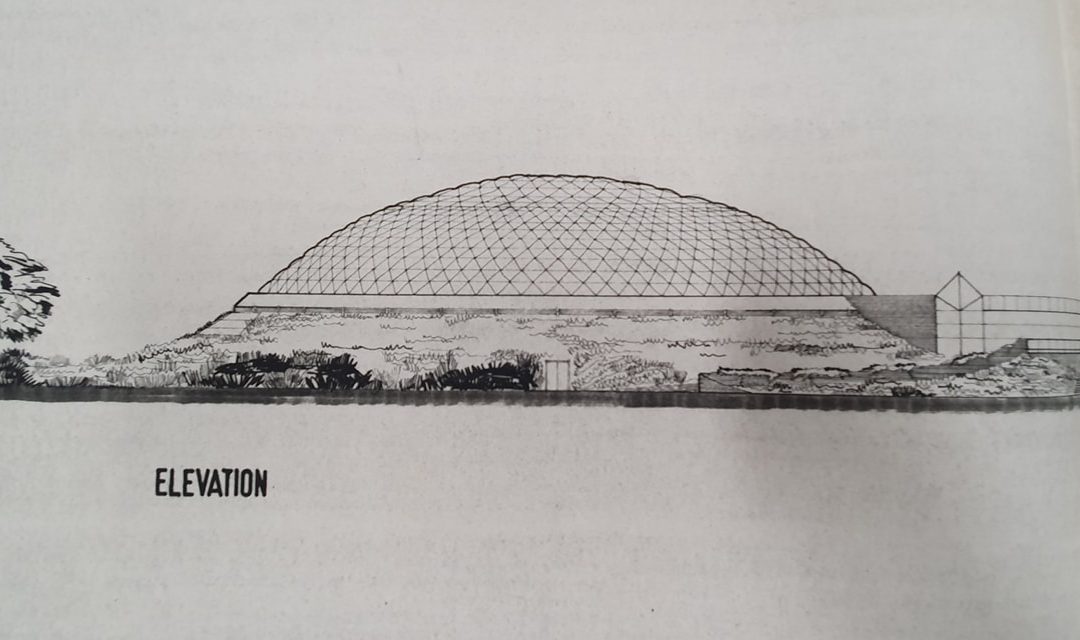
One significant, and emotive, issue is 7C’s plans to demolish the iconic Oasis Dome. 7C has gone to some effort in its plans to replace the dome with a difficult to envisage drum-shaped, see-thru, eco roof.
The great irony here being that demolishing the dome will do incalculable damage to the environment, releasing as it will, vast amounts of carbon into the atmosphere. Nothing green about that.
Demolishing the dome – aside from it being an act of cultural vandalism and all the bloody rest of it – will make SBC’s Be the Change campaign an UTTER, UTTER, UTTER joke.
NOTE: Every effort should be made not to demolish …and there is the history recorded in the traces of use of decades in the fabric – itself an architectural medium, it’s strata embodying an archeology of living. **
** But hey – what matter the environment and people’s memories when there’s cold, hard cash at stake? What we have people are a Council and a global development body that are the living embodiment of Oscar Wilde’s famous words about understanding the cost of everything and the value of nothing.
Here’s a challenge to SevenCapital, Swindon Borough Council and eco designers and architects worldwide: to design a feasible, eco-iconic dome – whether re-furbished or new.
Why would you destroy something wonderful and now unique, when you can do something special and ground-breaking and reputation-enhancing?
More questions than answers
It’s irksome that several questions around the Oasis story remain unanswered in anything like a satisfactory fashion. For instance:
1. Were all avenues fully explored back in 2012 when SBC outsourced the Oasis to the private sector (Morai Ltd) without any monitoring, standards or take-back clause?
2. Did GLL/Better Swindon put enough effort and business acumen into their x year tenure of operating the Oasis? Or is that the non-clause chicken coming home to roost for what was the final nail in the Oasis coffin?
3. Who on earth was overseeing the ongoing maintenance of the Oasis in the last twenty years? SBC/Morai/GLL/7C?
For the record – AGAIN
The SOS Campaign did NOT submit the listing for the Oasis.
It is though supportive of that request since Listing is one formal system the UK has to give some measure of protection to buildings that stand out as worth saving.
They know that if Listed, it will need 7C to go the extra mile to use its extensive expertise and resources to meet Listing requirements in the Oasis relaunch. But as the Twentieth Century Society point out: It’s worth it!
Oasis Exhibition
You can enjoy a vast collection of photographs and memorabilia for the foreseeable future.
“Celebrating the Oasis” at the Hub, in Swindon Town Centre (the former Old River Island shop).