The Double Helix of Carfax. Last year I published a post about the Seven Wonders of Swindon as described by the writer Jasper Fforde:
“Welcome to the Seven Wonders Of Swindon, compiled for your visiting pleasure by the Swindon Ministry of Information in association with the City Council and the Swindon Special Committee for Wonders.”
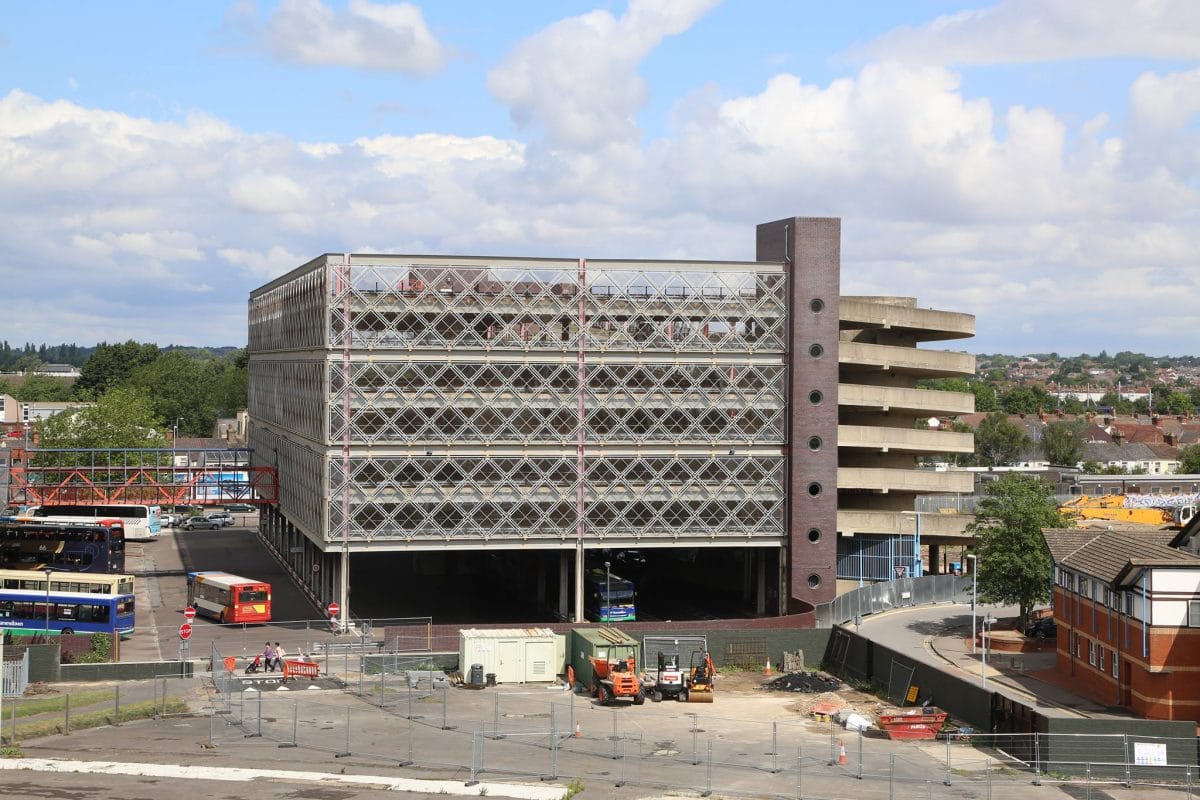
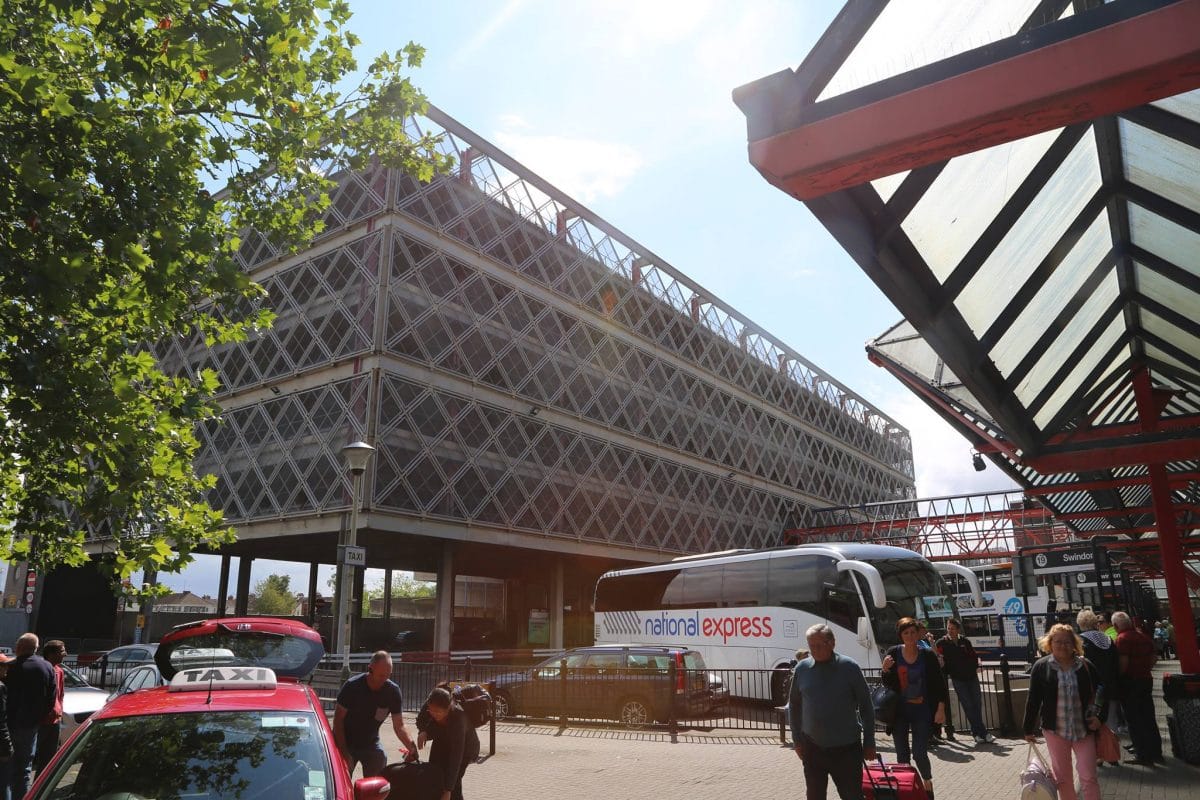
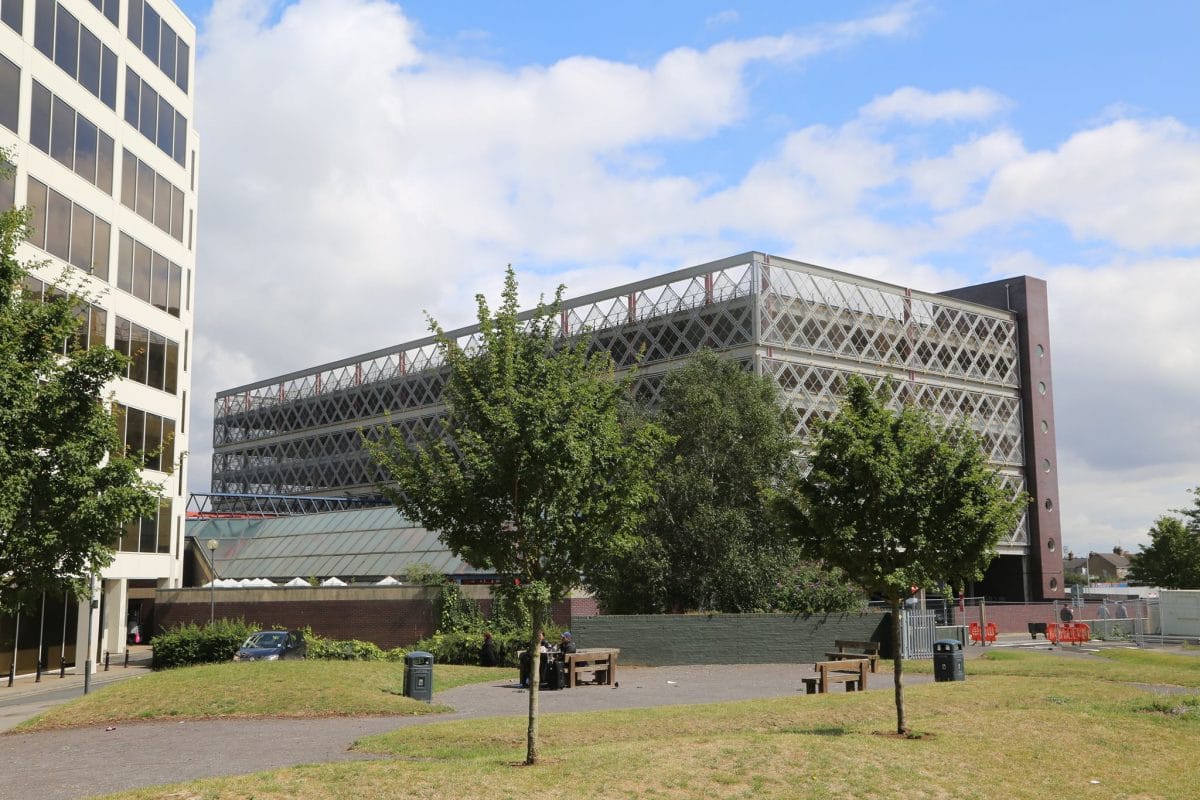
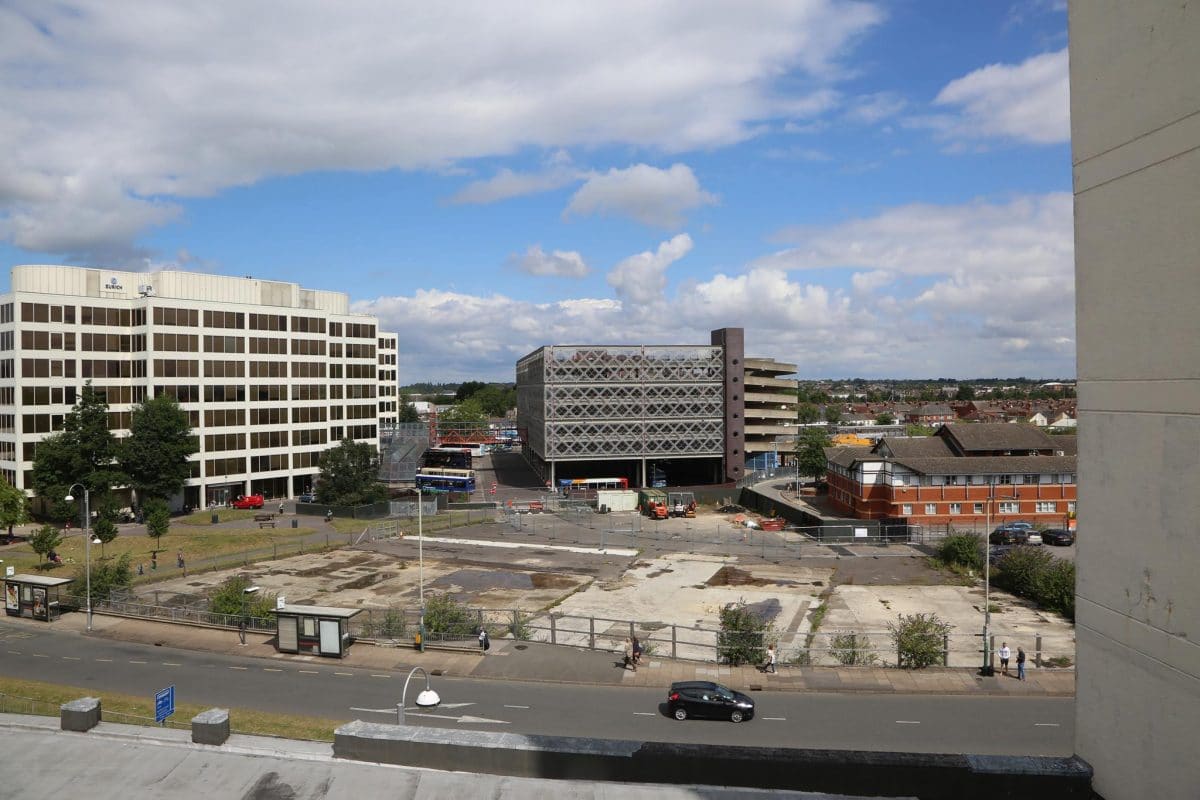
Sadly number three of FForde’s wonders, The Double Helix of Carfax, this literary landmark is no more – due its demolishment by Swindon council.
Described by Fforde thus:
‘Only just pipping the Railway Village to the number three slot, Swindon’s famous and groundbreaking early design in stressed steel concrete laid the groundwork for Corbusier, Frank Lloyd Wright, Gaudi and many others.
Designed by Swindon University physicist Alvin Suggs in 1893 as a friction compensated slope to study Galileo’s theories of conservation of momentum, ‘Sugg’s Marble run’ as it became known gained unexpected fame in the new and untried building technique of steel reinforced or ‘stressed’ concrete.’
Its loss leaves a gap in the market for a new wonder.
Here’s some photographs taken by Mark Kent shortly before its demise:
‘Tunes help you breathe more easily’ so went the advertising slogan back in the day.
Well, should you need it, you now have Julie Nicholls of Body-Mind coaching to help you breathe more easily – and more effectively than resorting to menthol-laden confectionary.
Series of talks
The aim of this post is to highlight the second in a series of free talks that Julie is running over the autumn. The subject of this second talk is breathing and it’s on: 12th Oct at 8pm at Julies’s practice in Swindon.
If, like me, (I’m a chronic asthmatic) you often have breathing difficulties you might be surprised to know that breathing deeply may not be the best thing for you at all.
Attend this talk and learn how to ‘ Ease shortness of breath and help many issues like asthma, headaches, shoulder tension with three simple techniques which will be demonstrated on the night.
You will increase ease of breath and lung capacity if you practice these regularly. If you are on medication, in time you will also find you rely on it less. You will also become more relaxed generally.’
It doesn’t have to be this way
Julie’s objective in running the talks is to give you an understanding of what she can offer, how she can help, and what you might gain from her methods.
She wants to educate on what she believes is possible to achieve in terms of our health. It’s her belief that we don’t have to keep suffering as we may be. It’s her conviction that we shouldn’t have to undergo lifelong treatments and medications—merely an occasional top-up to keep the tank of health full as it were.
Julie is a qualified RGN and definitely knows her stuff but she offers possibilities beyond conventional methods that you probably won’t find from other practitioners. It’s almost impossible to convey in a blog post. The best way is to attend – as I have – her talks and sessions.
The Buteyko Method
Julie’s approach to helping you breath more easily is based in part on methods devised in the 1950s by a Ukranian doctor Konstantin Pavlovich Buteyko.
The premise of the Butyeko method is that many medical conditions, including asthma, are caused by a chronically increased respiratory rate – hyperventilation in simple words.
When our stress levels increase we breathe more quickly and more shallowly which leads to all manner of symptoms such as headaches. Yes – been there and done that!
Julie’s approach is to help your feel in control of your breathing – something like meditation practice.
“Never in the field of human conflict was so much owed by so many to so few” – Sir Winston Churchill
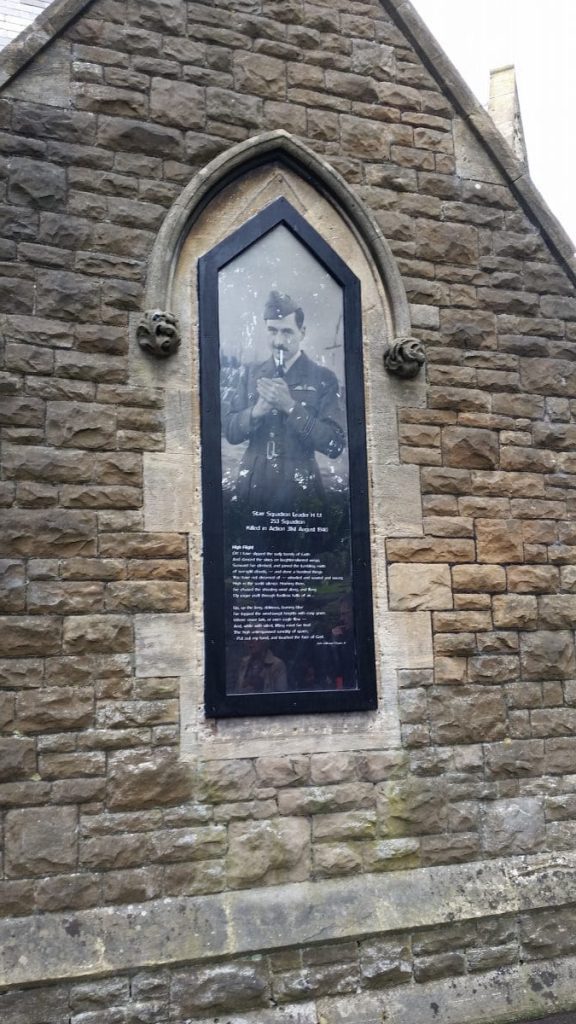
Swindon Remembers The Few.
Yesterday marked the culmination of a week’s worth of activities and months of planning to mark the 75th anniversary of the Battle of Britain. And celebrating Swindon’s own Battle of Britain hero: Harold Morley Starr. I’m super proud to share a birthday, the 8th of September, with Harold Morley Starr.
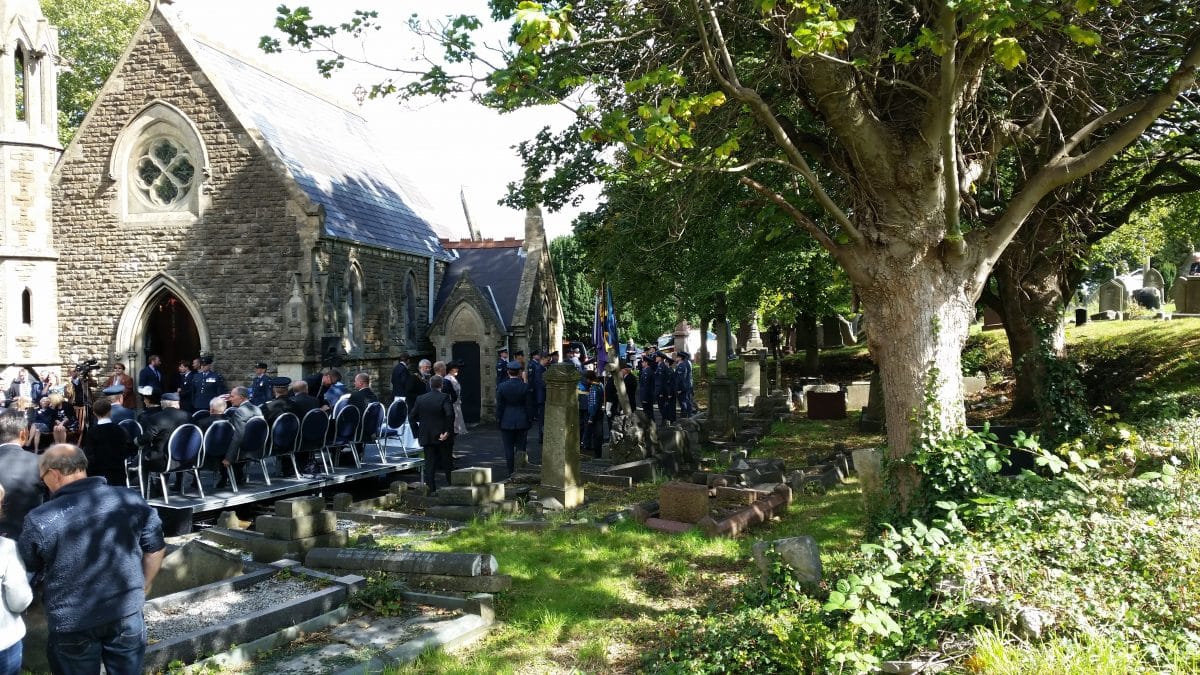
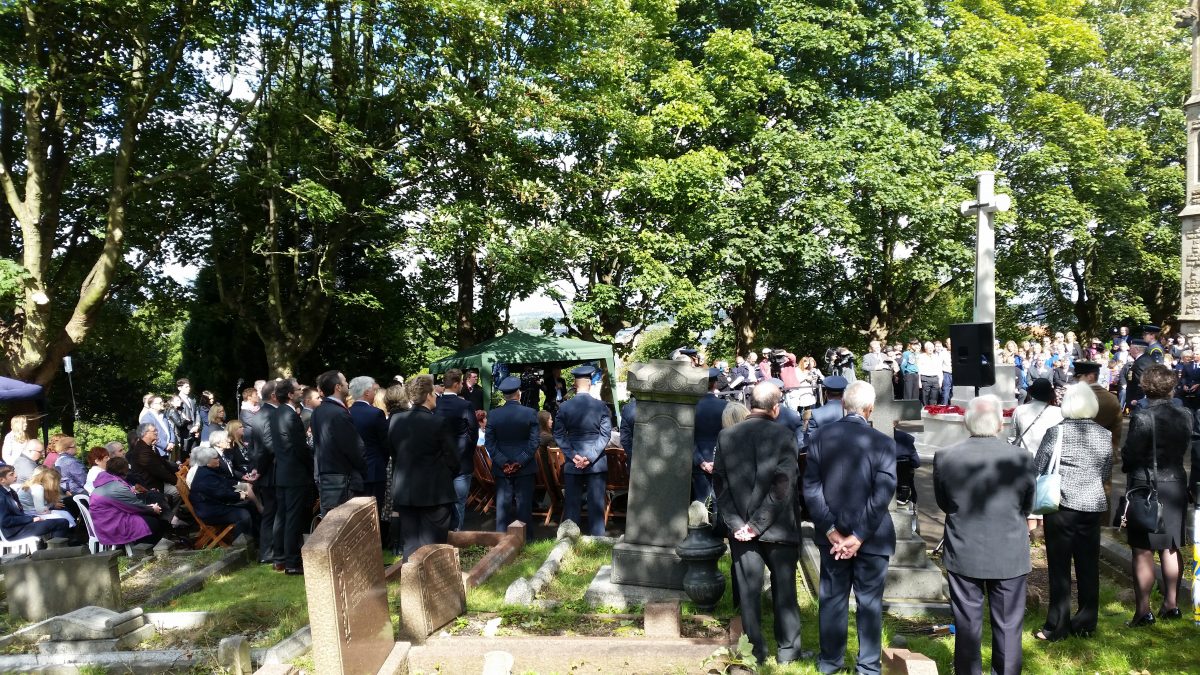
I was fortunate to get an invitation to attend the ceremony and flypast of the Battle of Britain Memorial Flight at Radnor Street cemetery yesterday. An honour and privilege to do so. This was such an amazing experience. And Radnor Street cemetery is a special place – it has numerous Commonwealth war graves.
Here’s a few of my photos to give you a flavour:
Swindon Remembers The FewHarold Morley Starr
The rain held off for the proceedings – most fortuitous though the flypast did have a delay of a couple of hours due to inclement weather at its starting point at Goodwood. But at least it happened – albeit late. So hurrah for that as it would have been a crushing disappointment for it not to have happened at all.
‘On August 15, the crisis of the battle of Britain was reached. All the resources of Fighter Command in the South were used. The most difficult and dangerous period of the Battle of Britain was between August 24 and September 6, when the German attack was directed against the R.A.F airfields in the South of England with considerable success. In this speech Churchill coined the phrase “The Few” to describe the R.A.F fighter-pilots. The phrase stuck. The final sentence of this speech, including the use of the word “benignant,” is a good example of Churchill’s choice of unexpected and assertive adjectives to make a phrase memorable.’
“The Greeks’ fierce pride in their heritage has kept the basic culture intact. Whether a slave under Roman rule, a captive under Turkish domination, or a newly arrived immigrant, the Greek is always aware that he is the direct descendant of men like Plato, Homer, Aristotle, Demosthenes, Aristophanes. The Greek who begins life in a new land on the bottom step of society as a dishwasher needs only to remember how Aesop left a legacy of poetry while cooking as a slave.”
Theresa Yianilos, ‘The Complete Greek Cookbook’
A most agreeable bank holiday
Well, what a lovely way to pass a few hours on a dreek and dismal Bank Holiday Sunday that was!
I refer to the Greek Olive restaurant on Faringdon Road in Swindon. And my apologies to them for the slightly out of focus photographs below. I’m blaming Aphrodite. The wine we drank by that name, not the actual Greek goddess of love, desire and beauty. Though, being as how the food and service at this place are embodied in those things, it’s kinda appropriate.
What a wonderful addition to Swindon’s epicurean offerings this place is. Xenia is the ancient Greek concept of hospitality and certainly it’s much in evidence in the Greek Olive. From the complimentary amuse-bouche to the complimentary baklava to the complimentary shot of Metaxa knocked back as our taxi arrived – everything was wonderful.
Chatting to Stamades ( I hope I’ve got that right) I discovered that his mother is a Swindonian and his father is Greek. He’s been here for three months fresh from the island of Kos. Now as much as I love Britain and Swindon, he must be wondering where on earth he’s come to in this grim weather.
Find them on Facebook
From the restaurant’s Facebook page: ‘Proudly bringing to you from Greece, @Greek Olive – A family run restaurant. As we Greeks are passionate about our food, we were disappointed to discover that mediterranean food was not available in Swindon, after moving here from the Greek Island of Kos. As we missed our beloved Greek traditional food and the nearest restaurant was over 37 miles away, we decided, after a long family discussion that we would love to share our Greek kitchen with you all. Head chef, Michael Kalotinis has over 20 years experience running his own restaurant in Kos. He takes great pride in the meals served from his kitchen, serving only authentic, traditional Greek cuisine, a large amount of his ingredients will be direct from Greece, of course, to ensure you will experience the real Hellenic taste of the Mediterranean…..’
Kos’ loss = Swindon’s gain
Well – Kos’ loss is certainly Swindon’s gain. It might lack a view of the Med or the Aegean but it has to be the next best thing to being there.
The place is pleasingly decorated in restful shades of (olive) green. The tables have actual linen tablecloths – a rare thing these days – and fresh roses on each table. A nice touch. The walls are adorned with lots of snaps of Greece – possibly Kos, I didn’t ask. I should have done. I’ll try and rectify that next time. And there’ll definitely be a next time – and soon I hope.
For a starter we settled on a hot meze platter for two people. This comprised a generously portioned selection of calamari, meatballs, gigante, grilled halloumi cheese, dolmades and three types of dip. It was all delicious.
Moving on to the main course we opted for fish. Sea bass for me and swordfish for my companion. Again all beautifully cooked.
We washed it all down with a bottle of Greek white wine that was dry and crisp and fresh. The Metaxa with which I rounded off my meal was smooth and lovely and slid down a treat.
So all in all great food, really great, friendly service and great value. The only real disappointment being the absence of plates being smashed. That said someone did break a glass while we were there… Yamas!
Body Mind Coaching: Posture. When we have an issue with our bodies pain is the last thing thing to appear and the first thing to disappear – thus tricking one into thinking that the problem – whatever it might be has gone away – and the chances are it really hasn’t.
Pain is such an uncomfortable feeling that even a tiny amount of it is enough to ruin every enjoyment.
Will Rogers (1879-1935) American humorist and actor.
Julie Nicholls, business owner and practitioner of Body Mind Coachingin Swindon is running monthly talks combined with practical demonstrations to illustrate her unique approach to pain and stress relief.
Since 1993 Julie has helped people like you and me to relax and feel well again from her Swindon practice. Trained in both conventional medicine (RGN) and complementary therapy, Julie provides care that covers physical, mental, emotional and spiritual needs.
Julie Nicholls testimonial
Autumn Talks
If you’d like to know how to reduce pain, increase flexibility and not, as the quote above suggests, have every moment ruined by pain, then these FREE talks could well be of interest to you.
You can find dates and times of all the talks by visiting the events section of Julie’s website. And it’s quite the veritable treasure trove of information and resources.
The first autumn talk: 14th September 2015 – Neck, shoulders and posture
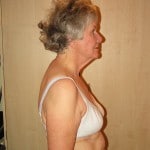
‘For most people tension is held in the shoulders and causes pain in the neck and headaches. Many people stretch their arm forward to ease the tension yet this is the opposite of what you need to to solve shoulder pain and tension.
At this talk you will discover how to ease tension and improve round shouldered posture easily and without going to the gym. You’ll learn some simple techniques you can use anywhere any time.
These free talks are designed to give you time to relax, reflect and give you some tools to reach your peak performance. If you benefit from them then a retiring donation would be appreciated.’
The talk will comprise a combination of demonstrations from Julie with an opportunity for you to practice the correct ways to relieve everyday tension & discomfort.
Consider this quotation from Robert J Wiersema:
“The trouble with chronic pain is that it is so easy to become accustomed to it, both mentally and physically. At first it’s absolutely agonizing; it’s the only thing you think about, like a rock in your shoe that rubs your foot raw with every step. Then the constant rubbing, the pain and the limp all become part of the status quo, the occasional stabbing pain just a reminder. You are so set to endure, hunched against it – and when it starts to ease, you don’t really notice, until the absence washes over you like a balm.”
Julie is keen to stress that you don’t have to learn to live with these things. And that a solution can indeed be found. And it’s that belief that informs her treatment.
Before posture exercises/treatment
Ear & shoulder more in line following posture exercises/treatment
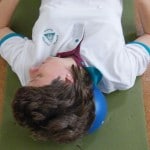
Exercise with ball
So – do you want to know more? Here’s the when and where: