Lawn Park: one time Goddard family stomping ground
25th November: A small amendment/correction from a regular listener. St Mark’s church, by the railway village, was consecrated in 1845. I’m not sure how long after that date, that services began. But the point being, to say that Swindon’s only church was Holy Rood until 1851, when Christ Church ‘took over’ isn’t quite correct. Thanks for that. Good to know.
Sunday 23rd November
Historical open space in Swindon’s Old Town
Today is stir-up Sunday. Next week is the beginning of Advent and the winter solstice and Christmas are hurtling towards us at warp speed. It’s also a damp and gloomy morning and I hate winter at the best of times. I most definitely suffer from Seasonal Affective Disorder (SAD). Thus I’m sat here at the computer with the light box blasting out and writing this post by way of a hark back to the glorious summer of 2014 and a visit to The Lawn. It being yet another of those places that I didn’t know about for yonks and yonks. And even when I did know about it, it took me even more yonks to get to it.
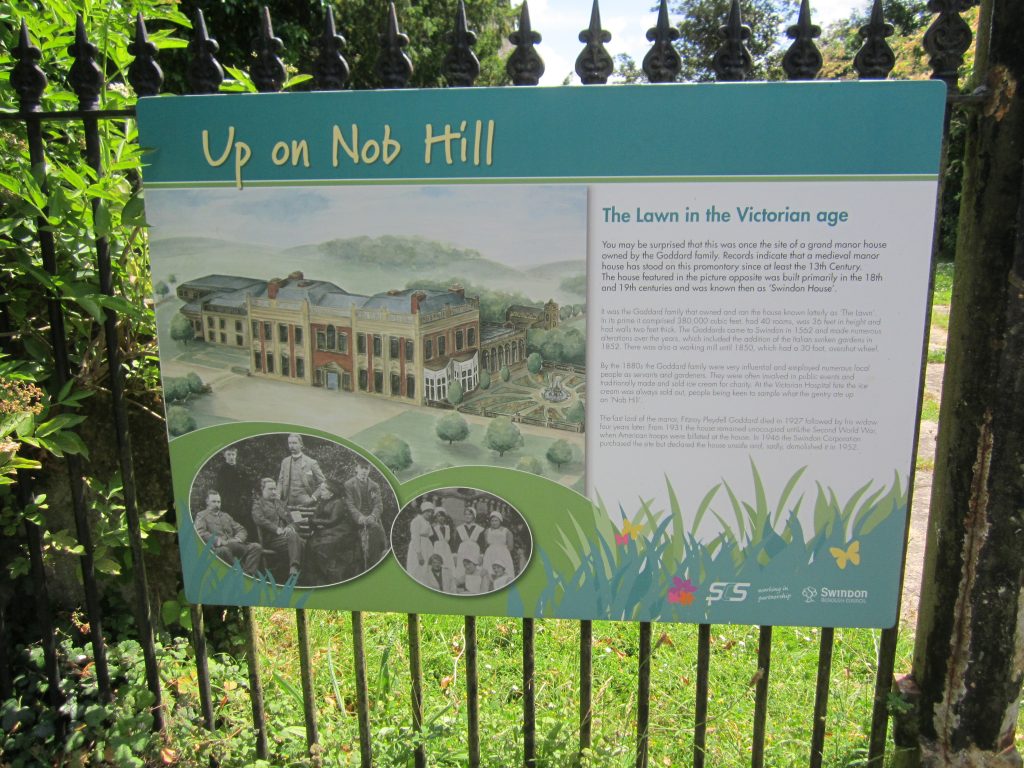
So what is Lawn? Lawn Park is a 50 acre park that comprised the house and estate of the Goddard family. They were the Lords of the Manor of Old Swindon. Their house is now long gone and the estate a public park – though their name lives on in the nearby pub and hotel, The Goddard Arms. According to Swindon Web the 18th century house stood on the site of a Tudor Mansion. The Goddard family were Lords of the Manor from 1563 until 1927.
The Swindon Advertiser have an article here with more information about the house. There’s also a good picture of it before the wrecking ball had its way with it.
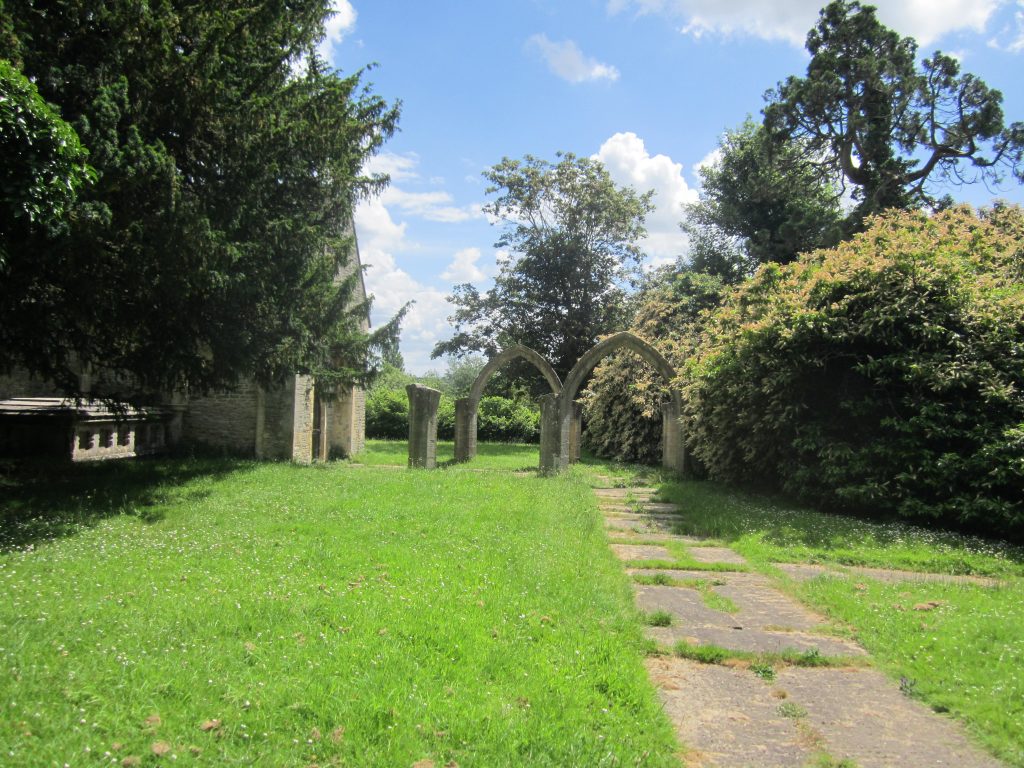
The estate included the area now known as Lawn, bounded by the high street and the site of Christchurch. It was situated next to the 13th century Holy Rood Church – which is really now just a little bit ‘goffick’. It doesn’t take a big leap of imagination to picture ghosts and spirits floating between the remaining arches. Sadly only the chancel area is left of this Norman Church which, until 1851, was Swindon’s only church. Frances Bevan, on her fab Swindon History blogspot writes about the church here where there are some lovely pictures too.
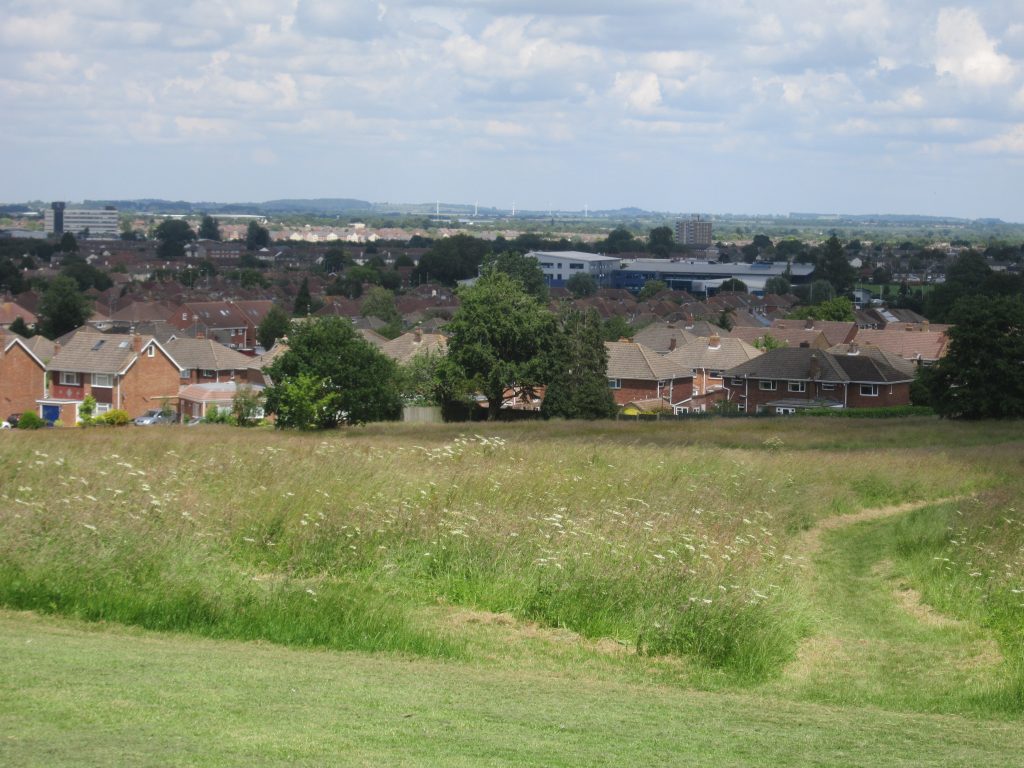
SignageHoly Rood ruinsView across to Highworth
Holy Rood
NB: In case you didn’t know, and I didn’t until I just looked it up, ‘Holy Rood’ is an Anglicisation of the Scots Haly Ruid meaning holy cross and possibly refers to the relics of the true cross on which Jesus died.
I must say the Old Town high street entrance to it is quite hard to spot – you kind of have to know it’s there. Once through the gates there’s a long avenue leading to the gardens, the remains of the house and the original Holy Rood Church. Storms ravaged the 19th century avenue of trees. Replacing them in 1992, we have an avenue of American Pin Oaks. You can also access the park from Old Walcot or the Lawns housing estate.
As is the way with stately homes and manor houses right across our green and pleasant land, the estate is in a wonderful setting with rolling grasslands, two lakes and stunning views across the surrounding area. Masters of all they surveyed indeed.
Many of Swindon’s most popular events take place here: the Old Town Festival, the Forest Festival and the May Day dawn chorus.
And, it has to be said, that an expanse of grass the size of the lawns would take an awful lot of mowing. Of course back in the hey day of The Lawn the Goddard family would have had staff to do the work for them.
Nowadays you’re more likely to be doing it yourself. If your garden is any sort of size then a good mower is essential and even more essential than that is taking care of your mower. This article here: http://yardday.com/mowers/maintain-gas-lawn-mower is full of great advice about doing just that.
I’m actually not at all sure I ever got that list finished – so much is there here in Swindon that is blog worthy.
Anyway, in these earlier posts, one of my 10 things was/is the Swindon-born artist Ken White. And, as an actual son of Swindon and acclaimed artist, Ken deserves a place on this blog.
Yet, what I didn’t know then and have slowly learnt as Born again Swindonian has tottered along, is that this town is home to a whole Guggenheim of artistic talent of all types.
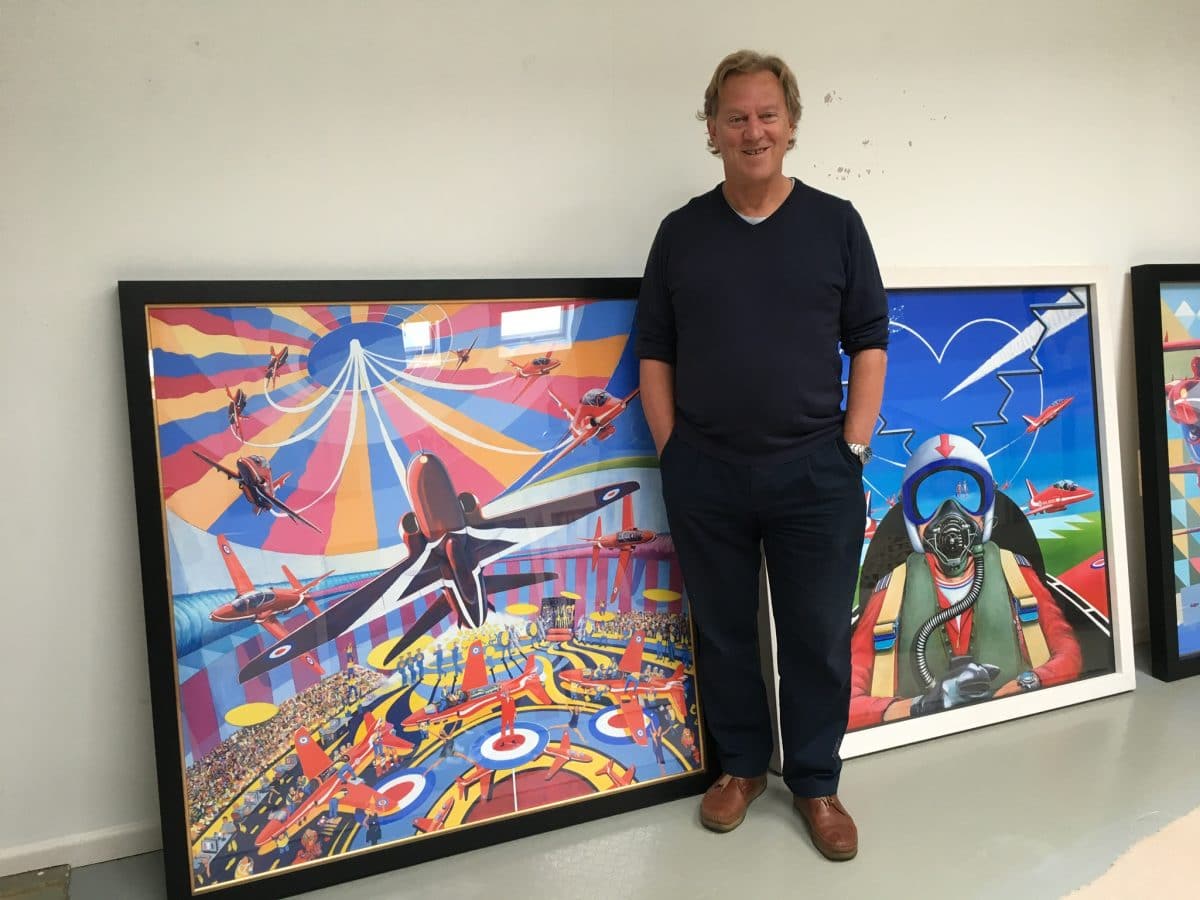
So one glaring omission now being rectified, is David Bent.
It was only when a furore with Katie Hopkins kicked off earlier this year that David and his work came onto my radar. And I realised that he too should be featured on this blog.
And that was only because David’s lovely wife Carole is involved with Better Swindon. In that capacity she, along with your very own blogger extraordinaire, received an invitation onto BBC Wiltshire to respond to Ms Hopkin’s verbal diarrhoea.
So I guess we have something to thank her for eh?
So anyway, life being as it is it’s taken until now for Carole and I to meet. I wasn’t able to get to their recent open studio weekend. So Carole kindly invited me to their home to have a chat, meet David and look round the studio.
His wife Carole has given me lots of really interesting information about David, his work and his support of, and contribution to, our less-than-perfect but much-loved Swindon. So I’ve drawn the rest of this post from that.
I mentioned above the Open Studios event – something that David has supported for the last ten years. One year there was just him and two other artists doing it to keep the event alive.
As alluded to above, and as Carole says:
” His work is diverse – covering social issues , landscape geometry and more.But his niche interest in aviation is the strand that he is best known for”.She goes on to say that: ‘Having first shown this work in a B&Q tent at the far edge of the airfield at Fairford, his work in the aviation sector has spread far and wide over the past decade. David is credited with leading a new movement in modern aviation art.
Solo exhibitions over the past 10 years have been held at the Royal International Air Tattoo. With Dave’s artwork appearing on the giant billboards from Paddington station to sites across the country.
Flying High
Farnborough International , the Cotswolds VIP , the Dubai International Air Show & the Royal Tent @ the Al Ain Aerobatics Air Show , UAE.
Supporters of Dave’s work include the Red Arrows who invited him to collaborate as artist in residence in 2007 . A celebratory book – a collaboration between Dave , the Red Arrows & Breitling was presented by Red 1 to HRH Prince Charles at RIAT 2014
In 2012/ 2013 the RAF Museum hosted ” Fresh Air ” a year long retrospective of Dave’s work – the first of its kind for a living artist”.
Away from the studio
But even an internationally renowned painter likes to do other things.
So while his relationship with the Red Arrows is well known and oft talked about, it’s worth mentioning that David gives significant support and commitment to the creativity of other people.
This isn’t always easy to do when one is self-funded. But both David and Carole believe in the importance of being part of the community. And doing something for that community.
Thus they’re both member’s of PaRa, the local resident’s association and actively take part in the spring and autumn clean. Laudable for sure. Indeed, I myself often go Wombling when I go to the shops at Freshbrook. The litter is disgraceful. Time to bring back the Keep Britain Tidy campaign surely?!
Anyway, back to topic:
“Children from Churchfields school were hosted by Dave for a tour of his Old Town studio & a private view of this exhibition. They enjoyed spending time with the Red Arrows who we had arranged for them to meet. In 2013, we attended an Art Auction at Churchfields school , buying childrens artworks in support of their creativity .
Other children have also been involved in Dave’s work. 800 took part in the Big Draw, creating their own artworks based on his exhibition at the Museum. Their work was then displayed beneath the wings of a Mosquito.
Who knew eh?
So there you have it.
HAD I known about David and his work he would most certainly have gone on my ‘Ten things to celebrate about Swindon’ list.
But now at last his work ia on Born again Swindonian, alongside all the other fantastic artist talent in this town. An adopted Son-of-Swindon for sure.
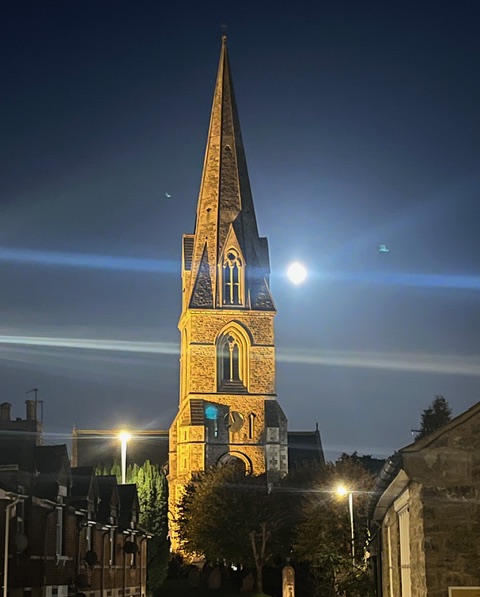
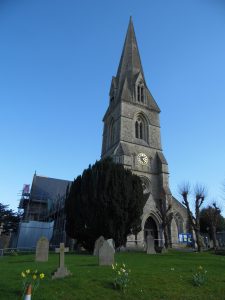
Yesterday I paid my first visit to Christ Church, the lady on the hill, in Swindon’s Old Town for the occasion of the Autumn fair. It was a really smashing event. And, I have to admit, a notch or two up from the autumn/summer/Christmas fairs I used to attend back in little old Whitwell when my daughter was small.
Christ Church Old Town Swindon
The stalls and the activities were spread in and around the church and its community centre. I had a lovely hour or two chatting to some great people from various community groups. Friends of Lydiard Park, the Swindon Society and the bunnies from the Wilts and Berks Canal trust.
A very confident young lad, who will surely go far, persuaded me to take him on in a five-penalty shoot out. Much to my surprise and no doubt his, I managed to beat him! David Beckham? Who’s he?
As I strolled round it struck me how wonderful it was to see community centre, church and the grounds opened up with stalls and displays.
Libraries have now recognised the need to have facilities and events that engage current readers and the readers of the future. And yesterday’s autumn fair was a great example of the church opened up to the community.
George Gilbert Scott
It’s a lovely church with some stunning stained glass windows in it.
Designed by Sir George Gilbert Scott in Midlands Decorated Style. He also designed St Mark’s church – and more famously – St Pancras in London.
Opened in 1851, Christ Church replaced the old medieval church of Holy Rood. Located on The Lawn. That church was, by the 1850s, woefully inadequate for Swindon’s growing population. There’s lots more information about Christ church in the visitor’s guide leaflet I picked up in there.
John Betjeman
Like several things/places in Swindon and its environs, John Betjeman celebrated the church. In ‘On hearing the full peal of ten bells from Christ Church, Swindon’, Wilts he said:
“Your peal of ten ring over then this town, Ring on my men nor ever ring them down…” and “Oh still white headstones on these fields of sound, Hear you the wedding joy-bells wheeling round?”
The purpose of art is washing the dust of daily life off our souls.
Pablo Picasso
An analogy
Well listeners, if we stretch that analogy a little further and consider the wealth of art – and even architecture -of all kinds that we have here in Swindon we can find ourselves washing the dust off our souls in a veritable ocean of creativity. Much of which has featured at various times on Born again Swindonian.
I popped in to Artsite today too and met Lynette Thomas who works with mosaics. I ended up buying a piece of her work and having a good old natter with the lovely people in Artsite. Lynette has created a wonderful mosaic homage to the Magic Roundabout a couple of pictures of which are in the gallery below. I like it. I want it. Don’t give me any other… I find myself drawn to mosaics.
Earlier this year I bought a mosaic piece from another of the artists at Artsite which now has pride of place in my garden. Maybe I was a Roman in a past life? Anyway…
Paul Sullivan & S.Carr/T.HumphriesMagic roundabout mosaicTim CarrollDavid BentBowie!
David Bent
This year too I’ve learnt of the existence of David Bent about whom I really need a blog post. DONE! Missing still is Tim Carroll. That needs to be addressed – I’ll get there. As well as the small piece up above I’m the proud owner of one his 100 views of Swindon. I LOVE them all. I like a lot of his work in general.
And of course there’s the small but perfectly formed Museum and Art gallery in Old Town with its terrific art collection. So who needs the Guggenheim?
A few months or so ago art work by Caroline Day started appearing on my Facebook timeline. I started sharing it on the Facebook page for Born again Swindonian – an act that resulted in a lovely guest blog post from Caroline in which she explained all about the work of the Old Town Garden’s art work.
So today it was a great pleasure to finally get to meet Caroline, up in the town gardens and to see some of her lovely works first-hand as part of the Old Town Garden’s Little Big festival and Swindon Open Studios art event. I like her work very much. Many of her prints have interesting juxtapositions of photographs of the band stand and even her children set against drawings of flowers.
Plein Air artists
Two artists I also had the pleasure to meet today were Terry Humphries and Susan M Carr. Susan is, amongst other things, a ‘Plein Air’ artist. A little bit of internet research reveals that ‘En plein air’ is a French expression meaning ‘in the open air’. It’s used particularly to describe the act of painting outdoors. “Artists have long painted outdoors.But in the mid-19th century working in natural light became increasingly important to multiple schools of art.
The Barbizon school of France was of particular influence on the Realists. They focused their work on everyday subjects versus prominent figures. These Realists inspired the Impressionists, whose style included visible brush strokes, ordinary subject matter, and an emphasis on light in its changing qualities.
The popularity of painting en plein air increased in the 1870s with the introduction of paint in tubes.That replaced the task of grinding and mixing dry pigment powders with linseed oil. It was also during this period that the “Box Easle “, typically known as the French Box Easel, was invented. This development increased the ease and portability of art supplies. In turn that made treks into the forest and up the hillsides less intimidating and more appealing to those looking to paint new landscapes.”
Going around Swindon’s Roundabouts Hello listeners. Here we have the second instalment of posts featuring a few of Swindon’s roundabouts. And the reasoning behind their names.
The first post –Round and Round, examined roundabouts related, by dint of name and location, to some of Swindon’s industry.
This time around it’s pubs. With coaching inns in days gone by often sited on road junctions, a number of Swindon’s pubs sit on or near to roundabouts. And that gives the planners a convenient handle for said roundabout.
So yesterday, on a somewhat dreek and dismal day, @Swindondriver, Swindon bear, Penny penguin and myself set out on a second EXPOTITION to check them out.
Swindon bear and Penny Penguin go on a road trip.
The Rat Trap
First stop on the road trip was the Rat Trap, an Arkell’s pub in Stratton St Margaret. This hostelry – or maybe it should be HOSTILERY – has an interesting little story.
Originally called the ‘Speed the Plough‘ (generally shortened to The Plough) the landlady in days of yore, one Fanny Stroud, devised a foolproof method of making her customers settle their bills: quite simply she locked then in the pub until they coughed up. It wasn’t long before the locals nicknamed the pub the Rat Trap – it becoming so interchangeable with its official name that, in 1875, court records referred to both.
Arkell’s bought the pub in 1899 and kept its official name, The Plough, until 1974. However, following refurbishment and the adding of an extension, Arkell’s endorsed the nickname re-naming it The Rat Trap. Echoing this story, the pub’s interior features a carpet with a Pied Piper motif whilst on the outside roof there is a plough and the pub sign depicts the landlady taking money from her customers. I wonder if the Boomtown Rats had heard this story….?https://www.arkells.com/pub/the-rat-trap-stratton-st-margaret.htm
The Crown Inn – Stratton
Next up on our agenda was the Crown Inn, again in Stratton. A 19th century coaching in, the Crown Inn has, as it says on their website, come full circle in returning to its former function as an actual residential inn even if there’s no longer accommodation for horses. Furthermore: “An inn has stood at the junction of Highworth Road and Ermin Street for the best part of 250 years – and possibly much longer, making the site of The Crown an important one indeed to the local historian.
The original building got sold for £60 in 1767 when it bore the name The Sow and Piggs. It became the Crown in 1792 – ironically the same year that King Louis XVI was losing his crown – not to mention his head – in France.
Forty years later a new building replaced the old one, complete with the impressive arch, pretty courtyard and stable block. All tyypical of coaching inns at this time and all of you can see today. Arkells’s bought the building in 1868 and – as with many of the pubs it has brought – proved the stabilising element in the story.”
Still in Stratton
Now we go to The White Hart, still in Stratton….and another Arkell’s pub. As Arkell’s do with all their pubs it seems, they’ve got some history and background to this hostelry on their website: ‘As a change from railway history roots, the original White Hart owed its existence to the Wilts and Berks canal which once ran nearby.’
It goes on: ‘Coal merchant William Seymour was the owner by 1841 and his family kept it for many years. In those days The White Hart stood on the other side of the current Oxford Road. It sold beer produced in the brewhouse on the opposite side of the road.
Brewing ceased when Arkell’s bought the freehold of the pub (and an adjoining orchard) in 1878 for the princely sum of £925. The original building remained in use for another 59 years before it was demolished to make way for another pub with the same name. Completed in 1938, the current pub is a much larger building than its predecessor … “
It seems rather a pity that there is no White Hart emblem anywhere on the pub.
And finally
The final place on the pub crawl, sorry I mean cultured tour of Swindon’s hostelry and roundabout history, was The Moonrakers – another Arkell’s pub, this one on Cricklade Road, with a roundabout named after it.
As with all these pubs/roundabouts there’s an interesting tale behind it. The legend of the Wiltshire moonrakers is well known round these parts. Swindon Web have an excellent article all about it so to get the full story go there. But in essence the story goes likes this:
‘A pair of Wiltshiremen, engaged in smuggling brandy, hid a barrel of the contraband from the excisemen in a nearby pond. When they return at some later time, in the dark, they are caught in the act of raking the barrel back to land. They immediately claim that they are trying to rake cheese – the reflection of the moon – from the pond. And the excisemen, amused by the apparently simple-minded rustics, leave them to it.’
The moral of the tale being of course that Wiltshire folk are not as daft as some would believe.
I don’t get to that side of town overly much. And, since I was last there, the parade of shops across the road has been piffed up somewhat. The frontage in front of the shops now features some rather wonderful giant flowerpots. They immediately brought a certain ancient children’s TV show to mind. little weeeeeeed …. flob a dob …. There are also some benches, funky asymmetric patches of lawn and wooden posts that turned out to be a homage to the moonrakers legend. Fab stuff! I loved it.
So all in all we had an interesting afternoon of urban discovery, local history, good beer and lousy coffee.
Swindon bear & Penny penguin sample the offerings in the Moonrakers.