THE tradition of the Midnight Hunterand his headless hounds–always, in Cornwall, associated with Tregeagle–prevails everywhere. Whether the slice of mythology and folklore below is the inspiration for Swindon’s fantastical Wish Hounds sculpture I’ve no idea. But they’ve always intrigued me.
The hounds, created in 1994 by Lou Hamilton, have a menacing air about them even on a pleasant May Bank Holiday. It doesn’t take much of a leap of imagination to hear them howling Baskerville-like in the dusk and making mere mortals quake. Perhaps dusk is a better time to see them, to feel their hot breath, see their jowls heavy with saliva…
“And then he sought the dark-green lane, Whose willows mourn’d the faded year, Sighing (I heard the love-lorn swain), ‘Wishness! oh, wishness! walketh here.'” — The Wishful Swain of Devon. By POLWHELE.
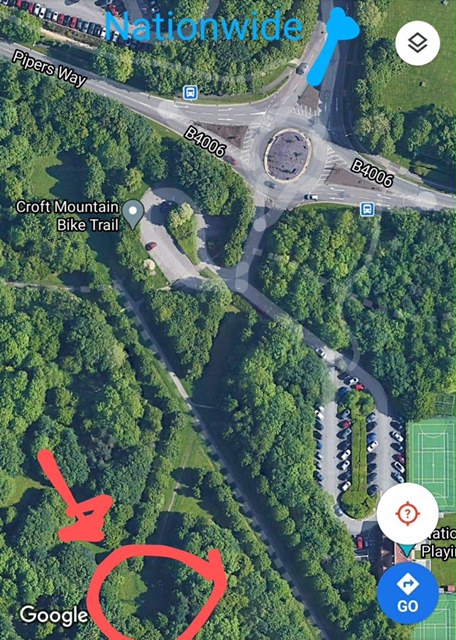
Location Location Location – where the Wishhounds are
I found this information – and you can get the location of them here too on Geograph.org: ‘Wish-hounds also have other many other names, such as Yeth.
It seems the word wish is from a Sussex word meaning marsh. For hundreds of years there’s been reports of ghostly black dogs, usually with glowing red eyes. Such tales probably date back to the mists of time. It’s generally reckoned not to be a good thing to meet one. When this sculpture was first mooted, there were protests from some local Christians who objected to what they felt was pagan imagery and therefore, in their view, undesirable.’
The sculptor wrote a poem about them: the last two lines of which read: ‘They are the Guardians of the Earth’s secret; Wish-hounds of the Old Land.’
The Wish Hounds is a sculpture in three parts. 1. concrete cast lettering, 2. powder coated scrap metal and 3. earthworks in a circle of trees. As you can see from the pictures the lettering is becoming a bit grown over in places and the floodlighting is no longer working.
Swindon’s erstwhile Thamesdown council was the first in the country to adopt a percent for art policy. This policy encouraged developers, once their scheme was completed, to fund a piece of public art. This forward thinking and innovative scheme resulted in Swindon acquiring an unusual, if not unique, cultural landscape. A landscape that had public art scattered the length and breadth of the town. Amongst my personal favourites are The Great Blondinis, the West Swindon Sculpture walk. And the lonely cow chewing the cud up at the hospital. Though really I love them all.
Though some of the original ones are long gone, new ones have sprung up. And, even though some of them are now somewhat unloved they are no less interesting for all that. Before I started blogging about it all I’d never heard of the term ‘public art’ and really the closest I got to it was an old village pump, the Cenotaph and a redundant pit winding wheel..
May 26th – comment left by a listener:
“If I remember correctly, the Wish Hounds are on their long legs because they were designed to appear above the tree line for drivers on the M4. They used to look magnificent, leaping over the trees.
However, I’m not sure whether it was because of budgetary constraints or simply forgetting that trees grow but, they were gradually hidden by the ever growing trees. It’s a shame.
They used to provide a great introduction to Swindon art to drivers between J15 and J16″
Oh listeners, I do love a bit of urban discovery. As is evidenced with my travelogue on the West Swindon sculpture trail. And the subject of this post turned out to offer some nuggets of urban discovery.
When I say ‘discovery’ I do of course mean new to or previously unnoticed by me. Not that no-one ever has seen then before. I’m referring to the Richard Jefferies Old Town walk. A trip round the eponymous area of Swindon taking in buildings and spots that were known to him. I did this walk last week with @swindondriver AKA Jess Robinson who took the photographs.
I’ve broken the walk up into two separate posts as there’s a lot of it and it would be a VERY long post otherwise.
Richard Jefferies – Born at Coate, Swindon, Wiltshire in 1848 – Died in Sussex in 1887
I’ve written a couple of times on this blog about RJ but before I talk about the walk here’s a bit of information about who RJ was. From the website of the Richard Jefferies society:
“(John) Richard Jefferies (6 November 1848 – 14 August 1887) is best known for his writings about nature and the countryside. His birthplace and home at Coate, now on the out-skirts of Swindon, provide the background to all his major works of fiction and for many of his essays.”
Wikipedia: “His childhood on a small Wiltshire farm had a great influence on him and provides the background to all his major works of fiction. For all that, these show a remarkable diversity, including Bevis (1882), a classic children’s book, and After London (1885), an early work of science fiction. “
Now onto the walk
This is a circular walk that begins and more or less ends at The Square in Old Town. Despite the fact that the leaflet I found about it was a few years old the walk remains pretty much as described. Here’s a link to a plain text web page of the walk and a numbered map which corresponds now to each paragraph in the post: http://writersgate.co.uk/map/rjwalk.htm
1) The bakehouse and shop belonging to Richard Jefferies’ grandfather, John Jefferies (1784-1868), stood to the right of the Corn Exchange building, fronting the road. The shop is long since demolished. Richard went there frequently, as a child, and would have found there, also, his aunts Eliza (Sewell), Mary and Sarah. Now Jess and I weren’t entirely sure where the bakehouse and shop mentioned would have been as the description isn’t particularly clear from which angle of the Corn Exchange (the Locarno) it referred to.
2) Take the lane leading out of The Square along The Weavers and continue left into Old Mill Lane. On your right is an old ‘squeeze-belly’ stile. The path beyond it leads to Coate, no doubt Richard used it to come and go, on foot. Continue along Old Mill Lane and note the buttresses in the churchyard wall. Close to this spot stood the mill, once in the charge of Richard’s great uncle James. The Goddard family mansion, ‘The Lawn’, now demolished, stood a few yards farther on. NB: the squeeze belly stile is still there – that was a new ‘discovery’ for me.
3) On the right stands what is left of Holy Rood Church. The gates are locked but if you can get the key you may see the box tomb of Richard’s great grandfather Richard (1738-1825). Richard was baptised here. Not that I have any idea from whom or where you get the key.
4) Return via The Planks (an ancient and raised walkway) to The Square and go into High Street. Notice the Bell Inn, (no longer an inn but the building and bell are still there) sometimes visited by Richard where, as a young reporter, he would talk with Sir Daniel Gooch* and other leading citizens. Cross High Street and walk to Newport Street. The National School, now pulled down, stood in Newport Street. A Mr Jenkins ran it and Richard attended in the evenings in his teens.
Sir Daniel Gooch now has a Wetherspoons in his name – there’s lots of interesting information and pictures on the stairwell in there.
There are lots and lots of reasons why we can be proud of Swindon – many of which I’ve posted about on this blog as regular listeners will know. For a start there’s al the public art about which I’ve banged on ad nauseum. Plus the host of parks and green spaces and the bewildering range of artistic talent that Swindon hosts. And much, much more.
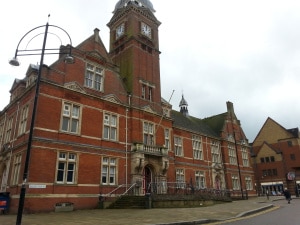
Swindon Dance Steps Out – Swindon town hall
Discovering Swindon Dance
But now listeners I’ve discovered a new reason to be Swindonian and proud: Swindon Dance. Well, when I say ‘discover’ – I should perhaps refer to Mary Louise Pratt who I believe, in ‘Imperial Eyes’, describes the ‘anti-conquest’ which she defines as “the strategies of representation whereby European bourgeois subjects seek to secure their innocence in the same moment as they assert European hegemony” . Or – put another way – when we Europeans went stomping around the world claiming and naming rivers, rocks, islands, and countries for King, Country and Empire we weren’t actually ‘discovering’ anything. Because of course ‘it’ (whatever ‘it’ was) was already there and well-known to the indigenous populations without whose help we Europeans might never have ‘discovered’ anything much at all and which we then proceed to steal from said indigenous peoples dressing it up as we did so in a discourse of scientific discovery.
So it is then, in that vein, I’ve recently discovered – or, to be more precise, learnt about – Swindon Dance – who are lovely folk of discernment and intelligence being fans of this blog.
The lovely Lizzie sent me lots of fab information which is way better than my scrawls so, with no further ado, dig out your leg warmers and prepare to be, as I most certainly was, duly illuminated! For a start it was news to me that there’s a 100 seat theatre in the old town hall which is the home of Swindon Dance. Nor did I know there was a mural in the building painted by one Carlton Attewood of ‘The Watcher’s’ fame.
ABOUT SWINDON DANCE
Swindon dance is a registered charity that operates as a not-for-profit dance organisation dedicated to creating and developing the dance, dancers and audiences of tomorrow.
Swindon Dance is firmly embedded in the national dance sector. It’s got a 35-year track record and national reputation for providing high-quality dance training in Swindon and the south-west. Their expertise in dance along with a focus on participation and access has ensured that they facilitate quality dance experiences for anyone willing and able to take part.
Swindon Dance are providers of:
A programme of community classes for all ages and abilities in Jazz, Ballet, Tap, Urban and Contemporary.
Both amateur and professional performance opportunities to dance artists via our unique 100-seat theatre.
Artist and talent development in the form of mentoring, networking, career-training and space provision.
More in-depth dance development for young people, as one of nine Centres for Advanced Training (CAT) in the UK via our Youth Dance Academy (YDA), which gets its funding fron the Department for Education and has the only YDA Urban stream in the country.
Numerous opportunities for our YDA students to work with new and current professional artists, including award-winning hip-hop group Plague, internationally acclaimed choreographer RussellMaliphant,Matthew Bourne protégé John Ross and award-winning, rising star Aakash Odedra.
Opportunities for primary school children to experiences ballet as one of five organisations working with the Royal Ballet School on their primarySTEPS programme.
As a charity, SD are committed and dedicated to our vision for anyone to access high-quality dance development, regardless of age and experience, economic, social, geographic or physical disadvantage. As a result of our vision, we have seen dance change lives time and time again, including those who are over 60; those who never stopped wanting a purpose in life and an opportunity to learn, grow, create, achieve and contribute.
Swindon Dance – did you know? – Yet more reasons to be proud:
Our Youth Dance Academy (YDA) is funded through bursaries by the Department for Education, as a Centre for Advanced Training (CAT) for exceptionally talented young dancers aged 11-17 years.
We are one of only nine centres in England, providing access to 100 plus young students across the South West.
YDA is the only CAT providing an Urban stream in the whole of the UK.
Swindon Dance is one of only three places outside London providing the Diploma in Dance Teaching & Learning for Children & Young People (DDTAL), as one of the first registered centres and training providers for Trinity College London.
We are one of five UK centres working in partnership with the Royal Ballet School through their primarySTEPS programme.
We‘ve been funded by Arts Council England and Swindon Borough Council since 1979.
Annually, we have some 19,000 attendances by children and young people at 1,300 dance activities led by Swindon Dance.
50,000 people come to our events, classes and performances each year.
Longest standing resident producer of dance events for an area serving a population now exceeding 3 million as the only dedicated dance theatre space in Wiltshire.
One of the few dance organisations left in the UK that is building-based.
Early careers that have begun at or been supported by Swindon Dance include: Yael Flexer, Wayne McGregor, AMP and Motionhouse.And, more recently, James Wilton and Protein Dance, among many others. Matthew Bourne and Russell Maliphant both presented early work in our theatre.
A diverse range of artists have also been supported through our partnership with The Association of Dance of the African Diaspora (ADAD), including: Brenda Edwards, Jonzi D (Artistic Director of Breakin’ Convention) and Bawren Tavaziva.
Other artists, including filmmakers, musicians and videographers, have also been nurtured through multidisciplinary arts at Swindon Dance, including Barry Ganberg (composer and musician and now head of music at the Rambert School of Ballet and Contemporary Dance), David Yates (director of a number of the Harry Potter films) and Rannel Theatre Company (who have just finished a sell-out show at the Tobacco Factory, Bristol).
Our YDA has nearly 5 times more BME students than the national average (22% in comparison to 14.5%), based on 2011 Government figures.
Since 2006, 96 dancers from the YDA have gone onto full-time training at vocation college &/or a conservatoire. In 2012, the Swindon Dance CAT achieved 100% success rate for students auditioning for entry into vocational training &/or conservatoires.
Further facts
And finally – some further facts about Swindon Dance – consider yourself educated. And hopefully very proud. 🙂
We are a National Portfolio Organisation, funded by Arts Council England (ACE). We have been funded by ACE and Swindon Borough Council since 1979.
Annually, we have some 19,000 attendances by children and young people at 1,300 dance activities led by Swindon Dance.
30,000 people come to our events, classes and performances each year.
Early careers that have begun at or been supported by Swindon Dance includes Yael Flexer, Wayne McGregor, AMP, Motionhouse and, more recently, James Wilton and Protein Dance, among many others. Matthew Bourne and Russell Maliphant both presented early work in our theatre.
Other artists, including filmmakers, musicians and videographers, have also been nurtured through multidisciplinary arts at Swindon Dance. They include:
Barry Ganberg (composer and musician and now Head of Music at the Rambert School of Ballet and Contemporary Dance)
David Yates (director of a number of the Harry Potter films) and Rannel Theatre Company (who have just finished a sell-out show at the Tobacco Factory, Bristol).
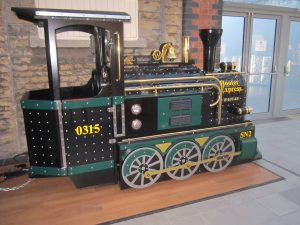
Get on track at the Outlet Centre with the Hooter Express!
I absolutely LOVE a miniature train – of any description – they evoke something so visceral. Whether they’re the ones you sit astride or the ones you sit inside.
In fact – extending the genre – wherever there’s a miniature train, a funicular, a monorail or even a cable car – I have to go on it. This might stem from childhood holidays in Butlin’s chugging round the campsite on Puffing Billy. Or perhaps it’s connected to being of a generation that can remember ‘proper’ trains. Y’know, with carriages, corridors and sliding doors and windows that opened so you could lean out and get soot smuts on your face. And the wonderful artwork and the luggage racks overhead in each compartment.
Oh those were the days – before Dr Beeching came along with his metaphorical axe and the car became king.
Or it could simply be because my inner-child is not just alive but positively flourishing. Mostly likely it’s a melting pot of all those things.
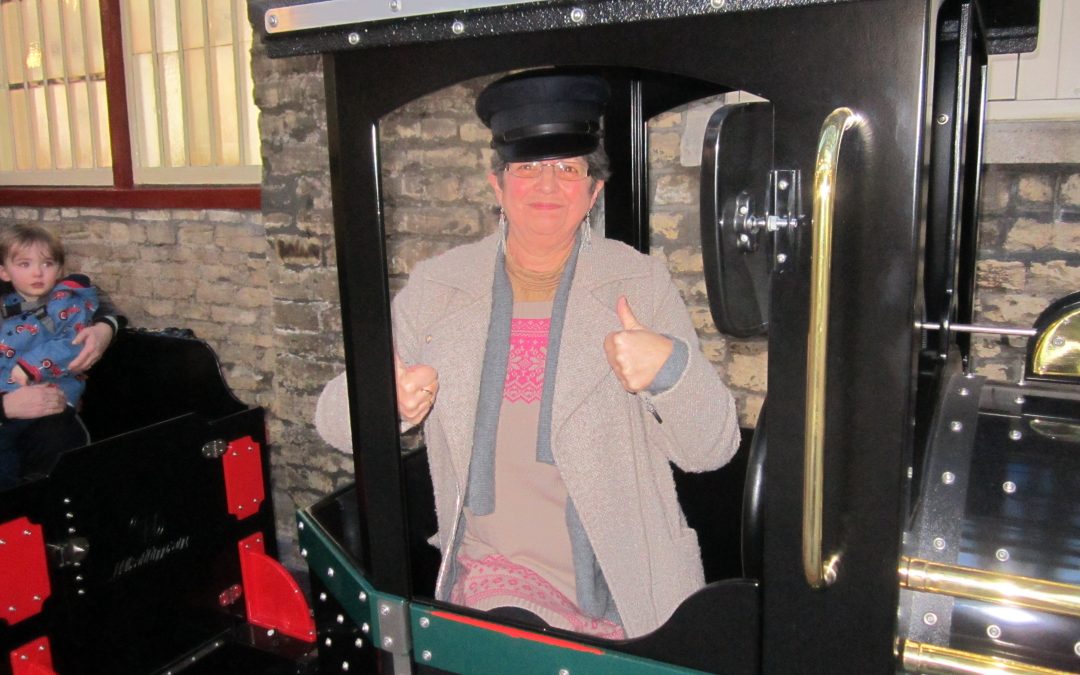
Born Again Swindonian on the Hooter Express
Came into service in 2014
Negotiations to install the train began in July 2014 and it began its service on the 12th December 2014.
Of course there are miniature trains like this one up and down the land. But it’s especially appropriate that there’s one in the Outlet Centre.
It’s the perfect addition to the building that is itself, a fabulous homage to the railway industry that pulsed within its walls and was the lifeblood of the new Swindon that grew up around it.
The train’s tooting good fun and an attraction for children. And it serves as a terrific way to get an overview of the stores. In much the same way as an open-top bus in a new city gives an overview of its attractions so it is with the train. Only it’s what might catch your eye in what shops and where they are.
It’s also a useful way of gauging the attitude and approachability of the personnel in the shops – the ones that engage with the train and its cargo of shoppers as it does its tour around the centre.
Shortly before Christmas 2014 I paid a visit to the studios of Swindon 105.5 community radio for a couple of reasons.
One was to talk to Shirley Ludford, the station manager, about the money-raising initiative the station was running in December.
It was my delight kick the initiative off on the 1st of December with a chat over the phone about my own business, AA Editorial Services. I also had a few minutes on the actual radio talking about this here blog.
Aside from those two bits of excitement I certainly learnt quite a lot. Prior to this visit my perception of local radio was of stations whose programming is peppered with advertising for and by local companies and services. And I’d assumed Swindon 105.5 to be the same.
I confess I hadn’t listened to it – but then I don’t listen to anything very much. I’m not one of these people that can work with noise in the background. If I’m doing anything requiring any concentration then silence is golden as far I’m concerned. But now, having met Shirley at the station and having done a bit of research on community radio as opposed to local radio, I’m somewhat enlightened.
What is community radio?
Ofcomdefines community radio as being radio stations that typically cover a small geographic area. They must be run on a not-for-profit basis. The idea for this form of broadcasting was conceived and piloted in 2002 by the then Radio Authority. In 2004, the Radio Authority’s successor, Ofcom issued a consultation on the creation of Community Radio.
Supporting itself – and others
While some community stations can carry advertising and sponsorship a small number – where they overlap with small commercial services – may not. And Swindon 105.5 comes into that group. As they say on their website: ‘SWINDON 105.5 is one of only 18 Station in the UK NOT permitted to support itself in any way commercially on air.
The Station Manager successfully invited Minister Ed Vaizey to visit the Station in December 2012 and in July 2014. Then, with support from MP Robert Buckland she went to the House of Commons to put the case for a relaxing of the regulations for this Station and the other 17 to ensure more fairness.’
Furthermore ‘SWINDON 105.5 is a non-commercial radio service in Swindon, by Swindon, for Swindon. Licensed by OFCOM as a Not For Profit community broadcasting organisation, with a specific brief and funded by grants, donations, corporate support, fund-raising events and support in-kind.
105.5the only locally-based station that’s broadcasting 24 hours a day. And they take no sustaining external service, unlike all other radio services in the region.
Now while I had no real understanding of Swindon 105.5’s status I was vaguely aware, though ignorant of specifics, of the community activities of the station. And, as this blog is all about celebrating the positives of the Swindon community here we have this post. ‘Cos surely this radio station is a positive for Swindon?
An award winning station
Between them, Shirley Ludford, the station manager, trainer and fund-raiser, and her team have reaped a cornucopia of well-deserved accolades and awards. Both for themselves and the station.
But two particular highlights of 2014 were: 1. The award to Shirley of the High Sheriff’s award for long service to the community. 2. And a visit to the station from HRH the Duke of Kent – 1st cousin to The Queen.
The station prides itself on giving a completely accessible and inclusive service to the town. All the while providing training and volunteering opportunities.
And that’s Shirley something to celebrate? What say you? 🙂 😉