Swindon, as we know, is famous – even infamous – for its roundabouts. Of course there’s the grand-daddy of them all, the Magic Roundabout. Such a rich vein of material is that particular jewel in Swindon’s roundabout crown that it has its own category on the blog.
But as any driver will tell you there are sooooo many more roundabouts in Swindon. Whilst they can’t all be as exciting/terrifying/world-famous as THE roundabout many of them are, nevertheless, quite interesting – if only by dint of what they are associated with and named for.
With this in mind, myself and Jess Robinson, aka @Swindondriver on Twitter, recently went out – in manner of Winne-the-Pooh – on an EXPOTITION to photograph some of them and dig out a little of the history behind their names.
When we started to look at this idea in more detail it became clear that, due to the rather large number of roundabouts in Swindon, we’d have to break them down into sets of some kind.
So if you’re sitting comfortably listeners – then I’ll begin – with roundabouts associated with Swindon’s industry.
But where to begin?
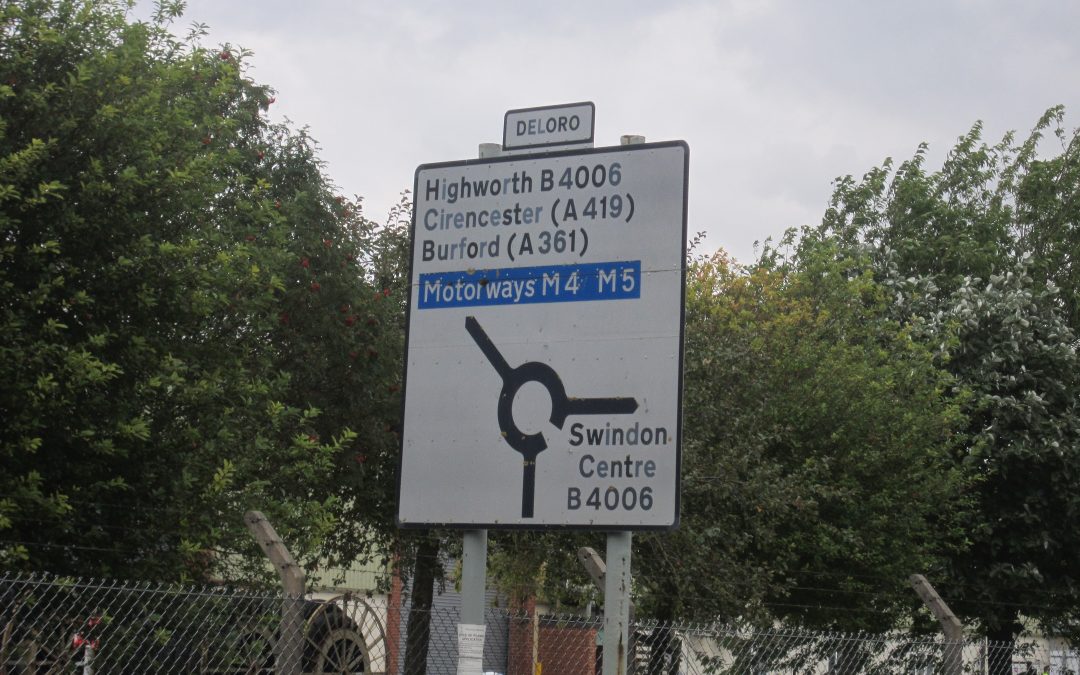
After some discussion we figured the most interesting ones to focus on for the purposes of this particular post were the Supermarine, Vickers, Deloro and Renault roundabouts. Why? Because all of them named for industries/organizations that were once close by to the location of the roundabouts.
Taking flight
I only learned relatively recently of Swindon’s connections with the aviation industry. And that’s where Supermarine and Vickers came in.
Around 1912 the first aeroplane, a Bleriot monoplane, visited Swindon. Then, not so many years later, Swindonians found themselves thrust into the midst of both aviation industry and history when – in 1938 – South Marston was chosen as a shadow site* due to its good communication links and proximity to the skilled workforce of the Swindon’s GWR works. *As Swindon Web explain in one of their articles on the subject, shadow sites were sites intended to provide back-up to the leading aircraft factories in the event of war-time attack.
As the jolly useful Swindon Webwebsite further describes, at length the factory passed to Supermarine. The South Marston site became a shadow site of the Castle Bromwich site in the Midlands and the original Supermarine factory in Southampton.
Little remains of that factory. It’s now an industrial estate and in part of the massive Honda plant there are echoes. The sports club that was once part of Vickers still retains the name.
In addition of course, there’s the Supermarine roundabout and further homage to the Spitfire is paid in the industrial estate in the area.
Deloro Stellite (Kennametal) is a specialist engineering firm – no longer manufacturing in its Swindon factory and now a distribution centre but again the name lives on in the roundabout sign.
Vickers
So where does the name Vickers fit with all this you may ask?
Well, back to our old friend Swindon Web again for enlightenment. It seems that, by the 1950s, the South Marston factory was part of the Vickers-Armstrong (Aircraft) Ltd, Supermarine Division.
There’s much more information on their article about what came off the production line, in particular about the Supermarine Swift. But the link between that and the model of Concorde you see in the pictures below is that, through the 1970s and 1980s, the South Marston site produced components for a range of Vickers products – and for Concorde. Supersonic Swindon eh? Hence the model you see in the pictures below. It would be nice though if someone gave it a wash and brush up… I do really miss Concorde coming over…
Having around Supermarine and Vickers, had coffee in the Spitfire cafe, stopped for a peek at the nearby portrait bench on the South Marston cycle path, one of the figures on which is a Spitfire pilot, and chuckled at the sign for Equity Trading Centre which just looks so very, very random … etc….. we headed off to the other side of town to a have a look at the Spectrum Building. It’s still indicated as Renault on the roundabout sign and indeed I still refer to it as the Renault building – never the Spectrum building.
But whatever you want to call it, this Norman Fostor designed and now listed building, is I think, fabulous. It’s certainly iconic anyway.
The most random and curious sign for an industrial estate ever – Equity Trading Estate
Ralph Bates – Swindon born writer and Spanish Civil War Chronicler
1899: 2000
Ralph Bates 1899-2000
Ralph Bates Swindon Writer Some time ago, in the tourist information centre in Bristol, I saw an information sheet on a literary trail round the city. And that got me thinking that Swindon could surely have such a thing here what withRichard Jefferiesand Alfred Williams. No sooner had I had this thought than what should appear on my social media stream than something publicizing a forthcoming talk at (Museum and Art Swindon)Museum and Art Galleryabout Ralph Bates Swindon writer. No – I’d not heard of him either. And in his day he was rated as better than Hemingway. Who knew?
As it happened I couldn’t attend the Ralph Bates event but I was fortunate enough to know someone, a lovely lady by the name of Monica Timms, who could. And she wrote about the evening and the man it concerned.
A fascinating story not well told in Swindon
I’m sure you’ll agree that this is a fascinating story. As Monica says, here was a writer of international stature who is criminally unrecognised in the town of his birth.
About Ralph Bates Civil War Chronicler
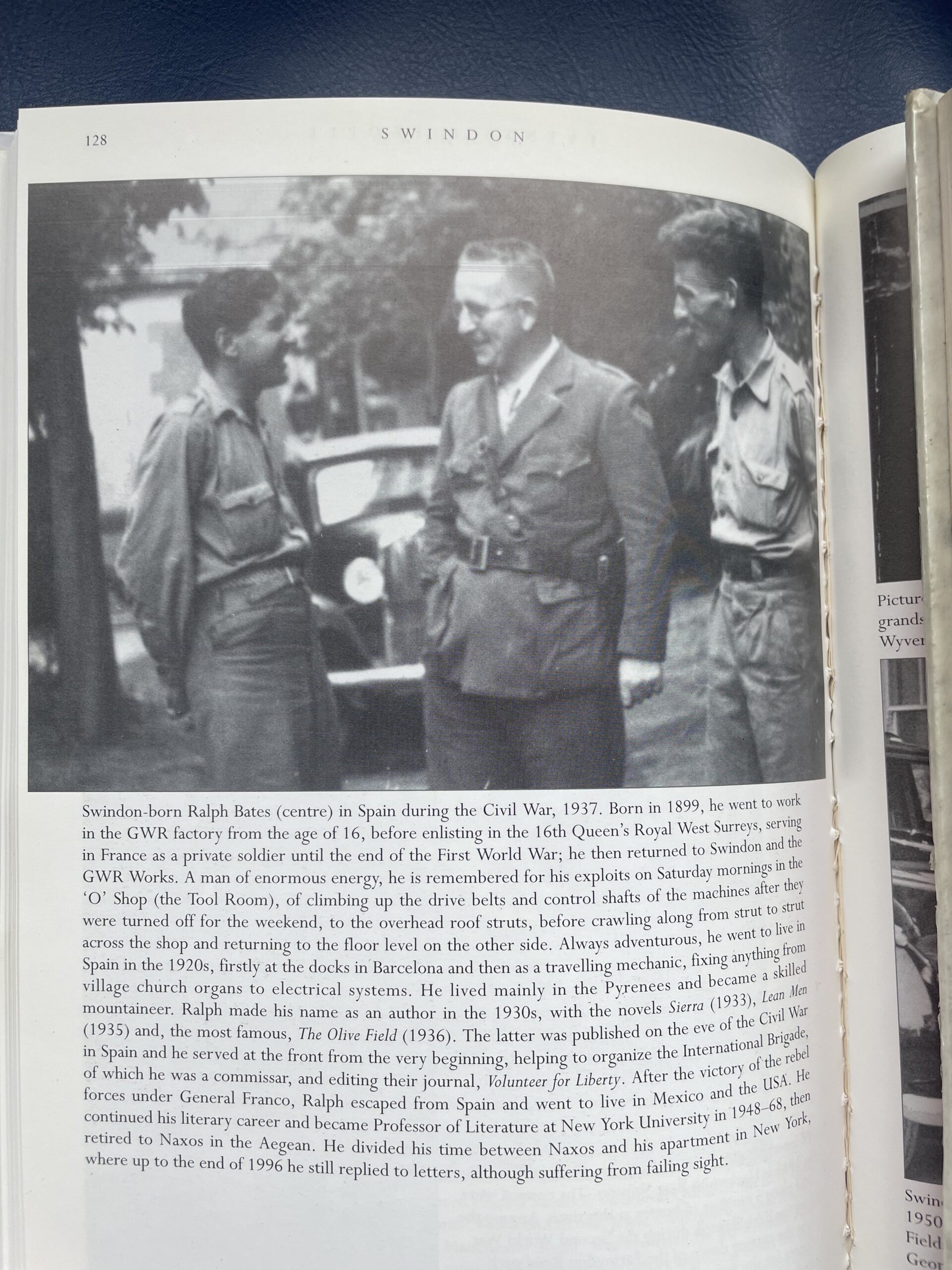
Ralph Bates entered this world in Morse Street in Swindon in 1899. On leaving school, Bates entered an apprenticeship in the repair yards of the Great Western Railway as a fitter, turner and erector. In 1916 he volunteered for service in the Royal Flying Corps but was turned down. He did however serve as an infantryman with the 16th Queen’s Royal West Surrey Regiment achieving the rank of Lance Corporal.
He then returned to the GWR. But, dissatisfied with factory work, went to Paris and worked as a street cleaner. In 1923 he returned to London and married Winifred Sandford, a socialist who taught in London’s East End and they supported the Communist Party of Great Britain (CPGB).
During most of the late 1920s the couple moved around Europe. Ralph also spent some time in Spain working as a seaman and trade union agitator in the docks of Catalonia. The couple eventually settled in the Pyrenees where Ralph became a passionate mountain climber. It’s interesting to note that one of Ralph’s great-grandfathers had been the owner and captain of a Spanish tramp steamer carrying sherry and other goods around the Mediterranean. Ralph often said his first reason for going to Spain was to try and find his great grandfather’s grave in Cadiz.
His first book ‘Sierra’ a collection of short stories about the hardships of Spanish village life saw publication in August 1933. He followed ‘Sierra’ with ‘The Lean Man’ published in two volumes in 1934 – a novel about a country in turmoil. The Manchester Guardian described it as ‘a work of rich nature and of rare experiences. A book of force and beauty…All who are interested in Spain and its present conditions should read it.’
An energetic man
Bates’ energy levels were the stuff of fable. He organised unions and swam and climbed. The Spanish dubbed him El Fantastico! His need for money drove him to take up writing. He was in touch with literary comrades and friends in London. In fact, he appears to have travelled back and forth between Spain and London with London publishers publishing his books.
First book
His first book ‘Sierra’ a collection of short stories about the hardships of Spanish village life emerged into the light in August 1933. ‘Sierra’ preceded ‘The Lean Man’ published in two volumes in 1934. This novel about a country in turmoil is the story of an English Communist agitator Surely Ralph Bates himself – who is ‘up against an overwhelmingly cruel and powerful state?’
According to the Manchester Guardian ‘It is a work of rich nature and of rare experiences. A book of force and beauty. All who are interested in Spain and its present conditions should read it.’
‘Almost 60 years ago he was considered by some to be one of the best writers on Spain. ”He stands out as perhaps the best informed — not even excepting Andre Malraux or Ernest Hemingway — of the chroniclers of the preceding disturbed decade in Spain,” said 20th-Century Authors: A Biographical Dictionary of Modern Literature, published in 1942.’
In 1936 he published‘The Olive Field’ – a story of unsuccessful revolutionary struggles and the life of the cultivators of olive trees.
The Spanish Civil War
When the Civil War erupted he became involved straight away. Being well acquainted with the Pyrenees he guided volunteers across the passes, taking part in fighting with the militias. The International Brigades made him and he edited their English-language paper, ‘Volunteer for Liberty’. In that he wrote pieces about the war for such London journals as ‘Left Review’. His wife, Winifred worked as a nurse.
In 1937 the Communist party sent him to the USA to drum up financial support and to attract more volunteers for the war in Spain. Madison Square Garden’s held a huge rally and Bates became most popular with the American left. At such a meeting he met Eve Haxman whom he married in 1942, after divorcing Winifred.
After the 1939 collapse of the Spanish republic, Ralph Bates moved to Mexico. That provided the setting for his novel ‘The Fields of Paradise (1941).
Ralph Bates resigned from the Communist party with the signing of the Stalin-Hitler pact in 1939. He settled in New York and got involved in trying to get the USA to enter the Second World War. From 1948 to 1968 he taught creative writing and other literary topics at New York University. He also came to the attention of the House of Un-American Activities Committee but refused to testify.
Bates continued to write. His last published novel ‘The Dolphin in The Wood’ (1950) appears to be based on his early years. It ends with the hero travelling to Spain.
“Almost 60 years ago he was considered by some to be one of the best writers on Spain. ‘He stands out as perhaps the best informed – not even excepting Andre Malraux or Ernest Hemingway – of the chroniclers of the preceding disturbed decade in Spain,’ said 20th-Century Authors: A Biographical Dictionary of Modern Literature, published in 1942.”
And yet he remains pretty much unknown in Swindon. Unlike Richard Jefferies and Alfred Williams. And the latter isn’t that well-known.
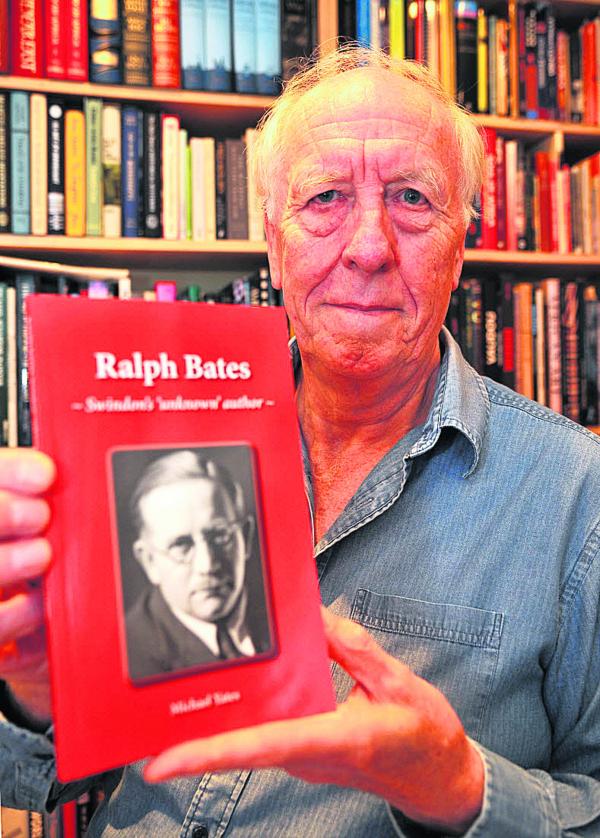
There is though a biography about him by Mike Yates that you’ll find in the library shop. Photo below from the Swindon Advertiser.
During recent months all sorts of posts about the Western Flyer kept appearing on my social media streams. However, absorbed as I was in the final few months of my degree studies, I had neither time nor energy to engage with it all. Well, I’ve finished the degree now. So I find myself with some time to explore some things that had to go on the back burner. And one of those things was the Western Flyer.
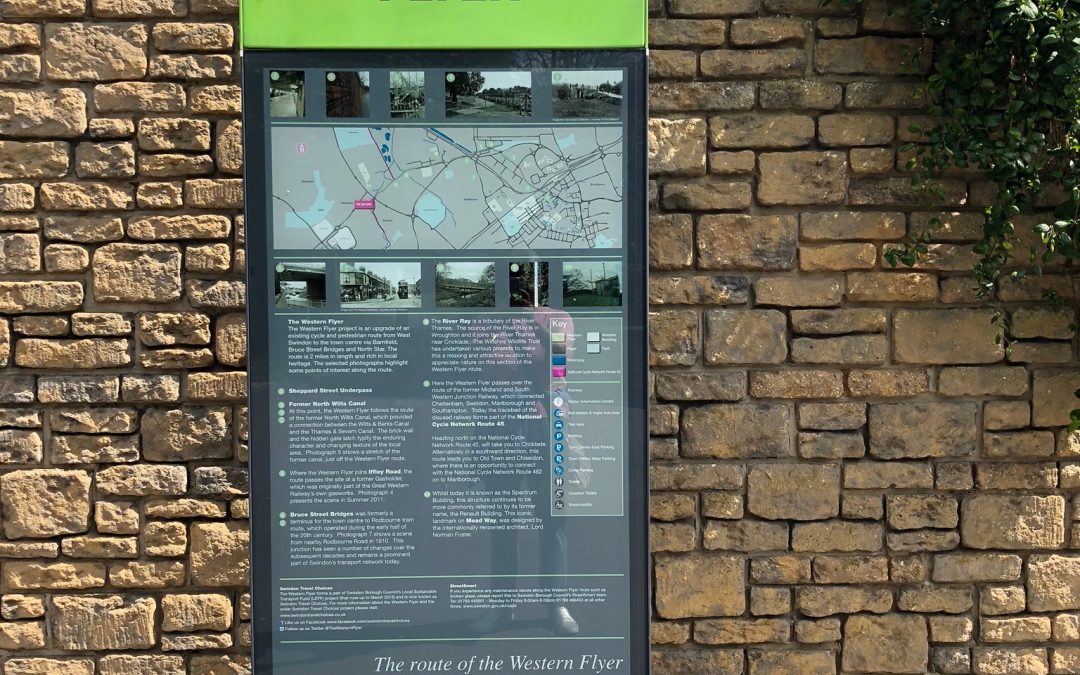
So what is the Western Flyer then? It’s an upgrade of an existing cycle and pedestrian route. It goes from West Swindon to the town centre via Barnfield, Bruce Street Bridges and North Star, bringing you into town across from Holbrook House on Station Rd. It incorporates National Cycle Network Route 45 .The National cycle network is a ‘series of safe, traffic-free lanes and quiet on-road routes that connect to every major city and passes within a mile of 55 per cent of UK homes. It now stretches 14,500 miles across the length and breadth of the UK.
Sustrans developed the concept and coordinates the development of the National Cycle Network, working with Local Authorities and partner organisations to identify future routes and, in some cases, providing the funding to build extensions.
Route 45 of the NCN links Chester with Salisbury via Whitchurch, Ironbridge, Bridgnorth, Droitwich Spa, Worcester, Gloucester, Cirencester and Swindon. The full route travels 270 miles from Chester to Salisbury. It takes you via Shrewsbury, Bridgnorth, Worcester, Gloucester, Stroud, Cirencester and Swindon. Read more information about Route 45 here.
Apropos of the gates below: There’s a better photograph of them on this site which says this about them:
The cast iron gate posts date back to the years when this area was occupied by the huge Great Western Railway factory developed in the mid 19th century by Isambard Kingdom Brunel. It manufactured everything needed to run a railway. I don’t know the age of these gate posts but they pre-date the second world war and may be even older. Originally they provided access to 24 Shop which I think was used for carriage and wagon repairs.
Old gates once accessed GWR worksOld gates once accessed GWR works
On this stream from Swindon Local you can see a picture of the gates as they were in 1953. With the infamous ‘white stick man’ along with some other great pics.
History built in
Other than the gates, and as Swindon Heritage pointed out, the Western Flyer route has lots of history built into it as it ’emphasises the heritage that’s underfoot (or wheel) wherever you go in Swindon.’ Just one of the things they highlighted is the fact that, just a stone’s throw from the Western Flyer, is the workshop where Swindon’s ‘Hammerman’ poet Alfred Williams spent 25 years working for the GWR.
Born in South Marston, Williams published six books of poetry and a series of books about the area. He’s renowned at national level for his contribution to preserving the lyrics of folk songs. I was recently on the top floor of the central library chatting with the lovely peeps in the Swindon Local section where I saw a photograph of Alfred Williams.
On a personal level I’m interested to note that Alfred’s wife’s maiden name was Peck. Because my maiden name too is Peck and it’s not a name one comes across much. Hardly at all even. Except for in Suffolk, which is where my dad originated, where there seem to be millions of them. In my entire life I have only come across two other Pecks – aside from relatives in Suffolk. With Alfred Williams’ wife making three.
Whenever I go meandering along the Western Flyer, I’m struck by the astonishing amount of greenery, natural habitats, bridle paths, play parks and open spaces there are most everywhere one goes in Swindon.
I’ve written about the West Swindon sculpture trail in several different ways in this blog. This West Swindon Sculpture Trail Travelogue though is a bit different. It’s a more literary piece that I wrote as a piece of coursework for a travel writing module I took as part of my degree level English studies.
“Sculpture to me is primitive, religious, passionate and magical—always affirmative.” Barbara Hepworth (1903–75)
Nexus by Hideo Futura at Freshbrook
The West Swindon Sculpture Trail or A Quest Becomes a Blog
Twice in year two of my BA literature studies I encountered a quest. In ‘A Handful of Dust’, Evelyn Waugh sends his chief protagonist off on an ill-fated quest to seek another Eldorado. In ‘Coming up for Air’, George Orwell packs George Bowles off on a nostalgic, and similarly ill-fated, quest back to his childhood.
So it was that, in one of those curious ‘life-imitating-art’ symmetries, I found myself on a quest of my own. Well, two quests actually as it turned out. Quests it seems are like buses: you wait more than half a lifetime for one to come along and then two arrive at once. If only one could say the same of trains.
Quest 1: dispelling negativity about Swindon
A spur of the moment decision early in the summer of 2013, to set up a Swindon centred blog, began as a conscious quest to dispel the all-too-commonly held belief that the town is a dull, soulless urban landscape bereft of culture.
Given the sometimes dispiriting skin of Swindon it’s not hard to see how one might draw this conclusion. But peel back that skin and juicy segments of culture, leisure, parks and a varied industrial heritage nestle there, ripe for sampling.
So it was that, tired of the constant dribble of negative opinion about the town I have made my home, and come to love, I decided to mount an offensive and redress the balance. My weapon of choice – a blog. It is said, after all, that the pen is mightier than the sword. Or in this case – a keyboard and computer.
Quest 2: seeking out the West Swindon Sculptures
To give my personal homage to the town a starting point I conceived a non-definitive list of ’10 things to celebrate about Swindon’. I intended this list as a shout-out about things that struck me as being positive attributes when I first pitched up here twenty years ago and which, for the most part, remain so now. High on this list came the public art.
Perhaps surprisingly, given its any-town status, its enormous urban expansion and generally derogatory media portrayal, Swindon possesses a rich cultural landscape just one feature of which is its abundance of public art. Back in my corner of Derbyshire the nearest we got to public art was an old pump, a Cenotaph and a redundant pit-head winding wheel. Indeed I was entirely ignorant of the term public art until I began blogging about it. Hence I was quite fascinated by this ordinary town with its extraordinary punctuation of sculptures and statues.
So having found the blog’s beginning, I inadvertently triggered a secondary, interrelated quest of exploring Swindon’s sculptures. And herein began a voyage of urban discovery. Not an epic journey on the scale of Columbus looking for his New World but nevertheless significant in the newness it revealed in my own world.
A Blog’s Starting Point
Needing to start the aforementioned shout-out list somewhere I settled on Swindon’s sculptures. This for the entirely pragmatic criterion that two of them are situated in close proximity to my home. Internet research on these art works proved interesting.
These two sculptures turned out not to be random isolated pieces as I’d assumed. Rather they formed part of an entity, a five-mile circular sculpture trail installed when the extensive West Swindon suburbs were built. And I had absolutely no idea of its existence, despite having lived here for twenty years.
It was clear now that, in the interests of blogging research, I was going to have to do this sculpture trail when the opportunity arose.
In ‘The Quest becomes a Trek’, Pico Iyer writes that travelling should be done alone. Ignoring that advice I decided an impending visit from a University chum was a good opportunity to explore it – I needed someone useful with a map for a start.
Hence, in the early summer of 2013, with exams done and the sun actually shining for more than two consecutive days, we made a plan to go exploring sculptures in uncharted territories of West Swindon. Here be dragons!
Diana Dors
First on the list for our enquiring minds and eyes was a statue in bronze of Diana Dors, a daughter of Swindon who grew up to be a famous film-star. A larger-than-life character, often given the epithet ‘Britain’s answer to Marilyn Monroe’: hence the fittingly larger-than-life homage in bronze outside my local cinema complex.
Though I’d seen this one before, together we spent some time studying and discussing it. After some debate our conclusion was that whilst she was undoubtedly in a fitting location, it was a pity the statue wasn’t especially flattering, being more caricature than portrait. Moreover, it was a greater pity still that some wag had stuck chewing gum under one of her nostrils giving the effect of a giant bogey hanging there. The immaculately groomed, old-school glamour puss that Miss Dors embodied was no doubt never seen in such a sloppy state so it’s rather a shame that vandalism and neglect are letting her down now.
How the Mighty Fall – Tim Sandys-Renton 1989
Anyway, having duly debated and digested Swindon’s very own blonde bombshell, off we went in search of the next one on the trail, ‘How the Mighty Fall’.
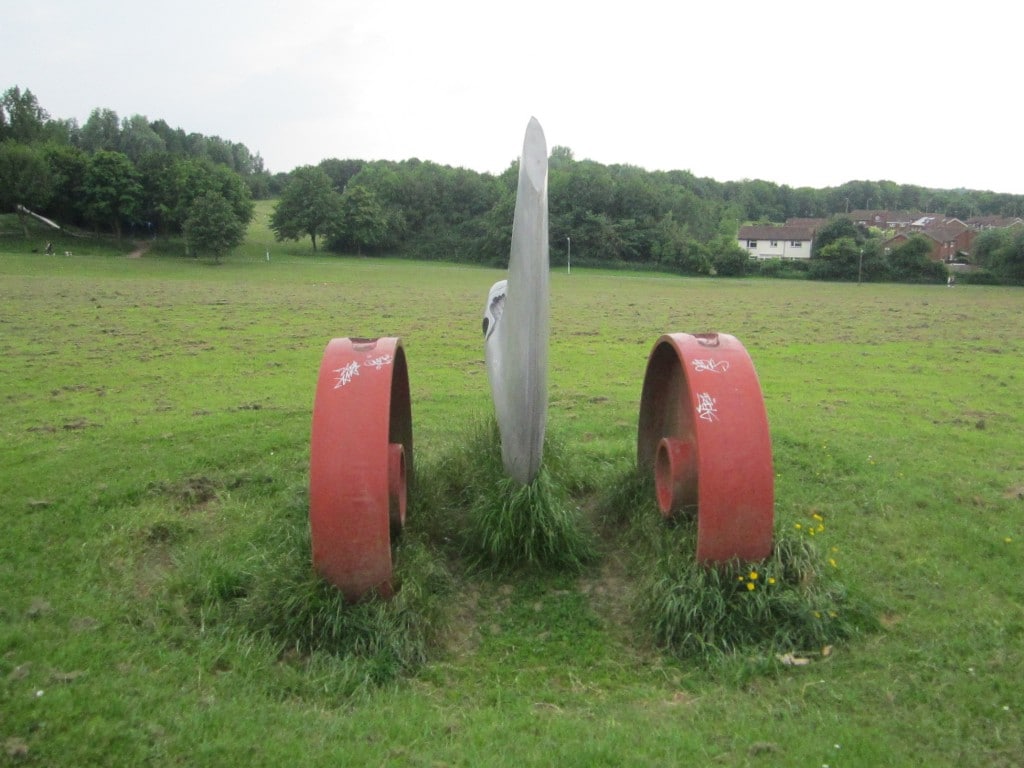
Installed in 1989 its creator invited observers to transport themselves into the future and view it as a 20th Century archaeological artefact. An envisioning made reality with the turn of the century and an invitation the visitor to this shape-shifting sculpture is compelled to accept as it neither willingly nor easily relinquishes its meaning.
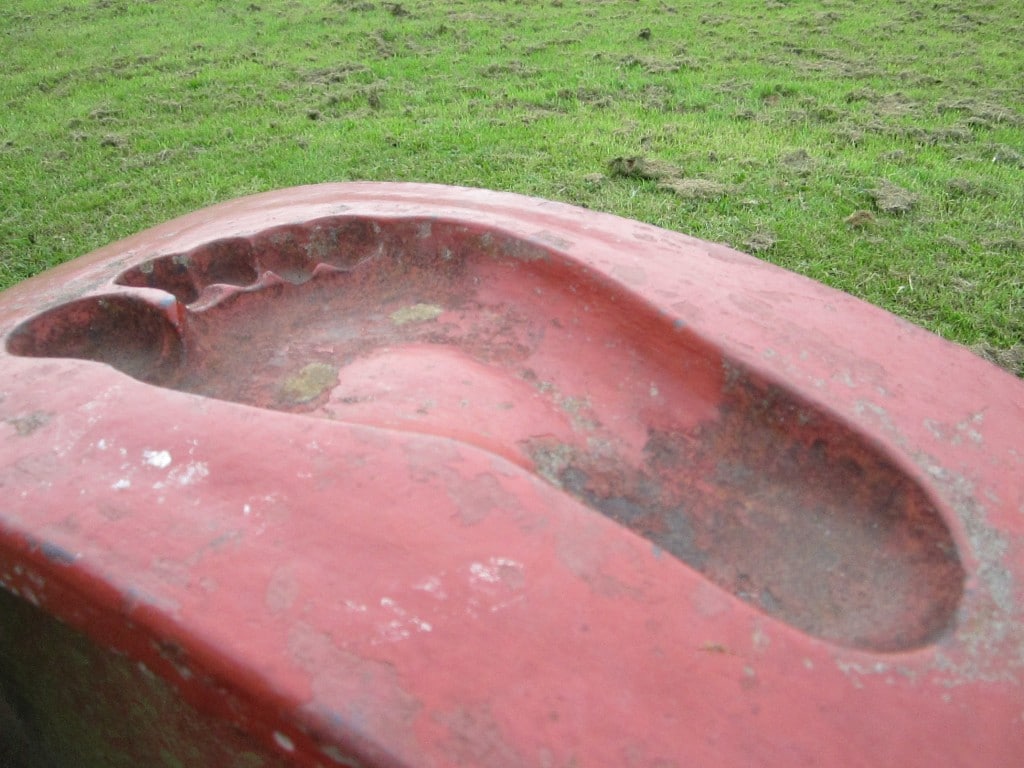
Viewed from one angle you can see a crash-landed WWII aeroplane, a perception encouraged by the imprint it bears of arms and hands cupped around a mouth that appears to be screaming. But walk right round to the other side of it and it changes completely: now there’s a torso of man imprinted on the metal. Viewed from behind though it becomes something else entirely, conjuring an image of a slender, silver, slither of a carriage with red wheels either side of it, emanating a sense of something alien, a sense of alterity.
Side view of ‘How the Mighty Fall’
How the mighty Fall – 1989
How the Mighty Fall – 1989
Not only is Swindon in possession of a rich, albeit often well-hidden, cultural landscape, it additionally benefits from a vast number of green spaces, somewhere in the region of two hundred I believe. It’s astonishing. Some of these are formal parks and gardens, some of them – as in the case of Lydiard Park – once formed the estates of minor aristocracy. But others are simply large areas of open space.
It’s striking that, a mere five-minutes walk from the statue of Diana Dors, en route to the next sculpture, you find yourself in one of them. Once there you can immediately forget that you are actually in the middle of a sizeable conurbation. It was in this particular green space, as my companion and I meandered along this barely-known sculpture trail, that we came upon an outdoor gym and a play-park, both of which were new to me. Herein we met the first distractions to our quest. Well, slides are there to be slid down after all.
Eventually tiring of the dubious pleasures of the outdoor gym and the play-park and having given ‘How the Mighty Fall’ all due consideration we followed the map to sculpture number three en route to which further discovery ensued. The walk took us through the Bramptons, a Stepford-like housing estate the existence of which I was utterly ignorant. It’s worrying. How can one live so long in a place and have so little idea about what is out there – particularly not a housing estate like this one with a swimming pool and a clubhouse not to mention impossibly neat hedgerows, shrubbery and squeaky-clean pavement and paths. And of course no graffiti. One imagines those walls would repel any such endeavour. It really was most discomforting.
In search of White Horse Pacified
Number four on the trail, a huge blue and white concrete horse with rider, billed as a homage to the numerous white horses carved into the hillsides of Wiltshire we found to be in a sorry state of repair, it being covered in graffiti and overhung with branches from the surrounding trees. Quite forlorn he was.
The walk from him to sculpture number five took us through bits of the old/real Swindon tucked away amidst the 1970s and 1980s developments, jewels of a past time waiting to be chanced upon. We passed an old farmhouse (Lower Shaw Farm) once part of the Lydiard estate, but now a city farm thing with chickens roaming about and ancient caravans in the yard. It’s the sort of place that knits things with yoghurt. Many people love it. Close by there’s a converted barn with a lovely stained glass window in its side. I later discovered this too had been a farm on the Lydiard estate.
White Horse Pacified 1989 – West Swindon – View from rear
Fruitful chance encounters
Echoing Pico Iyer’s sentiment on traveling being best done alone, Jonathan Raban has observed that lone travelling puts you more in the way of the chance encounter – and there may well be something to be said for that. Indeed, we had no lack of them as we sauntered along. Whilst traversing yet another stretch of green space we fell into conversation with a chap out walking his dog. In the course of this exchange we discovered he and my companion shared an interest in ukulele playing and that POWs had been billeted at Lydiard Park in WWII – a facet of Swindon’s rich history of which I had hitherto been ignorant. In one of those odd coincidences that punctuate our lives, what should pop onto my Facebook timeline the very next day but a photograph of those self-same POW barracks?
Hey Diddle Diddle
My bus ride home from the town centre takes me past the garden of a house that has always puzzled me, having as it does a giant stone cat in the front garden. Why, I’ve asked myself for the last twenty years, would someone do that? Well, as it turns out, they didn’t. What I’ve spent two decades thinking was a rather grandiose albeit grubby garden ornament installed by a cat-obsessive turns out to be number five on the sculpture trail.
Entitled ‘Hey Diddle Diddle,’ it’s actually a representation of the children’s nursery rhyme. Stomp all over the lawn on which it sits, as we did, and you see that each side of it represents a different facet of the rhyme.
The front end of this sizeable plinthed sculpture, glimpsed all these years from the number 1A bus, is the cat of the rhyme – hence my erroneous assumption. But go round the back of it and you will find the cat’s bovine companion whilst each side respectively features the rhyme’s little dog laughing and the dish running away with the spoon. It’s a delightful piece of work, intentionally and appropriately placed in this suburban domestic setting. Though sadly and direly in need of a wash and brush up.
Rear view of hey diddle diddle – cow
A defamiliarizing experience
This being a pleasant summer stroll in shorts and sandals rather than an arduous trek involving sleds and snow-shoes we didn’t require the fortitude and strength of character of Scott and Oates crossing a frozen continent to plant a flag for Queen and country. Not with several pubs and shops along the way. Nevertheless much that we’d encountered thus far as we sallied forth around West Swindon had been a defamilarizing experience that provided literal and metaphorical revelations. Some things were revealed to me for the first time whilst many familiar things were seen with new eyes.
A Eureka moment – I make a connection with Nexus – as is appropriate
In approaching and reaching the last sculpture that my companion and I visited as by now we’d been out for four hours and dinner and red wine were beckoning – there was one final eureka moment and somewhat thought-provoking chance encounter.
Walking to this final one on our walk, though not the last of the trail, and reading the information on it, still it didn’t register with me. Still I didn’t make the connection with the words on the page and what was shortly to be in front of me. Only then did I realize.
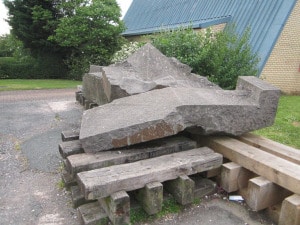
This particular sculpture is five minute’s walk from my home. Situated alongside my GPs surgery and the local Tesco Express I walk past it several times a week. And all those times, in all those years, I’d seen but never, until that moment, properly noticed orconsideredthis sculpture comprised of big blocks of carved stone and railway sleepers. And I felt quite chastened that I’d given this artefact so little thought.
As it often has children climbing all over it I might simply have viewed it as an elaborate, low-level climbing frame. But now, in possession of its name, it suddenly made sense. Entitled ‘Nexus’, meaning link or connection, made of railway sleepers and situated at a point where one village centre connects with three others this previously ignored sculpture took on a new mantle of significance.
A Heritage Site?
In spite of this I wouldn’t say I had that same un-definable emotional response to it as I did to some of the others of this set. But at least now I understood something about it. As we were photographing it, a gentleman out taking the summer evening air with his young son approached us. He strolled across and commented that he’d no idea he lived in a heritage site. Which brought me up short rather and caused me to take stock. Because in fact, at twenty-five to thirty years old, heritage is exactly what these unloved and unexplained sculptures are.
A West Swindon Sculpture Trail Travelogue – in conclusion
According to the information obtained from the Internet about this sculpture trail, the five miles the trail covers should be completed in two hours at a leisurely pace. Oh dear. We were at it for nearly four hours and we still didn’t get them all done.
No doubt that’s because we took time out to slide down slides; pump some iron on the outdoor gym; get involved in encounters en route; stop for ice-cream; have a beer at a pub and, in the fine tradition of all good explorers, veer off course slightly. So was this a sculpture trail fail then? Well, no, it wasn’t. We certainly had lots of fun and I got a number of blog posts out of it. But more importantly than that it made me realize just how much I, well most of us I’m sure, see without ever properly noticing. Why? Because we’re too busy hurtling here and there and never have or never make the time to properly absorb the gems, whether hidden or in plain sight, that are around us. Which is a huge shame.
William Henry Davies expressed it well when he wrote: ‘What is this life if full of care/We have no time to stand and stare?…’
Last night I was in Swindon Arts Centre for the first time in ages for a Swindon Festival of Literature event. And I haven’t attended anything in that for 3 years as it’s always clashed with summer exam time. But having sat my final, final exam the previous day I was up there! Whenever I visit either of the theatres in Swindon, I reflect on how fortunate we are to have two such fabulous theatre venues.
So long is it since I was in there and so absorbed have I been in my degree studies that the transformation of this 200 seater, intimate theatre into a local cultural hub had passed me by. There is now an improved cafe and bar area and the Old Town library is now located in there too. In addition a new studio space has been created for small-scale cultural events. You can read more about all of that on Swindon Web.
So it’s all really great to see the Arts Centre at the hub of the local community. And I can see how positive that is for all concerned. But I can’t lie. I do miss the old bijou, unreconstructed Arts Centre. It had a vintage condom machine dispensing boxes of art for £1. Oh I flipping loved that. Please can we bring back the art boxes?!
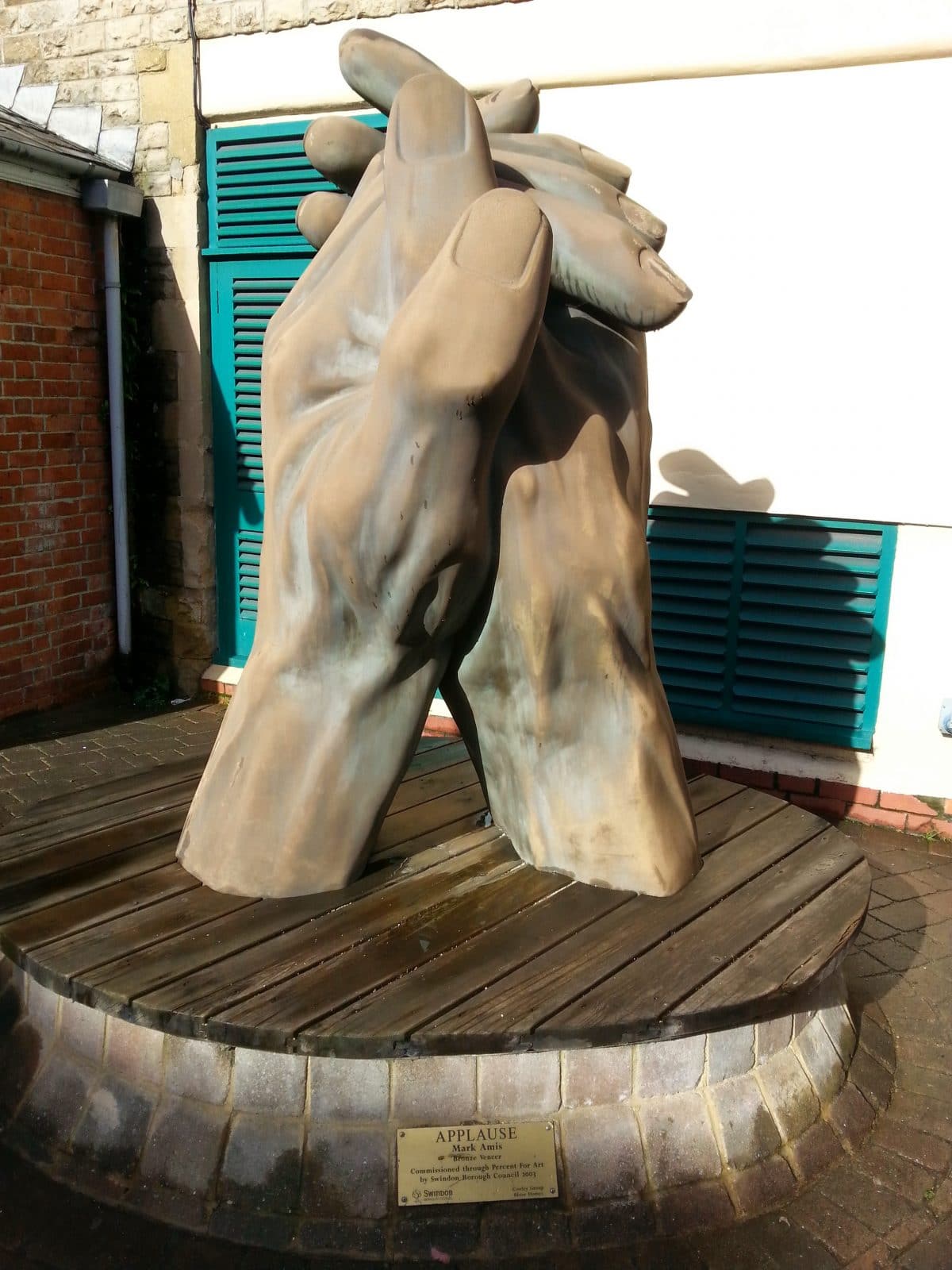
‘Applause’ – at Swindon Art’s Centre You’ll find the sculpture in the forecourt of the Arts Centre. The work is by Mark Amis and is described on the plaque as ‘bronze veneer’. It’s dated 2003.’
In the same year the refurbished and enlarged Arts Centre was reopened by poet Pam Ayres. The cost was £665,000
Management
Management of the Arts Centre recently moved from Swindon Borough Council to the same hands that manage the Wyvern Theatre– so here is a complaint: £5.70 for a glass of wine?!! Seriously – this is Swindon not the bloody Home Counties. It’s too much and it’s taking the p!ss.
But over-priced vino collapso aside the Arts Centreis well worth a visit for its excellent programme of events. There’s parking only 5 minutes walk away and Old Town has a plethora of bars, cafes, and restaurants. Who knows – you might get a glass of wine somewhere that costs less than the price of a bottle…?
Opened in 1956 as the Arts Centre it’s as old as me in that particular manifestation- blimey! But being the home of the Arts Centre was not the building’s first role in Swindon life. For the Bradford Hall used to be a dance hall. Other than that though there is a some interesting wartime history linked to the building.
Swindon local have a picture of a ticket to the opening ceremony which you can see here.
American servicemen
Swindon Web carry a great article in their Swindon History section about the presence of Amerian Servicemen in and around Swindon during the war.
It’s a really interesting article which I urge you to readso I won’t quote it verbatim. But will share this snippet of information about the military unit, the 203rd General Hospital set up to tend to casualties of the second world war Normandy campaign:
“Its staff of more than 600 stopped off in Swindon for a month in the run-up to D-Day (June 6, 1944), and their written memories, which were first published in print in the 1990s but are now partly available online, paint a vivid picture, from an American perspective, of life in Britain during the war …
While personnel were dispersed to their billets, an administrative headquarters was set up at 25 High Street (which no longer exists). But the Bradford Hall in Devizes Road – then a dance hall and destined to become Swindon Arts Centre in 1956 – became the staff’s main focus. In particular as three tents were erected as a temporary mess, on land behind the hall.’
So knowing that, the next time I visit the place I will have a whole new perspective on it.