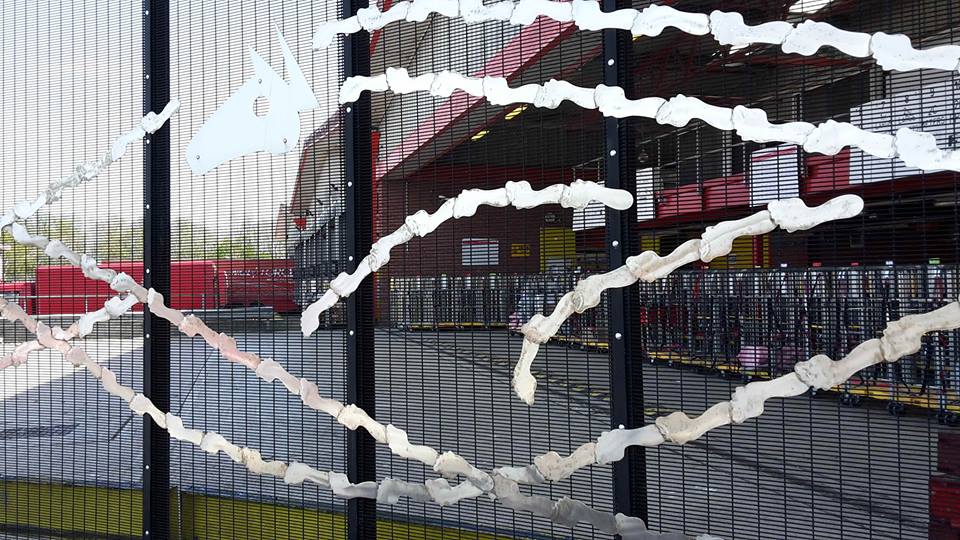
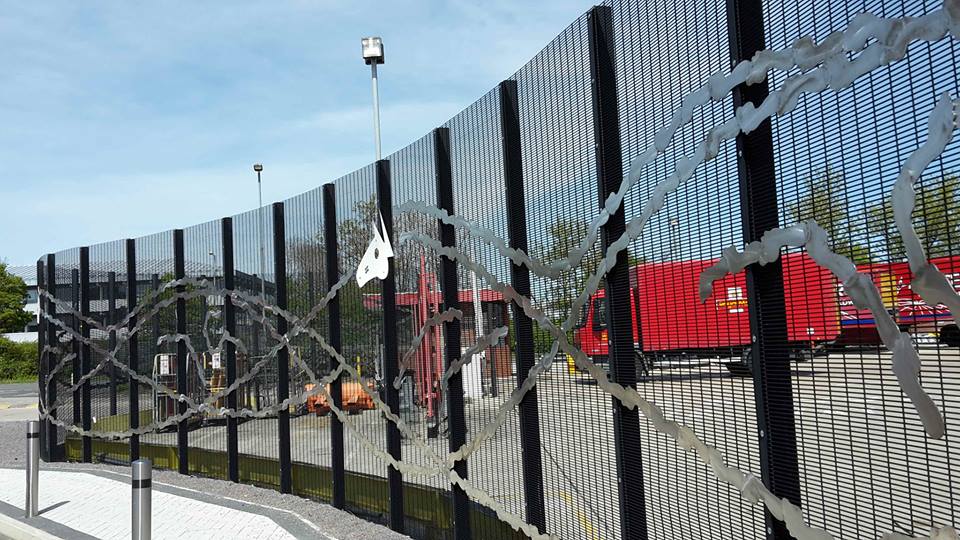
Feet Artwork Dorcan Mail Office Not being a driver I don’t generally get to the Royal Mail sorting office out at Dorcan. But recently I was there with someone else. I was pleasantly surprised to see this feet artwork on the perimeter fence of the Dorcan office.
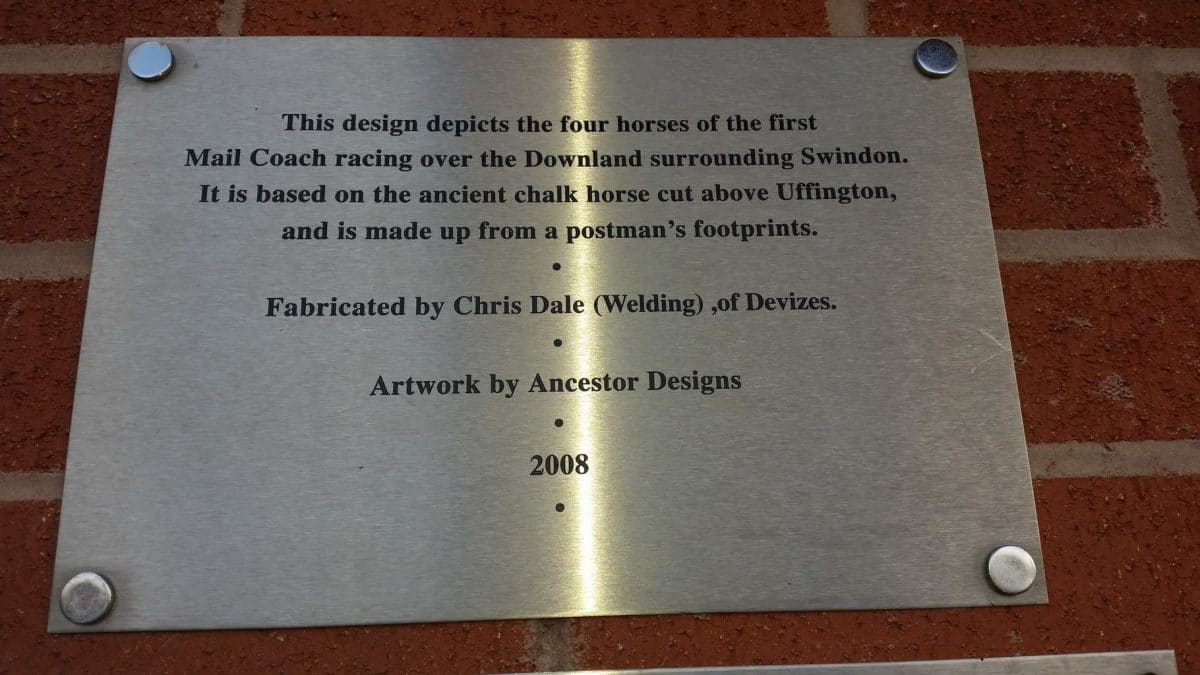
Now I’ve searched and searched on Google for some more information about this artwork and its creators but I’ve drawn a blank. So all I have to offer is what’s on the signage:
“This design depicts the four horses of the first mail coach racing over the Downland surrounding Swindon. It is based on the ancient chalk horse cut above Uffington and is made up from a postman’s footprints”
I like it. I think this Feet artwork on Dorcan Mail Office is interesting and rather clever. And it definitely brightens up a dull, utilitarian perimeter fence.
And this one courtesy of Debs Donkersley:
Origins of the first mail coach:
“When a public postal service was first introduced in 1635, letters were carried between ‘posts’ by mounted post-boys and delivered to the local postmaster. The postmaster would then take out the letters for his area and hand the rest to another post-boy to carry them on to the next ‘post’. This was a slow process. And the post-boys were an easy target for robbers, but the system remained unchanged for almost 150 years.
John Palmer, a theatre owner from Bath, had organised a rapid carriage service to transport actors and props between theatres. He believed that a similar scheme could improve the postal service. In 1782, Palmer sold his theatre interests, and went to London to lobby The Post Office. Despite resistance from senior Post Office staff, who believed the speed of the mail could not be improved, William Pitt, the Chancellor of the Exchequer, accepted the idea. An experimental mail coach journey, undertaken at Palmer’s expense, started from Bristol on 2 August 1784, at 4pm. It reached London at 8am the next day, exactly on schedule. A journey that had taken up to 38 hours now took just 16.”
Not having got any small children I’m not au fait with the town’s play parks. However, I have a friend with a small daughter and sometimes visit a play park with them. And a few weeks ago we went to the Angel Ridge play area.
The who, the what, the where
You’ll find the Angel Ridge play area on the site of Swindon’s original NHS hospital, Princess Margaret Hospital, now redeveloped as a residential housing site.
According to Building Construction Design – http://www.buildingconstructiondesign.co.uk/news/angel-ridge-play-area-swindon/– ‘Swindon Council had the task of creating a challenging and exciting play area that referenced the rich heritage of the site, keeping the local residents on side and also improving links with the surrounding communities. They worked with Timberplay, selecting the best products to suit the site and its heritage.’
As the article goes on to say: “Angel Ridge is a linear development, situated along a ridge, hence the name. When embarking on research for the site, Swindon Council Landscape Architect, Andrew Norris found that the bones of an Ichthyosaur (marine dinosaur) were discovered nearby – that went on to find fame on Blue Peter. This pre-historic relic inspired the use of fossils throughout the site, with hidden replica fossils secreted in the sand area and a giant ammonite heralding the start of the play site. “
One of the key features of the site is the weighty Turning Stone, a huge 5 tonne boulder which even small children can easily rotate. This is personalised with an inscription, a poem by Jane Evans that summed up the overarching themes of the scheme:
“Up here, Nudging the sky, You’re no more an a pinprick On the timeline Stretched taut By lynchet and tumulus d the tremendous Secrets of the rock Time out of mind Under turf and furz”
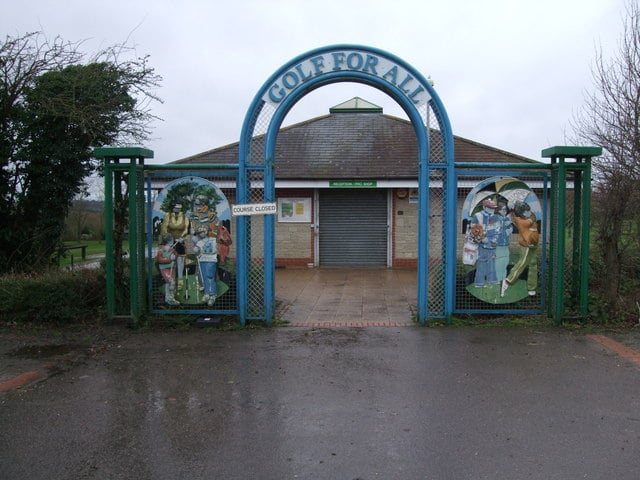
All about golf in Swindon. Now Mark Twain famously referred to golf as a ‘good walk spoiled’. I’m not entirely in disagreement I won’t lie. Many quips and quotes surround golf and here’s a couple more of my faves:
“Hockey is a sport for white men. Basketball is a sport for black men. Golf is a sport for white men dressed like black pimps.” Tiger Woods. And if you hark back to the way golfers dressed in the 1970s in particular you can see exactly what he meant.
“I regard golf as an expensive way of playing marbles.” ― G.K. Chesterton
Golf in Swindon
Now this golf in Swindon blog is a guest post from Lee who I ‘know’ from Twitter. I’m delighted to have it. Because I do like to cover as many aspects of Swindon life on this blog as I can and golf is surely one of them?
I gotta say that I hesitate to refer to golf as a ‘sport’. Surely it’s not reasonable to call a sport, any game where you can progress in a motorised cart, and that can be played by overweight middle-aged men with cigars in their mouths. But, for the sake of argument, I’ve categorised this post as ‘This Sporting Life’. Reluctantly.
Lee’s interests in sport
Lee takes an interest in sport. He’s written for the blog before about Swindon Town Football Club for a start. So thanks to Lee for being my roving (coughs) sports correspondent and sending me these lines and the photographs. Lee also has a keen interest in history, which is reflected in his musings.
Among his photographs is one of Swindon’s own golfing success story: David Howell. Now I hail from Worksop – home of another very successful golfer: Lee Westwood – his mother used to be my chiropodist. She was always full of stories of ‘R Lee’. Time was I had a partner that was a keen golfer – I used to threaten to get a T-shirt printed with ‘David who? on one side and ‘I HEART Lee’ on the other. But I thought we might have been blackballed or whatever it is.
Anyway – with no further ado – Lee’s words:
“I love golf but to be fair I’m not that good at playing – not exactly a natural you might say.
In the Swindon area we’re spoilt for golf courses. There’s Ogbourne, Marlborough, Bowood and the lovely Wrag Barn at Highworth. Then of course there’s Brinkworth and South Carney. The 9-hole course in Highworth presents quite a challenge but the courses at Moredon and Coate are 3-par and friendlier.
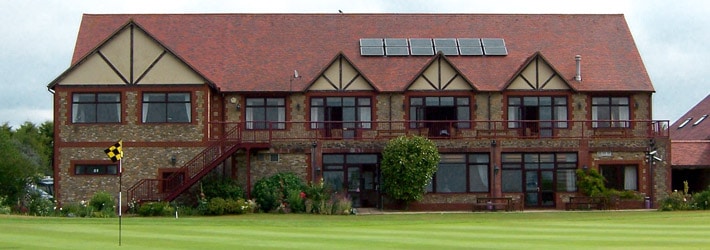
All these courses have their histories but none so much as the jewel in Swindon’s Broome Manor Golf Complex.
Ancient woodlands
Here there are hidden acres of woodland not far from the ancient villages of Hodson and Coate.It really is a golfer’s paradise. Will it remain so with the plans currently afoot for a 50 room hotel at the complex?
Many good players have paced the fairways at Broome Manor – or Broome as it gets called.
A well-known name in the golfing world is that of Swindon born David Howell. Continuing to shine, David fine-tuned his game at Broome Manor. A six times winner in Europe he still is in the worlds top 130….with power to add hopefully when he returns from injury. David’s achievements with the niblick have been recognised at the club with an annual Pro-Am in his name. Here he is action. Oh and it’s in the rough … ! 😉
David who?
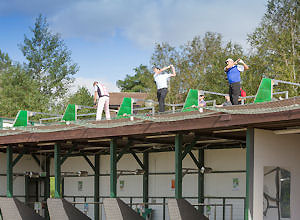
The driving range at Broome was opened by none other than Ian Woosnam – and to throw in a bit of history, the Old Broome Farmhouse still stands – a remnant of the 1000 year old manor.’
There’s lots of fab information here about Swindon’s various manors. I was going to quote some bits but the coding on the site won’t allow it. So if you’re interested you’ll have to visit it. http://www.british-history.ac.uk/vch/wilts/vol9/pp119-124
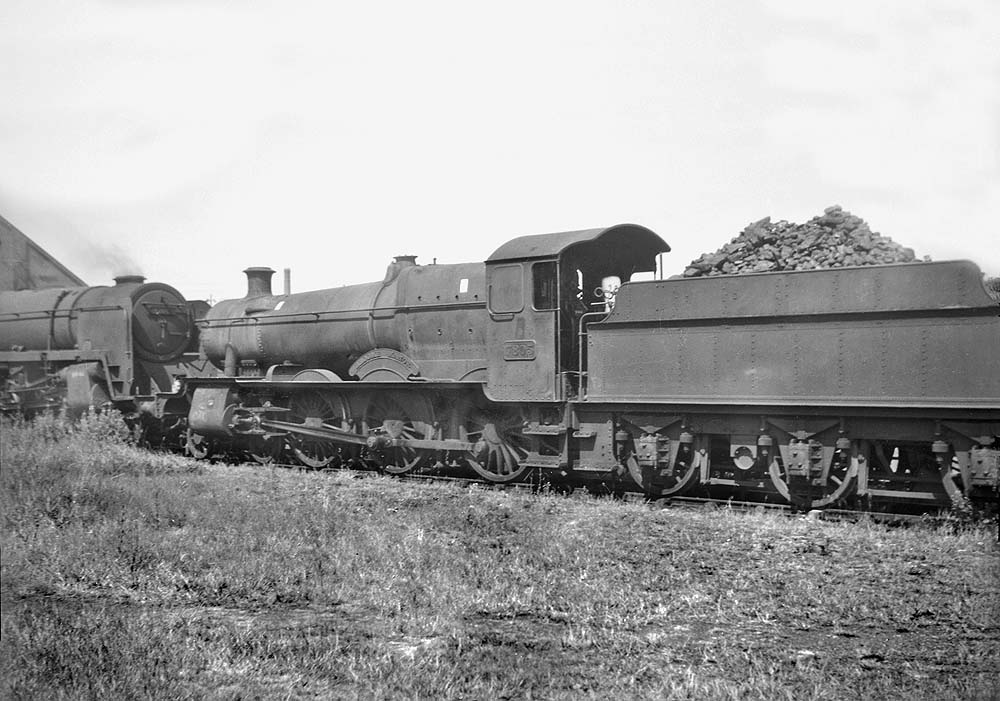
The train now standing … the Locomotive Broome Manor built in Swindon in 1938
‘In filthy condition ex GWR 1938 built 7805 Broome Manor lies parked at the back of Tyseley shed.
Although the back of Tyseley this and a parallel line extended to the main Warwick Rd in Birmingham affording a view of several locomotives that were in steam without the need to trespass. The shed had two turntables and these overflow lines were an extension from them. 7805 had certainly visited the coal drop before being stabled here.’
Says Lee: ‘This is a negative that I found in an old envelope, I think someone gave it to me in around 1969.’
Straight down the middle
Now to round this off, and despite not being a huge golf fan, I can take pleasure in a novelty song. And here we have Bing Crosby and Bob Hope from 1957 and ‘Straight down the Middle’. They wish. As the man says: Fore!
It’s only a few days since Martin Parry’s pièce de résistance ‘Railway Town Film’ premiered at the Wyvern Theatre to a sell out crowd. I had the privilege of being on the Q&A panel after the film – and what a great film it was. SUCH a wonderful testament to its maker and its subject matter: Swindon and its people.
It really was very moving and inspirational. It drove home just how much Swindon has to be proud of in its history and makes clear just how VERY special the Mechanics’ Institute is – make no mistake – that place is about SO much more than the building. It’s about the very heart and soul of New Swindon.
All of which makes a neat enough segue into other video footage about Swindon’s railway workers collected together by a chap I’ve come into contact with via Instagram.
His name is Mark Keen – known on Instagram as Sharpbluepix. Mark has YouTube and Vimeo channels that are worth taking a look at.
Mark was the first person in Swindon to get Instragramming I believe. He beta tested the app in 2010 before it got sold to Facebook and when it was only on Apple devices. So scrolling back through the #Swindon hashtag his are the first pictures.
He’s got some films online form the now defunct Swindon Cable (see below) – many featuring the GWR works.
Another 6 Swindon-related songs & why you should listen/watch
Hello listeners!
Following on from an earlier post listing 5 Swindon related songs here’s another 6 Swindon-related songs.
No 1 and No 4 are previously unknown to me. Clearly this Swindon-related music malarkey could go on forever so enough has to be enough with two posts on the theme.
To the moon ‘Robocop Spectrum 128K’.Why listen/watch? Because it was filmed at the marvellous Museum of Computing in Swindon that’s why! No 6 on my list of 10 things to celebrate about Swindon. I love this – I think it’s fab.
2) The Moody Blues back in 1969 – Tuesday Afternoon. Why listen? Apparently it was written under a tree in Lydiard Park. So I’m told.
3) Anything by Supertramp. Why? Because Rick Davies hails from Swindon! I’ve gone for the Logical Song because I remember it from my youth. Though I could just have easily gone for ‘Breakfast in America‘ for the same reason. Written in 1979 by Rodger Hodgson and apparently before he’d met Rick Davies. Who’d have thought when I was listening to this record back in Derbyshire that I’d end up living in the home town of the band’s co-founder and blogging about him?
4) James Pettefar – Swindon Town Song. Why listen/watch? It’s about Swindon. #obvs
And of course, I couldn’t finish this post without mention of this man:
6) Gilbert O’Sullivan. I was SUCH a fan when I was growing up. And yet another Swindonian. Well he was born in Ireland but came to Swindon when he was 7. So as good as. Gilbert – or Raymond as he’s actually called – went to St Joseph’s and then to Swindon Art College.