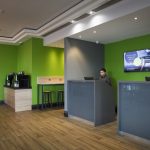
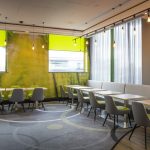
It’s good to see what was – many years ago – the Wiltshire hotel and latterly The Thistle, back in use as the Thistle Express. It’s in a super fab location for sure. Literally a spit from the railway and bus stations and the town centre. The Kimmerfields car park is just across the road and only a further little spit up to Regent Circus and the Cineworld cinema and eateries up there. What you might call at the heart of things.
I have an opportunity to try the place out soon so I’ll report back on that soon. I look forward to the bottomless breakfast. It sounds good to me! In the meantime, the official press release follows to give you a feel for the place.
‘Thistle Express is aimed at the savvy, value-conscious, modern traveller, providing more choice when it comes to booking trips.
The latest addition to the next generation of Thistle hotels in Swindon is opposite the future commercial quarter, ensuring the 95-bedroom hotel is conveniently placed for both business and leisure travellers. It’s the ideal location for guests to drop their bags, head off to that wedding, get ready for their big presentation, or get some well-deserved shut-eye. For those travelling from further afield, Thistle Express Swindon is just an eight-minute walk from the main train station.
The hotel offers fast, free Wi-Fi, bottomless tea and coffee and free breakfast for all guests.
Smart TVs in every bedroom allows those staying to stream their own content, along with blackout curtains and Hypnos mattresses for a good night’s sleep. Guests can fuel up for the day with the hotel’s delicious, free buffet breakfast, offering a selection of hot food as well as lighter continental options of fresh fruit, yoghurt and pastries. And with no need to check out, Thistle Express is turning the traditional hotel experience on its head.
The unique interior concept has been beautifully executed by Faber Design who recently created the Formula 1 R&D Centre, now used as the new headquarters for a leading Formula 1 motorsport company.
Thistle Express Swindon’s General Manager, James Preece, says; “As the latest addition to the Thistle Express family, I am delighted to be a part of the team here in Swindon. We’ve got a great team lined up, all of which are local to Swindon, and we’re all excited to welcome our first guests this autumn.”
Neil Gallagher, CEO at glh hotels says, “We are very proud to be extending our new Thistle Express brand. With increasing investment going into Swindon and the surrounding area and the new shopping hub and commercial quarter opening, we’re ready to welcome guests to this new, modern hotel. We listened to our customers and responded to the demand for a value proposition with fantastic amenities, such as free Wi-Fi, which is crucial to all guests regardless of the purpose of their stay.” ‘
Photography by Brydn Webb (c)
Launch Group 37284 Thistle Express , Swindon.
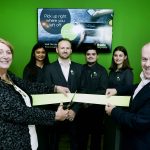
Ribbon Cutting, Swindon Mayor, Maureen Penny with Neil Gallagher, CEO GLH Hotels.
Launch Group 37284 Thistle Express , Swindon.
Team with Neil Gallagher (Right) CEO GLH Hotels.
It’s a great opportunity to undertake a gastronomic tour round the participating pubs, bars, coffee shops and stalls. It’s also great fun if you do it with friends – as I did. Cos then you can share lots of different burgers/bangers/fish stew etc. Even better. And that’s exactly what I did with my good mate Carole Bent and her friend Muriel. The photos below are Carole’s – she has a good eye for a photo I think. Unlike me.
‘We serve delicious, fresh juices and smoothies that are made to order every time. All the ingredients are juiced and blended right in front of you, so you can be sure that the nutrient content is at its absolute peak for you to enjoy. For anyone not in the mood for juice, then we also have a wide variety of hot drinks, including: teas, herbal teas and freshly ground coffee.’
Kris Talikowski founder of The Core
Now I have to be honest here listeners and tell you that I would probably prefer to eat my own feet than embark on a juice programme. It’s really not for me. I have to confess to being a die hard meat eater. That said, committed carnivore that I am, I can be tempted by an occasional vegetarian or even vegan dish. And The Core has some delicious offerings in that department.
Only a few days ago I had a meeting in there over lunch time and enjoyed a rather delicious avocado on toast. Rather than being smashed, as is usual, it was arranged in beautiful slices and was tasty indeed.
For the sausage and ale trail this year The Core offered a vegetarian burger. Come on – that’s surely an oxymoron or a contradiction in terms at least? 🙂 From the Collins English Dictionary:
‘A burger is a flat round mass of minced meat or vegetables, which is fried and often eaten in a bread roll.’ As opposed to a resident of Hamburg that is …
Not that I’ve any clear idea of how else you’d describe such a beastie. A pattie perhaps?
Anyway, Be all that as it may – I have to say that it was totally scrumptious. So scrummy in fact that I would love to have another one – all to myself this time! Who’d a thought it?
Here I am diving into it with some gusto and relish!
So, my personal reservations about juicing aside, there’s lots of epicurean attractions for me at The Core. And that’s nice!
Well done Kris and your team. The offerings at The Core are a great complement to the other other refreshment stops in both Old Town and the town centre. And YES – there’s some great food and great coffee down the hill too! #justsaying
I was keen to get to see David to get a good gander at one of his latest aviation related works: ‘Circus’ – having only had a glimpse of it until now. So here it is with its artist.
But what and who I particularly want to talk about in this post is Tim Carroll, some of his work, and his book ‘100 Views of Swindon’.
Tim’s work came onto horizon some time ago now – well before I knew him – when I bought a small piece of his from Artsite and the Post Modern. I hung my nose over it for long enough and hemmed and hawed so in the end I bought it – despite being skint. I love it. I’m can’t explain why – I just do. And – as I’ve explained in this post – that’s enough! As far as I’m concerned anyway. Here it is:
Tim uses this motif a lot – sometimes in ceramic form. Others in painted form. Sometime they are more rounded – but I like the angular nature of this one. I like to think of then as synchronized swimmers.
100 views of Swindon
The other thing I wanted to talk about on here is Tim’s 100 views of Swindon. Doing a Ronseal this is exactly what it says it is: a collection of paintings that comprises 100 personal and intimate views of Swindon. #obvs
I love these paintings. I love the style and I love the colours. And yes, I love them because they’re of Swindon. I also love because they don’t focus on the iconic and what one might consider to be the picturesque but rather prosaic, everyday Swindon scenes. The ones that we see all the time but yet rarely notice.
And now Tim’s collected them all together in to a lovely little book.
As it says in the book’s foreward: ‘… Tim’s 100 Views of Swindon wholeheartedly embraces the town from his own perspective; at street level, peering round a corner or over a rooftop. He brings urban scenes to life by accepting the awkward angles from which you might approach them, including what might be considered obstructions to the view such as street signs and parked cars.’
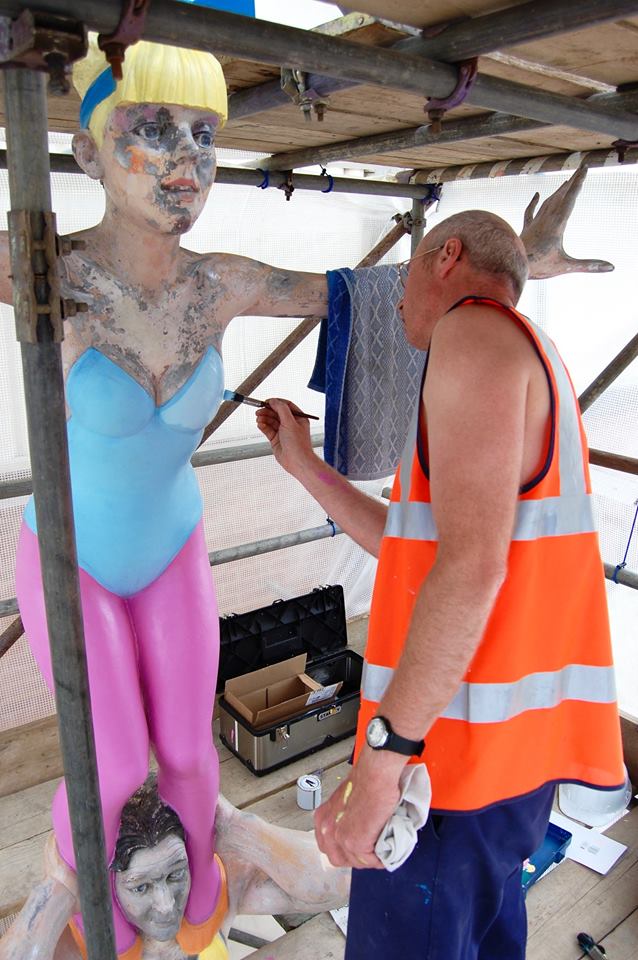
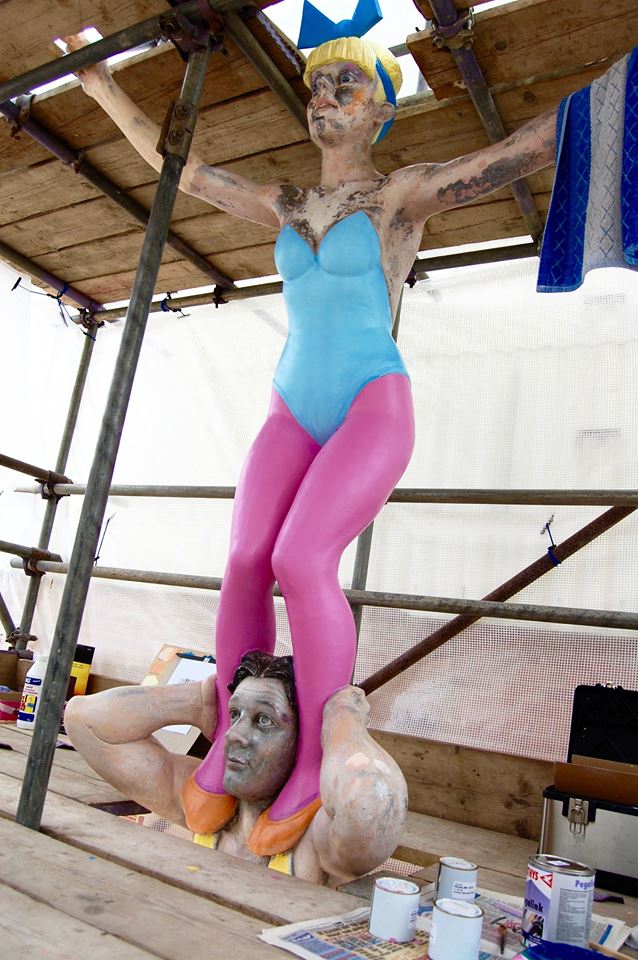
It’s a super collection of work. When I was deciding which to buy I had a terrible time selecting one. And there had to be a choice as I simply don’t have the wall space. In the end I plumped for one that featured the David Murray John tower because I love that building. So I’ve contented myself with that one and a few others in postcard form – notably The Blondinis. This post shows Tim, a few years back now, doing some restoration work on this gorgeous and exuberant piece of public art.
I also bought one of the tented market to give to my friend Ash Mistry, owner of Eggelicious. Here it is in situ on the Eggelicious stand in the tented market:
Print by Tim Carroll – one of his 100 views of Swindon
NB: Eggelicious are now in the new food court, The Crossing in the Brunel Centre. And E2 on Wood Street.
Of course, what we have here is bit of artistic foreshadowing what with the tented market now earmarked for demolition. So not only is 100 views a super affordable (£10) coffee table book that’s a perfect gift for any Swindonian it’s also a unique record of a town that was three years in the making!
The gorgeous book is available from the central library on Regent Circus or from Linda Kasmaty. If you’re a Twitter user look for @kasmaty
Swindon City of Sanctuary hosts Regional Meeting – a year on from launch
Just a year since the launch of Swindon City of Sanctuary, we are delighted to host a regional meeting for the National Charity, bringing together people who have formed their own cities/towns/villages of Sanctuary from all over the South West, Wales and even Ireland!
It’s promising to be an exciting and inspiring day, taking place at Los Gatos in Old Town, where lunch will be served to all in attendance. Food is being cooked by Los Gatos and presented by some of the refugees who’ve donated recipes for our very popular Pop-Up Restaurants and for “Sanctuary Tapas”, an initiative created by Los Gatos as part of their pledge to support Swindon City of Sanctuary in making Swindon a Welcoming, Supportive and inclusive place to live.
With a welcome from Swindon City of Sanctuary’s Chair, Shareen Campbell and Development Worker, Nicola Wood, there will be talks from the national charity’s Chief Officer, Sian Summer-Rees, as well as from delegates from Wales who are working on a “Wales, Nation of Sanctuary” project. Delegates from across the region will share ideas and successes from their areas. “The idea is we’ll all go away motivated and full of new ways we can make our cities more welcoming,” said Forward Maisokwadzo, organiser of the meeting.
It’s been a busy year for all involved with Swindon City of Sanctuary. We were very grateful to receive funding from the late Lord Joel Joffe, through his Charitable Trust. Since then, we have successfully piloted a hosting scheme called ‘Room for All’ in which Swindon residents with a spare room sign up to become hosts on a short-term basis, for refugees who might otherwise become homeless after receiving their right to remain in the UK. This gives them a vital safe place to be, whilst awaiting important documents to enable them to work and find alternative accommodation.
In June, Swindon City of Sanctuary took a lead in organising Swindon’s biggest Refugee Week to date, with the support of local businesses and charities such as The Harbour Project,Voluntary Action Swindon & Swindon Viewpoint amongst many others. Events took place throughout the week, including a community cinema, art exhibitions, live music and a Global Tea Party . It was a huge success.
We have also started a weekly Thursday evening event in partnership with the stylish Darkroom Espresso Café and The Harbour Project. It’s a relaxed get together over coffee, board games and live music and everyone is welcome (that means you!)
Development Worker, Nicola Wood, said:
“We are thoroughly excited to be hosting this year’s regional meeting for City of Sanctuary. It’s a wonderful way for us to celebrate how much we have achieved in the last year. It’s fantastic to be part of a growing movement to make the UK and Ireland a safe, welcoming place for all who live here, especially for those who have had to flee from war and persecution. We are sure to come away on Thursday inspired and motivated to continue our work.”
Chair, Shareen Campbell added, “We live in a global community and it’s so important to show compassion, to have empathy and offer friendship to all our neighbours in need, no matter who they are, or what their background may be. For me this epitomises what the City of Sanctuary movement is about, creating a welcoming, inclusive place for all who live in our cities, towns or villages and this is at the heart of all we do”.
NOTES
This is a closed meeting but please feel free to contact the below people for further information:
CONTACTS
• For information/detail about the event or to attend to take pictures please contact:
Forward Maisokwadzo – 07982136368 / Forward@cityofsanctuary.org
• For information about the lunch, sanctuary tapas/pop up restaurant please contact Shareen Campbell – 07716087361
• For further information about Swindon, City of Sanctuary and its future plans, Nicola Wood, Development Worker on nicola@swindon.cityofsanctuary.org
• For information about how to pledge support, or how you can help, contact info@swindon.cityofsanctuary.org or see https://swindon.cityofsanctuary.org
Information about the national charity, City of Sanctuary:
City of Sanctuary is a movement to build a culture of hospitality for people seeking sanctuary in the UK. Our goal is to create a network of towns and cities throughout the country which are proud to be places of safety for people seeking sanctuary and helping them integrate into their local communities.
The City of Sanctuary movement began in October 2005 in Sheffield. Since then, we have supported the development of over 90 City of Sanctuary initiatives in towns and cities across UK and Ireland. We believe the ‘sanctuary message’ of welcome and inclusion is needed in all spheres of society and as such we are committed to helping schools, universities, health and maternity services, theatres and arts centres, churches and other faith centres, sports, communities, businesses and homes become ‘places of sanctuary’. A key element of these ‘streams of sanctuary’ relationships is awareness raising, telling the true stories of refugees to those who never hear them.
Restoring the Blondinis First things first listeners: how ON EARTH did it get to be September already?! Now …
In the early days of this blog – in the summer of 2013 even – I wrote a post about the sculpture of the Great Blondinis. If you’ve no idea what I’m talking about here’s the post in question: https://swindonian.me/2013/06/24/the-great-blondinis-sculpture/
1. Thamesdown Borough Council, with financial assistance from Sun Alliance insurance group, Southern Arts, British Alcan and Metalfast Ltd, commissioned the work.
2. The commission came just before the Swindon rail works closed. It was made in association with British Rail craftsmen.
3. Jon Clinch sculpted it from foundry cast aluminium alloy (LM6).
What that doesn’t say is that this sculpture is the absolute last thing made in the once great GWR works. That singular fact surely affords this sculpture a special significance? Though derided by many I love and still miss its joyful, cheery presence in the town centre.
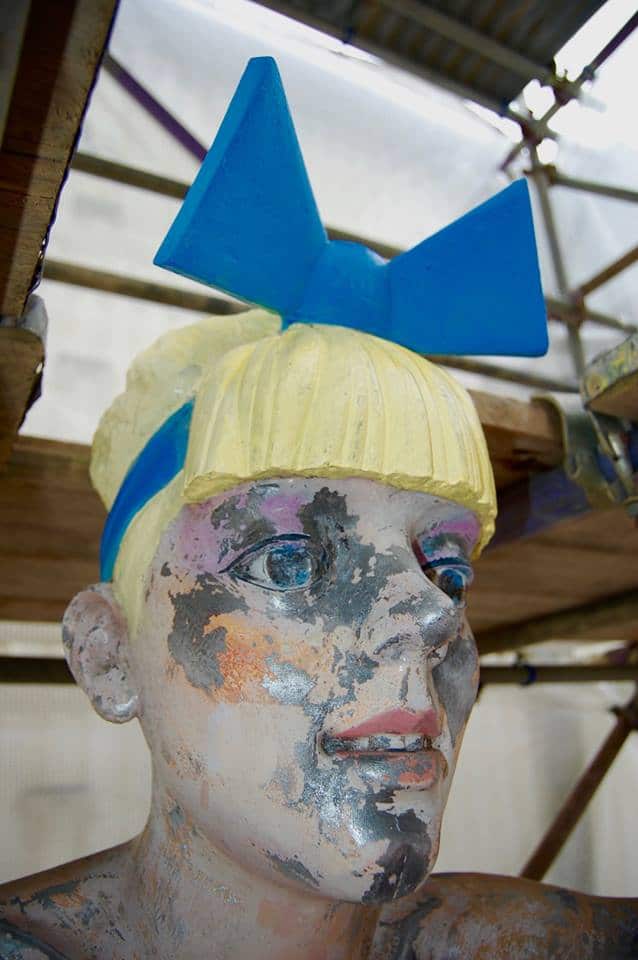
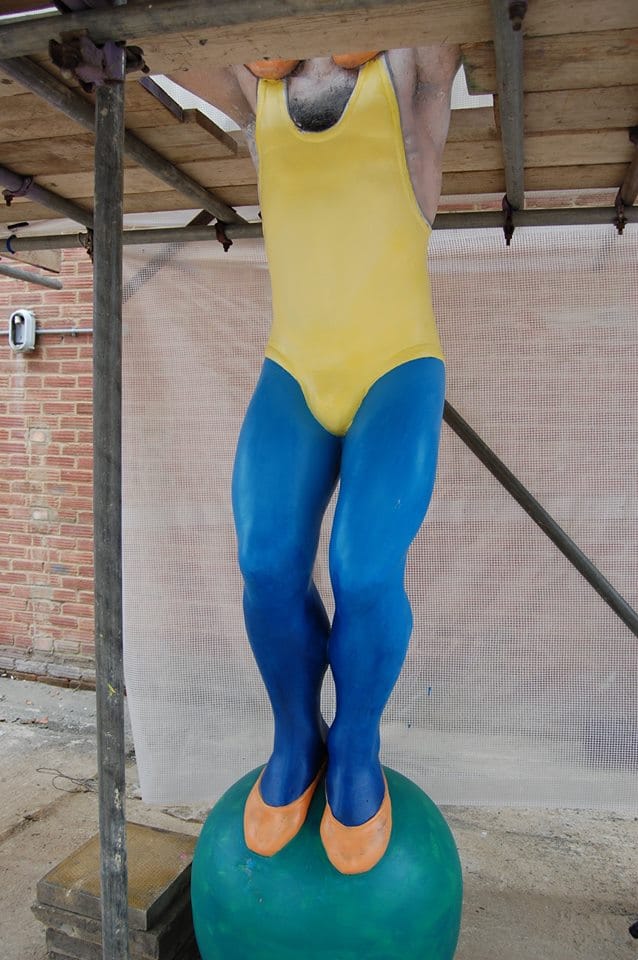
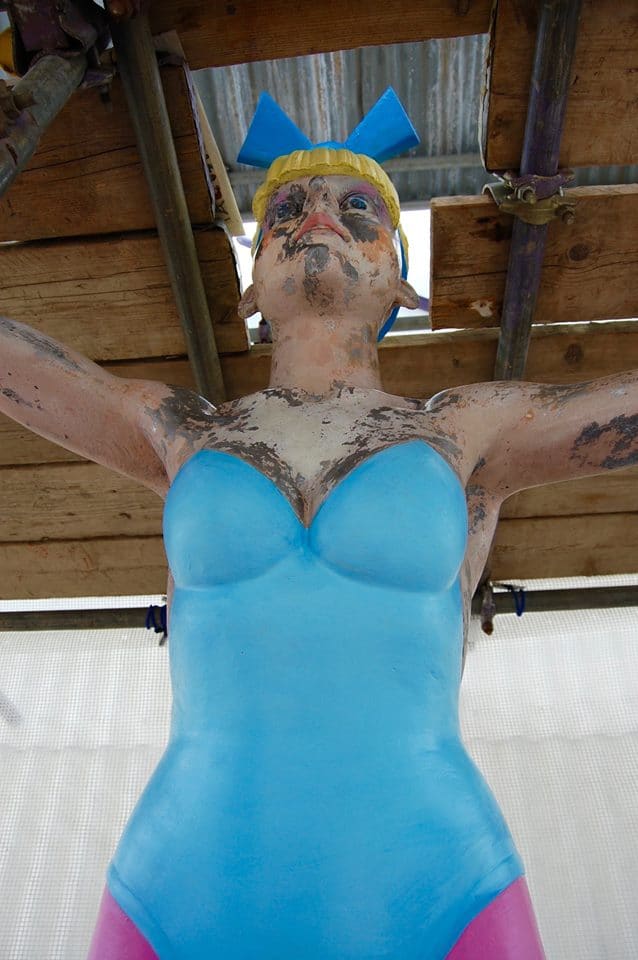
Tim Carroll restores the Blondinis
I chanced upon some photos on Facebook of Swindon-based artist Tim Carroll restoring the sculpture when it got moved from its original home in Wharf Green to its current location in a play park in Gorse Hill. This was some time ago I should add.
This wonderful, exuberant sculpture used to have a prominent position in Wharf Green. Now they’re in a play park in Gorse Hill. I do feel that’s a huge shame. I’d love to see them somewhere prominent once more.
Here they are duly titivated and in situ in Gorse Hill.
Find Tim Carrol’s impressive CV here: http://www.timcarroll.yolasite.com/contact-us.php Tim often uses Swindon and the area as subject matter. I’m particularly fond of his 100 views of Swindon. Would that I had the wall space and the cash! I’m delighted though to own a print of one of his views of the David Murray John Tower and some postcards of some others.
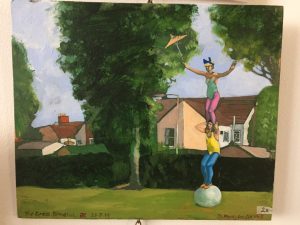
I guess, given the restoration work Tim did on the sculpture, it’s no surprise that he included it in his 100 views of Swindon. Here it is – it’s rather lovely:
Tim Carroll Blondinis 100 views Swindon – the Great Blondinis