Pew here for a hand-turned pen with a Christ Church connection
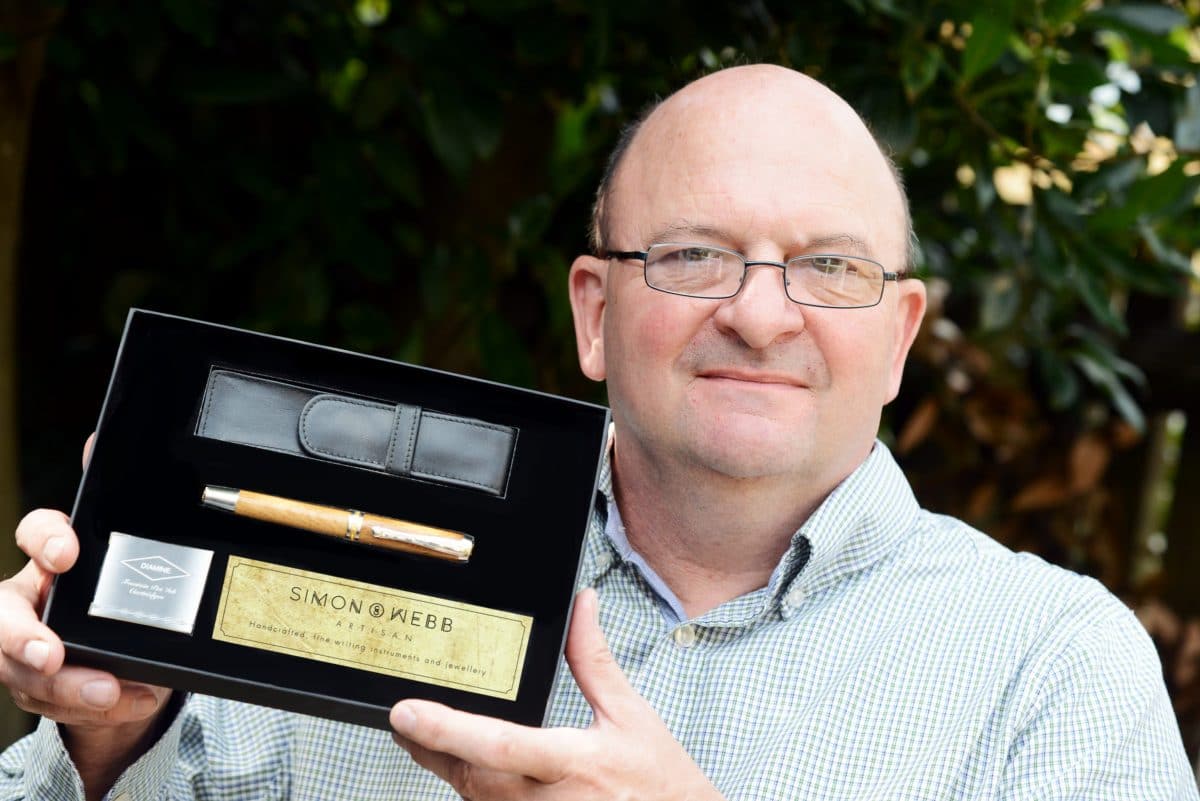
Swindon pen-maker Simon Webb, has a reputation for fashioning exquisite hand-made pens from wood connected to aspects of Swindon’s history. This time it’s pens from Christ Church Pews.
The latest piece of piece of wood to enter his workshop is a section of an oak pew from Swindon’s Christ Church. Commented Simon, ‘when I heard that, as part of a renewal project, the church planned to dispose of some pews I thought at once how fabulous it would be to give part of a pew another life as a pen.’
What lies beneath
‘Underneath the dark exterior the wood is a lovely pale brown colour with a gorgeous grain structure’ said Simon. Adding that he’s already been contacted by coupleswho were married at Christ Churchand want to own a piece of it in pen form.
Christ Church have commented on Facebook: ‘We are delighted such beautiful pens are being made from the wood of one of Christ Church’s pews.’
There are three styles of pen to choose from, all made to exacting standards. The range includes a gunmetal and platinum ballpoint, a standard-sized fountain or rollerball and a large desk pen. The fountain pens come in a presentation box, complete with leather carrying case and ink cartridges. Non-pen users can enjoy a piece of Ecumenical history too because Simon is also making cufflinks from the oak.
Prices for the pens range from £60 to £160 for the large desk pen. The cufflinks are £30 a set.
Other than at September’s autumn fayre you can buy a pen, from Christ Church wood or otherwise, directly from Simon.
For every Christ Church pen sold, Simon will make a donation to Christ Church.
Simon’s first foray into re-writing Swindon history came with pens made from the beloved, storm-felled, 300-year-old walnut tree in Lydiard Park.
Then came the STEAM museum pens, turned from a piece of Jarrah – a foundation timber in the GWR Works. For literature and nature lovers Simon has made pens from the famous mulberry tree in the garden at the Richard Jefferies’ Museum at Coate.
High-Tech lines standing proud on Swindon’s skyline
Back in 1950, in his ‘Studies of Swindon’, John Betjeman wrote, apropos of architecture in Swindon, that there was ‘very little architecture in Swindon and a great deal of building’. He then went on to say that ‘Swindon, instead of being a West Country town, looked on its outskirts at any rate, like any industrial town anywhere.’
Implicit in Betjeman’s observation is, I think, the suggestion that Swindon, by sheer dint of its position rubbing shoulders with Bristol and Bath and Cheltenham, should be architecturally similar. But why should it and why would it?
Different Births
Those three places grew out of very different circumstances to Swindon. The point that Betjeman appears to miss is that Swindon – well the ‘New Swindon’ at any rate – is an industrial town. It was the great GWR industry that brought it into being and it’s its industry that has breathed life into its lungs ever since. So why would it have sweeping Georgian crescents or Regency arcades? Why do we expect it to?
Betjeman made that observation two decades or more before Swindon gained the modern buildings that qualify, in my entirely non-expert opinion, as ‘architecture’. If nothing else their designers are people I’ve heard of: Sir Norman Foster and Sir Hugh Casson – responsible for the Spectrum Building (still known to many as the Renault Building despite Renault being long gone from it) and the Wyvern Theatre respectively.
Betjeman was a lover of, and passionate advocate for, Victorian architecture. And thank goodness for that. Otherwise the nation and the world would have lost the glory that is St. Pancras station in London.
We also have him to thank for the continued existence of our Railway Village. As this 2017 article from The Swindon Advertiser points out: ‘… by the 1960s there were plans to raze the area. And it was only saved following a campaign by famous poet and architecture buff, Sir John Betjemen.
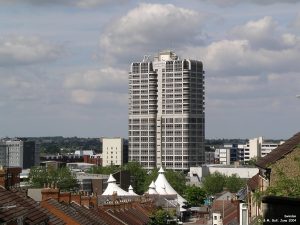
Yet it’s a moot point whether he would’ve approved of the Wyvern Theatre, the Link Centre and Foster’s Spectrum building. Tension structures such as those were of their time. Nevertheless, and love them or loathe them, all of them are architecturally interesting. But perhaps none more so than my particular favourite: the David Murray John Tower.
It’s an exuberant exclamation mark of a building that proudly proclaims itself across the Swindon skyline. At 83 metres high, the DMJ (along with Old Swindon’s Christ church) is the master of all it surveys.
The building struck me when I first moved to Swindon and I love it to this day.
Knowing even less at that time about architecture than I do now (and that’s not to say a great deal) it seemed to me to have something of a futuristic feel to it – though I couldn’t pin it to anything more specific than that. It’s only now, having researched the building a little, I understand what my subconscious was relating to.
Douglas Stephen
The architect responsible for the DMJ tower was Douglas Stephen. Sadly, Stephen is now dead, though his name lives on in the Douglas Stephen Partnership.
If your response to that nugget of information is ‘Douglas who?’ you’d be in good company.
Back in 2004, Jonathan Meades (essayist, broadcaster and respected architecture authority) published an article on Building.co.uk entitled: ‘Five great architects … you’ve never heard of’ in which he writes about a number of architects, Douglas Stephen included, on why they’re so good – and also so neglected.
On the subject of Stephen, Meades has this to say:
‘Yet there was something about the details … The Mount was the first of Douglas Stephen’s buildings I saw. It was completed in 1965, and was entirely out of step with its time: it was at odds with both the fey Festival style and with the sculptural brutalism that was the conventional reaction to the Festival style (and which Stephen had essayed). But Stephen belonged to no school. That, I suspect, is why he is overlooked. The Mount retains its extraordinary freshness. So does his David Murray John Tower in Swindon, that town’s most (only?) striking building, a mini-skyscraper that has affinities to a design of Frank Hampson’s for Dan Dare, Pilot Of The Future.’
I think now that it was the Dan Dare influence that was ringing a very quiet bell in my brain when first my eyes alighted upon the DMJ tower.
The David Murray John Tower is on that list. He wrote of it: ‘Designed by Douglas Stephen and built in the Seventies, this tower is a sleek, slick return to the smooth white grace of Twenties and Thirties Modernism. It’s a mixed-use building, incorporating social housing, offices and retail, which is rare in Britain. Stephen was a communist and believed in architecture as a power for social good.’
The DMJ keeps company on Mr Meade’s list with: Marseille Cathedral, the Walhalla Temple in Bavaria, Cothay Manor in Somerset and Edinburgh’s Stewart’s Melville College.
As to whether Stephen’s building achieved that lofty aim I’m not sure. Its intended mixed-use was innovative in its day. But it’s arguable that it turned not to be so workable.
So, with no knowledge of what it’s like to live and work in that building I base my affection for it on its aesthetics and what is so clearly stood for: the future.
It was the intention of the building’s futuristic look to reflect the forward-looking aspirations of the town at the time.
With its curved corners, the design of the building is sleek and sophisticated. It’s clad in stainless steel – an expensive material even then. It makes historical references with its nods to Art Deco and Modernism. Everything about the building makes a statement – it screams at you to look it. Indeed, you can’t avoid looking at it – it’s visible for miles. At night when lights are on inside it, it’s like a land-locked lighthouse.
Compare and contrast
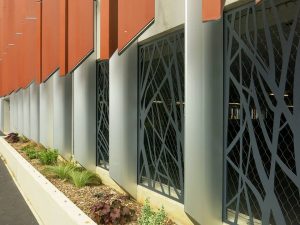
Think now to the Whalebridge car park at Kimmerfields in the town centre. Every time I look at that building I think of a stockade, a fort, in a western film. It’s all pointy edges and sharp protruding angles. Even the steel decorative panels inserted into the walls remind me of barbed wire.
side panels in Whalebridge car park – photo by Swindon Driver
This is a structure that’s doing the opposite to the DMJ. Where the former stands proud and tall and proclaims itself, the latter is a building on the defensive. Arguably much like society at the time of writing (2017): austerity, Brexit and more. Pathetic fallacy in architecture.
Kimmerfields car park – photo by Daniel Webb
A Wonder of Swindon
Mr Meades isn’t the only one to find favour with the David Murray John Tower. When talking about this building I ought to mention that the author Jasper FForde, famously invented ‘The Seven Wonders of Swindon.’ And taking the top spot on his list is the ‘Tower of Brunel’:
“Give me a tower to touch the sky!” With those words, city elder Mr David Murray John proposed the building of a skyscraper to give Swindon the skyline it had lacked since the destruction of the Cathedral of St Zvlkx almost five centuries before.’
Given that Fforde’s Seven Wonders of Swindon are set in a futuristic/alternative/parallel universe it’s not hard to think that he knew/recognised what niggled at me: the futuristic look of the thing.
Now. Okay. So the real ‘Tower of Brunel’ doesn’t quite reach the vertigo-inducing heights of Mr Fforde’s invention but a skyline it does give. And yes, there’s an argument that the architect’s intentions didn’t quite come to fruition.
But I still feel that there’s much around this edifice we should laud and applaud. There’s Murray John’s energetic exhortation for a tower to touch the sky. There’s the shining optimism it was built to represent and Ffordes T-I-C yet affectionate tribute.
Then there’s the singular fact that Jonathan Meades, a respected authority on architecture, placed the DMJ on his personal list of five extraordinary buildings. In the world. Keeping company with Marseille Cathedral, the Walhalla Temple in Bavaria, Cothay Manor in Somerset and Edinburgh’s Stewart’s Melville College,
Poetry in motion: Swindon Diamonds – Oh I love this!
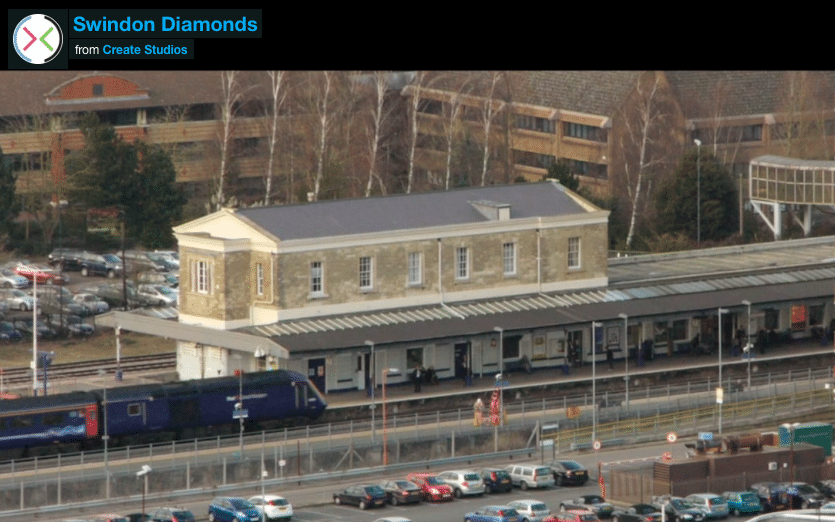
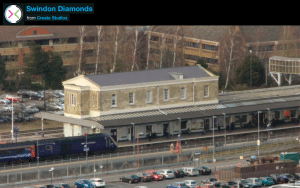
Idly scrolling through Facebook as you do, I came across a video. CREATE studios made the film and it features Swindon Community poet, Tony Hillier and his poem ‘Swindon Diamonds’. I somehow managed to miss it – never mind, I’ve found it now.
It’s wonderful! Share it far and wide. Swindonians need to see it! 🙂 It references so many wonderful Swindon elements. From the GWR toDeacon’s jewellers to the Mechanics’ Institute to Gilbert O’Sullivan and XTC , Ken White …. the list goes on and on and on. Much like Ariston washing machines used to … except they don’t now …
Community poet Tony Hillier created and reads the poem, performing it at many of the key locations mentioned in it.
The poem, a celebration of Swindon and its achievements, was commissioned by Swindon and Cirencester-based motor dealer, Pebley Beach. They did so as part of the firm’s support of Swindon 175, which marks 175 years since the railway arrived in the town. Swindon’s CREATE studios filmed and edited the piece….
…. The poem touches on cars and trains, but other Swindon innovations too, from the World War Two Spitfire to Garrard record decks. Landmarks including Canal Walk, the Mechanics’ Institute, and – of course – the Magic Roundabout are all name-checked.
The video even includes Tony playing table tennis in Quarry Road play park, while reciting a verse of the poem.
Well done to Tony and to CREATE studios. Super, fab, stirring stuff.Poetry in motion: Swindon Diamonds is really wonderful.
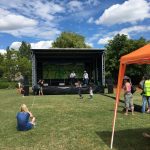
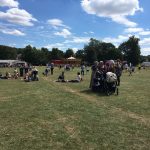
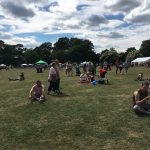
Hello listeners. I hope you’ve been enjoying the sunny weather. I certainly have. I LIVE for this time of year. It was great though that it was such a lovely day yesterday for the Children’s Fete 2017.
In case you missed my previous post about the Children’s Fete here’s a bit of background: ‘
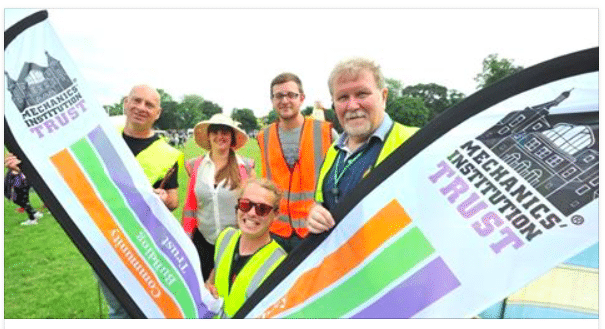
‘The Children’s Fete is Swindon’s oldest summer event, dating back to 1866. Organised by the Mechanics’ Institution, it ran until 1939 with the outbreak of the Second World War. The tradition was revived by the Mechanics’ Institution Trust in 2003 and has run since.
The most popular tradition was the cutting of the cake, a tradition which the Trust still maintains by providing a free piece of cake to all children on the day.’
Children’s fete organisers: Hannah Parry, Daniel Rose, Tom Falding, Bob Barrett
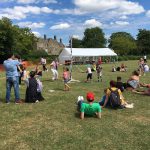
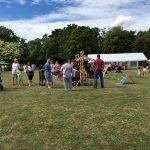
Now – just a few photographs of the fete. Including me queuing up to get on a carousel. As my mate Carole Bent has named me: ‘Angela – if there’s a carousel there’s a horse with my name on it – Atkinson’. Here’s the proof!
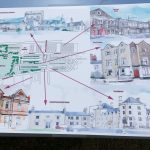
Daniel Rose and helper the Mechanics Insitute
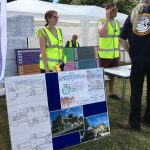
Plans of railway village conservation area
Falding’s Fandangoes
Swindon Wildcats
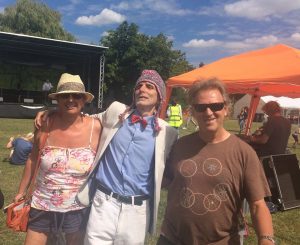
And finally a motley trio – I bumped into Carole and David with their chops round a 99 when I arrived!
I do like share a bit of good news on this blog listeners. And this is certainly that.
Now if it were left to me I’d have a place in Swindon’s art collection for dozens of Swindon artists. But until that’s possible it’s great that, in addition to works by the fabulous Ken White, both Creative Wiltshire and Swindon Borough Council have acquired works by David Bent. Because they both absolutely deserve to be there. So hurrah!
Swindon Borough Council are delighted to announce their most recent acquisitions to the Collections via the Creative Wiltshire project
‘These new works include a stunning landscape painting and prints by local artist David Bent. The painting, Beach House West of Looe, from David’s Landscape Geometry series will go on display from 19 July until 18 November as part of ‘The Lie of the Land exhibition’, which explores Modern British Landscapes from the Swindon Collection. This exhibition will also feature artists such as Richard Long, Mary Fedden, Roger Fry and Vanessa Bell.
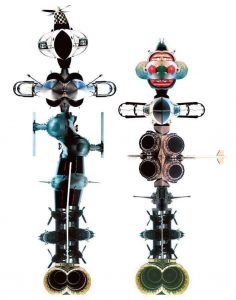
The Museum and Art Gallery has also obtained two prints from his innovative Aerobot photo collage collection which were first exhibited at the nearby Royal International Air Tattoo. David is credited as leading a new movement in modern aviation art.
This work has been purchased by the Creative Wiltshire project, which aims to acquire works by creative people across Swindon and Wiltshire.
The project is funded by the Heritage Lottery Fund and also recently secured a work by Swindon artist Ken White for the Swindon Collection as well as ceramics by Sasha Wardell, Trevor Chaplin and Patricia Volk, paintings by David Rolt, and prints by Howard Hodgkin and Joe Tilson.
Creative Wiltshire has also purchased David’s work (including books, a box set of Movement 2000 and prints) for the Wiltshire and Swindon History Centre and said “We are delighted that Swindon has acquired these wonderful works by David Bent. David is a talented and popular artist who has such a strong connection with Swindon and the surrounding area. It has been a pleasure working with David to select the works for Swindon and for the History centre and we feel they provide a fitting tribute to David’s long career. We hope visitors will enjoy discovering his work in forthcoming exhibitions.”
David said: “I am proud to have my work represented in the prestigious Swindon collection, sitting alongside works created by a number of great artists that have inspired and influenced me. I am equally pleased that the Wiltshire and Swindon History Centre have chosen to acquire a number of pieces.”
For further information please contact Nicki Western, Marketing Manager, Swindon Museum and Art Gallery, 01793 466560 or emailnwestern@swindon.gov.uk‘
David Bent David Bent lives and works in Swindon. His long career has taken him all over the world. Born in Dover, he has travelled extensively. His art shows the influences of the places he has visited, as well as his fascination with current affairs. In recent years he has been strongly associated with the Red Arrows, who have inspired a number of paintings within his Art of Flight series. David was recently awarded the rare distinction of Honorary Companionship of the Royal Aeronautical Society in tribute to his work. He is the first artist in 30 years to be awarded this.
Question: The Aerobots series is a departure for you. What was your inspiration?
David Bent: I am inspired and led to a certain extent by my general interest in science and technology, but nature and the human condition are also big influences on me. As a practicing artist, I always aim to infuse my work with the power of personal observation, skill and insights.
For me the relationship between Art, Science and Mathematics can be described as a drawn circle with a small gap at the end. Art is at one end of the open circle and science at the other. They are very close if you are prepared to jump the gap, if not you have to travel all the way around the circle and they become a long way apart. I like to jump the gap.’
Creative Wiltshire Creative Wiltshire is a five year project which started in 2015 and aims to acquire work by creative people from Swindon and Wiltshire to fill significant gaps in the collections across Wiltshire.
Wiltshire Local Studies, based at the Wiltshire & Swindon History Centre in Chippenham, received £178,000 HLF Collecting Cultures grant towards the five year project totalling £213,550 and materials are being acquired by accredited museums in the county of Wiltshire and Borough of Swindon, including Swindon Museum and Art Gallery and the Salisbury Museum.