Honour’s list recognition for Swindon Viewpoint’s Martin Parry
30th January 2017
Wow! This is fantastic news. Swindon Viewpoint featuredin one of the early posts on this blog. I’m super thrilled to see that Martin Parry has had his work recognised in this way. An MBE for Swindon Viewpoint Man!
Last year it was my great fortune to be present in the Wyvern theatre for the screening of Railway Town and on the panel that followed it. Such a wonderful piece of work. Buy it. Watch it. Love it.
“Railway Town is my tribute to the people of Swindon who I have grown to appreciate and care greatly for.”
Swindon film-maker Martin Parry recognised in New Year’s Honours list
A Swindon man has received one of the country’s top awards in the 2018 New Years Honours list. The British Empire Medal, a division of the M.B.E., is granted in recognition of meritorious civil or military service worthy of recognition by the nation.
Martin Parry, one of the country’s longest-serving exponents of Community Media, has been honoured for services to the nation in the fields of Film, Media and Music.
The accolade came for work that includes rescuing and continuing to maintain Swindon Viewpoint, Britain’s longest surviving community television service, as well as for wider media archive work.
Long-time Swindon Resident
A Swindon resident since 1980, Martin grew up in Herefordshire and after school trained as a Communications Engineer.
After a period at Hereford School of Art he studied Sociology and Psychology at the University of Southampton in the late 60s. In the early 70s he lectured in Communications at a college in Hertfordshire. After that, Martin trained teachers in Media Studies for the Inner London Education Authority.
Further Qualifications
In 1974 Martin won an MA scholarship in Psychology and Sociology. This took him to Canada, where he next worked as Community Channel Producer for a regional Canadian TV station. There he developed community programming and among other projects, originating some of the world’s earliest music videos. His next work, for the National Film Board of Canada, won him an international award for history documentary.
Returning to Britain in 1979 to raise a family, Martin took up a British Film Institute funded position as filmmaker-in-residence for Swindon. Within weeks, he got involved with Swindon Viewpoint. At that time, SV was the only surviving community cable television experiment of the FIVE licensed by the government in 1973.
Viewpoint was experiencing financial difficulty and would have sunk into the annals of media history were it not for Martin’s enthusiasm, tenacity and dedication.
“I’ve always believed in the potential of everyone, not just media professionals, to come up with original creative ideas and their right to use the language and technology of communication for their own ends.”
Martin’s Early Swindon Years
During his early years in Swindon Martin conceived ofand initiated, Media Arts (lately called “Create”) as a hub for both community and arts-based media practice. It became known nationally as one of the most successful media workshops of the 80s. He fund-raised and secured local authority support and was able to equip the initiative with the assets of Swindon Viewpoint. From 1991, Viewpoint was no longer able to access these resources. But Martin, with the help of his family and some of the original staff,maintained and operated Swindon Viewpoint as a public access TV service for the town.
There are now well over 2000 programmes available to view on demand on Swindon Viewpoint. The main body comprises programmes produced by Viewpoint itself, further enhanced by the collection of Western Film Archive (WFA).
Martin set up WFA in 1987, with the support of David Puttnam, to collect and preserve regional film material. Through his diligent (and voluntary) curation work, the WFA has amassed around 500 hours of film and tape in an archive. The collection spans almost 120 years of the region’s film-makers.
Freelance Film Maker
In the 1990s Martin became a freelance film-maker. But he’s continued to work on a voluntary basis for a number of national media organisations. Organisations such as the National Training Policy Committee for the Film Industry, the British Video History Trust and as a council member for the Community Media Association.
Training others
In Swindon and the local area, Martin has been responsible for the voluntary training of hundreds of local people and community groups across the town in the skills of media production.
Through grants from the National Lottery schemes and other grant-aiding bodies, Martin and his volunteers, operating under the Swindon Viewpoint banner have managed the production of hundreds of arts and music videos. And almost as many films for community organisations. He’s represented the interests of groups from refugees to railway workers.
Viewpoint continues to work at the cutting edge of social awareness communications. It has recently produced a new range of incisive films for local organisations on key social issues of our day. They include ethnic, age and gender equality, immigration, mental health and domestic violence.
Martin has plans for 2018. He’s developing a number of innovative projects designed to enable broader public access to community media resources both contemporary and historic. He also continues to work on the rich heritage of archive films. Many are as yet undigitised – and to embark on new education programmes around their use within the education system.
A Community Library Launches at the Swindon Hindu Temple
To be fair, ‘A community library LUNCHES at the Swindon Hindu Temple’would have been an appropriate heading being as how this event was celebrated with a food festival. Oh such scrummyness. Sadly for me, I’m getting over a virus and my normal appetite for Indian food – well food in general – is not, at the moment, up to scratch,
But that’s all a digression. I’ve been to the temple before so though it was about time it got a mention on this here blog. Because y’know, the overall vibe at the temple is never anything but welcoming and inclusive. It’s just lovely.
The temple came on to my horizon via Carole Bent – the photographs below are hers. Thanks Carole. I do try with photographs but they never come out right. Harrumph!
I had no idea, until Pradeep spoke at the event, that the community library that the temple has set up is part of the town’s library network. I though it was cool anyway. But when I heard that I thought it was even cooler! It was super fab to see Liam with the book bike there reading to the children!
Some pictures from yesterday’s library launch and food festival:
Pradeep, Swindon Hindu temple chairman
Library Liam with the book bike
Gujarti books in the library
Smiling, happy ladies serving food
You have to take your hat off to Pradeep Bhardwaj, chaiman of Swindon’s Hindu temple trust, and his associates. What they’ve achieved with a run-down industrial unit on the Cheney Manor estate can be described as miraculous. And a testament to what can be achieved with will and passion.
As Pradeep told the Swindon Advertiser last year when the Temple celebrated its official opening:
“For many here it is the biggest day of their lives. There have been Hindus in Swindon for 60 years but there hasn’t been a temple or community centre.
“I am very proud, more than proud, I am humbled. To be able to accomplish something like this for the entire community is beyond my wildest dreams.
“Throughout our lives we keep chasing dreams but having seen what it’s like to do this I would be willing to forego any of my personal dreams.”
The temple’s website describes its vision thus:
Establish “Cultural Hub & Centre of Excellence” – first of its kind outside India
A Social, Cultural and Community Hub accessible to all community groups with an interest in Indian music, dance, arts, culture, religion, cuisine, literature, health & wellbeing
Establish Swindon as a Cultural destination, one of the top places to visit in England, promote cultural & religious tourism, attract new businesses & investment
At this point I feel I should give mention also to SAPAC – another Asian organisation/group that Swindon is blessed to have in its midst. They too open their doors, their activities to anyone that is interested regardless of culture.
There’s lessons for us all from both these groups I feel.
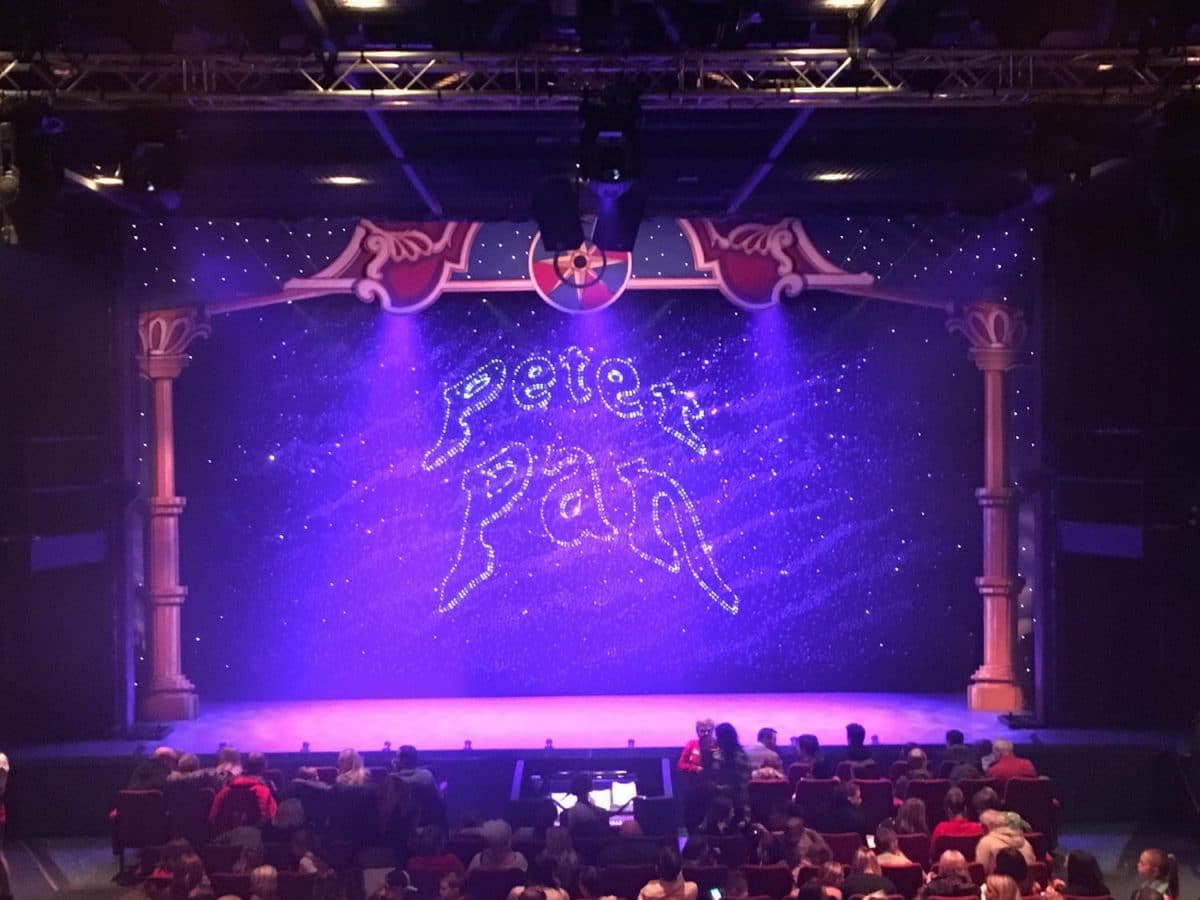
Well listeners it’s that time of year again. Oh no it isn’t! Oh yes it is! If Christmas is coming then the Panto is here.
Like all good theatres up and down the land, the Wyvern Theatre stages (see what I did there?) an annual pantomime. And this year it’s Peter Pan. Now were I to nitpick I’d be honour bound to say that, properly and traditionally speaking, Peter Pan isn’t a panto at all but a play and a novel by J.M Barrie. I guess now though, Peter Pan is a cultural icon and doing a panto version keeps the story alive.
Both versions of Barrie’s story tell the tale of Peter Pan – a mischievous little boy who can fly. He has lots of adventures on the magical island of Neverland – a place where mermaids, fairies, native Americans and pirates live.
The inspiration for both play and novel came from Barrie’s friendship with the Llewelyn Davies family. Barrie continued to revise the play for years after its debut until publication of the play script in 1928.
Tradition dictated a petite woman played the character of Peter Pan in the play. I daresay because in size and voice timbre they’d be better believed as a small boy than a grown man. One does have to suspend disbelief a tad more when it’s a grown man in tights flying about the stage. But hey – this is panto not a Pinter play.
Anyway onwards and UPWARDS to Swindon’s own Pantastic production
Oh we had the best time. This is a riotous performance with a terrific ensemble cast. The pirates, the indians and the lost boys all.
Not being an Eastenders viewer (I’ve never heard the theme tune in its entirety) I was keen to see Adam Woodyatt in action as Captain Hook. After seeing last year’s panto where the leading man was wooden to put it mildly I thought he made a quite decent stab of it. I said stab … oh suit yourself … He – well everyone TBH got proper warmed up in the second half.
But the top spot in the panto performance league has to go to Antony Lawrence as Smee. He does a terrific job as the comic turn – the Peter Pan equivalent of the ugly sisters, Widow Twankey etc. He’s fabulous on his own and together with other cast members – superb.
Like all good pantomimes this one has its share of song and dance routines, slapstick, innuendo, corny jokes, brilliant comic timing and of course – LOTS OF SHOUTING. And getting wet????!!!! Pirates with nerf guns??? Hmmm ….. In short: Pantastic panto pandemonium at Peter Pan. LOVING the alliteration opportunities here!
All in all it’s a great production that I heartily recommend. Oh no I don’t! Oh YES I DO!!
The wonderful Wyvern people have probably noticed my pitiful photography efforts so sent me some publicity shots to use. Not a bad idea!
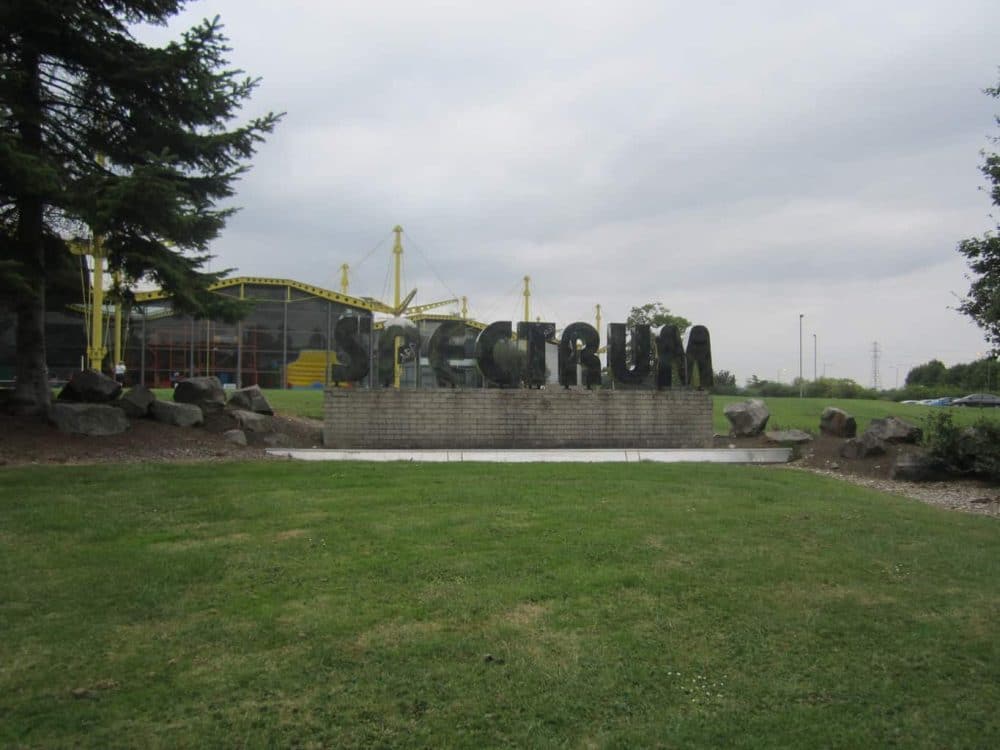
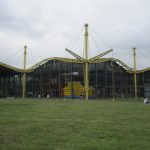
Architectural Interest: it’s a particularly important building of the 1980s by Sir Norman Foster – one of Britain’s foremost contemporary architects. It embodies the key features and characteristics of the British High Tech movement.
2. Technological Interest: This is an innovative industrial building using new materials, technology and design solutions, built for a forward-thinking client. One that demanded a fully flexible and prestigious building to promote the company and reflect the advanced design and technology of its products.
Historic Interest: The building’s strong association with the French company Renault, ranking among the most notable and prestigious car manufacturers of the twentieth century adds to its level of special interest.
Foster’s design and involvement didn’t stop with the building itself. He also designed all the building’s fixtures and fittings, free standing office furniture and warehouse storage systems included.
He designed glass top tables with steel and aluminium legs for the reception area and cafeteria to echo the design of the beams and mullions of the building itself.
He developed these designs from his own 1970s experiments in furniture design. They went on to inspire his later Nomos office furniture system.
Once completed, the Renault Centre received widespread admiration winning several awards.
Madam La Lumiere, the French Secretary of State for Consumer Affairs performed the official opening on 15 June 1983.
Fascinating fact:In 1985, the Spectrum building featured in the James Bond film, ‘A View to a Kill’. Not the only Swindon building to attract producers of Bond films, the Motorola building has also had that privilege.
Eastcott community book launch: Legacy of a rag and bone man
Well listeners! Yesterday was what I call a good Swindon day. The being cold, yet bright and sunny I walked into town from Grange Park.
First up was a visit to Theatre Square to the Artsite Christmas Fair. I love Artsite and the Post Modern. It’s a fantastic collective of artists working together in their studios. I like to get to their Christmas fair when I can because their’s always something to catch your eye. And they’re such fantastic people too. I LOVE that Swindon has got Artsite.
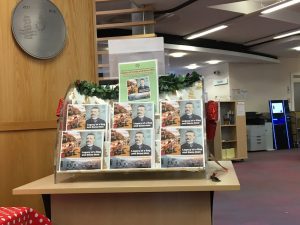
Talking of fantastic people the next thing on my agenda was the launch, in Swindon central library, of a super book put together by Eastcott Community Organisation. Caroline Davis-Khan and Anna Smart do a brilliant job up there – always lots of stuff going on up at Savernake Street hall.
Legacy of a rag and bone man
Anyroad up – with funding support from the Heritage Lottery Fund they’ve put together a great little book called ‘Legacy of a Rag and Bone man’ – a century of community life in Eastcott.
Alderman James ‘Raggy’ Powell is not a character I’ve heard of but many actual born Swindonians most certainly will have. So it’s an education for someone like me and a trip down memory line for many others.
There’s a quote in the book from the lovely Frances Bevan, local historian, who comments that Powell is one of ‘Swindon’s forgotten heroes’. ‘Despite his philanthropic contribution to the town, no street, or building has been named after him’. And, judging by what I’ve read so far, she’s right. But this book surely goes some way to address that?
So a hearty well done and congratulations to everyone involved in it. It’s a super addition to a Swindon-lover’s bookcase.
Caroline Davis Khan in Swindon central library launching their book celebration of James ‘Raggy’ Powell
See also this post about the unveiling of a plaque at Eastcott community centre in celebration of James Raggy Powell