The cornucopia of potential entries in that book, came as no surprise at all. For every building I put in it, I could quite easily have selected several more. So had to make choices. And it’s been tough I tell ya! There’s no shortage of interesting material in Swindon as we all know.
For instance, featuring Swindon’s County Ground in the book was a no-brainer. After all – a tale of any town or city couldn’t call itself complete without mentioning the town’s sporting life. A natural complement to that listing then is the County Ground Hotel. But did I have room for it? No I did not.
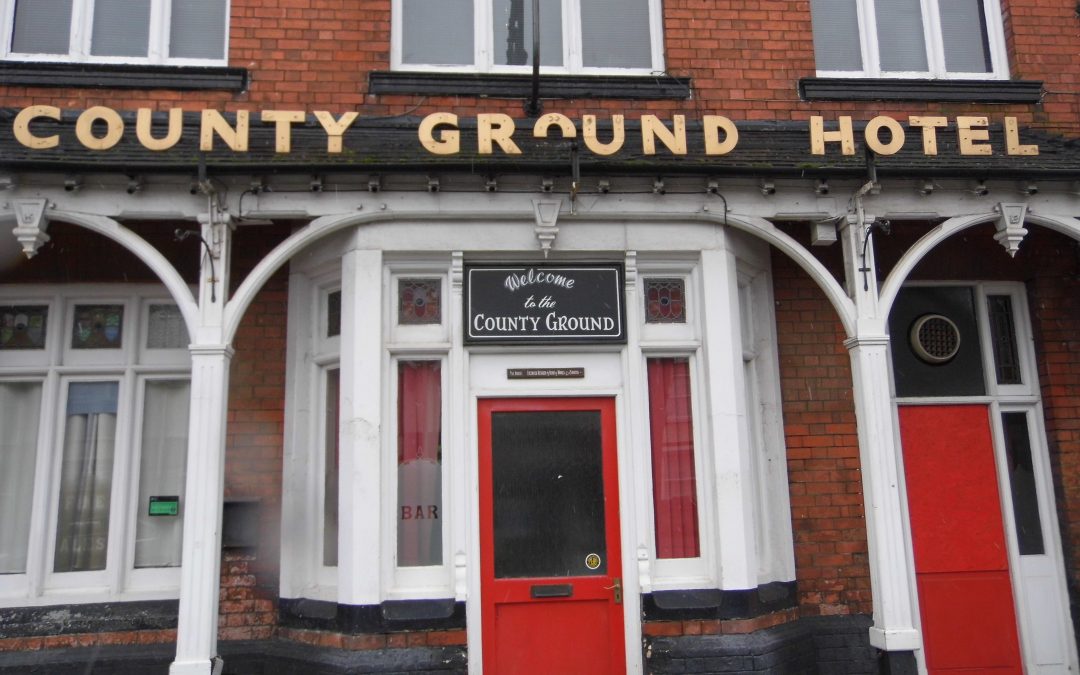
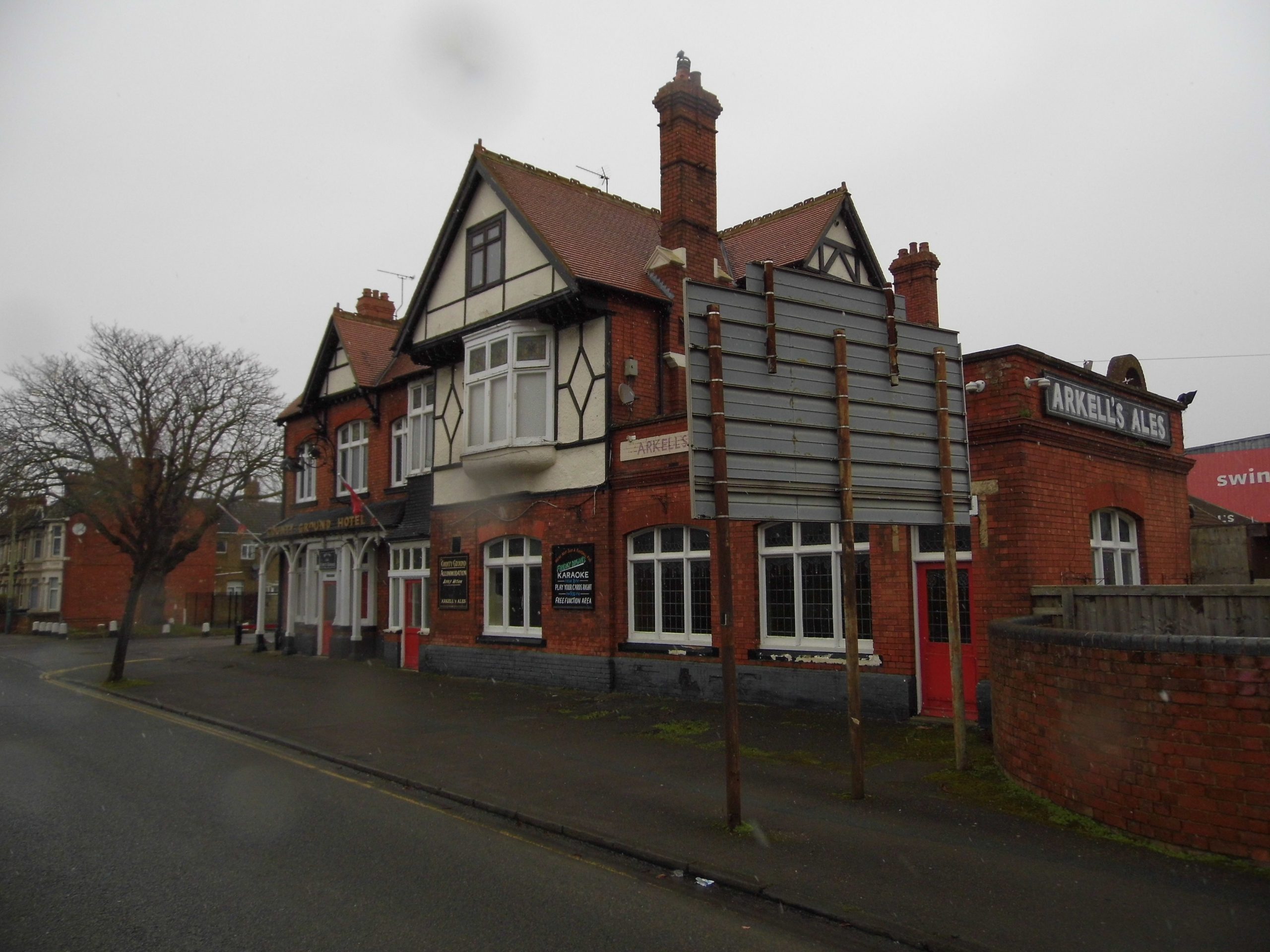
There’s lots more images of it on the Arkell’s website for the hotel and this Flickr stream has some too. And below are some shots taken by Born Again Swindonian photographer-in-chief: Chris Eley,
The County Ground Hotel
The Swindon County Ground Hotel lies a mere few yards from the stadium of the home team – Swindon Town football club. Hence its name. It’s a popular watering hole for fans whenever Swindon Town are playing at home. And, according the website, a down-to-earth ‘local’ when they are not.
Boxing Clever
Curiously, for a watering hole associated with a football ground, the pub has strong associations with pugilism. ‘In fact, the pub’s favourite sport in modern times has been boxing, having been equipped with a gymnasium and former licensee Pete Neal a well-known former boxer. Who knew? Well not I!
A bit of County Ground Hotel History
Taken from the pub’s website:
‘Regulars in the County Ground Hotel celebrated a special anniversary on 2nd November, 1997 when this grand old pub notched up a century of service to Swindon drinkers.
Commemorating its opening year is a terracotta plaque on side of the building. The plaque includes a portrait of Queen Victoria who happened to be celebrating her Diamond Jubilee that year.
Photo from Emma Williams
Arkell’s bought the land from C Williams the year before and had a ready-made licence thanks to the demise of a pub in Highworth. The Rampant Cat was closed by a relieved James Arkell – son of John Arkell – who lived nearby at Redlands and was annoyed by the rowdy behaviour of some of the regulars. So the County Ground got the licence and one of the town’s landmarks was born.
Outwardly, The County Ground Hotel is largely unchanged from how it looked a hundred years ago, though alterations and extensions in 1921 and 1954 mean that it is not wholly Victorian.’
Listeners! I have grave news for you. No apologies for the pun. I can’t help myself, I can’t stop digging – they’ll be the death of me.
Esteemed Swindon historian, Frances Bevan, has got a new blog. And it promises to be a rather riveting combination of research and fictionalised stories with which Frances will tell the story of Radnor Street Cemetery in Swindon. And, I guess, its inhabitants.
‘Every death touches someone; a husband, a wife, a friend, a lover, a stranger, leaving a mark on history itself. Each of these blogposts begin with the re-imagined stories of that unknown witness and continues with researched facts supported by contemporary accounts. Sources include books, emphemera etc held at Local Studies, Central Library, parish registers, Radnor Street Cemetery burial registers, Wills, census returns and the British Newspaper Archives website.’
As we enter a new year, it’s pure delight to feature Lis McDernott to the ‘Made in Wiltshire’ section of Born again Swindonian. Writing is creating. And creating is making. So writing fits here as well as anything else.
Lis’ writing and business personas cross over somewhat. As the Headshot Diva, Lis does what it says and takes great headshot photographs. The crossover comes because Lis has written a book on that very topic – and you can find out more about that here.
Yet her output is much broader than that and I’m in awe. I mean, I do a spot of writing myself. There’s this blog for a start. And this year I became a published author for the first time with Secret Swindon.
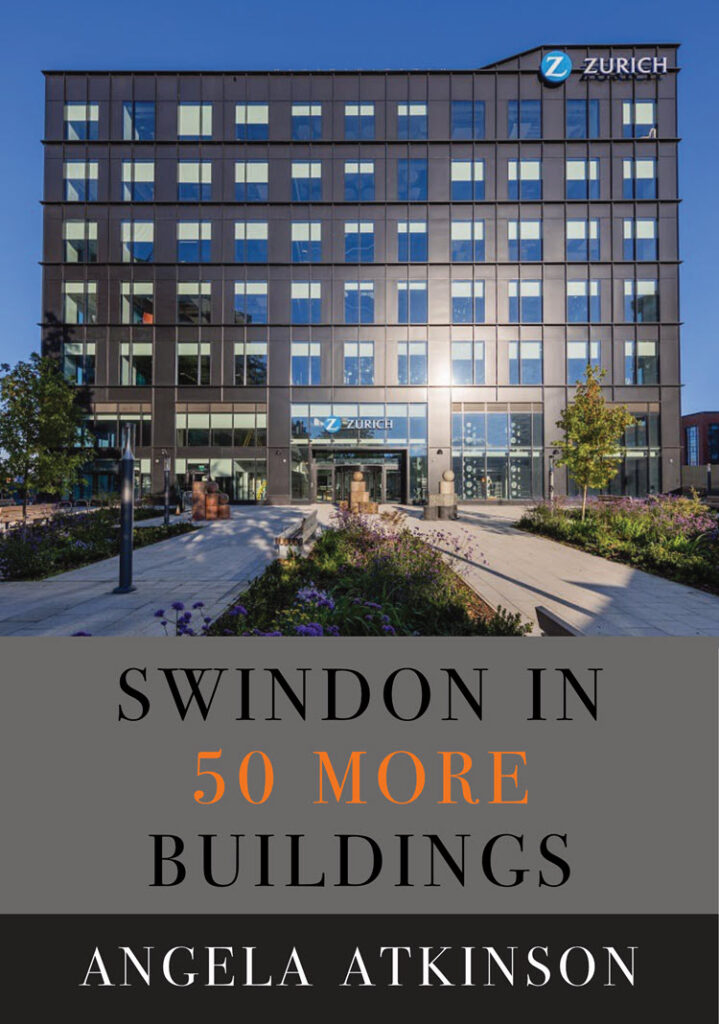
Plus, I’ve now got ‘Swindon in 50 Buildings‘ underway. But the prolific Lis is three books ahead of me. And fiction? No. That’s not me at all. I don’t have that sort of creativity.
Hailing from Leicester, Lis now lives in Royal Wootton Basset with her husband, Conrad.
Lis is musically trained, with a thirty-four year long career in music education under her belt. During this period, along with Mary Edwards she co-authored (under the pseudonym Lis Fletcher), Nelson Music. Nelson Music being a three-volume music scheme for primary schools.
2008 saw Lis change career and turn to photography. This allowed her to bring together her two passions: pictures and people. Complementing the photography, Lis gives talks on the topic and on writing and changing career at a later stage in life. (I sure as heck know all about that! What with necessity being the mother of reinvention. Baby boomer deprived of state pension and all that jazz)
Lis became an author in her own right in 2014 with the publication of ‘Headshot Diva‘. A proud moment came with a short story she penned being included in a short story anthology.
In 2017 Lis published her own book of short stories, ‘Changing Lives: 8 short stories’. Her latest book is, ‘Mixed Feelings‘, an autobiography.
[wpas_products keywords=”Lis Mcdermott”]
Amazon Links
Should you be interested in buying any of Lis’ books – and why wouldn’t you be – here are links to them on Amazon.
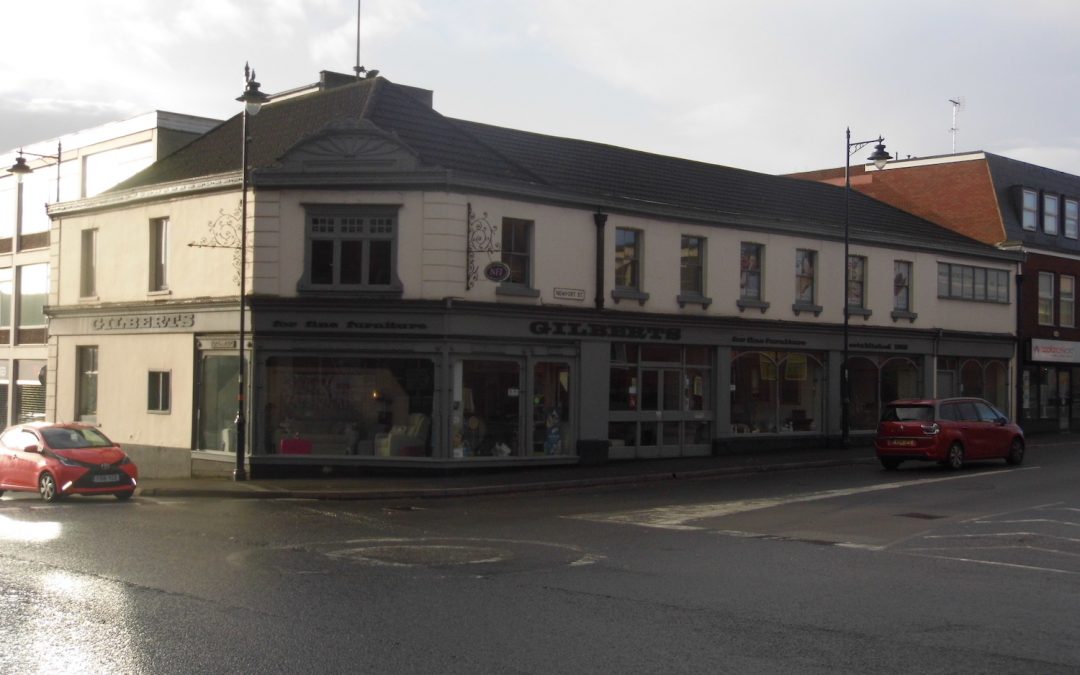
I don’t know if it’s astonishing or not, but it strikes me as being so, that there should be three long-standing retail businesses within a few yards of each other. Anyway – be that as it may – having already covered Deacon’s Jewellers and Blaylock’s Shoes it seemed only right to have a look at another long-standing Old Town business: Gilbert’s Home Furnishings.
Gilbert’s then, established in1886, has been in the business of serving their customers for 150 years.
Originally established in 1866, current owner Graeme Gatrill took on the business in 1991.
William Gilbert (1831-1911)
Philip Gilbert, a sawyer by trade, married Sarah Chouls in Great Bedwyn in 1828. Their son, William Gilbert, entered the world in 1831 at Grafton, near Marlborough.
By the time William Gilbert married Susanna Caroline (née Beaven) in Calne in 1860, he described himself as a ‘cabinet maker journeyman’. The couple made their first home in Blowthorn Street, Marlborough. But 1865 saw them living at 12 Belle Vue Road in Swindon and Willian employed as a grocer. A trade he continued to ply at that address for the rest of the decade. In 1867 he added ‘upholsterer’ to his occupations and cabinet maker in 1869. Thus the status quo remained until an unspecified point between 1871 and 1875.
At the earlier date, William Gilbert described himself as a ‘cabinet maker one man’ – though still living at Belle Vue Road. By 1875 though, the Gilbert family, comprising five children with another son on the way, relocated to a house and shop on the Newport Street site. Once there he advertised himself as a cabinet maker, selling a variety of furniture, fixtures and fittings for the home. Alongside all that, and on land at the year, he set up his furniture warehouse on the premises.
By 1881, William had staff. By now he employed one man and two apprentices. Following in his father’s footsteps, Gilbert’s firstborn son became a cabinet maker. As tradition often dictates, the couple’s second child, Emily, did what her mother had done before her and became a dressmaker.
In 1186-1887, the Gilbert clan rebuilt and remodelled the Newport Street shop to provide 6,000 square feet of warehousing space. The family moved around the corner into Ingleside, at 40 Devizes Road. In 1889 the business became William Gilbert and Son. The son, Albert John (AK John Gilbert) became the effective business boss in 1900.
Trams
In 1904 the new-fangled trams came to Old Town and the Gilbert business found itself a mere few yards from the Old Town terminus. The canny business owner capitalised on his serendipitous proximity to the tram terminus by telling his customers to ask the conductor for fares to ‘Gilbert’s furniture please!’
The elder Gilberts were still at Ingleside in 1906 when Susanna died. The following year, William wed Rosanna Breakwell, 23 years his junior.
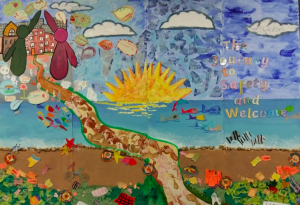
Last weekend saw me – and many others – in Swindon’s Old Town being part of The Journey.
The Journey, as described on photographer Elmar Rubio’s website, was ‘an immense, immersive theatrical telling of the Christmas story’. It entailed a processional performance that unfolded throughout Old Town that showed ‘the true nature, the faith and the fearlessness of those chosen to birth and raise Jesus Christ. It was truly epic, beautiful and moving and I offer my biggest and most heartfelt congratulations and thanks to all those who made it happen.
It began at Lethbridge School with crowd scenes, and the Romans telling the residents of Nazareth that they had to return to their birth place to be counted – for a census. The Journey progressed down to Wood Street, through a bazaar, and into Christ Church for the Nativity – with a real baby!
As I walked along with the performance it occurred to me how much the Christmas story carries resonances for all of us. Whether you’re a firm believer in God and Christ, are on the fence or strongly of the opinion that it’s nothing more than the greatest story ever told – it has resonances. Because, aside from the birth of Christ element, the Christmas story is one of people being made to move en masse, without fault and without choice. Whether it be fleeing from war, or famine or natural disaster – or forced from their homes for racist/political reasons – people have suffered mass exodus since time immemorial. The world hasn’t come to anything. Such atrocities were ever thus.
The residents of Nazareth, and all towns and villages in the region, were forced to undertake a long and arduous journey to Bethlehem because the Romans decided to count the population in its occupied territories. No matter if you were old, or sick or, like Mary, heavily pregnant – you had to go. Many must have died along the way.
And mass exodus is something that moved David Bent to paint his Movement 2000 collection. These works took David two years to paint. He undertook the project from feeling moved, inspired – driven even – to create a major piece of work in celebration of the new millennium. When he chose ‘Movement’ as the umbrella title for these paintings he was inadvertently prescient. Why? Because around this time the Balkan/Yugoslav raged. And, as we know, where ever conflict exists there are refugees. Where ever there is conflict there are people on the move seeking sanctuary.
So as I toddled along reflecting on all this, I considered how apt that this performance take place in a town that is home to the Harbour Project, aiding refugees and asylum seekers and is Swindon City of Sanctuary. And I reflected too, how so so very fortunate I am – that I am not them. I reflected that, to coin a cliché – there but for the grace of God go I. Go you. Go all of us.