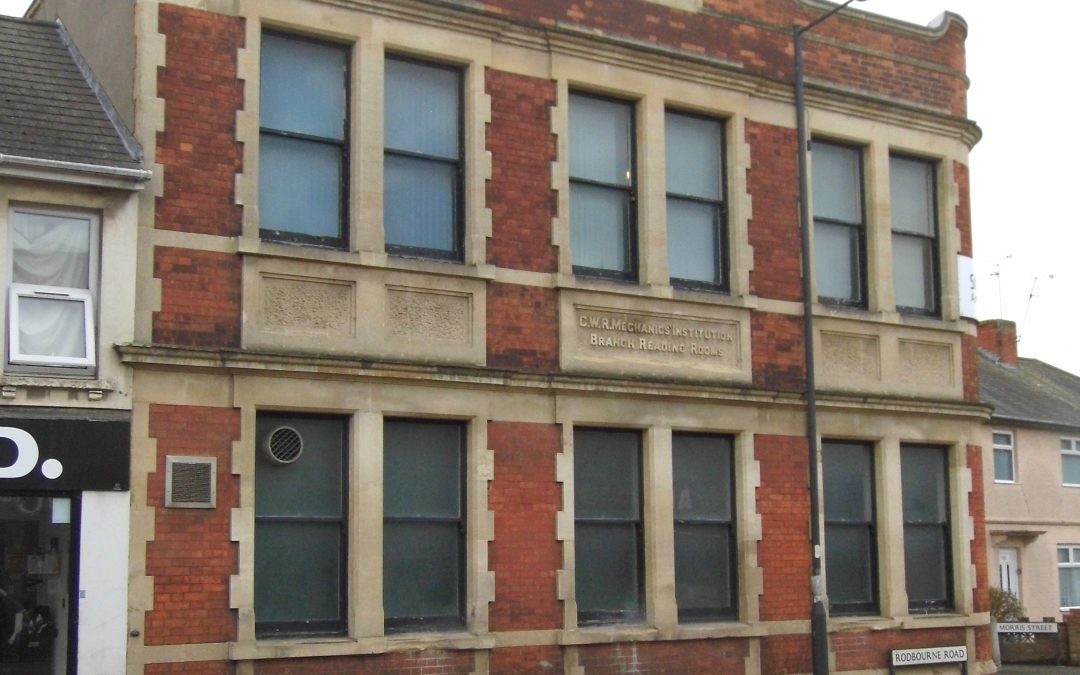
The GWR Reading Rooms Rodbourne Swindon – built in 1904
Between Secret Swindon and Swindon in 50 Buildings, I’ve given good coverage to Swindon’s Mechanics’ Institution itself in my published books. So this series of Swindon in 50 more buildings gives me a chance to give mention of the GWR reading rooms in Rodbourne.
Where are the GWR Rodbourne Reading Rooms and what are they?
Well the location speaks for itself – well Rodbourne Road to be specific. Just a little way down from the Outlet Centre.
‘The Rodbourne branch was built in 1904 and became known locally as the Reading Rooms. The ground floor consisted of a reading room, hall, office and yard. While on the first floor there was a games room.
The building is presently occupied by the North Wiltshire branch of the St John’s Ambulance Brigade. Evening brigade meetings and daytime first aid courses for companies in the North Wilts. area are provided.’
So Rodbourne’s GWR reading rooms then are a branch of the Mechanics’ Institution. The main one in the heart of the railway village in Emlyn Square.
This blog from Swindon in the Past Lane tells us about the architect of Rodbourne Reading Rooms – Robert James Beswick. Hailing from Manchester, Robert came to Swindon in the mid 1870s. He became articled to another popular local architect, WH Read, and was in practice from around 1874. In 1884 he wed Emilie Matilda Elliott, the daughter of John Elliott, a painter in the works. The blog explains that Beswick enjoyed a prolific career during which he designed several Swindon landmark buildings – this one included. But to say more would be spoliers! Read the Past Lane blog for the full lowdown on his architectural output.
The Mechanics’ Institution building served as a venue for New Swindon’s social activities, entertainment and educational activities.
In its glory days it offered a reading room, a theatre and a library – see Secret Swindon for so much more on all of that. It also boasted cold-water baths (before the building of the Milton Road Baths), a coffee room, a dining room, lecture rooms and public meeting rooms.
In the first instance the Mechanics’ Institution was accommodated within the Works. The institution moved in 1855 to a permanent building in the railway village.
The membership of its library grew fast, necessitating the opening of branches in Rodbourne and Gorse Hill.
The Mechanics’ Institute, Emlyn Square, in the GWR railway village, Swindon
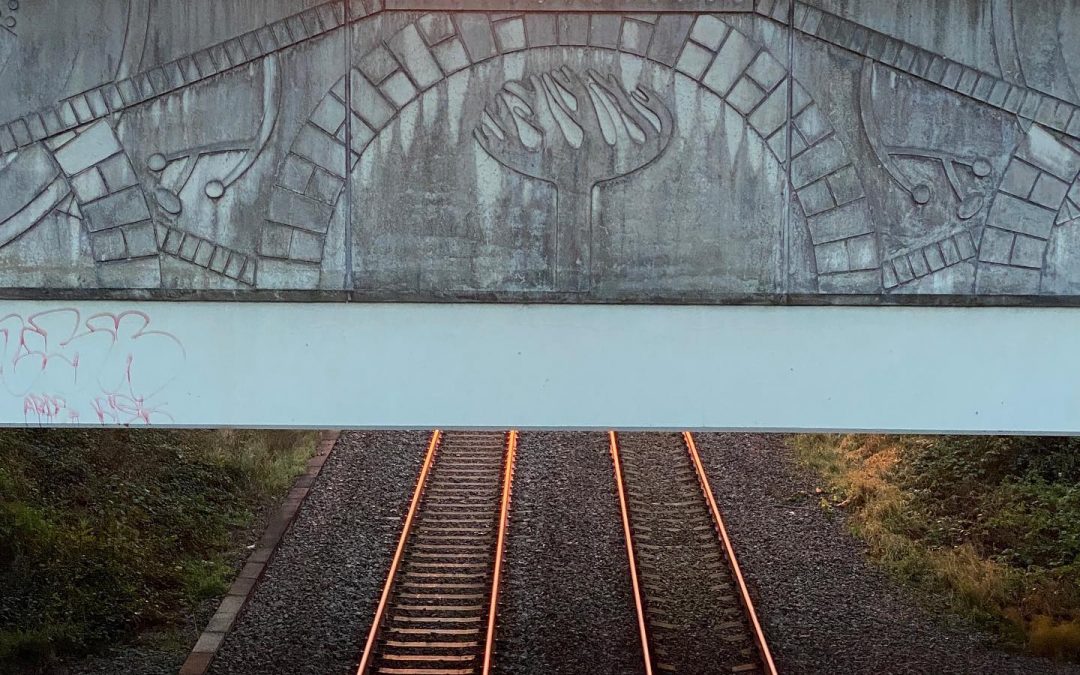
Purton Road Bridge Swindon – something I’ve seen often but have never thought too much about until Roger Ogle posted the photograph below on Facebook. That prompted me to ask him for more information about it.
Purton Road Bridge Swindon – photo by Roger Ogle
West and north joined
Back in 1993 the Link Magazine, created by Roger Ogle, covered the building of the new bridge.
The extract reads – paraphrased
‘A new bridge, marrying art and engineering and making access easier between west and north Swindon opened five months ahead of schedule.
The £1.25 million structure spans the Swindon to Glocs railway line and is the town’s biggest piece of public art.
The bridge parapets form a 140ft long relief sculpture frieze created by artist Richard Perry. The frieze incorporates motifs of transport, industry and environment.
The then Thamesdown District council and Wiltshire County Council joined together to commission the project. It formed part of plans made 15 years ago. At that point the two councils agreed on the building of Roughmoor and Shaw. The project included:
a. A smaller bridge over the nearby River Ray and … b. … 700 metres of new road joining Moredon with Sparcells.
The then mayor of Thamesdown, Doreen Dart, observed that the bridge was a milestone in the town’s development. She went on to say that it represented a link between the western expansion and future development in the north of the town …
… Although the old northern road will at length become a footpath/cycle route from which you can see the artwork, there’s no obvious pedestrian route to allow viewing.’
Link Magazine January 1994
Other posts about public art
This blog holds a great number of posts about public art in Swindon. I must have written about most of it at some time or another. Depending on how well I’ve organised and categorised my posts you should find most of them in this blog category here: https://swindonian.me/category/public-art-sculpture/
Last Orders gets gold. This monster compendium of lost locals written by John Stooke has scooped the top prize at the annual awards held by the Guild of British Beer Writers. John’s gold award is for the best ‘not for profit’ piece of writing in 2020.
The substantial prize, sponsored by iconic Sussex brewery, Harvey’s, is named the Tom Paine Award after 17th Century Tom Paine. Locals hold the belief that Mr Paine, a writer local to Lewes, Excise Officer and radical helped draft the American Declaration of Independence.
Judges commented on the endeavour, the degree of detailed research and the warmth that shone through on every page.
Writer John Stooke said, “This is a huge achievement to get national recognition in this way, for what is, in essence, a local history book”. He added, “the first and only print run is beginning to run out. So if you still don’t have a copy the STEAM Museum have stock. It’s also in WH Smith in Regent Street and the Hop Inn, although it can only open at weekends at the moment.
“Due to Covid, the normal rather lavish dinner and award ceremony in a top London hotel, saw relegation to Zoom. Not quite as good, but a great honour all the same”.
Last Orders gets gold!
Said Angela Atkinson …
Fellow Swindon author Angela Atkinson said “I so enjoyed the talk that John presented to Swindon Civic Voice about his book Last Orders in January – a lifetime ago now. He gave such a funny, informative and entertaining talk. His book is a thing of wonder that I urge you all to buy and support John and his charity.
I offer my hugest congratulations to John on getting this book written and now winning this award. I couldn’t be more delighted.”.
John Stooke with his book Last Orders at STEAM museum in Swindon
The Wiltshire Mummers’ Play: Mummers plays are an old Christmas tradition in many parts of the country. A group of friends would dress up, and go round the neighbourhood performing a little play. This had a set script. But, thanks to oral transmission, this would have varied from district to district. In return they received money and food, and, no doubt, drink.
They also (a bit like the traditional Punch and Judy shows) would have contained topical references. F. A. Carrington tells us that the version he recorded mentioned Napoleon Bonaparte. But he cut this out.
Today these interesting tradition have seen revival. In Wiltshire, a group called the Potterne Christmas Boys perform the play.
Their Facebook page, from where the above image is taken, says:
Guardians of the traditional Potterne Mummers Play, we tour the pubs round the Devizes area in the week before Christmas, to present our version of the traditional folk play, and collect a few quid for local charities and the Wiltshire Air Ambulance.
‘Key characters in the plays include the heroes, who vary somewhat, and are usually King or St.George and father Christmas. The adversaries include Valiant Soldier, Turkey Snipe (Turkish Knight) and there are usually several others that drop in that include Little Man Jack, Little Man John and old Almanac and there is always a Quack Doctor, who carries the reviving elixir brought in to revive the loser of the sword fight between a hero and an adversary.
Local schoolteacher, Bernard Baker revived The Potterne Play back in 1953. Mick Hiscock, the Moonraker Morris and others subsequently kept it going.’
Sadly, they are unlikely to take place this year, but maybe, now you have the script shown below you can put your own on?
Screenshot from the YouTube video linked to above
The script
The cast of characters in the Wiltshire drama are:
1. OLD FATHER CHRISTMAS. 2. MINCE PIE. 3. A TURKISH (evidently a Saracen) KNIGHT. 4. ST. GEORGE. 5. An ITALIAN DOCTOR. 6. A character called LITTLE JACK.
The Wiltshire Mummers’ play – from around 1838
(Slightly Adapted from the Wiltshire Archaeological and Natural History Magazine, Volume 1, 1853).
Enter OLD FATHER CHRISTMAS.
FATHER CHRISTMAS; (Merrily). Oh! Here come I, old Father Christmas, welcome, or welcome not, I hope old Father Christmas will never be forgot. Make room! Room! I say! That I may lead Mince Pie this way. Walk in Mince Pie, and act thy part, And show the gentles thy valiant heart.
Enter Mince Pie MINCE PIE; (Joyful). Room! Room! You gallant souls give me room to rhyme, I’ll show you some festivity this Christmas time.
Enter a TURKISH KNIGHT, with a wooden sword. TURKISH KNIGHT; (Boldly belligerent). I am a valiant Turkish Knight, And dare with any man to fight; Bring me the man that bids me stand, Who says he’ll cut me down with audacious hand, I’ll cut him and hew him as small as a fly, And send him to Satan to make mince pie.
Enter ST. GEORGE with a wooden sword. ST GEORGE; (Belligerently bold). Oh! In come I, St. George, the man of courage bold, With my sword and buckler I’ve won three crowns of gold; I fought the fiery dragon and brought him to the slaughter; I won a beauteous Queen a King of Egypt’s daughter: If thy mind is high, my mind is bold, If thy blood is hot, I will make it cold.
[ST. GEORGE and the TURKISH KNIGHT fight; the latter falls).
TURKISH KNIGHT;(Squealing like a sissy).Oh! St. George spare my life! FATHER CHRISTMAS; (Vaguely concerned). Is no Doctor to be found To cure this man who’s bleeding on the ground?
Enter the DOCTOR.
THE DOCTOR; (Improperly enthusiastic). Yes! An Italian Doctor’s to be found To cure the Knight who’s bleeding on the ground: I cure the sick of every pain, And raise the dead to life again.
FATHER CHRISTMAS; (Glumly). Doctor, what is thy fee? THE DOCTOR; (To business).Ten pounds is my fee, But fifteen I must take of thee Before I set this gallant free.
FATHER CHRISTMAS; (Sighing). Work thy will, Doctor.
THE DOCTOR; (prideful). I have a little bottle by my side The fame of which spreads far and wide, I drop a drop on this poor man’s nose.
[THE DOCTOR touches the TURKISH KNIGHT’S nose and he instantly springs on his feet quite recovered.]
Enter LITTLE JACK, a small man, with several dolls strapped at his back.
LITTLE JACK; (Cheekily). Oh! In come I, little saucy Jack With all my family at my back. Christmas comes but once a year And when it comes it brings good cheer: Roast beef, plum pudding, and mince pie, Who likes that any better than I?
FATHER CHRISTMAS; (Loudly and heartfelt). Me! [He gestures to the audience to join in].
MINCE PIE; (Sums up). Christmas ale makes us dance and sing; Money in purse is a very fine thing. Ladies and gentlemen give us what you please ALL; (Cheers). MERRY CHRISTMAS ALL!!
Carrington, F. A. (1853) On Certain Wiltshire Customs, Wiltshire Archaeological and Natural History Magazine, Volume 1, 1853. (p. 79-86).
And now for some mincemeat
If you’re wondering what that’s got to do with Mummers the answer is: nothing at all. Except that Rebecca likes to make her own so is sharing her recipe!
As she says: ‘Pretty every much everyone loves mince pies, and some people love making mince pies, me, I make the mincemeat. Shop bought mincemeat consists of pureed apple, palm oil and the odd raisin. I can do better than that!
I was told by a person who makes home preserves for the market that good mincemeat is not cost effective to make for retail. Hence the uninspired products on the market. So by making your own you get the chance to experience truly wonderful mince pies.’
Now in the immortal words of Jimmy Young – Google him:
This is what you do!
Take:
Put lemon and apples though mincer (or finely chop or grate), add to other ingredients in bowl, mix well and jar up. If a little dry, add more water/sherry.
Another Picture – Another Story … the continuing trawl through a press photographer’s archive
I’ve heard it said, more than once, that just about anything you can think of will have some connection somewhere to Swindon. Well, the briefest of trawls through Another Picture – Another Story, demonstrates how true that is. Swindon IS the centre of the universe!
The best way to describe the book itself is to use some of Richard’s own words from the inside cover:
‘As a press photographer, I take pictures of life. And, as an archivist of pictures, I store life’s stories. Stories that quite often a theme. Some are happy and some are sad … Most stories have a beginning, a middle and an end. And with many picture stories the start is a long way from the end – sometimes it’s years. In wading through my archive, I have found links between stories that never existed at the time.’
So the structure of this book then is, as you’d imagine, stacks of great photographs linked together by Richard’s recollections of the events they belong to.
For Dr Who fans it’s something of a wibbly wobbly, timey wimey hop, skip and jump through different times and events in Swindon’s history. And that’s an appropriate analogy given that the book features Dr Who and the Daleks. Obey! Obey! Resistance is futile!
Note though, the contents of the book are not entirely Swindon-centric. There’s world events too. But you need to buy the book to see why.
So what’s in it then?
Well – Lydiard looms large of course. As you’d expect Lydiard House and Park are more than bit players in this production. As too are the Queen and other members of the Royal Family. Indeed as you can see, the front cover features the Princess of Wales herself. All as apposite as it can be given that The Crown is running on Netflix at the moment.
Returning to Lydiard – at the very start of the book we see images of events at Lydiard with The Queen. Hard to conceive though it may be, there was a time when the importance of that house and park was not so well appreciated as it is now. Richard describes how, when scanning in some pictures from the 1980s/early 1990s, he had only one negative. And the legend on this negative was a simple: ‘house in Lydiard Park’. An indication of the lack of that aforementioned lack of appreciation.
Right – I haven’t yet finished the book, I’m about halfway. And so far I’ve encountered snow, stations, shopping and snakes. Also bricks, bears and brass bands. And I know there’s trains, planes and automobiles. You get the idea – everything you can think of and more.
Why buy it?
Well – if you have only the most passing of interests in Swindon you – or someone you know – is sure to get something from this book – if only looking at the pictures! Plus – it’s not ‘history’ as such. If the very mention of that word brings you out in a hive then you need have no fears with this book. You can put the anti-histamines away. It’s chock full of all manner of ‘well I never knew that’ moments. It’s a brilliant gift for that ‘hard-to-buy-for’ friend or family member – or a treat for yourself.
And besides all that – Richard will donate £1 from every book sold to the Neuroendocrine Cancer UK – a charity that Richard has good reason thank. Isn’t that a good reason too?