Important Development for Save Oasis Swindon Campaign
Important Development for SOS Campaign This week, the SOS campaign saw an important development.
Right out of the blue Damien Siviter, part of SevenCapital’s executive team contacted the campaign, requesting a meeting. Thus, on Wednesday of this week, two campaign representatives, Tony Hillier and Neil Robinson headed to the Park Lane, London offices of the development company.
The ultimate upshot of a fruitful meeting is a three-way media release, between the SOS campaign, Swindon Borough Council and SevenCapital.
Note:There was much negotiation between all interested parties about the wording of this media statement. The campaign stresses that SevenCapitalshowed much willingness for the campaign to be as comfortable as possible that what went into the press release reflected their goals. Thus SevenCapitalagreed not to publish anything until all parties were comfortable.
The meeting discussed much that the campaign is not at liberty to publicly discuss. Such as why they were met with blanket radio silence from SevenCapital. But what the campaign cansay is that it seems that SevenCapital never had any intention of removing the leisure facilities from that site. How serious they were about that hastily drawn CGI put out to Swindonians back in March is unclear. But the important point is that channels of communication are now open.
The campaigners took the opportunity of the meeting to present Mr Siviter with physical copies of all the information they’ve gathered from a range of expert witnesses. Information that points to preserving the iconic dome – a key thrust of the campaign – to be entirely possible. And, what’s more, possible in a sustainable and ecological way.
The onus now rests on SevenCapital to prove absolutely that they cannot save the dome before Swindonians will consider accepting a replacement leisure centre. One that may well be very fine but will not be the Oasis that we know and love.
An aside
So above I’m writing as a member of the SOS campaign team. What’s coming now is my voice – me – Angela Atkinson as a Swindonian – albeit one with experience of the campaign. But speaking for ME and NOT for the campaign.
When Cllr Renard says in the official press release (link above): ‘ We’ve consistently said that SevenCapital’s plans are the best way forward for the Oasis, and securing its future has always been my top priority, I’m not sure if he’s on this earth or Fuller’s Earth.#sorry #notsorry
He, and in particular a certain member of his Cabinet have indeed been consistent. They’ve been consistent in stonewalling, deflecting, belittling and blocking concerned constituents and the SOS campaign itself on social media. This from public servants who are PAID TO LISTEN TO THEIR CONSTITUENTS. And being blocked by this person, means the campaign can’t respond.
I’m neither imagining nor exaggerating all this. Too many constituents have experienced it and know it. Thus there’s huge irony in the alluded to Cabinet member now accusing the SOS campaign of antagonism.
Experience of the past few months and what transpired at this meeting have made evident that clearer communications and less pathetic political posturing from the town’s administrative party would have made this whole sorry saga much less fraught than it became over the last few months.
The needless and endless deflection that simply angered and frustrated residents is nothing but self-defeating and exhausting for all.
A quick recap: this meeting between SevenCapital and the SOS campaign happened because SevenCapital contacted the campaign and requested a meeting. SBC played NO PART in this step forward and must not be allowed to claim any credit for it.
#justaying
In summary
The SOS campaign sees this development as a cause for cautious optimism for the future of the Oasis. But of course, much can happen in the next few months. As Swindon Viewpoint said on the end of one of the many splendid videos they made at the campaign’s recent rally, the Oasis isn’t saved until the doors swing open again.
So, there is still much to do and the campaign is in dire need of practical help. So, if you feel you can get involved, wave!
But for now, the campaign awaits the results of the listing application.
And on that note, an important reminder because there appears not to be clarity on this point. It wasn’t the SOS campaign that submitted the listing application. In th first instance an unknown individual submitted a listing application – soon followed by another one from the 20thCentury society.
After initial resistance, the campaign does now support the listing application yes. But that isn’t the same as being the instigator of it. There’s a world of difference in those two chunks of discourse.
Swindon artist and Old Town resident, David Bent is exhibiting at Tetbury Good’s Shed.
David’s Out of This World exhibition runs from 30th June to 29th August 2021. Opening times are 11-4pm Wednesdays through Sundays.
Andrew Morton of the Red Arrows wrote:
‘2006 saw the Red Arrows invite leading modern aviation artist David Bent to collaborate as Artist in Residence. This remains a positive and enduring goodwill relationship with David the artist most closely associated with the team. The team exhibits David’s work on the walls of the team’s Lincolnshire, RAF Scampton home. That includes in the crew briefing room.
With a wonderful use of colour, expert detail and creativity, David’s work showcases both the excitement of flight and its inherent beauty. David’s art reflects the precision and engineering excellence of the Royal Air Force Aerobatic Team. Further, he captures the imagination of those who see and draw inspiration from his pieces. Just as the Red Arrows do with every performance and display.’
About David
Awarded Honorary Companionship of the Royal Aeronautical Society, David is credited with leading a new movement in modern aviation art.
Recent exhibitions include: a. the National Memorial Arboretum b. St George’s Bristol c. Royal Air Force Museum d. Swindon Museum & Art Gallery and … c. … Russell Cotes Museum & Art Gallery.
20% percent of sales from this Out of This World exhibition at the Tetbury Good’s Shed will go straight to the venue to help them with their work.
A Swindon Health and Leisure History Swindon possesses an important slice of social history. One that shows how health and leisure provision have changed throughout the years. And how important that is to people’s welfare. Both physical and mental. It began with the GWR Medical Fund Society and comes right up to date and feeds into the current Oasis saga.
Central community centre – one time GWR Medical Fund Society hospital – drawn by Dona Bradley
Always at the forefront
Swindon’s now demolished *Princess Margaret Hospital was the first new hospital built in Britain following WWII. And, what’s more, the first hospital built under the NHS. And its current GWH (Great Western Hospital) came in the first wave of the controversial private finance initiative scheme.
Yet Swindon was at the cutting edge of health and leisure provision way before that. In fact, you could go so far as to say Swindon invented the concept. And it began with the GWR medical fund society.
In my first Swindon-related publication, Secret Swindon, I recounted in some detail a history of Swindon’s Mechanics’ Institution and its achievements. But for the purposes of this article I’ll fast forward to this extract from the book:
1847–1947: A Century of Medical Provision from the GWR Medical Fund Society
Just as there were other Mechanics’ Institutions in the country there were other medical funds too. Notably in Tredegar in Wales, the birthplace of one Aneurin Bevan, the godfather of the NHS. The Tredegar Medical Aid Society, though, was newer, founded in 1890, and not as extensive as Swindon’s model. What made Swindon’s MFS so special was its breadth and its scope. The Swindon model took a modern and holistic healthcare approach symbolised by the dispensary and baths at Milton Road.
From cradle to grave
‘From cradle to grave’ is an expression synonymous with the NHS. Yet Swindon can lay claim to offering that level of care decades before Britain got its NHS. The GWR Medical Fund Society gave an inclusive health service for 101 years before the NHS came into being. It was healthcare ahead of its time. So much so that when Nye Bevan visited Swindon to see the health provision the MFS provided he commented: ‘There it was. A complete health service in Swindon. All we had to do was expand it to the whole country.’
The notion of a national health service was tabled even before WWII victory. A 1945 parliamentary white paper sketched the plan out. Yet, as Graham Carter wrote in Swindon Heritage magazine, records unearthed at the Wiltshire and Swindon History Centre reveal involvement by the committee of the GWR Medical Fund. Then, February 1946 saw the convening of an English and Welsh Medical Alliances conference. And they chose Swindon to host, in what we now call the Health Hydro – though it remains known and well-loved among older Swindonians as the Baths.
As Graham went on to explain, it appears that representatives from that famous medical journal The Lancet were in attendance. At least if the mention of the Swindon’s health service in its May 1946 edition is anything to go by.
Blue Plaque on Milton Road Baths
The dispensary and the baths
Outlining the town’s services and facilities, it focused on the dispensary and the baths, rather than the cottage hospital. Because they better fitted new ideas about the importance of wellbeing and prevention. In Swindon it found something special, something unique:
‘it will be seen that the society provides for its members’ needs from cradle to grave’. In the words of a distinguished medical visitor, ‘The Medical Fund Society is the only current example in this country of an attempt to provide a comprehensive health service for its beneficiaries.’
The Secret Swindon book then goes on to detail a timeline of events that led to the formation of the medical fund society. Note this from 1860:
‘In modern times we take the provision in our homes of baths and showers for granted. Back then though, the adage of cleanliness being next to Godliness was not so well entrenched as it later became. So, all the more credit to the MFS for inaugurating the first baths. The 1860 minutes record the granting of permission to put ‘the shower and slipper bath’ in the bath room at the Mechanics’ Institution.
A year later came a project of much greater ambition: Turkish baths on ground behind the Mechanics’ Institute. Three years on, in 1864, the baths got moved to the yard of the barracks … now The Platform, a youth music venue.’
Swindon’s first hospital
From there we do some Dr Who-esque wibbly wobbly, timey-wimey stuff and fast forward to 1872. That’s when the hospital, now central community centre in the GWR railway village, opened. The medical staff increased to two surgeons, Messrs Swinhoe and Howse, and two assistants.
The rules stated the hospital was for accidents only – not general diseases – and was to be free to all society members. Other servants of the GWR ‘shall be charged a fair and reasonable sum for their maintenance as may be decided by the committee’.
Now, jump back in to the TARDIS for a leap to 1892 – a most significant year for health and leisure provision in Swindon. For this year saw the opening of a new consulting room waiting halls and dispensary. All this along with two new swimming baths – one small and one large. By 1899 the Milton Road site sees the addition of new washing, Turkish and Russian Baths. The Turkish baths are going strong still and are now the oldest extant example of their kind in the world.
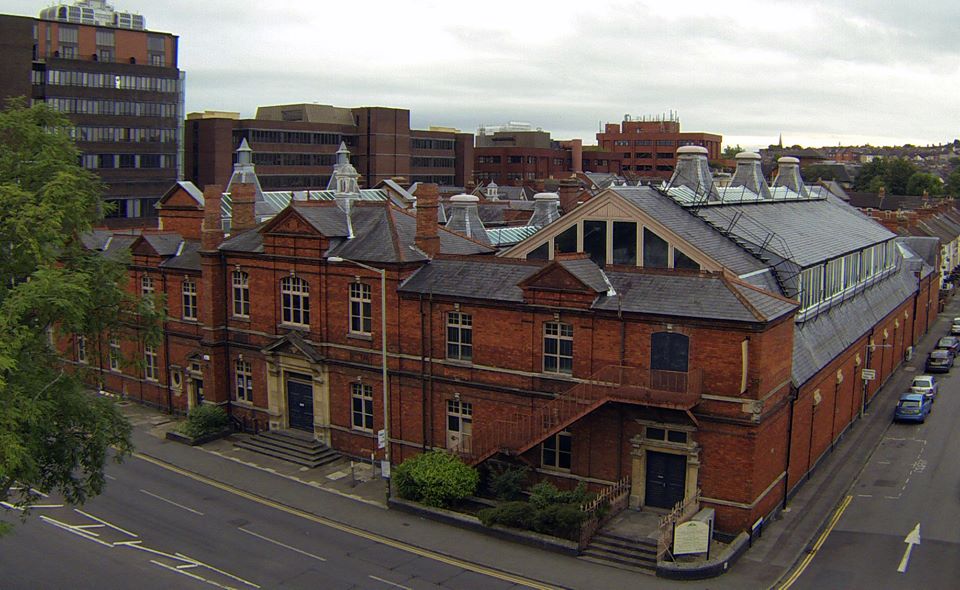
This building, the HQ of the GWR Medical Fund Society sits on Milton Road in Swindon. Now known as the Health Hydro it’s often still referred to as the baths, Milton Road baths or the old health centre.
Milton Road Baths – aka The Health Hydro
The Victorian love affair with communal bathing
Of course, Swindon wasn’t the only place to have a Victorian swimming bath. I grew up in a mining area on the Derbyshire/Notts border and have vivid memories of going to the baths in a nearby village. We never went swimming – we went to the baths. Cresswell baths were a smaller version of what Swindon has in Milton Road. Right down to the changing cubicles round the pool, the glazed bricks and the viewing balcony and even the slipper baths.
We kids learned to swim there just as generations of older Swindonians learned to swim in the small pool at Milton Road. Whenever I walk into the Health Hydro I’m transported back to childhood and school swimming lessons and getting my ‘learner’s certificate’ and a red stripe to sew onto my swimming costume.
The prevalence of Victorian swimming pools around the country was no accident though. Their 1846 Baths and Wash House Act kickstarted almost a century of municipal pool design. As this article about nine spectacular public swimming pools in the UKobserves, The UK has the largest stock of historic swimming pools in the world. Although only fifty-two of Britain’s 116 listed bathhouses are still operational today. And Swindon’s Milton Road Baths is one of them.
Swindon’s health care moves into the 20th century
With the twentieth century, other services came along. In the period between WWI and the mid-1940s eight further consulting rooms came into use at Milton Road. Along with a dental surgery, a psychological clinic, a dispensary, an ophthalmic practice, a chiropodist, a physiotherapist, a paediatric clinic, a skin clinic and a masseur.
Swindon’s Medical Fund Society, conceived by the men, for the men (and their families) and run by the men (via elected representatives), was a pioneering venture well ahead of its time. One that played a significant role on both local and national stages. A thing of beauty and breadth, the society was 101 years old when the NHS took it over. Digest that fact do! 101 years of health provision before the NHS took it over.
But, as we’ve seen the MFS offering included swimming and Turkish and Russian baths. If not viewed as leisure then – such things are now.
The rise of civic sport and leisure centres
What the Victorians began, modern British society continued.
During the post-war period, and in the 1960s in particular, this country saw, with government support, a big rise in the building of civic sport and leisure centres. As the article states, many such early leisure centres had amenities that remain popular today – swimming pools and ice rinks. Though they of course opened long before the advent of high-tech gym equipment or the steam rooms and spas that we’re familiar with now.
Even so, these 1960s pioneering leisure centres offered a range of opportunities for health and recreation. The Milton Road baths of their day.
These facilities came at a time when Britain was still recovering from the ravages of WWII and the austerity of the 1950s. The country built bright new homes. And these leisure centres formed part of optimistic plans for healthier environments and improved recreational opportunities for ordinary people.
The 1980s and a new breed appears
By the time we get to the 1980s in our leisure pool time travel it’s all changed again. During this period, according to the Sports Leisure Legacy, a new variety of leisure pools appeared. ‘…proved attractive, notably in Swindon, Minehead (Butlins) and Torquay.
Indeed, Thamesdown Council’s Link Centre at Swindon, with its ice rink, theatre and pool attached to the public library galvanised thinking on the part of local authorities across the south west of England. A fully integrated leisure service, including sports and leisure centres, under Director Denys Hodson helped Thamesdown’s reputation.’
Swindon is ahead of the curve once more
But here again Swindon was ahead of the curve. The Link Centre opened in the mid-1980s. But almost a decade before that, on New Year’s Day in 1976, the town opened the Oasis leisure centre.
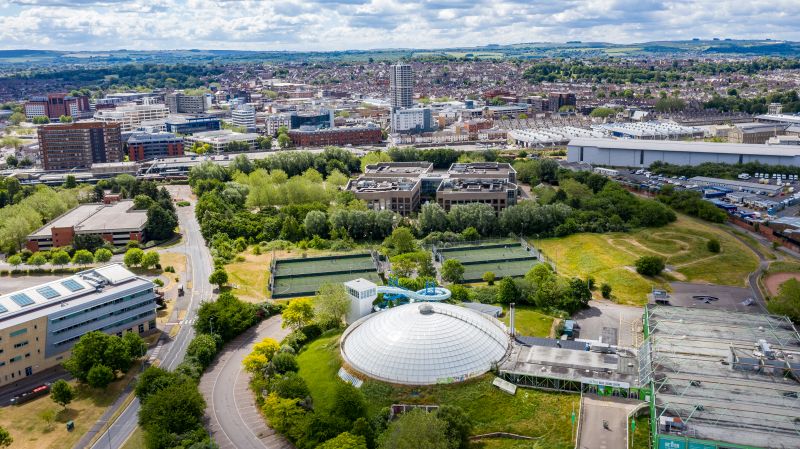
The complex was completed in Swindon, Wiltshire, in 1975 by Gillinson Barnet & Partners and is described in the RIBA Guide to Modern Architecture as a ‘fantasy structure, its half-submerged dome resembling a flying saucer’. More on the pleasure dome here.
One of the hand drawn plans of the Oasis
Research at the Swindon & Wiltshire history centre in Chippenham unearthed some wonderful documents from the time of the Oasis being planned. And, if you’re so inclined, there’s more of that here.
And now is the point in this article where I have to mention that controversy is raging over the Oasis as it’s under threat.
But to illustrate the vision in Swindon’s civic minds at the time, here’s an extract from an email sent to the Save the Oasis campaign by John Stevens who opened the facility. Powerful and moving words methinks.
The Letter from John Stevens
‘I had the pleasure and privilege of opening the Oasis, on New Year’s Day 1976, but never thought that I would see the day it could be closed – a very sad day indeed.
It was back in 1968 when the Borough Council discussed that, with the rapid expansion of the Town and the surrounding areas, we consider the building of a state-of-the-art leisure centre.
I had the good fortune of being on the Arts and Recreation Committee where we discussed and debated as to whether we could afford this kind of building and design.
We were aware that we were opening a very fine building, one of the best in the country, with this type of pleasure dome and provide the finest leisure activities in the country. Despite the financial restraints of the times we were committed to the people of Swindon and the surrounding area, to provide a fine and exciting building for the use and enjoyment of the community.
Let us not lose what was achieved for the people of Swindon, which is still enjoyed today by many of our residents, who look to the opportunities to keep fit and also relax. ‘
But of course, it’s also a 20th Century link in the long and noble chain of Swindon’s health and leisure offering. And it’s an important piece of social history. And as such it deserves honouring and preserving.
Just as generations of older Swindonians remember learning to swim at Milton Road baths and going to events there – younger Swindonians remember learning to swim at the Oasis. They remember having their childhood birthday parties there. They went to concerts there. And oh so very much more!
It’s played as big role in the lives of modern Swindonians as did Milton Road baths back in its day.
Swimming for fun!
And whatever happened to swimming for FUN? I’m not the only one asking that question.
Back in 2013 The Guardian wrote in praise of leisure pools. The author writes: ‘… But after a summer of getting wet with my children, in the sea as well as pools, I’ve become cross about the way swimming for fun – as in playing games, jumping in, doing handstands, diving for locker keys, racing each other – has been squeezed out of public pools.’
‘With the rise of lane swimming, kids preferring to do handstands have been washed into a corner of the municipal facility. What became of the council-run places dedicated to splashing about?’
Well if you’re in Swindon a Faustian pact with a property developer is the answer to that question!
The Oasis is the only place for MILES for some wet, wet, wet family fun!
The letter comes from: Save the Oasis Campaign in association with ACORN Swindon Email: saveoasisswindon@gmail.com
It will go to: Seven Capital 97 Park Lane Mayfair London W1K 7TG
The open letter to Seven Capital
Dear Bal Sohal
THE OASIS LEISURE FACILTY IN SWINDON
We, the Save the Oasis campaign, have tried, without success, to communicate with Seven Capital since the beginning of 2021 when the facility first closed. It’s both worrying and of the utmost frustration when an organisation is so impossible to talk to and won’t offer a named contact. It certainly gives the worst possible impression.
As we’ve not been able to make contact with you, here are our questions and demands that we request you respond to as a matter of urgency.
1. Communications with the SOS campaign
We call on Seven Capital to instigate direct communication with Save Oasis Swindon and to work with us to uphold the wishes of Swindonians: the retention of the iconic dome and refurbishment of the existing centre.
2. Maintenance of the building
Why haven’t you properly maintained the building since taking on the lease from Swindon Borough Council?
We understand that you inherited a backlog of maintenance from SBC when you signed the lease however, the centre has not been properly cared for while it was open. Further, it absolutely has not been either maintained or secured since it closed. Neither Covid nor the ongoing listing application prevent there being due care and attention paid to the heritage asset in your charge.
3. Your intentions if the Oasis is listed
The campaign wishes to know what you intend to do should the building be listed. Can we expect a statement from you?
4. Our financial concerns
Can you demonstrate to the campaign that you are: a. Solvent now and … b. Have arrangements to remain so for the next 25 years
5. Trespassing into the centre
Because you failed to secure the Oasis facility, there have been many incidents of trespassing and vandalism. All of which have added to this building’s woes.
The campaign wishes to know do you have insurance to cover repair from such trespass injury?
And, further, to cover compensation for injuries said trespassers may sustain in the course of their activity.
It took until the 15th June for the campaign to learn that the building you are going to secure the building.That’s great and we’re pleased. But the question remains why it has taken Seven Capital/Swindon Borough Council until now to make it secure. The campaign has literally begged, from the start of the year, for you or SBC or both to take control of this situation. In the absence of any contact from Seven Capital it’s Swindon Borough Council that we’ve had to hound to get this security.
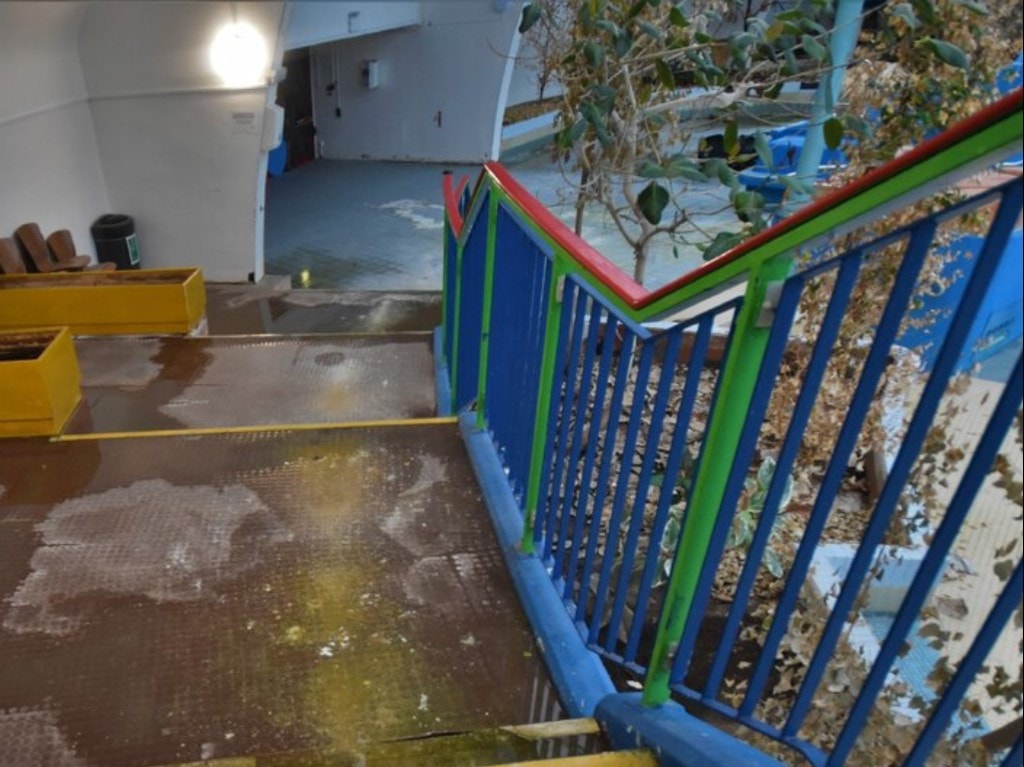
Below are just two images that show the degradation that you and SBC have between you allowed to happen to this facility. The very best spin that anyone can put on this, is constructive vandalism.
Yours sincerely Neil Robinson, Founder member of Save Oasis Swindon campaign Helena Bowie and Emma Williams, campaign co-ordinators Natalie North – Chair of ACORN Swindon
THEIMPORTANCE OF THE OASIS TO THE DISABLED COMMUNITY
20 June 2021
From one of the campaign team, Helena Williams Bowie, on the topic of the Oasis and inclusivity.
Back in 1972 when Swindon’s elders conceived the Oasis, the town had a population around half of what it is today. They knew back then the town’s population could and would have a rapid increase. And indeed, the expansion of Swindon continues almost 50 years on. Back then the administration in charge had a bold vision. Now we’re lacking facilities with double the population.
Sports in Swindon, during the Oasis’ planning period, were below national standards. A document in the archives proves resistance to a standard pool.
A letter from the British sub aqua club during planning stages shows that the oasis may never have happened. I’ll quote a line I think is important. ‘Not only will our organisation suffer but many young people, some disabled will suffer deprivation.’
That was then – and this is now
That was 1972. Yet here we are in 2021, in the same situation if not worse. For a high proportion of disabled people the Oasis is the only facility to accommodate their needs. Whether it’s swimming other sports or even events.
The Oasis then came along with inclusion in mind. It had a pool for fun and to encourage more women to take part in sports. Whether alone, with children or as part of the family.
It also encouraged use of the centre for weddings, the Eid Festival and more. The hall is large enough to hold ability /disability sports such as basketball, and Rugbyerc if requested.
On the beach
The beach-style fun pool was groundbreaking in design when it opened a full 34 years before the equality act 2010 became law.
This pool is the only one with total accessibility in Swindon and in a 50 miles radius with its specialist aquatic wheelchair. This means the world to those who use it.
It’s an extention of themselves, giving a feeling freedom and joy and not humiliation. They can exercise on their own terms and join in with family swims. For some autistic people feeling the waves in the wheelchair will be their only experience of the waves as many beaches don’t have the facilities.
Those a little more mobile find the beach style easier to enter if they can’t manage steps due arthritic joints, sports injury, hand eye co ordination , milder motor skills even dyspraxia. And with no hoist to face they avoid the humiliation and indignity of people watching them. Such things can take a toll on a person’s physical and mental wellbeing.
For the autistic
The Oasis is popular with many families of autistic children sometimes for the gentle slope or baby pool to help with water sensitivity. Smells are important here too. The dome provides a feeling of space even when busy to prevent an overwhelming feeling for both touch or sound. The wave machine is very calming for many. Who can remember seeing a face light up when first feeling the waves? I do.
The Oasis swimming pool was chosen for local school children with disabilities for their swimming lessons. The closure means they may not be able to meet the government education criteria by age 11. It also may put their lives at risk due to needing specific facilities.
Many different disability groups used the Oasis. Whether for the specific changing bench and hoist, the quietness of the pool or to meet friends with the same condition, for coffee and chat with mum and baby group. All these groups miss the Oasis and had no notice of it going. Nor has anyone offered them anywhere else. Non of the other leisure centres offer a like-for-like service in these aspects.
On the outside
The outside is more challenging to enter. Although planning didn’t consider disabled needs like now. Irrespective of the lsiting, we must do more to make access to the building via the front better for less mobile and wheelchair users. I have seen properties near my home with lift to the front door where the path and garden are at a sharp angle.
The Oasis was designed to accommodate changes.. Listing applications may take this into account such as laws and fire safety regs so it maybe possible.
Back in March, David Renard promised me a survey of all disability sports facilities available. So I plan hold him to this.
Please watch March Leaders in lock down video for precise wording. It’s all on the Save Oasis Swindon Facebook page and also below: