MALMESBURY TURNER ON DISPLAY FOR HERITAGE OPEN DAYS
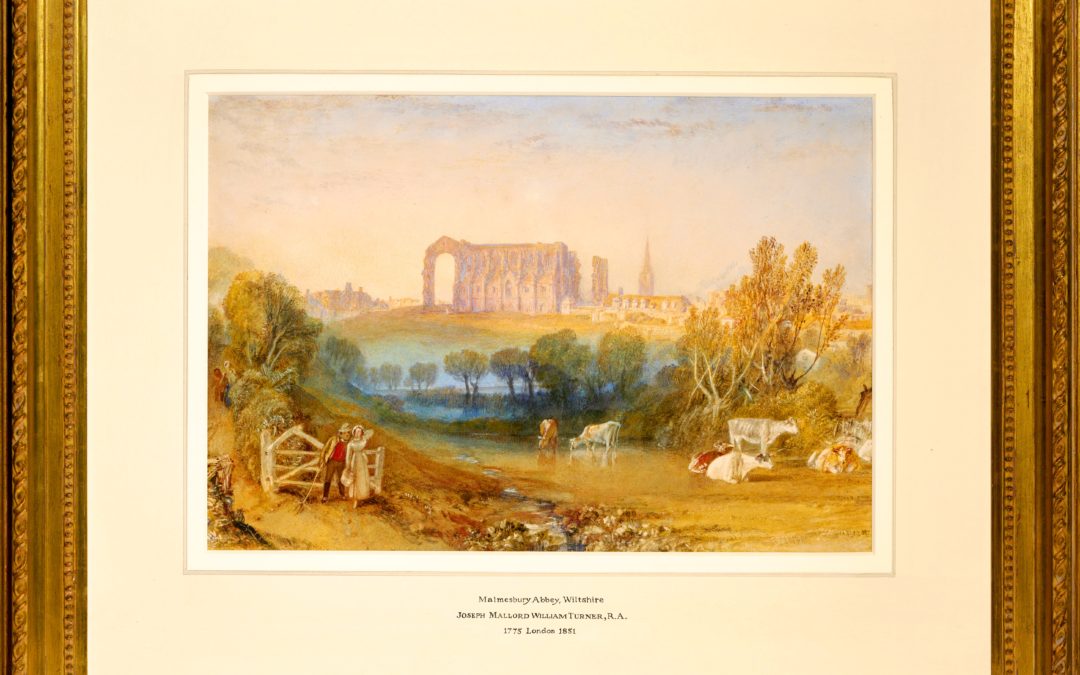
To celebrate the upcoming Heritage Open Days across the UK, volunteers at the Athelstan Museum will be shining a light on their ‘own’ Turner painting. The painting depicts Malmesbury Abbey.
Sharon Nolan, chairman of the museum said: ‘We’re throwing open our doors on Saturday and Sunday September 18 and 19 to celebrate Malmesbury’s own heritage. The highlight of our show will, of course, be our very own ‘Turner’!
‘We’re thrilled to share this amazing piece of art. We’re so proud we’ve secured this iconic picture for future generations’.
Turner
Joseph Mallord William Turner, born in 1775, has global recognition as one of the UK’s greatest artists. Some of his best known works include The Fighting Temeraire, The Burning Houses of Parliament and, of course, Malmesbury Abbey in Wiltshire.
Thanks to support from the National Lottery Heritage Fund, The Art Fund and local Wiltshire donors, the Athelstan Museum could buy one of the ninety-six watercolours that make up Turner’s set of ‘Picturesque Views in England and Wales’.
Turner visited Malmesbury as a teenager, made several sketches of the abbey and its setting above the River Avon. It became the inspiration for several artworks later in his life.
The Malmesbury Abbey painting, now housed at Athelstan Museum, came up for sale in 2018 at the Gallery of Richard Green in London. William Sykes spotted it in a magazine advertisement. After months of raising funds and negotiation the picture got bought for the community.
Heritage Open Days
Heritage Open Days are the UK’s largest festival of heritage and culture. They showcase more than 2,000 locations around the country and highlight the dedication and commitment of 1000s of volunteers. Other local heritage sites which will be open across the weekend include:
1. Ratcliffe & Son 2. Westport Iron Works 3. The Julia and Hans Rausing Building, once the Moravian Church. That’s been recently renovated by the Athelstan Museum. It too will be exhibiting some other items from the museum’s collection.
The Athelstan Museum can trace its origins back to 1931. Back then, the locals made an appeal for items to include in its first collection for display in the town hall.
The Turner holds pride of place at the top of the stairs in the newly renovated mezzanine floor of the museum.
Museum and art gallery summary In recent weeks the Swindon Advertiser have published several articles apropos the museum and art gallery. So what follows is a summary of those articles from the start of August to date.
4th August – Swindon Museum and Art Gallery campaigners promised announcement next week
Thousands of people campaigning against the closure of Swindon’s museum have been urged to be patient as council chiefs prepare to unveil their plans for the future. Swindon Council has come under fire locally and nationally for closing the building in Bath Road because it fell foul of disability discrimination laws.
More than 3,000 people have signed a petition organised by the Friends of Swindon Museum and Art Gallery, calling for the facility to reopen. The council has also been criticised by the sector’s professional body, the Museums Association. And by the Council for British Archaeology. Campaigners have accused the authority of closing down the museum with no clear plan for its replacement. But cabinet member for culture and heritage, councillor Robert Jandy, said the council would make a major announcement next week.
Work behind the scenes
“A lot of work is going on behind the scenes. Nothing is going into storage. All appropriate stakeholders are involved in in-depth conversations. Cllr Jandy has previously said that the museum building needs hundreds of thousands of pounds of repairs. That aside from extra work to make it compliant with the Disability Discrimination Act. There’s a suggestion that the council might us other authority buildings to showcase the collections in the medium term. But conservation bodies say this could be a poor substitute. And further that the long-term scheme lies mired in uncertainty.
The Council for British Archaeology executive director Neil Redfern said in an open letter to the council: “As we understand it there is no detailed plan in place for the new facilities or agreed budget and timescale for delivery of the cultural quarter.”
6th August: Swindon Museum and Art Gallery campaigners encouraged by announcement promise
A PRESSURE group battling to get Swindon’s civic museum reopened has welcomed an assurance by a council chief that its treasures won’t go into storage. Swindon Council is preparing to make a significant announcement about its plans to replace the museum and art gallery in Bath Road, which it has controversially closed.
The authority kept the facility shut as the country emerged from lockdown, saying the building needs expensive repairs and other work to make it comply with disability laws.
This week cabinet member for culture and heritage Robert Jandy told the Adver that it wouldnb’t be putting items into storage as it developed its plans.
Ultimately, it wants to see a new museum and art gallery built in the new Kimmerfields cultural quarter in the town centre. In the meantime, there has been speculation that the council might use other civic buildings to display art and artefacts.
Said SOMAG
The Save our Museum and Art Gallery group said that, until realistic funding for the long-term project was in place, the collections must remain at least as accessible to the public as they are at the moment.
Spokeswoman Linda Kasmaty said:
“We welcome the council’s aspirations for a purpose-built museum and art gallery in a new cultural quarter. But it’s clear that the coming years represent a challenge in securing funding for any major construction and infrastructure project.
“The time lapse between closing the current museum and art gallery and building a new cultural quarter could be many years, or even decades. We’re most concerned that many items that the people of Swindon could normally see in that space would have to go into storage for all that time. So it’s very encouraging to hear the cabinet member responsible for this to say that nothing is going into storage.”
10th August – Thousands sign petition calling for reopening of Gallery and Museum
You’ll find the petition set up by Friends of Swindon Museum & Art Gallery on change.org – signed by 3,337 people thus far.
Last week the new cabinet member for culture, heritage and leisure Robert Jandy urged patience from supporters of the space. He said the council will make an announcement about the future of the collections and how they’ll be displayed this week. Further that they wouldn’t go into storage.
21st August – Swindon Museum & Art Gallery could be re-opened on a temporary basis
Apsley House in Bath Road closed at the start of the pandemic in March 2020. And it didn’t reopen with the summer’s relaxation of restrictions.
Swindon Borough Council said the Grade II-listed Regency building is no longer fit for purpose. And further it would cost too much to repair even temporarily. While the authority has announced ambitious plans for a new museum and art gallery, many feared mothballing of the collections for years until a new home was built.
But now, after talks between the new cabinet member for culture, heritage and leisure Robert Jandy and members of the campaign group Save Our Museum & Art Gallery, the council says Apsley House will be among the options for a temporary home for the collections.
“We want all our residents to have the chance to see our wonderful collection. It is a collection to be proud of – let’s share it far and wide.”
Linda Kasmaty, chairman of the Friends of SMAG and founder of the Save Our Museum group said: “Many of our group, including some heritage professionals and friends of the museum and art gallery, were very concerned that Swindon residents, who collectively own the art and artefacts, wouldn’t have access to the larger part of our collections for years.”
What the SOMAG group say
Repair work to Apsley House
The Save our Museum and Art Gallery campaign members have got information about the defects that have appeared in Apsley House since the building closed when lockdown began.
Items obtained under a Freedom of Information request are: 1. Leaking rainwater downpipes and a roof leak. They’ve allowed rainwater into the building leading to mould growth in certain areas. 2. The need for replacement boilers and … 3. … a new fire alarm.
Does this constitute ‘hundreds of thousands of pounds of repairs, aside from extra work to make it compliant with the Disability Discrimination Act‘? As Councillor Jandy claimed?
Alterations to improve accessibility
Apsley House is a Grade II listed building. Ergo it doesn’t legally have to comply with the DDA regulations on accessibility for disabled visitors. Full accessibility for all would be the ideal situation yes. But the fact that Apsley House isn’t compliant is not a valid reason for closure.
In 2019 Swindon Borough Council allocated £400,000 for the refurbishment of Apsley House. They’ve still not spent it.
Government funding for museum buildings
At the beginning of July this year the Council had the opportunity to apply for Government funding under the MEND (Museum Estate and Development) scheme for repair work and accessibility improvements for all the Museum buildings in its care.
So far the Council has not provided any evidence that it has applied for this funding.
Swindon Museum and Art Gallery Curator
Sophie Cummings left her post as Curator in January 2020 to take up a new post elsewhere. Swindon Borough Council failed to appoint a replacement.
Share your Mechanics’ Memories For decades the Mechanics’ building was at the centre of the community. But today it stands empty. Many Swindonians have fond memories of time spent with friends and family in the building, from first dates and theatre performances to ping pong and dancing! Sadly, some have only ever known it covered in weeds and scaffolding.
We’ll display these Mechanics’ Memories on 11th and 12th September around the building.
So, join us in the village on the day to write your memory label. Or send a short email to helen@mechanics-trust.org.ukand we’ll add it to the display.
NB: Although we’ll make these memories public we will never disclose your personal details without permission.
But what a lovely way to share your Mechanics’ memories.
Mechanics’ Institution newsletters
If you missed the recent newsletters from the Mechanics’ Institution Trust find links to them below:
Recently, meandering round town with a Federation of Small Businesses colleague, Ruth Lambert, we chanced upon The Drink Valley– sounds good right? Well it is. There’s a good selection of beers some of which I doubt you’d find in the supermarket.
Though I’m largely a wine drinker, I’m partial to a drop of beer too. And have been since I was a little girl – I blame my grandad. From my being a young age he gave me brown ale and stout to sample!
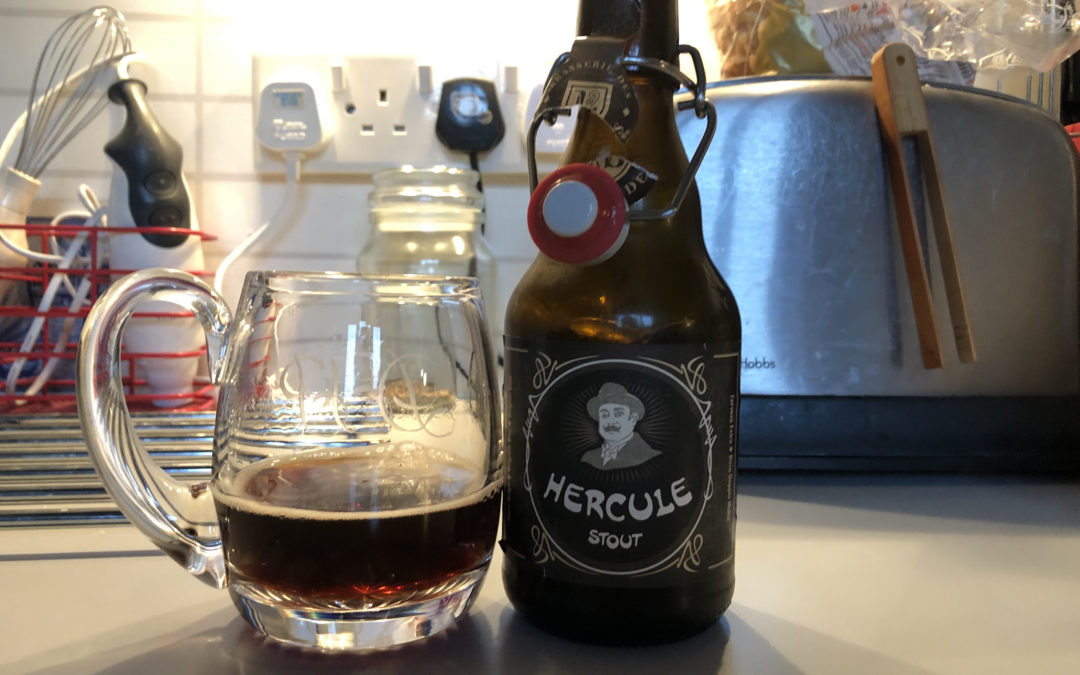
So anyway, scanning the shelves for something different to try, my eyes alighted on the Hercule Stout. Being a lover of Agatha Christie, feeling that David Suchet was the definitive Poirot and being partial to a drop of brown ale AND Belgian beer, I plumped for it.
‘Considered a world classic, this beer is named after the famous Belgian detective, Hercule Poirot. The brewery makes the brewery in small batches and lagers it for ten days in German oak casks. Many beer drinkers regard the Hercule beer as a classic. It’s very malty, yet dry, with a hint of sweetness in its finish. Further, it’s perfectly hopped.
It carries a distinctive and intoxicating spicy scent of fresh spruce. A scent that fills the room when you release the swing top.
It’s likely that its unique character comes from the strains of yeast that the brewery, the Brasseries des Legends, uses. And possibly from the fermentation in oak. And because the beer is made from malt and hops with no spices or sugar.’
Well – I don’t know about a lot of that. But I can say the top made a most satisfying ‘sigh’ when I opened it. And it’s delicious!
‘ … The shop is run by brewer Dhiraj Pujari and his wife Deepali and stocks over 150 different beers, ciders, wines and spirits including locally-produced drinks as well as beverages from national and international artisans.
Dhiraj has worked in the brewing industry for 11 years and has an MSc in Brewing and Distilling. His intention is to also run a Craft Beer Bar in the shop but due to the current pandemic he has had to put these plans on ice for the time-being. Instead Dhiraj and Deepali are concentrating on building up the business from their Canal Walk shop which now stocks an extensive range of beverages, including low-alcohol and non-alcoholic drinks. Next month they will be introducing a same-day delivery service for Swindon customers plus next-day UK deliveries. ..’
Unmemorable Dinosaura of Wiltshire by by Rebecca Davies BSc. (Hons)
(With much thanks to Christopher Tanfield of St Laurence’s church, Bradford on Avon, for suggesting this title).
Before I get to uploading Rebecca’s words on the Unmemorable Dinosaura of Wiltshire – it made me smile did this. Though I’m not sure what my dinosaur barmy, budding palaeontologist, 4-year old granddaughter would make of it. I have told her about the Swindon stegosaur at the Natural History museum. It’s the first stegosaur specimen to be so described.
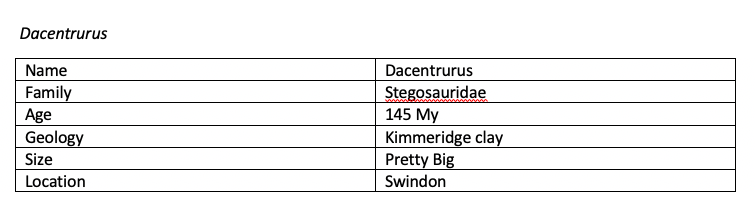
The specimen you see in the cabinet in the picture below (in the Natural History Museum in London) is a Dacentrurus – a type of Stegosaur. Whereas a stegosaurus is a different kind of Stegosaur.
Stegosaur hierarchyThe Swindon stegosaur in the Natural History museum in London – the thing in the case not the lady stood by it! That’s Cllr Strinkovsky.
In the YouTube film below Palaeontologist Prof Paul Barrett shows science communicator Dr Nick Crumpton the Museum’s Dacentrurus specimen, the first stegosaur specimen to be described.
And it was found in Swindon! Pretty cool huh?Swindon Stegosaur info in Museum and Art Swindon
The Angel Ridge play area, on the site of the old PMH, references the ichthyosaur found nearby. It featured on Blue Peter – no greater accolade surely?
So that’s a round-up of some of Swindon’s memorable dinosaura. Now onto Rebecca’s wry and and amusing tale of Unmemorable Dinosaura of Wiltshire.
Introduction
This article is about something different, for Angela told me about Wiltshire dinosaura. Something new to me I must admit.
So, your intrepid researcher is now hunting Dinosaura in Swindon and Wiltshire. Where will I find any? Not at all sure what to do, I went to the park. Ah! I see some already! What luck!
Great BustardMallardsRookRoosterRobini
I had a look through my old photographs and picked out some more birds. This is Sulis Sgeir, the Rock of the Gannets. If you ever lose faith in life, go visit a Gannetry, they are so full of life and action.
Sulis Sgeir
It’s said that the dinosaura are the dominant life-form of the world – apart from ants and bloggers that is. I certainly have found loads!
And now I am hungry – dinosaura are very good eating! I think I am doing quite well, don’t you think?
Harrumph! Angela is not satisfied with my very productive research, Well, as it turns out the Dinosaura I am supposed to be looking for are old fashioned ones, not modern ones. What did she expect?
Now I know. I was so looking forwards to eating one too. I said I was an archaeologist and not a palaeontologist, didn’t I? Never mind. I have to look in what we call the Age of Reptiles.
The age of reptiles
The Mesozoic period was from 252 to 66 million years ago and was divided into three sub periods:
The climate was hot and dry but then sometimes hot and wet. This was the period in which the supercontinent of Pangea broke up into the present day continents, which drifted to their present positions. The plants were gymnosperms like tree ferns, conifers and ginkgo’s, but flowering plants evolved later.
GinkgoScots Pine
It was in this period that reptiles diversified into many storied lineages. There were the Ichthyosaurs and Plesiosaurs in the sea and the Pterosaurs in the skies. But most of all there were the Dinosaura.
Mammals had evolved too, but until the end of this period, remained small and insignificant.
Wiltshire geology
A quick look at the geological map shows that the geology of Wiltshire is almost all of the Mesozoic period. Only the alluvial gravels of the Upper Thames and my Sarsen Stones on the Downs are much younger. We are saved. And I, with a bit of searching, have found some old fashioned Dinosaura!
So,Ipresent to you some unmemorable Dinosaura I found in Wiltshire.
Dacentrurus
Dacentrurus comes from Swindon, from the in the Kimmeridge clay to be precise. This is a small member of the Stegosaur family, possibly one of the most visually appealing of all dinosaura.
Jacquetta Hawkes in her meditative book of British landscape, A Land, describes Stegosaurus as: A childlike scholar who has lost his wits, and having hung himself with pot lids and tea trays in order to protect himself from his critics, strays though life sipping crème de menthe and eating ice cream. It would be a fine thing to see a life-sized statue of this singular creature, made strong enough to withstand children climbing on it, as they invariably will do, Stegosaurus being an ideal climbing frame.
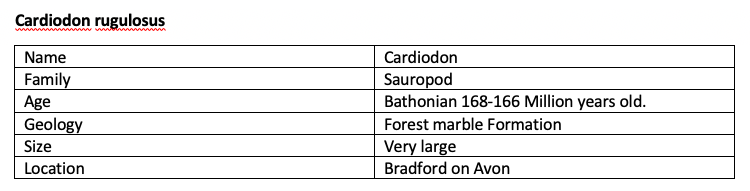
Cardiodon Rugulosus
Sauropods are the really huge ones, the largest land animals to have ever lived, and ones just as big as the hugest whales. Unfortunately, like most dinosaura from Wiltshire the fossils are fragmentary and so we can find out very little about it.
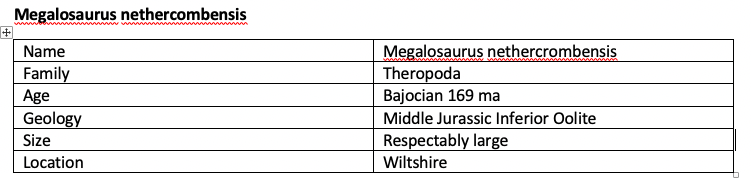
Megalosaurus Nethercombenis
Megalosaurus Nethercombensis
This is a dinosaur much more familiar. It is a therapod, and so a close relative of my bird friends. But did they have feathers? Some dinosaurs have feathered remains, some don’t, but bear close relation to those known to have had feathers. And so it’s reasonable to assume that they too had a fluffy coat.
Nuthetes Destructor
Nuthetes destructor
Another Theropod, this one much smaller. Being close to birds, many theropods would have had feathers evolve for insulation, sexual display and eventually flight. Thermoregulation is harder in small animals than it is in large, so a rough rule of thumb; big therapods naked, small ones feathery. Of course, some big therapods may have had a temporary cover of down when very young.
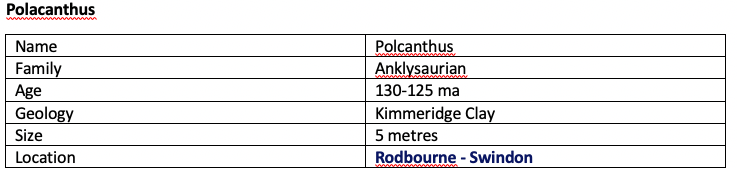
Polacanthus
Now this dinosaur certainly did not have feathers. Rather, this family are famed for their armour. Indeed some mummified specimens have been found, giving us an unprecedented understanding of their anatomy.
Conclusion
Wiltshire never ceases to surprise me. While not as well-known for its prehistoric life, like the Isle of Wight for instance, it still has an interesting variety of fossils. Mostly marine life but also some from on land. All of which begs the question – what will I discover next? Meanwhile – back to KFC – all this dinosaur exploration has made me hungry again.
All pictures, even the drawings, are by me, the author. Ditto any stupid mistakes.
Bibliography
A Land, Jacquetta Hawkes, Readers Union 1951.
Feathered Dinosaurs; the Origin of birds, John Long and Peter Shouten, OUP 2009
Hidden Depths, Wiltshire’s Geology and Landscapes, Isobel Geddes, Ex Libris Press 2000