Son of Swindon’s Swimming Challenge. A Swindon-born Royal Navy officer’s 200-day challenge puts swimming in the spotlight.
What do you do if you love swimming, hate litter and want to fundraise for charities that prevent drowning, all at the same time? Well, if you’re Cdr Mark ‘Scotty’ Scott Rtd, then the answer is obvious. What you do is set yourself a 200-day challenge to swim to or from as many of the UK’s Royal National Lifeboat Institution stations as you can. Then, at the same time, you fundraise for the RNLI. And also for drowning prevention charity SwimTayka, which runs free learn-to-swim programmes for children.
And when you get out of the sea and onto the beach, you litter-pick accompanied by a toy womble. Remember the Wombles? The fictional creatures famed for tidying up on Wimbledon Common.
For Scotty, a Royal Navy helicopter pilot instructor based at RAF Valley, in Anglesey, this seemed doable.
Son of Swindon’s Swimming Challenge- Mark ‘Scotty’ Scott – swimming for SwimTayka and RNLI
The swim so far
To date, Scotty has completed about 500km of swimming and visited almost 40 of the RNLI’s RNLI’s 238 stations. In the process he’s raised £4,000 for the RNLI. And he’s now fundraising for SwimTayka. SwimTayka runs free swimming programmes for children in coastal locations in countries such as Peru and Brazil, where children don’t learn to swim and are at risk of drowning.
So, what inspired Scotty, who hails from near Swindon, in Wiltshire, to take on this challenge?
When I first came up to Anglesey, I couldn’t always swim because the sea is rough here. And the amount of plastic on the beaches is horrendous. This is where the wombling started, so I swim when I can and also pick up litter when I’m at the beach.
I’m RAF Valley’s liaison officer with the RNLI. It’s celebrating its 200th anniversary and I wanted to do something to support them.’
SwimTayka
Scotty is also a trustee for SwimTayka, having had involvement with the charity since he joined one of its English Channel relay teams in 2022. Every summer, SwimTayka organises relay teams to swim the Channel. They help swimmers achieve a lifetime ambition and raise funds at the same time. Scotty has since completed a solo Channel crossing.
‘I love helping raise money for SwimTayka and awareness of what they do. I’ve even taken part in swims with SwimTayka tattooed on my arm. This year, I became a trustee of the charity and hope to go out and visit one of their swimming programmes in the future.’
So far, Scotty’s challenge is going well. One stretch involved swimming from Dover to Portsmouth, covering 200km and passing 15 RNLI stations. Another was in the North Sea – a chilly 12C – swimming from Berwick-upon-Tweed to Blyth. That swim covered 52km and passed 8 RNLI stations. The challenge will finish on October 31, with a swim into Poole Harbour.
Scotty doesn’t wear a wetsuit and swims unsupported. He takes all his gear with him, including a tracking device, radio and inflatable life raft on his tow float. When he gets out, he does his ‘wombling’, by picking up and disposing of rubbish.
‘At length, I’ll swim around all the 238 lifeboat stations. But this 200-day challenge is to reach as many as I can and raise the profile of the RNLI, as well as SwimTayka.’
For more information about SwimTayka, joining a Channel relay team, and its swim programmes, visit https://swimtayka.org/.
Bryan Avery, founder of SwimTayka, said Scotty was a great advocate for the charity. ‘Scotty is a fantastic supporter of SwimTayka and we’re so impressed with this challenge he has taken on. It’ll not only help fund the vital swimming programmes we run but support the RNLI and the incredible lifesaving work they do.’
Wroughton Spring. Who knew? Well not me that’s for sure. Not until I saw a photograph of this X-marks-the-spot-stone-plaque somewhere on social media.
Wroughton Spring stone plaque set into the wall on Croft Road in SwindonDetail of the inscription on the Wroughton Spring plaque
So, Wroughton Spring has now come to my attention. And that means I’m bursting to know a bit more about it. #Obvs my first port of call is Local Studies in central library. They found a mention of it in Wiltshire Archeological Magazine Volume 40. It weaves a tale of the Swindon Advertiser and its proud boast ‘Printed by Steam Power’.
Students in the GWR Works made the boiler that provided the steam power. And the water for the boiler came from … drum roll please …. the eponymous spring. It seems there once was a trough in the wall from which the water was fetched in pails. Fancy that huh?
The plaque in situ in the wall on Croft Road
But there’s more – a bit anyway
A friend has loaned me a stack of Wroughton history group books. And, turning to the contents list in the issue below my eyes alighted on an entry entitled Wroughton Waterworks. That piqued my interest. Would it have any mention of the spring? Well yes .. it did/does.
NB: I imagine that Local Studies has copies of these Wroughton history books should you want to read the full Wroughton Waterworks article. Or indeed anything else about Wroughton’s history for that matter.
The pertinent extract tells us that the construction of Wroughton Waterworks began in 1866. The Swindon water company chose Overtown Dell as the best site for obtaining a water supply for the fast-expanding railway town, called Swindon. Up to that point water carts and wells had supplied the Swindon district.
The spring on Wroughton Road leading into Swindon comprised the main source of the water supply. And that of course is now marked by the stone plaque on Croft Road that we see in the images above.
Below is an extract from something and I can’t remember now what or where that gives good mention of the spring.
The Bothy at Burderop. Or the Bothy at Burderop estate to be more precise. The bothy and the walled garden once comprised part of the Burderop Manor estate – but were sold as a separate entity some years ago.
Now, if you’ve been paying any attention at all to my literary output of the last few years, you’ll know that the publisher’s brief with Swindon in 50 Buildings didn’t allow me to write any words about anything in the wider borough. So I’ve used this Swindon in 50 More Buildings series to make some small redress to that position. Thus, on the Oxford side of Swindon, in Highworth, I’ve done St Michael’s and All the Angels (greedy!!). And the Old Post Office. And on the Wroughton/Wilts side of town we’ve got Pavey’s Mill in Wroughton and now this bothy. Having never come across a bothy and with the work that Jules and Mark are doing in the walled garden being so fantastic, I felt it deserved a place in this series.
In the walled garden that once belonged to Burderop Manor, the bothy is going to make an unusual and terrific home. A simply delightful couple, Jules Gilleland and Mark Wheeler, are converting it into a dwelling for themselves and their family. Within this wonderful walled garden it will from part of a wonderful enterprise. See more about the bothy gardens and the couple’s plans for it here: https://swindonian.me/2024/08/30/introducing-bothy-gardens/
2024 – The bothy at burderop walled garden undergoing restoration
What is a bothy?
You may well ask. It’s a good question to which there’s more than one answer – but both relate to a place of shelter.
So, in the first instance a bothy comprises a basic shelter often found in remote mountainous areas. They’re there to provide shelter to anyone out roaming caught short by the unpredictable and dangerous weather of such areas. Then in the second, and this relates to our building, a bothy describes basic accommodation often used for gardeners or other workers without the status of the head gardener. He’d have a home of his own elsewhere on the estate.
The Burderop bothy
Grade II listed, and derelict for well over two decades, this stone bothy dates back to the 1730s. It’s now undergoing sympathetic restoration by Jules and Mark.
Jules outside the bothyWell-worn bothy stepsAn ancient stone wallBothy interior
The main focus of this post is of course the bothy. But the walled garden is so incredible I can’t leave without showing a few photos of it. Bear in mind that it’s all a work in progress.
View of garden with Burderop House in backgroundWrought iron gate – isn’t it splendid?
Thomas Calley
Plaque in one of the walls in the walled garden bearing the initials TC – Thomas Calley
For a time, the Burderop estate bore the name, Okebourne Chace. Here the Calley family lived for over two centuries. In 1649, William Calley served as High Sheriff of Wiltshire. Then, in 1807, Thomas Calley held the title.
Thomas marred Elizabeth Keck, daughter of Anthony James Keck of Stoughton Grange. The pair had a son, James Calley. He sold the estate to John Parkinson, who held it as trustee for the Duke of Wellington.
Also owned by Thomas Calley and his wife, were the estates of Broad Hinton and Salthrop House. 1860, saw the second Duke of Wellington sell them to Anthony MS Maskelyne of Bassett Down.
Given the official title Burderop Manor in the 1300s, the house came to Hyde Abbey as a religious building. But it returned to the king in the 1500s who then gave it to Sir John Bridges.
It’s believed that Elizabeth I visited the manor house in 1592. Now, she visited Lydiard House so this may well be true. Anyway, in 1619 a wealthy silk and cloth merchant by the name of William Calley bought it.
The manor house then stayed within the family until 1977 when engineering company Halcrow bought it. They left the site in 2018 when developers City and Country obtained planning permission to erect 57 executive homes.
Malmesbury Town Council has signed an official friendship agreement with the Ukrainian city of Cherkasy. Its aim to cement a growing relationship of support and mutual respect.
Malmesbury mayor, Cllr Phil Exton, signed the formal agreement in an online ceremony at the Town Hall on August 23. That being the eve of Ukrainian Independence Day. Signing it with him was Cherkasy mayor Anatoli Bondarenko.
Witnessing the event were special guest including:
Deputy Lieutenant of Wiltshire Angus Macpherson MBE
Cllr Gavin Grant, Malmesbury Stands With Ukraine support group convenor
Julia Bowen Malmesbury & District Twinning Association chair
Reverend Oliver Ross of Malmesbury Abbey and …
… Great Somerford residents Natasha and Brendon Ball. Natasha comes from Cherkasy and was translator for the ceremony. Both are active members of the support group.
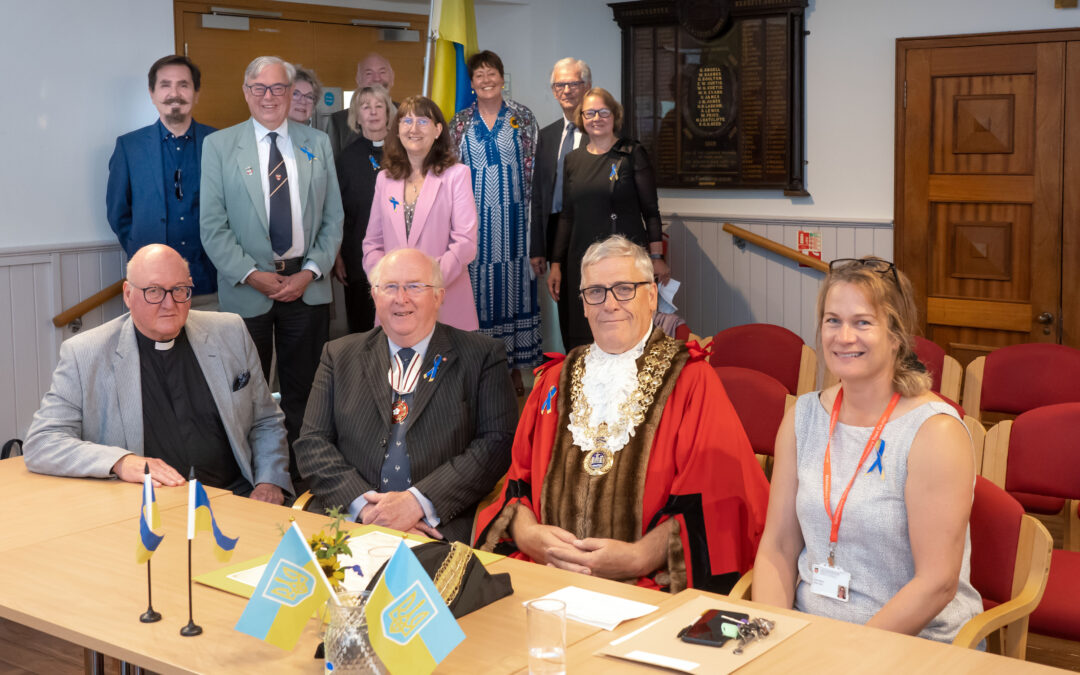
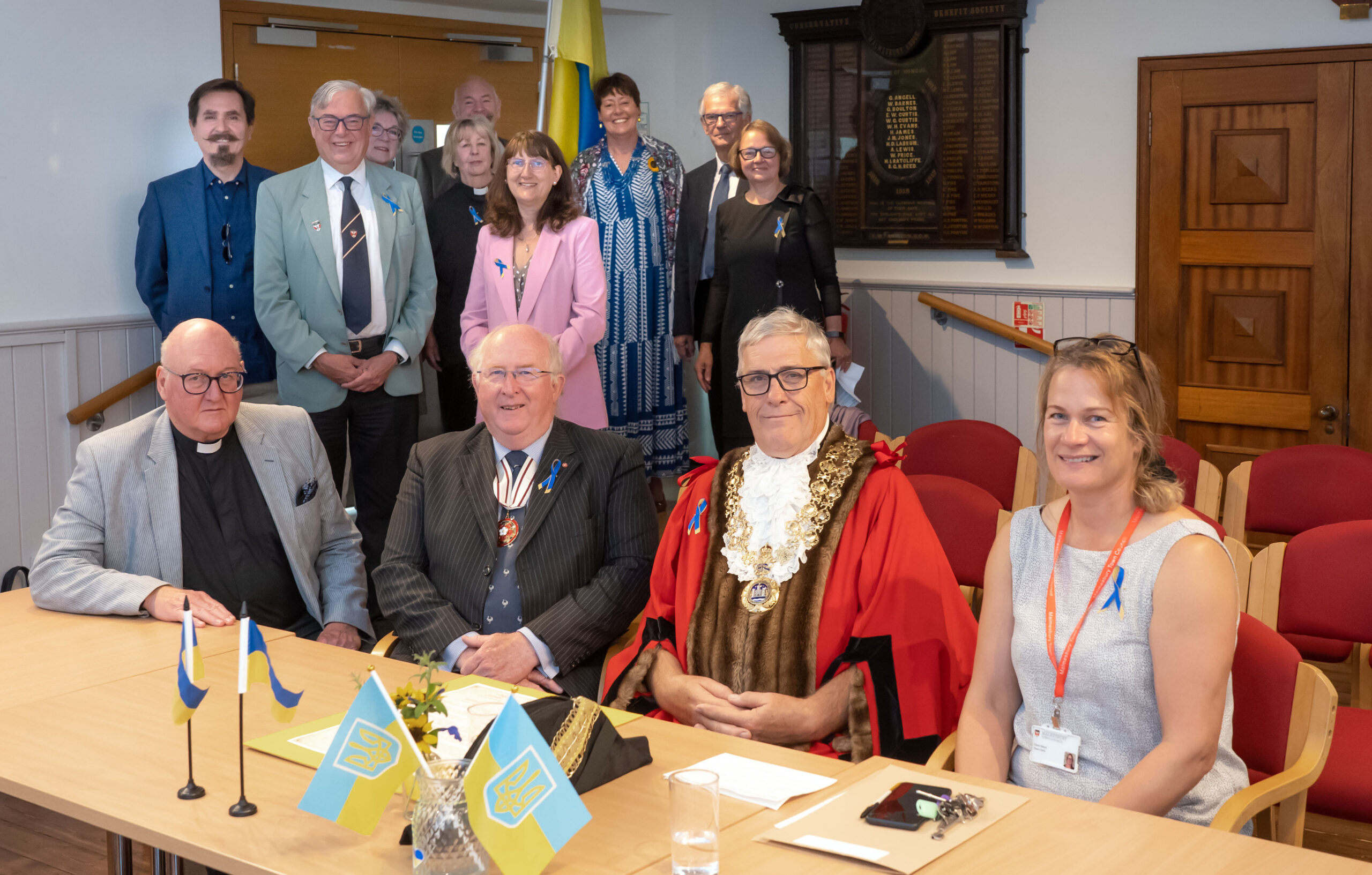
Malmesbury Links to Ukraine City – Pictured (seated, left to right) Reverend Oliver Ross, Deputy Lieutenant of Wiltshire Angus Macpherson MBE, Malmesbury mayor Cllr Phil Exton and Malmesbury town clerk Claire Mann.
A bond formed
Thus we’re delighted to create a more formal friendship agreement with this city community.
Cllr Exton said: ‘Our bond with Ukraine in general and Cherkasy in particular has grown since the war began two and a half years ago. Thus we’re delighted to create a more formal friendship agreement with this city community.
It’s our hope to strengthen those ties and offer support to our friends in Cherkasy as they continue to deal with the terrible effects of this illegal war.’
Malmesbury has shown itself to be supportive of Ukraine since the Russian invasion. There’s been two midsummer festivals and festive services in Malmesbury Abbey. Further the town has fundraised through cake sales and quizzes. And have donated more than £20,000 to support the city’s main hospital.
Mayor Anatoli Bondarenko said: ‘Such support is more than words. It’s concrete actions that inspire and unite. Especially today, when Ukraine fights not only for its freedom, but for the freedom of all Europe.
Following the official signing, on Ukraine’s Independence Day (August 24) a civic reception took place at Malmesbury Town Hall. All to show continued to support to Cherkasy and all Ukrainian people.
Malmesbury local support group invites all local hosts and Ukrainian guests to join its Facebook group Malmesbury Stands With Ukraine to keep in touch with local events.
Cherkasy
Cherkasy is a city of around 260,000 people which sits around 120 miles south of the capital of Kyiv. It’s on the banks of the Dnieper River and its history dates back to around 1200 -but could be further.
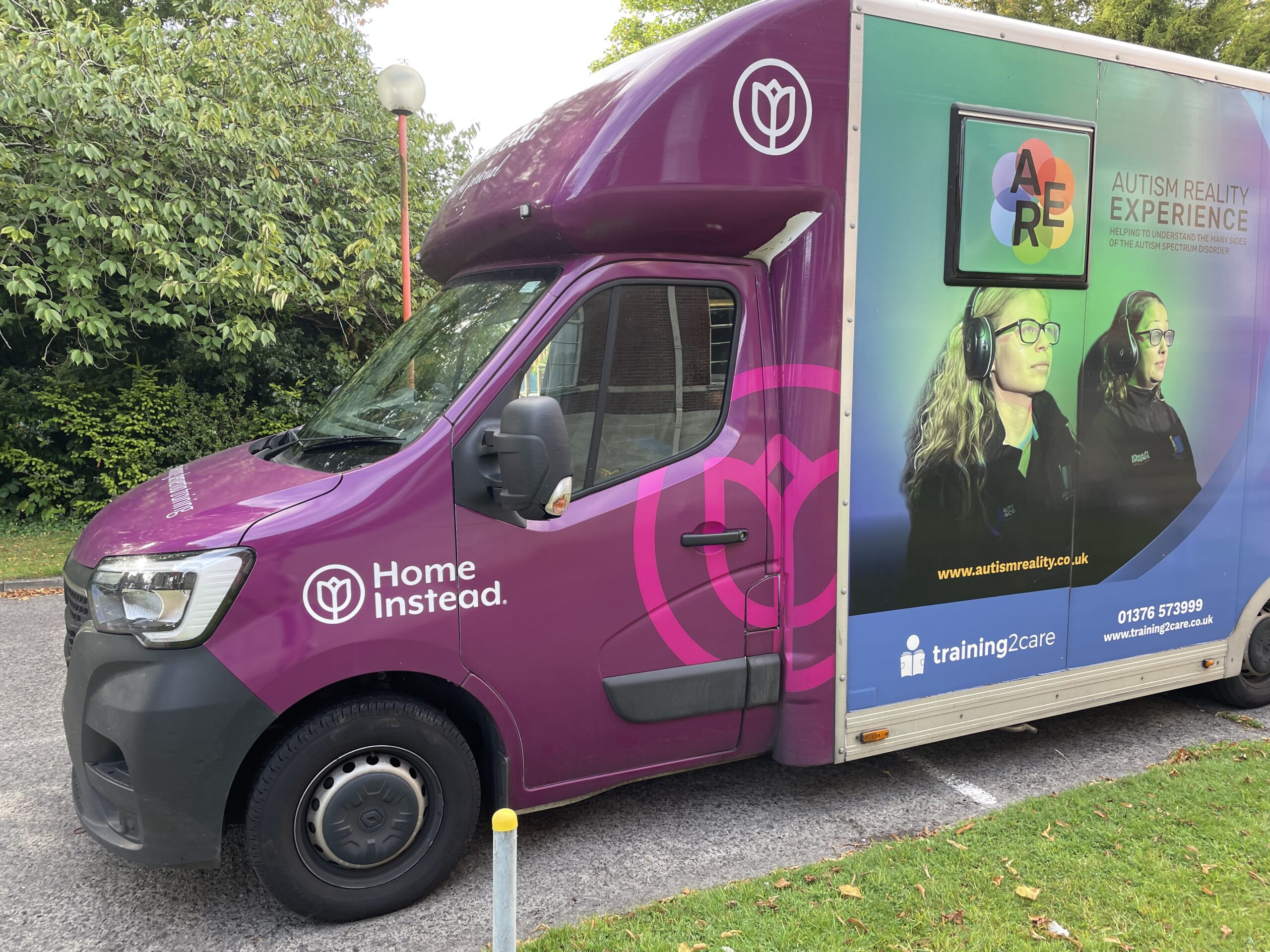
The Dementia Bus run by training2care visited Swindon’s civic offices this week. So I popped there to check it out and to have a chat and see what it’s about.
The Dementia Bus
In the simplest of terms, visitors to the bus get a ticket to ride into the minds of those living with dementia. The bus is a simulator.
The training2care website explains the point of this worldwide method with scientific and medical provenance. It gives a person with a healthy brain an insight into what dementia might be like. It allows delegates to enter the world of the person. And then, further, to understand the simple changes they can make to their practice and environment to improve the lives of those living with dementia.
The bus – well buses (there are twelve of them – travel the country to places of work and business. To fund it , Home Instead sell tickets to the ‘delegates’ attending the sessions on the bus.
From what I saw of it, it appears to be an excellent and …vital … offering.
The origins of the process
One Professor PK Breville invented this process of insight 25 years ago, in the USA. It’s owned by a body called Second Wind Dreams. Training2Care are the UK partners and pioneers of it in this country.
Research by Ulster university has proven the virtual dementia tour to change practice within 95% of delegates. Further it improves knowledge in 97% of delegates and improves outcomes for 100% of clients.
Over 200,000 people in the UK take the benchmark dementia tour per year. It’s now been commissioned by:
18 NHS trusts
4 HSE trusts
Care homes
Nursing homes
Police and prisons
Ambulance services
Universities and colleges
Councils
CCGs
CQC
Electricity and water companies
About dementia
The Alzheimer’s Research Society tell us that dementia is not a disease in itself. Rather dementia is a word used to describe a group of symptoms that occur when brain cells no longer work as they should. This failure happens within specific areas of the brain. And that can affect how one thinks, remembers and communicates.
The all-too-familiar Alzheimer’s disease is the most common cause of dementia. But there are other types. And it’s possible to have more than one type of dementia at a time. For instance, Alzheimer’s is sometimes seen with vascular dementia or dementia with Lewy bodies. You might hear this called ‘mixed dementia’.
The Alzheimer’s research website features nine different types of dementia. But there may be as many over 139.