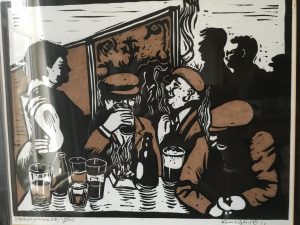
This blog is an opportunity to share a few photographs of the work of Ken White Swindon artist. In my recently published book, Secret Swindon, I made a big effort to convey that Swindon’s cultural and creative present is as rich as its cultural and creative past. Many people/entities/artists contribute to Swindon’s varied cultural landscape as the recent Swindon Open Studios even will testify. And one of whom is Swindon born Ken.
An extract:
‘Ken White: Painter not artist
That’s his description of himself not mine. He’s emphatic on the point. Yet, however you describe him his talent is indisputable.
A born Swindonian, Ken had the great good fortune to get what you’d call ‘a big break’. First though, like so many young men in Swindon, at the tender age of fifteen saw him enter the Works (the 3rdgeneration of his family to go ‘inside’) as a rivet-hotter. Escaping that role, he began his artistic career with sign-writing and stenciling numbers on carriages in the Works. During this period Ken went to evening classes at Swindon Art College to study ‘O’ and A ‘Level art with the intention of becoming a full-time artist … ‘ For the rest – buy the book! 😉
Ken’s portfolio is a wonder to behold – the just-passed Open Studios is the ideal time to view it.
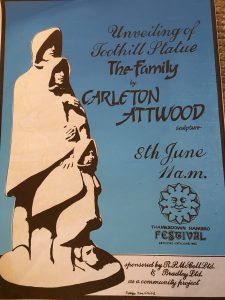
When researching for Secret Swindon I visited Ken and spent ages poring over his output from over the years. His collection of posters designed for Swindon events back in the day are an exhibition in themselves – never mind the rest. Here’s a small few that didn’t get used in Secret Swindon:
Ken White’s famed Red Lady emblem for Virgin AtlanticPoster for the unveiling of Carleton Attwood’s ‘The Watchers’ at Toothill village centrePoster for old GWR Railway museum
Deacon’s Jewellers Old Town Swindon and the regulator clock
It’s struck me often that Swindon’s Old Town has, within a few yards of one another, three long-standing and still family-owned businesses. That must be somewhat unusual surely? On Newport Street there’s Gilbert’s. On the corner of Bath Road and Devizes Rd there’s Blaylocks and on Wood Street of course we have Deacon & Son (Swindon) Ltd. The business was founded, by George Deacon, in 1848 as jewellers, watch and clock makers. It remains a family-run business that’s now in its sixth generation.
That is quite remarkable for sure. But on its own, a ‘so what’ is fair enough – after all, they can’t be the only long-standing family jewellery business in the land can they? At least I wouldn’t imagine so.
Deacon’s Jewellers Old Town Swindon
So what makes this business stand out?
But there’s something else about this business that makes it stand-out – and that’s its relationship with the story of New Swindon. Because there’s no doubt at all that the reason Deacon’s is such a well-known Swindon business, is the coming of the Great Western Railway.
An ambitious, 26-year-old George Deacon had the vision to see the need for time-keeping in a fast-growing town – one that arguably was the crucible of the industrial revolution. So – with an eye on the main chance, young George Deacon moved from his home town of Westbury to Swindon.
The business expanded and won one of the timing contracts for the Great Western Railway on the Paddington to Swansea line from the early 1850s to 1893.
The regulator clock
Around 1865, Deacon & Son Ltd made the Regulator Clock that stands to this day in the jewellery, clock and watch department of the shop. Before radio and the telephone gave universally available time, local means were designed to maintain accurate time-keeping. And this tended to be done by means of a regulator clock.
The famed regulator clock in Deacon’s jewellers in Wood Street, Swindon
The dead-beat escapement in this movement causes less friction and dampens vibration, giving greater accuracy. The self-regulating mercury pendulum, changes volume equally with the changes in temperatureand thus keeps the clock on a constant steady beat giving better time keeping.
Close up of the face of Deacon’s regulator clockExplanatory plaque on the regulator clock in Deacon’s
Deacon’s workshops made extensive use of the regulator clock for clock timing and regulation for many years. But then, in 2011, radio-controlled timing came from the nuclear caesium clock at the National Physics lab in Rugby.
So – were it not for the coming of the Great Western Railway, Deacon’s as we know it may well not exist at all.
An early receipt from Deacon’s of Swindon’s Old Town.
These boots are made for walking
Of course, Deacon’s is not the only long-standing, family-owned business in Old Town. I’m really rather fond of Blaylock’s – the shoe shop on the corner of Bath Road and Devizes Rd.
Blaylock’s is what I call a ‘proper’ shoe shop – though you’d need to be of a certain again to even know what I mean by that. And, what I mean by that is, that the shoes are stacked in boxes on shelves in the shop itself. Exactly as I remember shoe shops!
There’s no going out the back somewhere with an iPad and a headset on. Pfft. It’s friendly service and I love it. Not quite as old as Deacon’s they’ve been around for somewhere in the region of 100 years. Still, to my knowledge, this is a family-run business and an independent shoe shop. Fabulous.
Gilberts
Having bought your super comfy carpet slippers in Blaylocks – where better for your actual carpet than Gilbert’s on Newport Street, Gilbert’s have been in Old Town since 1866 so must have furnished a few Swindon homes in the intervening 152 years. What an astonishing thought.
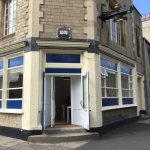
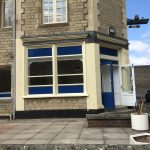
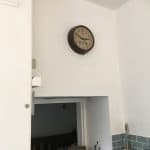
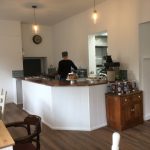
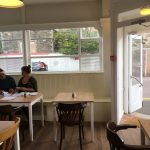
It’s been sometime in the coming – you know how it is with building works – it always takes longer and costs more than you think. But at last it’s open and getting underway and, best thing of all, it’s a lovely bit of good news for Swindon’s heritage and the railway village conservation area.
What am I talking about listeners? The Baker’s Community café of course.
From guns to buns
Or as suggested on social media:
From riot to quiet
From thugs to mugs
Moving on!!
I’m pretty ignorant of the history of this ex railway village pub, but it seems it had a reputation for being ‘a bit rough’ – to understate the case. As this article in the Swindon Advertiser explains:
‘The Bakers Arms will reopen as a community café this week after a makeover that saw builders rip out moulding bar and restore historic fireplaces in the 150-year-old pub.
It will prove a major reversal of fortune for the Emlyn Square pub, which was once a source of anti-social behaviour and ire for residents.
In December 2011, police raided the Bakers Arms and found a shotgun and a large amount of what officers suspected was cocaine. The pub was closed three months later after a review by the council’s licensing panel. .. ‘
Huge congrats to everyone at the Mechanics’ Institute Trust – I’m sure it will be great asset to the central area and to Swindon as a whole. Goodness knows Swindon’s heritage areas need some uplift. So this is super welcome.
‘I noticed there were quite a few communities in Swindon of South Asian origin, but they were divided into different groups,” she recalled. “They arranged various festivals and cultural programmes, however they were not really available to a lot of the people in Swindon.
A lot of the time, these communities were not even going to each other’s programmes. I thought, why don’t we make it available to everyone and we could share it?’ … Our focus so far has been to present diverse cultural events. We would like to share these with the general public – with whoever is interested.’
SAPAC work often with the splendid Swindon Dance – a recent event staged in conjunction with them back in June of this year sold out. How fab is that? And later this year – on October the 6th to be precise – SAPAC will be part of a spectacular collaborative arts project at the Wyvern Theatre. Presented by Nicky Alberry, the current High Sheriff of Wiltshire, the event is called ‘Uncelebrated Journey’.
‘Uncelebrated Journey will feature an eclectic mix of dance, music and film, including a contribution from SAPAC.
It’s based on a poem Alfred Williams wrote, about a place in India he stayed in during World War I, when he was in the army, Indu said.
Alfred Williams – the Hammerman Poet
He stayed in Ranikhet, a hill station in the Almora district in the Indian state of Uttarakhand, in the foothills of the Himalayas.’ The image below shows Alfred’s home in Swindon named after Ranikhet:
Years ago, in my early years in Swindon, I recall going to the Arts Centre in Swindon and there being an old-fashioned vending machine there. You put your £1 coin and out popped a little box of art. Oh I thought this was simply the best thing. I still have the mini art works I got from that vending machine collected together in a display box.
But then the winds of changed blew: the Arts Centre was re-furbed (TBH I preferred it before) and the art box disappeared. *sad face*
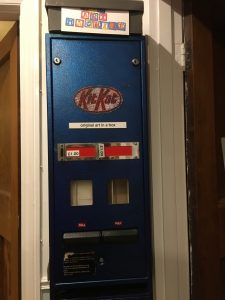
But Lo! Some years later, visiting artists during Swindon Open Studies, I went to the home/studio of Tim Carroll. And – to my delight – there on the wall in the hall was an art box vending machine. Yay! Not the one I remember but another one. It turns out there was more than one back in the day.
When researching for Secret Swindon I got this information about the Art Boxes from Tim:
ART boxes:
‘ In collaboration with likeminded artist Gordon Dickinson, we found old KitKat and condom vending machines and converted them into one-pound coin operated dispensing machines of original art. These were a great success. We had several machines around town – in The Beehive, The Victoria and the Arts Centre. The pressure of producing hundreds of small art objects each month and keeping the machines operating smoothly eventually proved too much for us and the only machine still in action today is at my house.’
Swindon Open Studios
The fantastic community art event that is Swindon Open Studios is coming next month. Dates below. Brochures in the library and all over Old Town including the museum and art gallery. My favourite artists are taking part, including Tim Carroll, Ken White and David Bent. And many more besides! Check the website and the brochure to find out who’s doing what and when and where.
Since the first open studios fifteen years ago, the event has taken place annually, being organised by a committee of volunteers since 2008. After that the committee settled upon September as a good month because it didn’t clash with any other open studios events in the area.
It’s held over two weekends in September, to give flexibility to visitors, some of whom visit a few studios of their choosing one weekend. Though others try and visit all 60 odd studios over two weekends. It’s now a permanent fixture on the cultural scene in Swindon, attracting more visitors each year.