In the midst of the ongoing situation with the Oasis leisure centre, my ad-hoc guest blogger Rebecca Davies, shares her memories of the Oasis from the late 1970s to the early 1980s.
My Memories of the Oasis, by Rebecca Davies BSc (Hons).
I thought I ought to write down my own personal memories of the Oasis, though they are faint. I didn’t go much – it wasn’t a regular swimming venue for me – instead I went to Wootton Bassett pool instead. So I shouldn’t think I went to the Oasis more than a handful of times.
I went with Dad – never with the school. How old I was at the time I do not know. We used to use the family changing rooms.
The pool
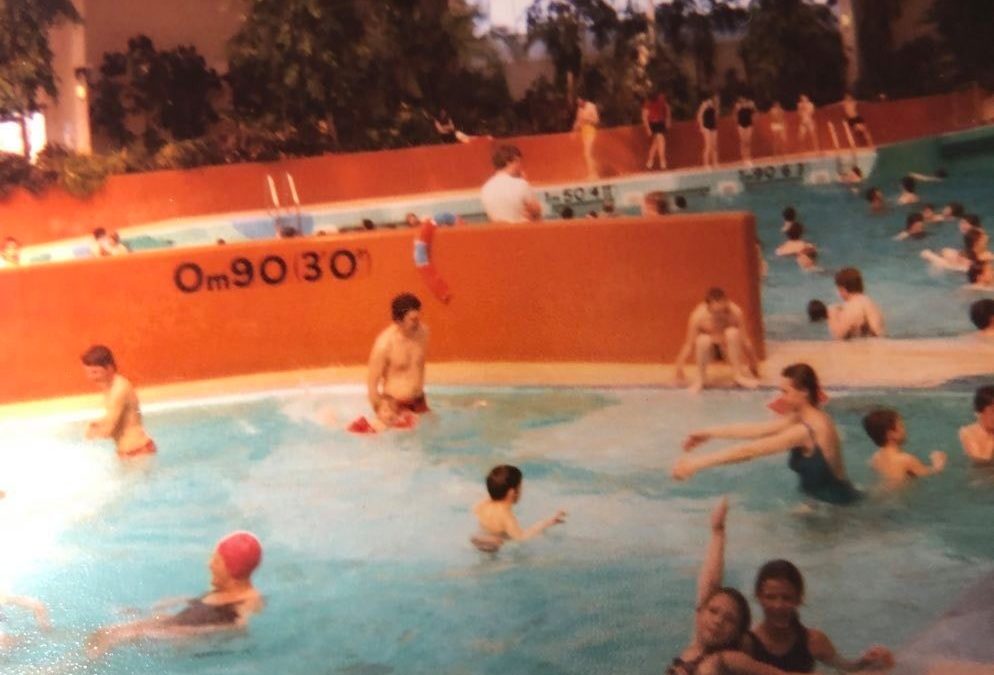
The pool entrance was always an appealing experience to me. To walk from the slightly grotty changing rooms, through the tiled annexe with the foot bath and the showers – not having showers at home that was also a novel experience – into the wide open area of the dome.
And inside that dome, the pool was like no other I had seen.
It was a swimming pool – yet shaped like a pond – that you walked into rather than climbed in. In those days of less than efficient pool heating climbing in was often an endurance exercise in cold water. As soon as I learned to swim I always started in the DEEP and so WARM end.
Surrounding it were plantations of tropical plants, real ones I hasten to add, growing much bigger than most houseplants.
The pool was generic blue tiles of course. But there were also mosaics, a dolphin, and I think, also an octopus.
More than only a pool
There were other facilities, a small toddler’s pool, and a deep diving pool with round windows in the side, often unused. Though I do recollect once seeing a diver in it. There was also slides -at the time I went they were orange plastic. How brave I felt when I first dared to go down! The slide might have been my most favourite part, even more so than the wave machine.
There were other facilities, a small toddler’s pool, and a deep diving pool with round windows in the side, often unused. Though I do recollect once seeing a diver in it. There was also slides -at the time I went they were orange plastic. How brave I felt when I first dared to go down! The slide might have been my most favourite part, even more so than the wave machine.
And yes, this pool had a wave machine which they turned on every so often. When it worked – it didn’t always. Being unused to the sea, the waves were a new experience. This was a pool which was so much more interesting that the standard swimming pool and offered so many more experiences.O
Extract from original plan for the Oasis showing the now long-gone diving pool
Inside the Oasis
I don’t remember much about the rest of the Oasis. You went in the main door and there was the booking desk in front of you, a gym and squash courts to the right and the cafe and pool to the left. I recall watching (and listening, the sound is fascinating) to the squash courts.
The Oasis cafe was very modern and fast foody. My favourite was the Hot Dogs – not that easy to get back then. I am a great lover of Hot Dogs.
Trouble at the Oasis!
One memorable Oasis session did not go at all smoothly.
We were swimming about as usual when the tannoy went, asking us to exit the pool as fast as we safely could. The lifeguards ushered us out of the pool, and through the fire exits to wait outside. This was in February! At length, staff let us back in. But not to resume our swimming but to get dressed and leave. Passing the pool there was an odd, chemical smell in the air and a strange bubbling on the surface of the water.
Out in the lobby were paramedics. Me and Dad saw a young man stopped and given oxygen. Parked by the main door was an ambulance. It turned out there had been a gas leak. No wonder the staff were so concerned.
The event made the front page in that night’s Evening Advertiser. There had been a chlorine leak in the Oasis forcing the evacuation of the public. The story had accounts of people panicking, fainting and all. If there was panicking and other tremulous events as described in the Adver … I for one did not see anything too worrying. Which is not to say it didn’t occur – only that I did not see it.
This was a very good lesson in the trustworthiness – or otherwise – of the press!
Condition of the Oasis
The Oasis, though well-patronised and well-built, to my mind always had this element of sleaziness. But in fairness, looking back, that was my youthful perceptions rather than reality.
For a start, its location by the railway tracks in a busy industrial estate didn’t seem salubrious to the youthful me. It seemed to be on its own, and not connected with other parts of town. This notion I think came from driving in. Because in fact it is within convenient walking distance of several districts and the railway station.
By the period of my last visits in the early 1980s, some of the panels on the dome had begun to look faded and had moss on them in parts.
The Domebusters
When these slides opened they were very popular for a while. I always meant to try them out, at least when they became less fashionable, but I never got round to it.
As far as I can recall I never went to the Oasis when the Domebusters were there, so I assume that I have never visited since. I am not that enthused on swimming and didn’t swim from my early teens until about a year back when I went in a friend’s pool.
So you have a Terminus ante Quem for my visits – Literally, Latin for the ‘time before which’.
This is the story of Swindon’s famous crocodile. The one that lives on the top floor of Apsley House, home to Swindon’s museum and art gallery. Well – sort of. More on that later.
The words are courtesy of Sue Pycroft of Vox PR – edited only to pacify the great gods of Yoast and SEO.
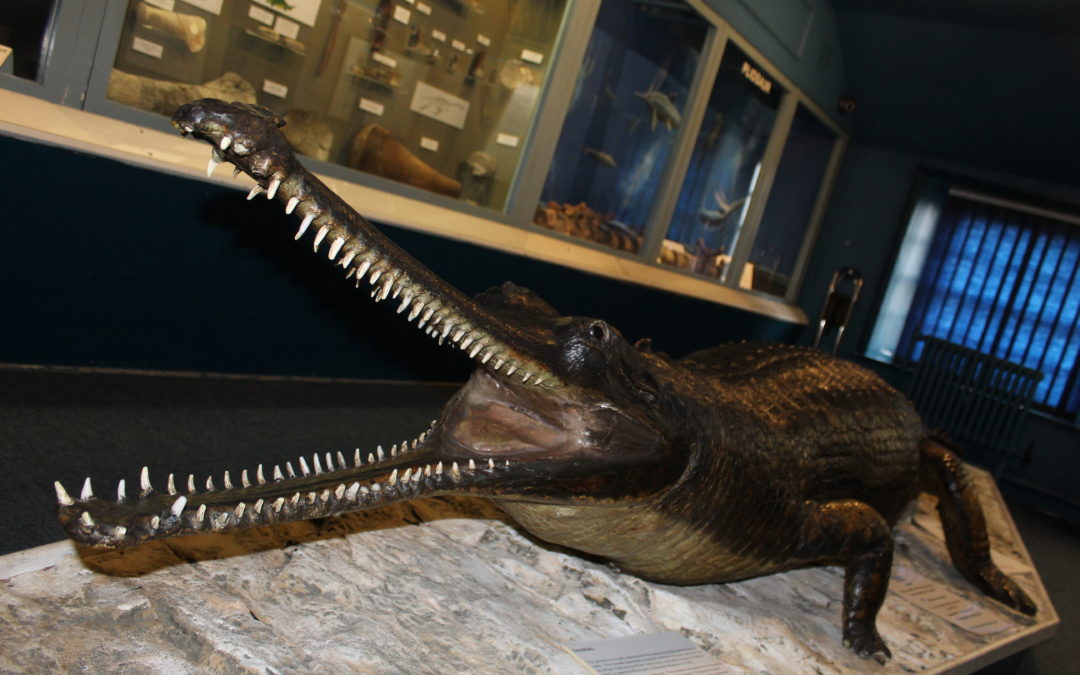
Swindon’s Famous Crocodile or gharial – called Apsley after Apsley House. Known also as Geraldine. Photo by Syd Pycroft
A Swindon touchstone
Every museum has an iconic exhibit that is synonomous with it. An emblem if you like. The Louvre has the Mona Lisa, the Natural History Museum has its diplodocus and Swindon Museum has its croc.
But Apsley (who used to go by the name of Geraldine or Georgina??), as staff no doubt tire of explaining, isn’t, strictly speaking, a crocodile. Nor is she an alligator.
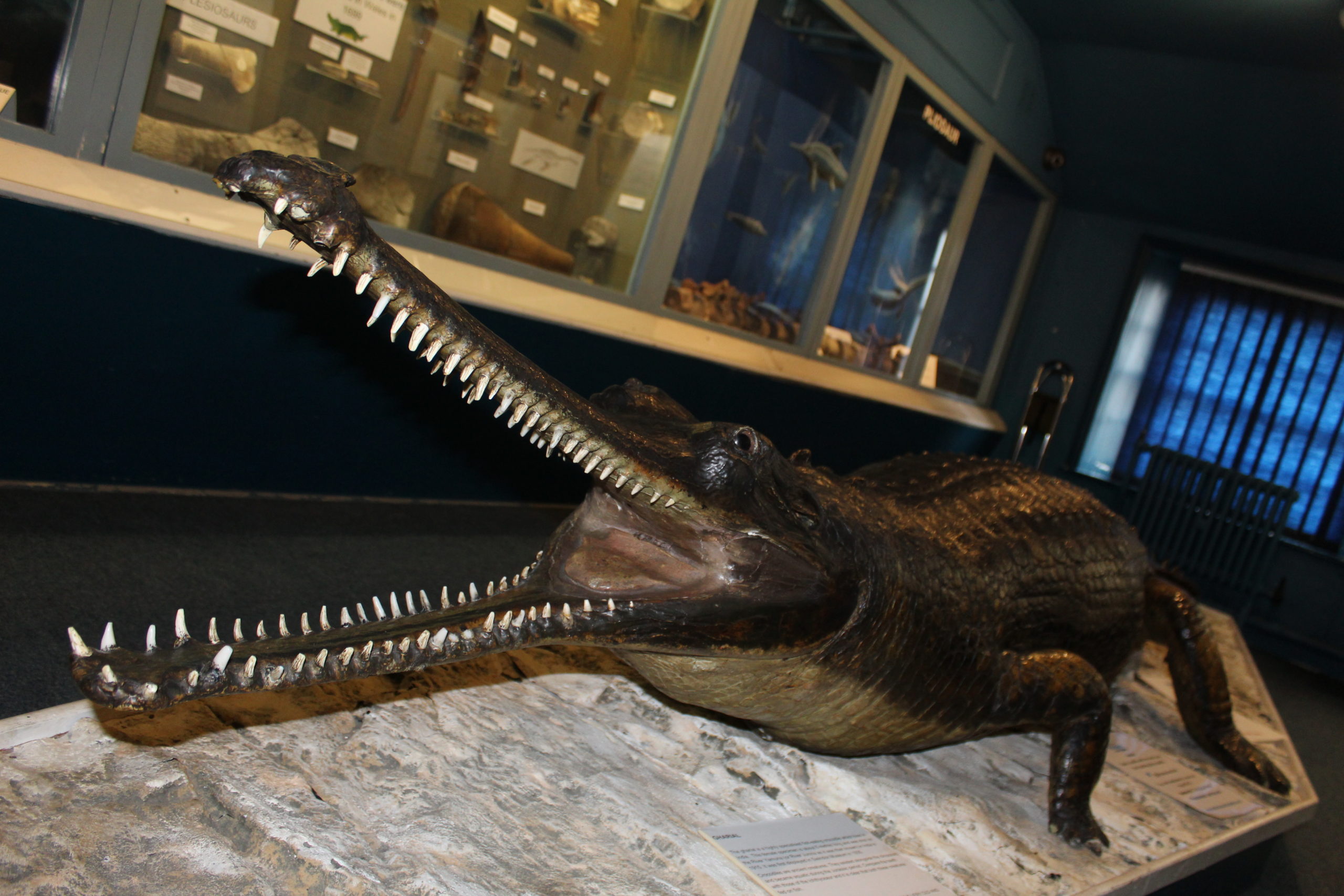
She is in fact a Gharial. She is a member of the crocodile family, but she hails from India. Gharials are one of the longest living members of the croc family. They can reach up to 20ft in length and boast 110 razor sharp teeth. These are perfect for slashing apart fish, their staple diet.
The males have a bulbous protuberance on the end of their nose which look exactly like an Indian cooking pot known as a ghara, hence the animal’s name.
Endangered species
Unfortunately, the Gharial is an endangered species thanks to hunting, pollution, the decline in fish stocks and deforestation around the rivers that form their natural habitat.
There are now estimated to be fewer than 250 still alive, although they are being bred in captivity in India. Fishermen hamper efforts to keep them alive in the wild by driving them away. They’re aided and abetted in that by contamination of the rivers in which the gharials once thrived.
Gharials are not known to be very mobile on land. Unlike their crocodile cousins they are unable to raise themselves up right and walk – instead they have to slide along like snakes.
It’s likely that, that’s what accounted for poor Geraldine’s demise. Someone hunted her and killed her in 1915. And she made her way to England sometime after.
The gharial in swindon museum – photo credit Syd Pycroft
Charles Gore
The museum’s famously eclectic collector, Charles Gore, acquired her in 1935. His natural history collection had grown from a few fossils to an enormous array of animals, historical and military curios and artefacts. Gore’s collection reached the point where it formed the founding collection at Apsley House in 1930.
Charles was the first curator and it’s easy to Charles was the first curator and it’s easy to imagine his delight at adding Geraldine to his attraction. Indeed, she became the star of the show and has fascinated generations of schoolchildren ever since.
There have always been postcards of her to take home. But some rascals wanted much more of a souvenir and at some point helped themselves to a handful of her teeth. Luckily a nearby dentist stepped in to save the day with some falsies to restore that famous grin.
Sadly Swindon museum and art gallery is under threat – and with that everything in it – including poor Apsley who is now abandoned and lonely in the museum. Poor old croc!
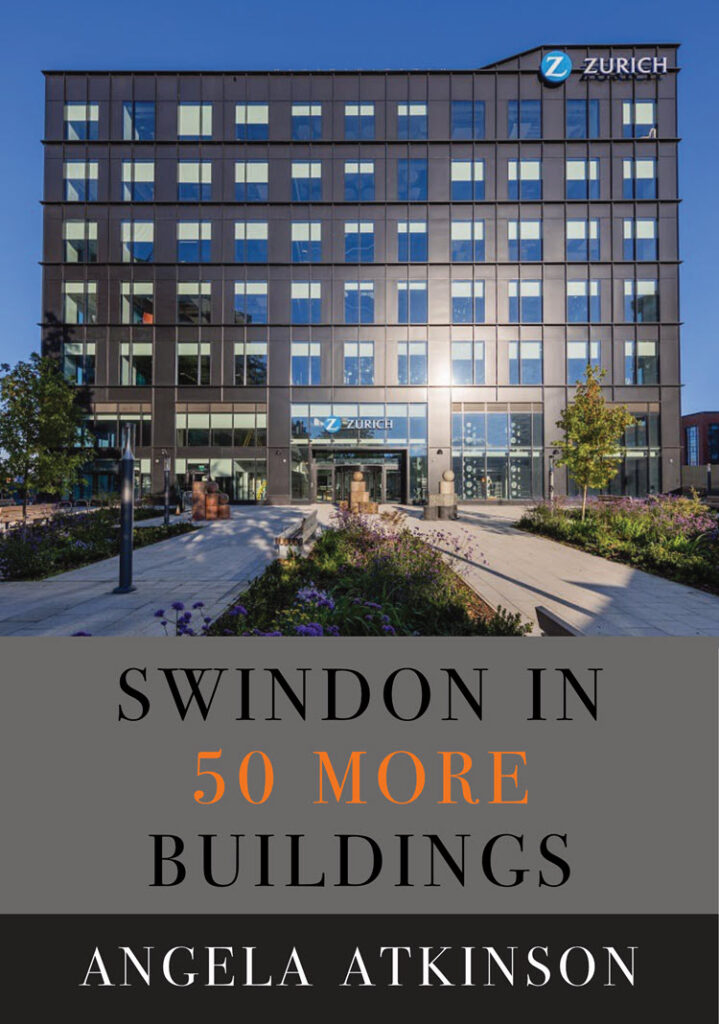
In varying ways, Apsley House as a building, the art collection and the museum as a thing all feature in Secret Swindon, Swindon in 50 Buildings and my guide book. So it would be very nice not to have to make sad amendments to all of those publications!!! So PLEASE – get signing and get sharing!
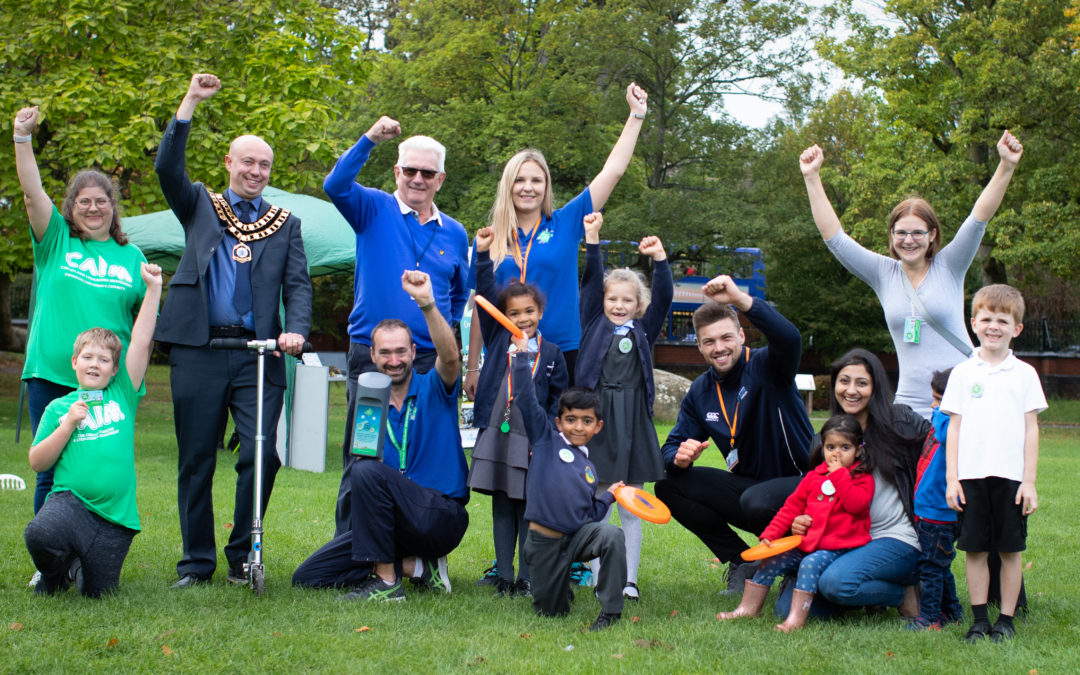
The Beat the Street physical activity game is returning to Swindon this autumn
The Beat the Street game is back! 2021 sees Beat the Street Return.
The walking, cycling and rolling initiative that has twice turned Swindon into a real-life interactive game is returning. It hits Swindon’s streets again from Wednesday, 15th September to Wednesday, 27th October.
Swindon residents are well-versed in the Beat the Street game. In 2018, more than 32,000 local residents walked, cycled and rolled 313,000 miles. And again in 2019, 25,978 participants clocked up 252,126.5 active travel miles.
Beat the Street is about getting communities moving by helping people to make small changes, such as walking or cycling to school every day. And in so doing to improve health and help make being active part of everyday life. Evidence shows that the programme helps adults and children become more active. And it encourages families to spend more time together outdoors and in green spaces.
Across the UK
Since its creation GP Dr William Bird, more than 1.4m people have played the game in more than 120 locations in the UK and beyond. Beat the Street has had a significant effect on increasing how active people are. It’s also helped reduce congestion and improve air quality.
New for this year, participants are being offered awards on the www.beatthestreet.me/swindon website where they can see their in-game achievements.
Free to play
The game is free and open to anyone of any age who would like to take part. Children use a fob, provided by participating primary schools. Adults can pick up a free card from one of the distribution points listed on the Beat the Street Swindon website.
Players then find their nearest Beat Box which will appear on lampposts around Swindon and some surrounding villages. Your first visit to a Beat Box registers the journey. Walk, cycle or roll to the next Beat Box within an hour to score 10 points. Then keep going! The game has seen recent adaptaion. It’s now got more sensitive Beat Boxes and new cards to ensure that it’s COVID safe and contactless. All you have to do is hover your card or fob over the Beat Box and it will beep and flash to record your points.
There are prizes for the teams and individuals that travel the furthest. Plus there are leaderboards for total points and also average points so that teams of all sizes are in with a chance of winning a prize. You can also help a local charity get a donation, and there are “lucky spot” prizes simply for taking part.
Councillor Brian Ford, Swindon Borough Council’s Cabinet Member for Adults and Health said: ‘After two fantastic games, we often get asked about bringing Beat the Street back to Swindon. So it’s a real delight to be able to announce that we have commissioned the game once again. We know that one of the best things people can do right now for their physical and mental health is to move more and to get out into green space where possible. And Beat the Street helps people do that in a safe way.
It’s free to take part in Beat the Street and it’s open to everyone regardless of age, ability or background. More than 250,000 people across the UK have played the game safely since the beginning of the pandemic. It’s helped to get people out exercising and spending time with friends and family. We hope that it will provide a real incentive to get Swindon moving.’
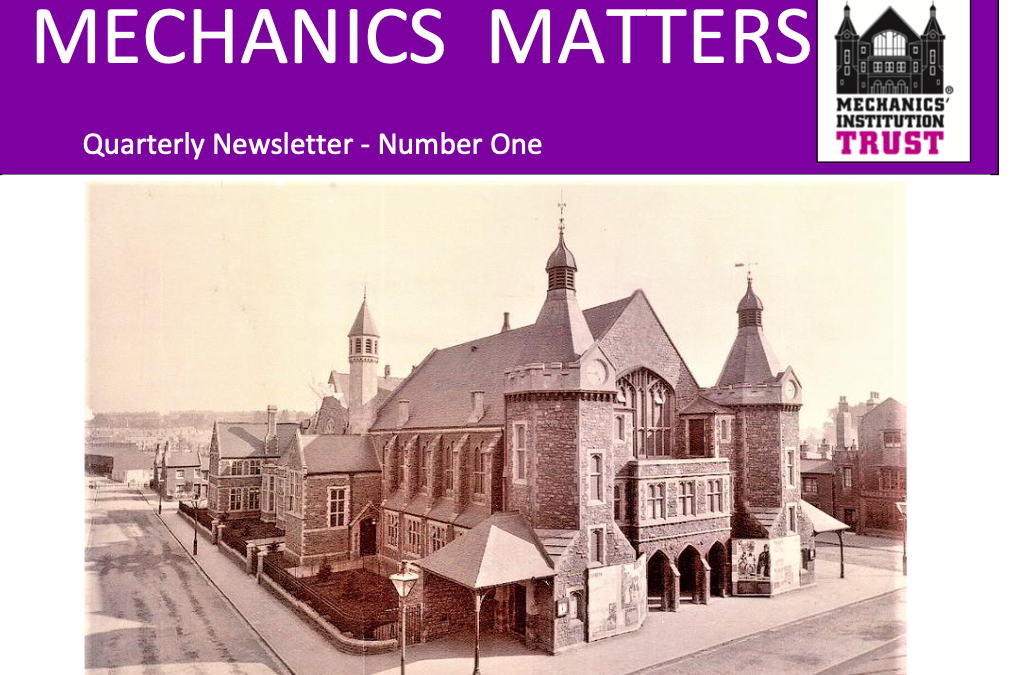
Mechanics’ Matters Newsletter No 1 – Quarterly Newsletter
Mechanics’ Update
The Mechanics’ Matters Newsletter The building has been through three independent reviews. Two of these reviews covered viability proposals. And we’re pleased to say that a use, based on the Trust’s own proposals, is deemed viable.
The proposals are mainly based on a theatre, flexible space, education, retail and community use. The other review, led by the Council, concerned the actual structure. It’s feasible to restore the building – it can become a reality.
The current situation is that an independent heritage consultancy is using resident feedback to improve the viability proposal. That will ensure we cover every base and that we base future funding applications on sound proposals.
Changes at the Baker’s cafe
With regret, due to the pandemic, we’ve had to close the Bakers Café for the foreseeable future. We’ve not traded for 15 months and that’s led to a review of options. For the interim, we’ll use the Bakers as two community rooms. The smallest of these rooms will also act as a visitor centre.
These are excellent, clean facilities, right in the town centre and with good public transport. We offer flexibility and a range of room layouts. Space is available at attractive prices, in particular for local or charitable organisations. For booking – email: centralcommunitycentre@mechanics- trust.org.uk
HERITAGE ACTION ZONE
The Swindon Heritage Action Zone was
Launched in June 2019, the Historic England heritage action zone is an ambitious five- year plan. One that aims to revitalise the town’s unique heritage and unlock its economic potential. The hope is, that by improving the zone it will build on England’s favourite conservation area, the town’s Railway Village. The village and its surroundings are a rich heritage area. It’s an area full of promise for residents, businesses, tourists and investors.
The website also contains a map to explore, as well as key projects aimed at achieving the improved heritage zone.
The intent is to regenerate Brunel’s 1841 Great Western Railway Works and the village built to house its thousands of employees. It will restore and repair neglected public buildings and bring them back into use. The HAZ will also improve public spaces and connections between the village and the town centre thus promoting and celebrating the area’s special qualities. In turn that will help to instil a sense of local pride.
We’re looking forward to reopening the Railway Village Museum on Saturday 11 and Sunday 12 September 2021, 10-4pm as part of the Heritage Open Days festival.
You can arrange private tours and school visits in exchange for a donation. For more information please contact Katie Knowles – katie@mechanics-trust.org.uk
How to get involved
The Mechanics’ Institution Trust is a charity and relies on volunteers and charitable funding. That said, we do generate income from the buildings we currently have responsibility for. We have a range of opportunities and are looking for volunteers and Trustees.
If you’re interested, contact us here. We’d love to hear from you!
Swindon’s Street Art Back in the day, thanks to a Labour government job creation scheme and a visionary arts officer called Terry Court, Swindon became something of a mural capital thanks to the work of Swindon-born artist Ken White. One by one his murals disappeared and now only one remains, the first one, the Golden Lion Bridge mural.
Ken White as a much younger man with the Golden Lion Bridge mural
But in recent years murals and street art have once again started to grace Swindon’s walls, gable ends and ugly hoardings.
Back in 2015 I wrote about the new mural on Cambria Bridge. As it happens, there used to be a mural by the aforementioned Ken White on the self-same wall. So, in a neat bit of artistic symmetry this new mural references Ken.
And now here we are in 2021 and Swindon’s street art and murals are cropping up all over the place. I haven’t seen them all and can’t possibly cover them all in one blog post. So I’ve picked out four – in no particular order.
You can read more detail on this mural in this article here.It explains who the artists are and what the mural depicts. This particular piece of mural magic happened in a partnership between the Regent Circus management and the artists, Swindon-born Martin Travers and a London-based street artist, Lionel Stanhope.
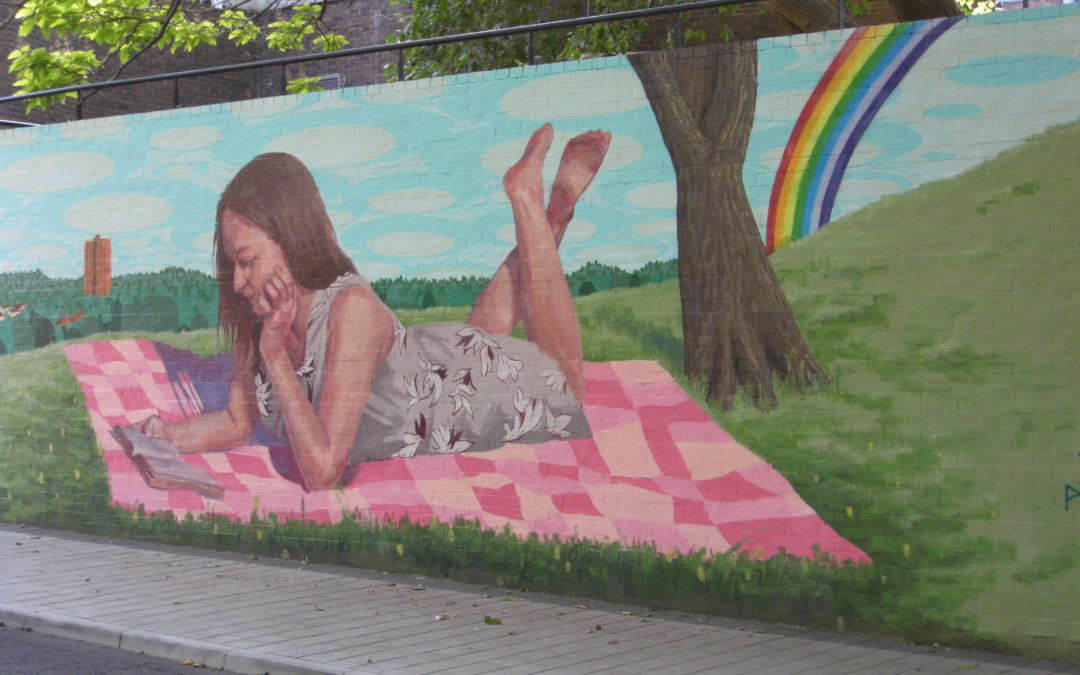
2. Princes Street
This is a Swindon Borough Council production on an old wall near the Rendezvous Chinese restaurant. It’s co-creators are Peter Cowdy and Caryn Koh from Artiste and the Post Modern.
The work represents Swindon and its amazing outdoor spaces from the GWR Parkto Queen’s Park in the town centre. I love it because it features my very favourite building in the background – the David Murray John Tower.
3. Wharf Green – Mother Earth with flower of life
This mural is staggering and I can not at all show it properly here. Funded by InSwindon, it’s painted by Pete Cowdy and Dayna Baxter and runs the length of the wall where the sadly-defunct big screen hangs.
4. And last, but by no means least, a note of HOPE