Church Art in Swindon – a little look at some of what you can enjoy in Swindon’s churches.
Church art, or Sacred Artwork is, by its definition, art that is set apart from the mundane. We find it in uses and places that command deep respect. From a Christian perspective, the term sacred artwork, is best applied to works that are either:
Intended for liturgical settings or are …
… appropriate for liturgical settings
Common types of church art
There are four common varieties of church art – most of us will have encountered some if not all of them at some time in our lives – either at home or abroad.
Stained glass – letting glowing, colourful light into a church interior, stained glass windows tell stories – often of the Bible and saints. But they’re not restricted to that. They can be geometric patterns, they can tell an allegorical story or they can be a tribute to a significant person. Or to local industry – see below.
Frescoes and wall paintings: these are large paintings on church walls and ceilings often using bright colours. I’ll argue that the ceiling of the Sistine Chapel in Rome is the go big or go home version.
Altarpieces: carved or painted wooden and stone panels placed behind the main altar.
Icons – Sacred wooden panel paintings used, in the main, in Eastern traditions, these pieces are rich with deep symbols.
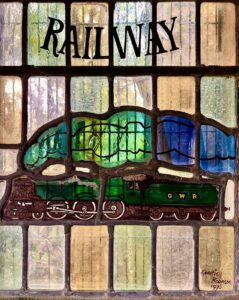
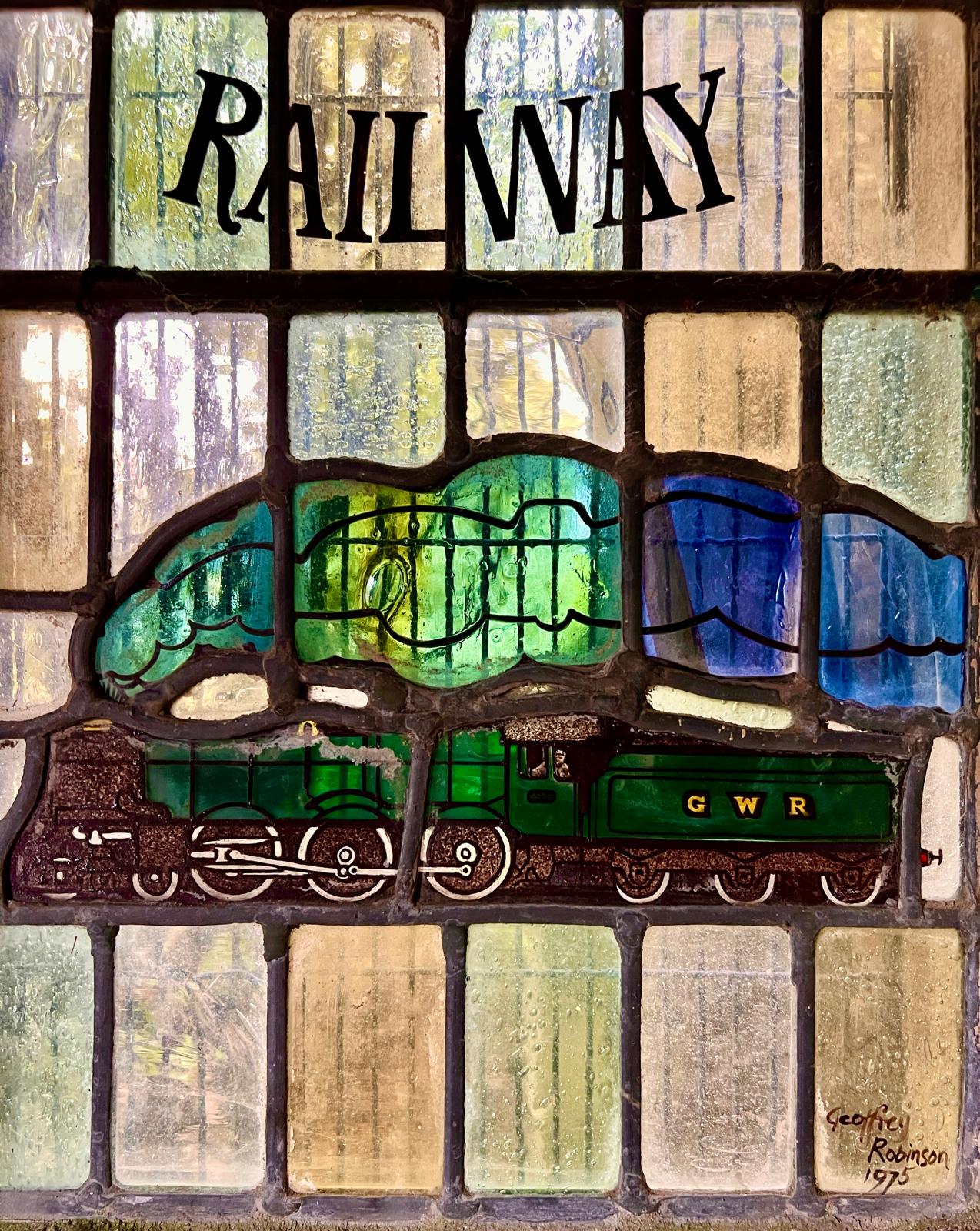
Church Art in Swindon – GWR stained glass in Christ Church. Often unnoticed, tucked away in the south porch of Christ Church is this gorgeous stained-glass window featuring a GWR locomotive.
Local bell ringer Nancy Davis donated the window in 1975.
Christ Church has deep ties to the GWR. The company’s chief engineer, George Jackson Churchward has his resting place there.
So, what’s Swindon got in the way of sacred art?
Well quite rather a lot actually. And some of it is quite astonishing. I obvs can do more than give an overview here of some it I know. And that I miss I beg your pardon – to paraphrase a V old song about an English country garden!
I do hope though that this will whet your appetite and encourage you to visit the churches mentioned here and others in the town, to see what they might have in the way of church art. And then tell me about it – because what I talk about here is about the extent of my knowledge.
St Mary’s church in Lydiard Park
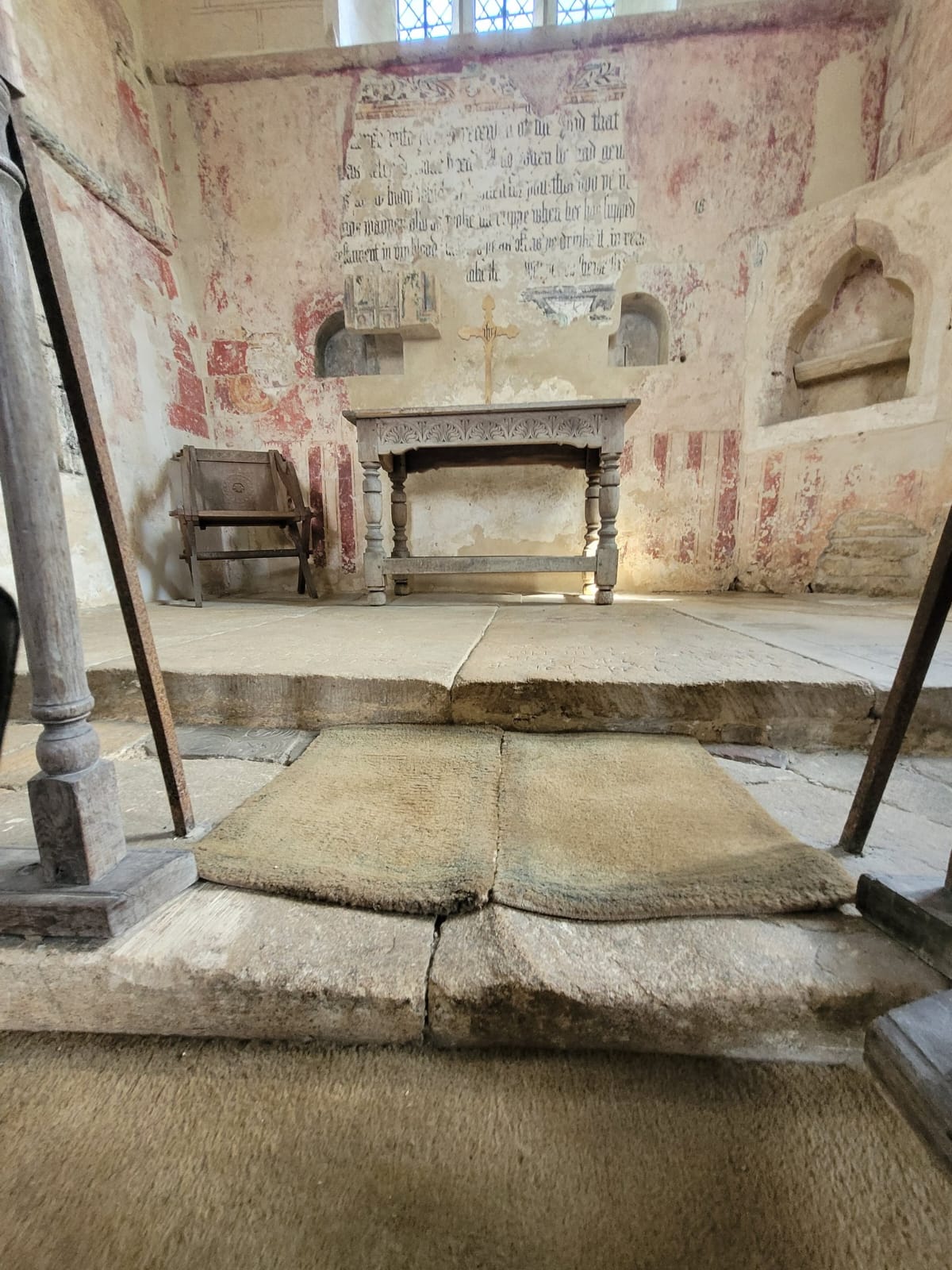
Right then! To kick off our whistle stop tour of some of Swindon’s church art we’re visiting St Mary’s at Lydiard. In 1999, writer and historian Simon Jenkins featured this church in his book England’s Thousand Best Churches. In it he stated that, were the chancel to be moved to the Victoria and Albert Museum, lock, stock and barrel, it would cause a national sensation. And not a lot of people know that. Thus, I included that rather fabulous fact inSecret Swindon. But, we’re not concerned here with the Golden Cavalier nor the tremendous polyptych. No. Instead we’ll concentrate on the wall paintings at St Mary’s. These remarkable survivals offer a rare insight into how much different the church would have looked to the mediaeval worshiper. For they would have offered their prayers to God surrounded by walls covered in brilliantly coloured patterns, foliage and action figures.
The 16th century saw all St Mary’s wall paintings defaced and covered up when the new Protestant doctrine forbade the use of sacred images and the worship of saints. Some enjoyed a brief moment in the sun when the Victorians temporarily exposed them, 300 years later. They uncovered them from layers of lime-wash during 1901 renovations.Now though, they’re in better shape than ever. And it’s all thanks to extensive conservation work undertaken in a £1million conservation project (2018-2021). The programme involved twenty-four trainee conservators from different countries under the professional guidance of Jane Rutherford & Associates.
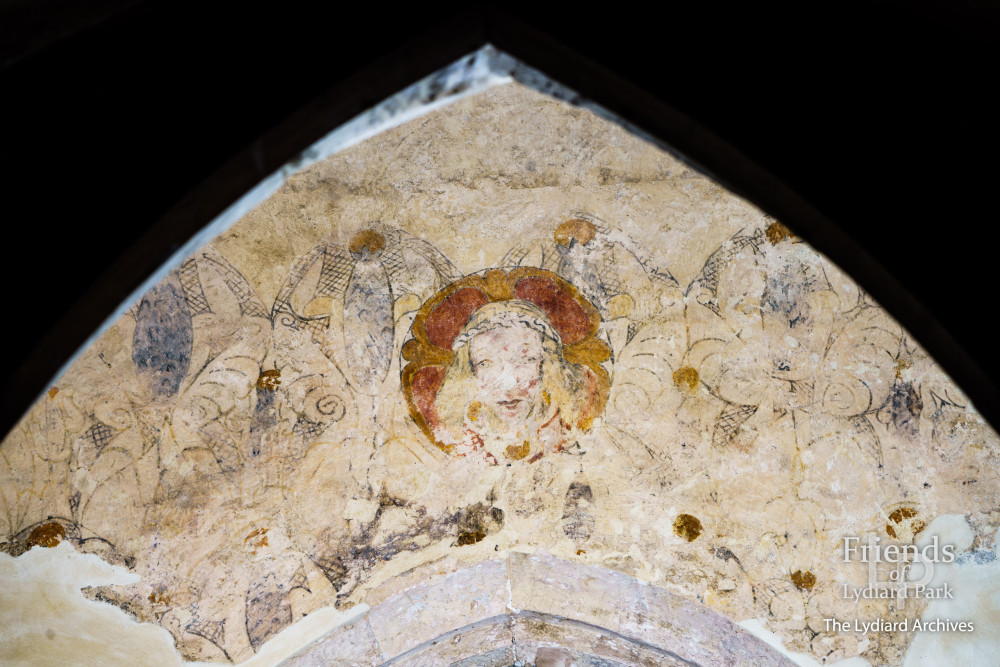
You can explore the wall paintings (and more) by browsing the Lydiard archives here: https://thelydiardarchives.org.uk/collection/wallpaintings but as a teaser there’s one below. What you see here is an unusual depiction of Christ with long blonde, wavy hair surrounded by a pomegranate design.
Dating from the 15th century it’s part of a set of once brightly-coloured wall paintings introduced by Margaret Beauchamp (c1410-1482) and her husband Oliver St. John – pronounced Sinjun or Sinjin. The couple are credited with enlargements and improvements to the church that took place in the 1400s. Their work included the addition of the south porch – where you’ll find this painting.
ST MARY’S Renaissance Christ – Image courtesy of the Friends of Lydiard website. As indeed are many of the words.
Inglesham church, St John the Baptist – 13th century
Keeping with ancient wall paintings and bouncing out into the wider borough we’re now paying a visit to Inglesham, described as ‘an ancient painted wonder saved by William Morris.’ That’s he of Kelmscott Manor not the Swindon Advertiser. I mention it because confusion does arise.
‘An amazing series of paintings, from the thirteenth to the nineteenth century, cover the walls often with one painted over another, in places seven layers thick. While it is not always easy to puzzle out the subjects, you can see fifteenth-century angels above the chancel arch, an early fourteenth-century doom on the east wall of the north aisle, and several nineteenth-century texts, as well as a thirteenth-century masonry pattern throughout the chancel.’
The church art tour bus now comes back into Swindon, to Rodbourne. Here we’ll pay a visit to St Augustine’s, one of the four so-called railway churches, built to meet the spiritual needs of the ever-growing GWR workforce. The other’s being, in no particular order) St Mark’s (by the railway village), St Barnabas (Gorse Hill) and St Luke’s at Broadgreen.
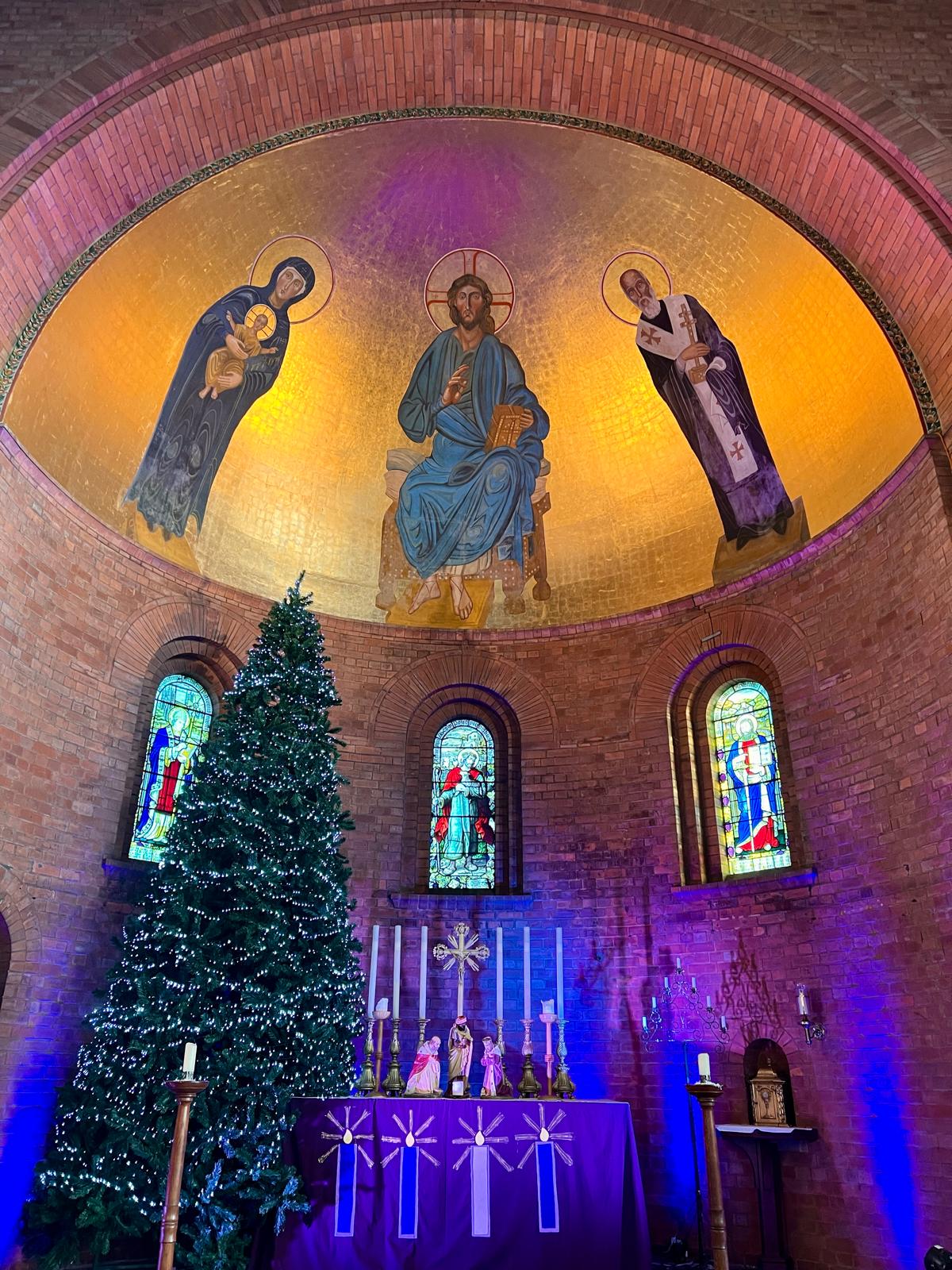
Anyway, as you go through the doorway of this modest, red-brick, railway church prepare yourself for shock and awe as you’re greeted with the simply stunning apse ceiling you see in this image.
Back in 1987, discussions began about a new work of art for the apse at St Augustine’s. Funding it were several members of the Done family, in memory of Winifred Done. A much-loved member of the congregation, Winifred had died in March of that year.
Now a young artist seeking work, Fleur Channer, had approached the clergy. They commissioned her to prepare sketches for a painting in the early Christian style. They wanted something resembling that which St Augustine himself might well have seen in Rome. Adaption’s to the sketches followed. By the time the final drawings received approval the figures were of a later period than at first intended. They now showed the influence of Italian, Greek and Venetian artwork.
But better still, visit it. It’s a lovely church, one of which I am rather fond.
The apse in St Augustine’s church in Rodbourne. The Byzantine-style apse ceiling in St Augustine’s painted in the 1980s by a young artist called Fleur Channer.
I am Alpha and Omega, the beginning and the end, the first and the last. Revelation 22:13
St Barnabas’ Gorse Hill
Continuing with the theme of tales of the unexpected, our next and final stop on this trip takes us to another railway church, St Barnabas in Gorse Hill. Now, I’ve written about St Barnabas and its marvellous mural paintings before on this forum so I’ll not go on too much them. But in case you missed that one or need a reminder here’s an overview.
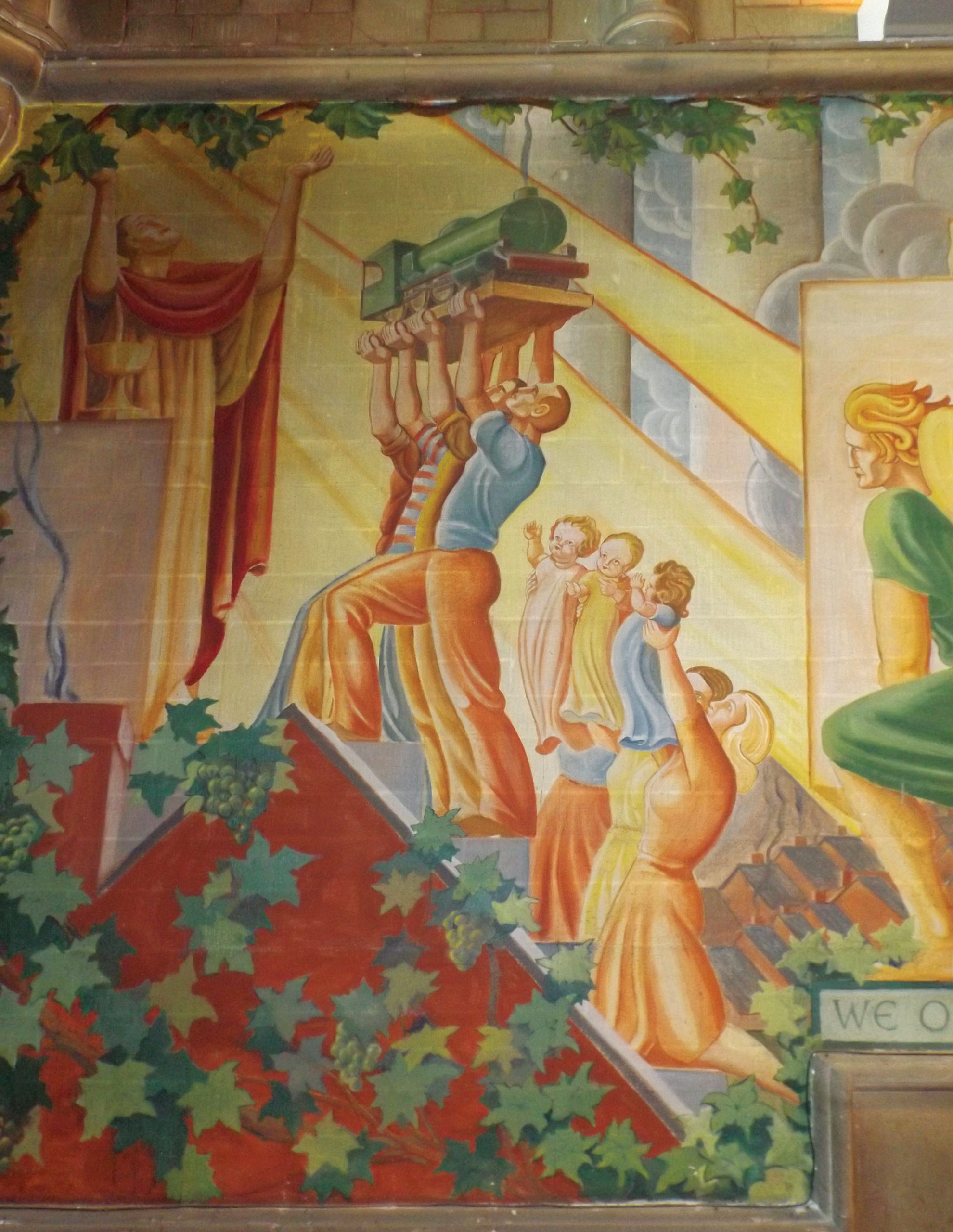
The mural paintings are the work of the Rev. John (Jean) Perret, sometime Rector of Stanton Fitzwarren, near Swindon. The Rev. Basil Minchin encouraged their execution and they comprised a thank you offering on the part of the artist for recovery to health. Painted in the years 1946, 1947 and 1948, the artist prepared the walls with lead and canvas.
Section from St Barnabas’ Church Murals – the young men offering the locomotive and the mothers offering their children.
So, there you have it – an overview of a small sample of Swindon’s sacred art. I trust it’s tickled your metaphorical taste buds and that you’re now energised and enthused enough to visit them for yourself.
Swindon Theatres is proud to announce the return of popular free group, Memory Sing sponsored by Willowbrook View. Memory Sing will run alongside their popular memory café and memory cinema sessions. They occur every month at both the Wyvern Theatre and Swindon Arts Centre.
Memory Sing is a friendly and welcoming singing group. It’s held at the Swindon Arts Centre for people living with dementia and their carers. Through familiar songs, music, and shared experiences, the group provides a relaxed space. One where participants can connect with others, build confidence, and enjoy the many benefits of singing together. Memory Sing encourages social interaction, wellbeing, and joyful moments. Thus helping people create new memories while celebrating old ones.
Oli Webb, Creative Learning Manager and Chair of the Swindon Dementia Action Alliance said ‘Musical memory and emotional memory often survive much longer than other memories. It’s proven to help with mood, memory, and connection to those who take part in choirs and singing groups. We want to create a group with deep roots in the community of Swindon, for the community of Swindon. Each session will include a time to chat and have a cuppa, but also go over people’s favourite songs and have guest performers join. Running the group is the wonderful Trudy, an accordionist and singer, and Carole, a singer and dancer. They both work at the Wyvern Theatre and have supported the Memory Events since their inception 10 years ago. Memory Sing hopes to welcome you soon.’
Dementia Friendly Singing Group Returns
The sponsors
Willowbrook View sponsors the Memory Sing. That’s an all-inclusive luxury care home in Wichelstowe providing residential, dementia and respite care. All in a warm and well-designed setting.
The home offers spacious en-suite bedrooms, comfortable communal areas and facilities including a cinema, fine-dining bistro, spa and salon. Under Connaught Care’s all-inclusive model, a single monthly fee covers all the amenities. Thus removing the uncertainty of hidden costs or extra charges. As part of its commitment to the wider Swindon community, Willowbrook View often supports initiatives that:
bring people together
reduce isolation and
create meaningful opportunities for those living with the impacts of memory loss.
Film Classics at the Bowl. It’s lights, camera, action and open air as two much-loved cinematic classics come to the big screen at the Town Gardens Bowl this September.
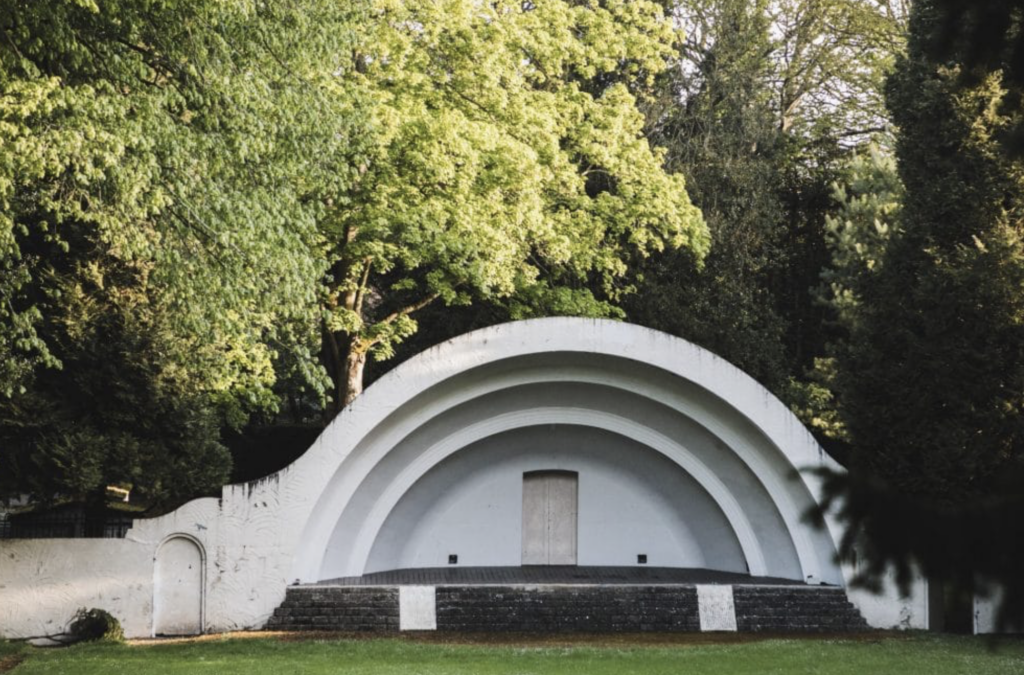
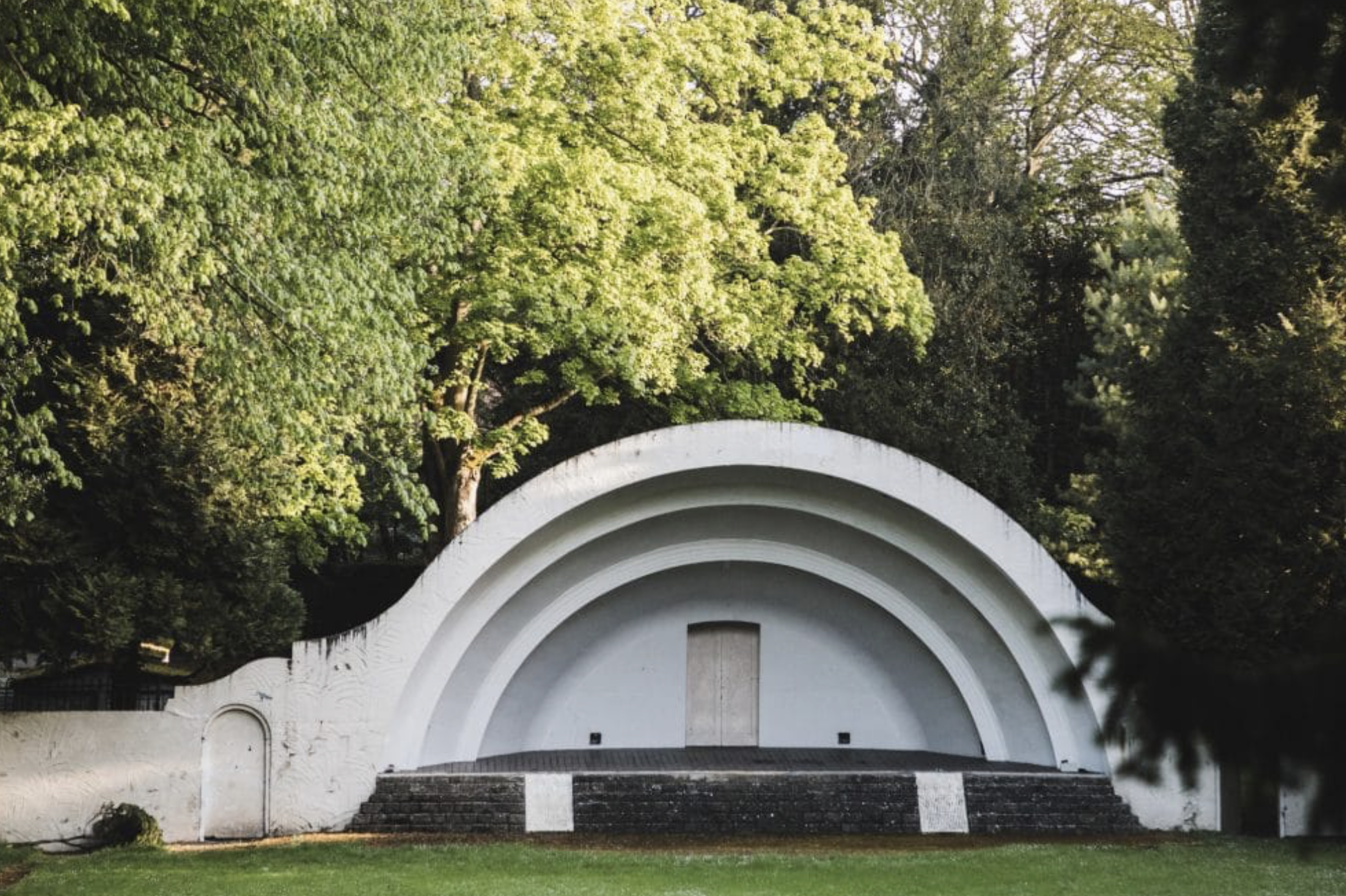
The Town Gardens Bowl will become an open-air cinema for two nights. Thus offering audiences the chance to enjoy a film in the unique surroundings of the Town Gardens.
Film Classics at the Bowl – the bowl in Swindon’s Town Gardens
I’m ready for my close up Mr DeMille (no doubt showing my age with that reference)
The programme begins with The Wizard of Oz on Friday 4 September. It will transport audiences over the rainbow with one of cinema’s most enduring and beloved adventures. All together now: ‘Follow the yellow brick road, follow the yellow brick road …’
Then, on Saturday 5 September, audiences can experience the magic of Disney’s Fantasia. That’s the landmark animated classic that brings together memorable music and stunning animation.
With the big screen set against the backdrop of the Town Gardens, the screenings offer a different way to experience these much-loved films. Combining the atmosphere of the cinema with the freedom and character of an evening outdoors.
Doors open at 7pm, with screenings commencing at 8pm
Whether you’re looking for a family night out or a relaxed evening with friends. Or a chance to revisit a classic on the big screen, the Town Gardens Bowl provides a memorable setting for an open air cinema experience.
SSPC encourages visitors to bring their own picnics and chairs and settle in for an evening of film under the open sky. Note, you cannot take alcohol or glass into the venue.
WROUGHTON-based financial advisers take on their next fundraising challenge. They’re running Swindon’s Half Marathon for child bereavement charity, Wiltshire Treehouse.
At the start of 2026, Southby & Co Financial Planning announced their charity of the year as Wiltshire Treehouse. So, as part of their fundraising efforts, the team are undertaking a ‘Summer of Fundraising’. September is their biggest undertaking.
They’re kicking off the month with a sponsored 26-mile walking challenge from Stonehenge to Avebury on Friday 4th September. That’s followed by CEO and founder, Dave Southby, and financial adviser, Jenny Ashfield running Swindon’s Half Marathon as a further challenge at the end of the month.
‘We decided to add a half marathon to our summer of fundraising as a challenge to push ourselves!’ said Jenny, who ran the Bristol half marathon earlier this year, also for Wiltshire Treehouse.
‘When I heard about our local half marathon, I knew we had to participate. And after I suggested it, Dave volunteered to join me to make it more of a team event.’
Dave and Jenny will be among the predicted 2,000 runners who’ll take part in Swindon’s Half Marathon. It takes place on Sunday 27th September 2026 through the town and its surrounding countryside.
‘I’ve never before had involvement in a half marathon,’ said Dave. ‘So, this is an exciting new challenge for me and, hopefully, running together will make the race easier. We’ve both been preparing by getting some training miles in and spending time on our feet – despite the heat!’
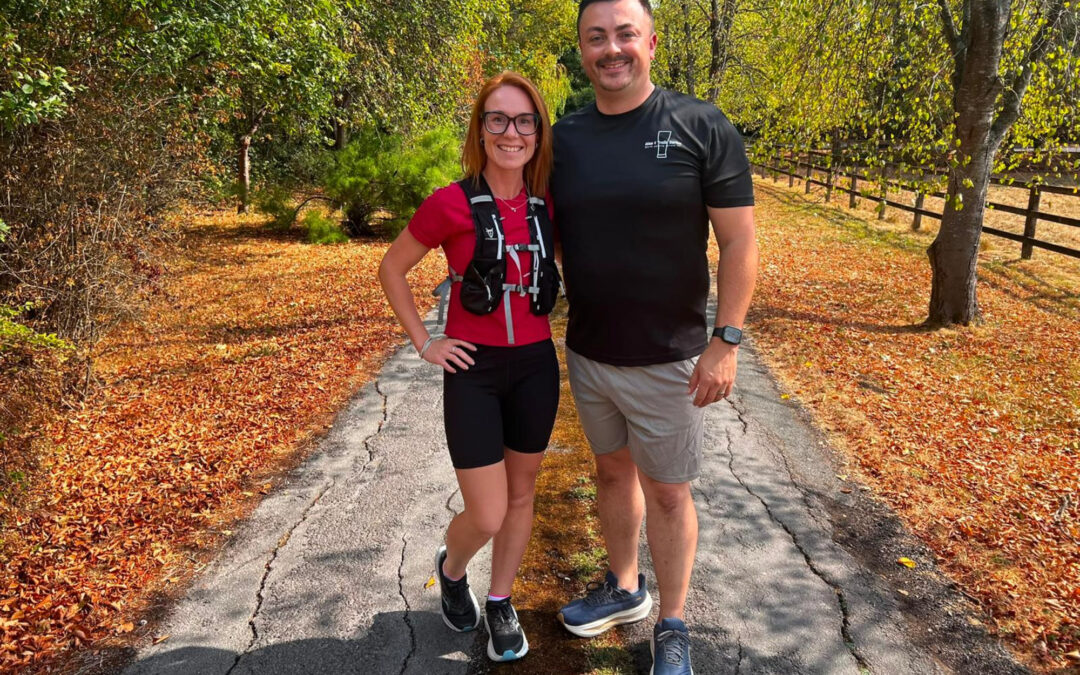
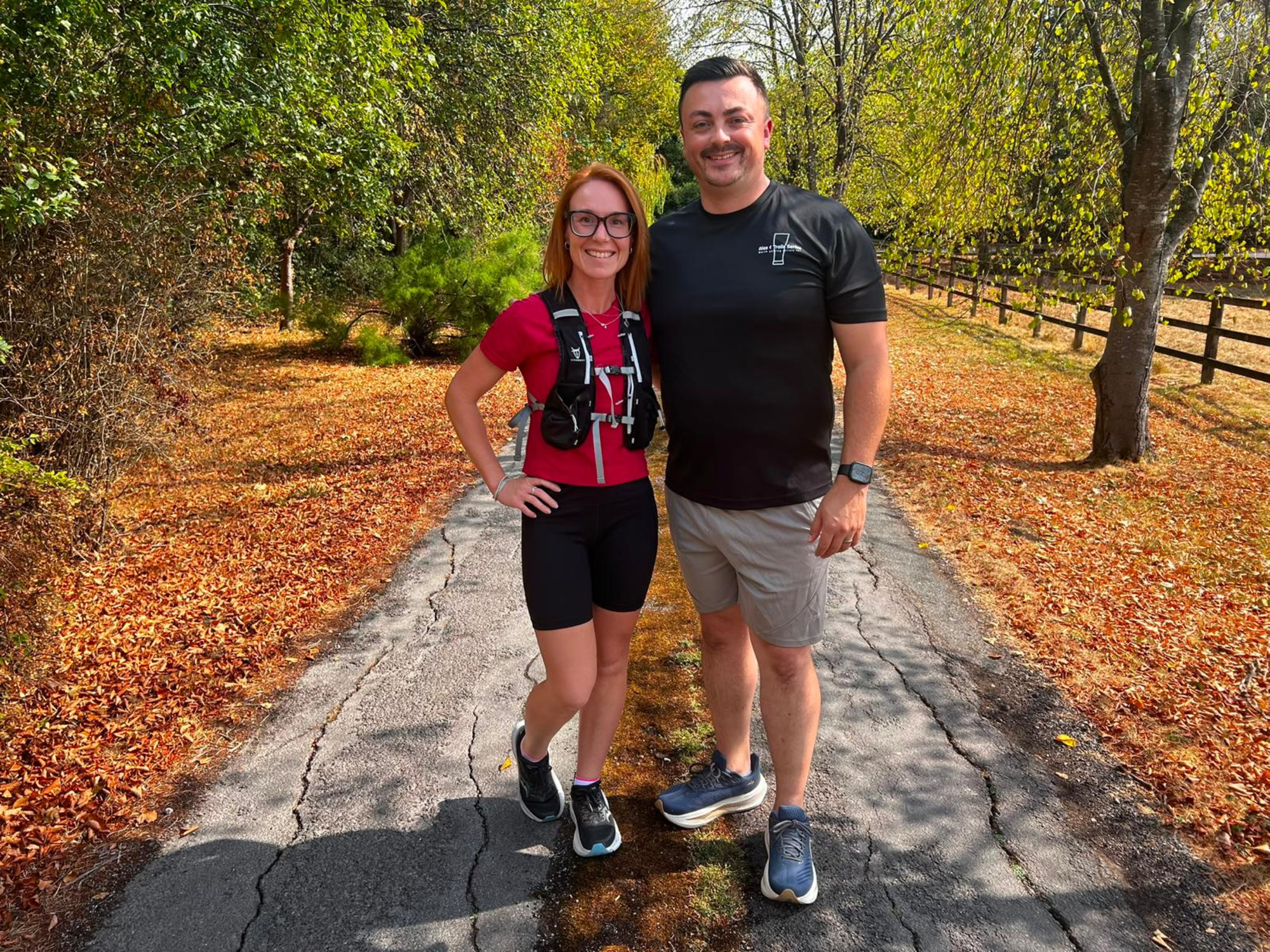
Financial Advisors Counting Steps – Dave Southby and Jenny Ashfield of Southby & Co Financial Planning, who are walking a 26-mile trek and running Swindon’s Half Marathon 2026 for Wiltshire Treehouse.
Wiltshire Treehouse
Wiltshire Treehouse provides free bereavement support to children, young people and families across Swindon and Wiltshire. The charity doesn’t receive regular financial support from the government or local authorities. Thus, they’re reliant on public donations.
Dave said: ‘We chose Wiltshire Treehouse because it aligned perfectly with what we stand for. They support local families and they have a direct effect in the wider Wiltshire community. For us, it’s about raising money as well as bringing awareness for the incredible work this charity does.’
‘Swindon Half Marathon and our 26-mile walk are both great opportunities. They allow us to raise money and awareness for the community Wiltshire Treehouse supports.’
At the start of the year, the team pledged to raise a minimum of £3,000. So far, they’ve raised almost £2000 and are on track to meet their goal.
Dave and his team work with individuals, families, and business owners across Swindon and Wiltshire, helping them manage their finances effectively and plan for the future. For more information visit: https://www.southbyfp.co.uk/
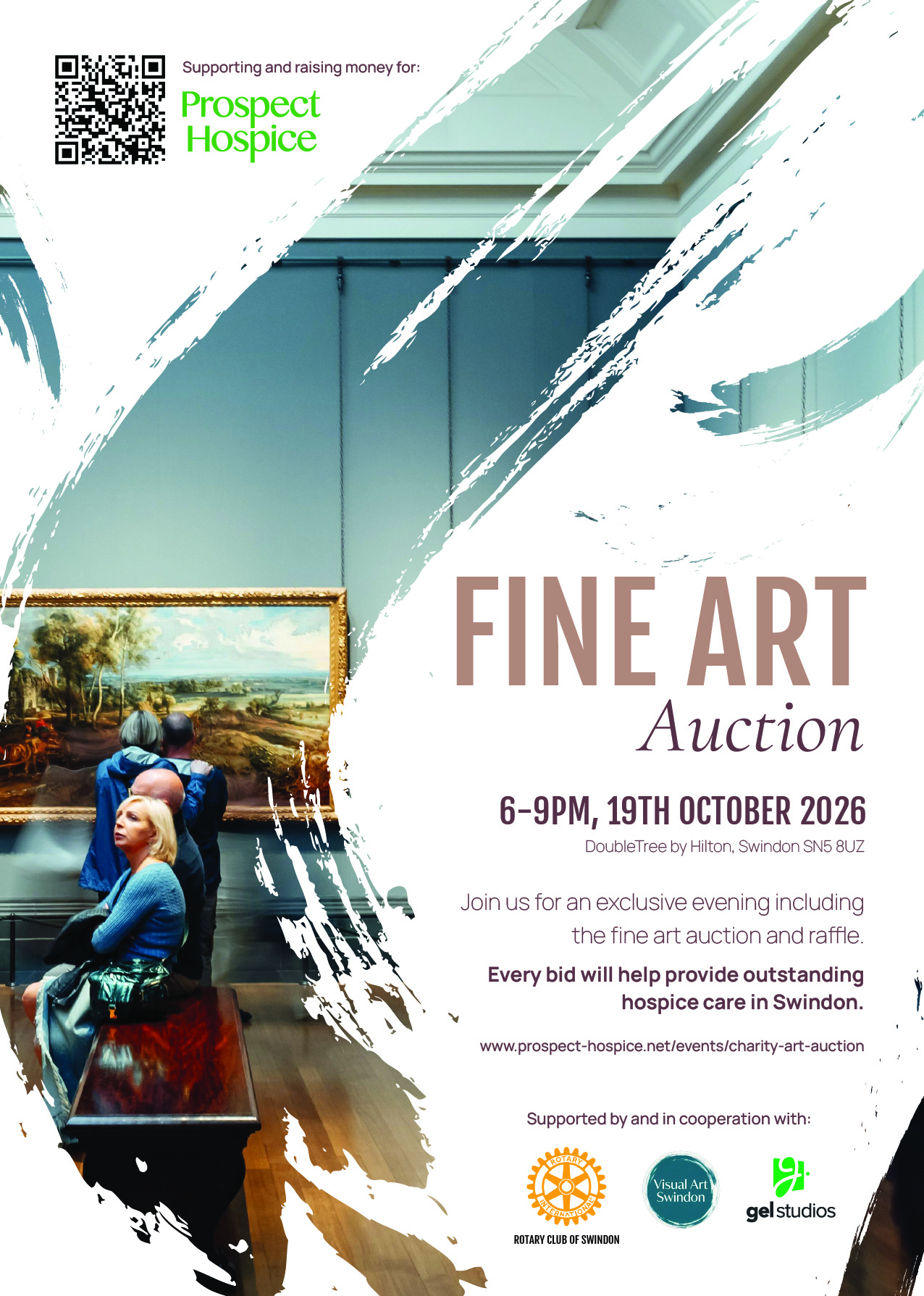
Art Auction for Prospect. All money raised through the auction will go to Prospect Hospice, Swindon.
The auction is being organised by Jeremy Holt, a retired solicitor, and former President of the Rotary Club of Swindon. And local artist and Visual Art Swindon founder Caroline Day. Jeremy has before organised two successful charity art auctions in partnership with local artists.
Art Auction for Prospect
When and where
The art auction will be at the DoubleTree by Hilton Swindon Hotel near Junction 16 on Monday 19th October. Viewing from 6pm, auction starts from 7pm.
There’ll be a variety of fine art paintings and limited-edition fine art prints. They’re all kindly donated by both prestigious professional and emerging local artists.
Some of the paintings donated will go under the auction hammer. While the rest are destined to be offered at a fixed price. Free drink on arrival. Please do bring anyone else you think would have an interest. It should be a fun evening!