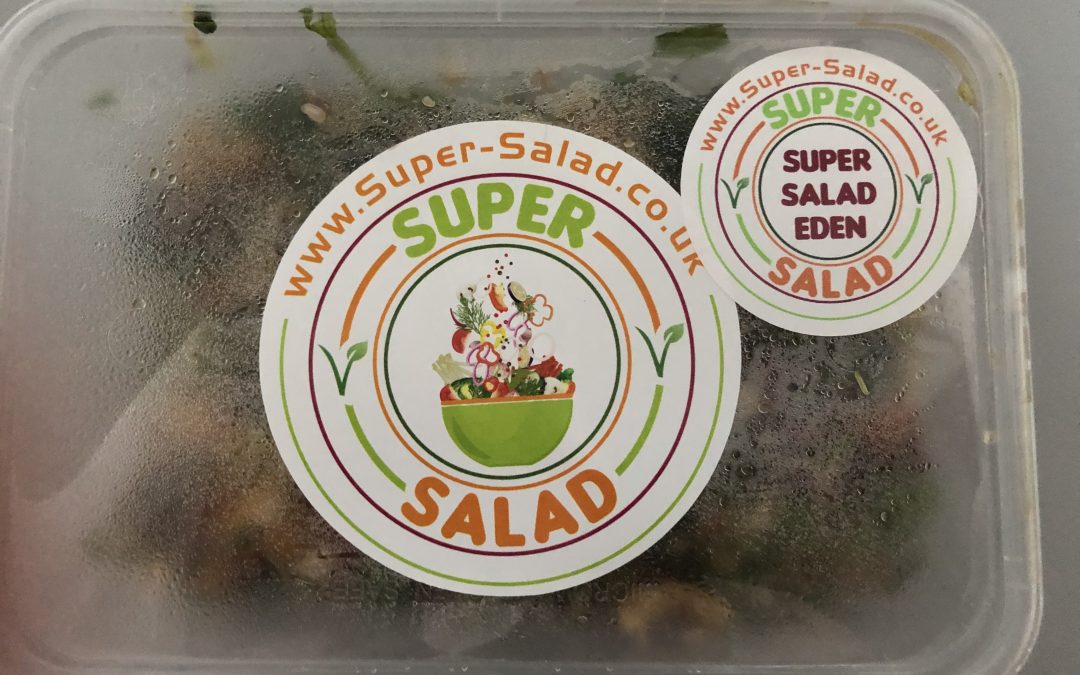
Despite the fact that I’m less than fond of cooking, I don’t spend a lot of dosh on takeaways/brought in meals. Not as a rule. But with the Covid-19 lockdown situation curtailing any socialising, I’ve treated myself here and there. So, when the opportunity arose to try this Swindon super salad company I jumped at the chance.
What is Super Salad? Super Salad is a small new company that has created what might just be the healthiest single serving meal in the world. It’s a bold statement but with our salad consisting of between 50 and 65 different ingredients and 25+ Superfoods we believe this just might be true.
If you want something at home – and don’t feel like cooking – but want to be healthy these are definitely worth considering.
The two salads I ate were chock full of different ingredients – all finely chopped. It would have taken me hours to create something like that. It takes me all day to make a bloody quiche – snipping bacon and chopping onions and garlic. Pfft.
You can get an idea, from the image of the leaflet above, of the range that the company offers.
Talking of garlic, I topped both of the salads that I tried with garlic in olive oil, cubes of feta and a few vine ripened chopped tomatoes. And with that, each one was surprisingly filling! This is an important point – I do have quite an appetite (this why I’m not a size 10) so filling me up can be a challenge.
If I’m honest, I found the two that I had a bit on the bland side. That could be my palate – what with me being addicted to chilli olive oil. But anyway, that’s a minor negative soon sorted with a sprinkling of that Himalayan pink salt stuff – it doesn’t half give food a lift does that.
So what you get here is something that’s refreshing and filling. Uber nutritious and full of fibre. I think if you’re trying to lose weight but don’t want to forgo a takeaway treat, these salads are a good option and good value for money.
Dessert Salad
Swindon Super Salad also do a home-delivery fruit salad with which to finish off your super healthy meal.
I tend not to eat much fruit. I don’t personally consider fruit to be food for a start. And aside from that it mostly makes me fart and smell like dead people. Or so my daughter tells me.
However, eaten together with a piece of lemon drizzle cake brought to me by a friend, it was most enjoyable. Though I suppose the cake rather negated all the other healthfullness. Oh dear. How sad. It was was good though!
Simon Webb, is well-known as a maker of beautiful hand-turned writing implements that tell stories. He’s crafted pens from woods that include church pews, Isaac Newton’s apple tree, the mulberry tree at the Richard Jefferies museum, HMS Victory and more.
But it’s arguable that his drumstick pens beat it all.
In 2019, Simon had the great good fortune to get an invite to a charity event at Middlewick House – erstwhile home of Camilla Parker-Bowles – and now the home of Nick Mason of Pink Floyd fame.
Selling his fine pens at the charity event, Simon sold one to Nick himself. An email exchange followed as Nick needed a fine nib fitting to his pen. A service Simon happily provided.
Said Simon: ‘During our email conservation I offered to make something for his charity auction – perhaps from one his drumsticks.
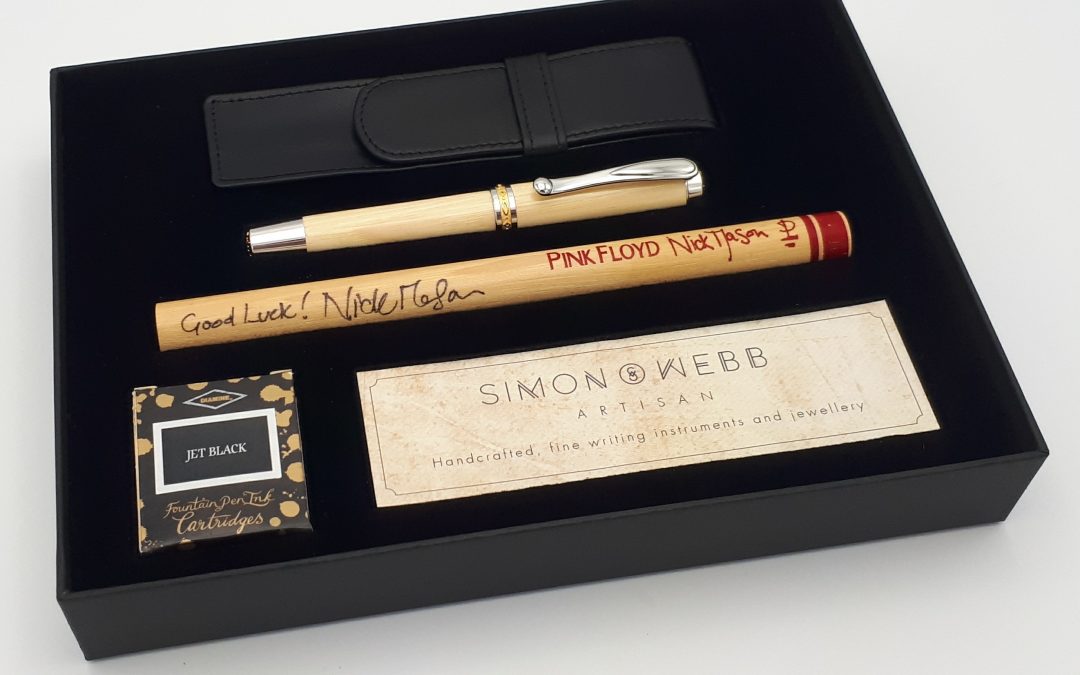
At length, to my great delight, I received a pair of his drumsticks signed by the man himself.’
‘I’ve been working this project and am now proud to reveal the result’ added Simon. ‘I’ve made a rhodium and gold fountain pen and included the signed section of the drumstick in the presentation box with the pen.’
Drumstick Pens Beat It
It’s been a real thrill to do this and Nick has said he’s happy for me to use whatever is left of the wood for what I want. So I’m planning some cufflinks.
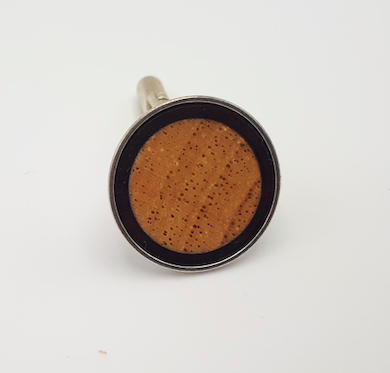
They’ll be available from me soon, complete with a certificate of authentication. See picture below showing a prototype where the hickory wood of the drumstick is surrounded by ebony in a sterling silver setting.
Prototype cufflink
An anecdote
Said Simon: I’d heard Nick on the radio early before I set up at the event. The presenter asked if he did any gardening. He replied that it was a standing joke that he was a ‘zero hours’ gardener.
So when my stand caught his eye and he wandered over to me, I shook hands with him and said it was great to meet another zero hours gardener.’
Jubilee Lake Nature Reserve RWB – Royal Wotton Bassett
3rd June 2023 – update
In the period since Lis wrote the post below about Jubilee Lake, my good friend Marilyn Trew has busied herself painting a map and information boards for a nature quiz trail that takes you all round the lake. You can pick up the trail leaflet at the cafe by the play area. Be sure to have a pen/pencil.
jubilee lake nature trail quiz -art work by Marilyn Trew
And one of the information boards featuring Marilyn’s most marvellous artwork:
Information board about bats on the Royal Wootton Bassett Jubilee Lake nature trail
I did this trail with my 6-year old granddaughter and she loved it. In part that was because she’s a task-oriented child. So even if the subject matter of a trail doesn’t interest her too much she’ll still focus on finishing the task. But that wasn’t the case here. So this is a fab, free activity for any time of year.
The cafe at jubilee lake in Royal Wootton Basset
The cafe at Jubilee Lake – there’s also a great play area.
About the lake
Here’s a smashing guest post from Lis Mcdermot about Jubilee Lake Nature Reserve Royal Wotton Bassett. Until recently I had no idea about this place. And, as you’ll see, it took Lis a while to realise it too!
We had lived in Royal Wootton Bassett for eleven years before we realised there was a lake!
In 1940 the Town Council purchased Wootton Bassett Lake. But it wasn’t until 37 years later, in 1977 that it became Jubilee Lake Park, renamed to mark Queen Elizabeth ll’s Silver Jubilee.
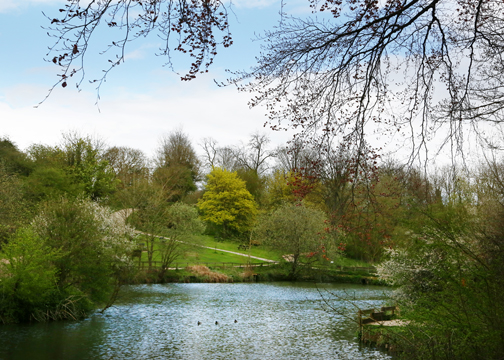
2007 saw the lake area designated as a Local Nature Reserve. It is a beautiful, small area of ancient woodlands and meadows, located north east of the town, a little over a mile from the High Street.
After parking in the lake car park you can choose to either walk though a little copse or walk down the tarmac road. The latter being a much easier option for anyone pushing either pushchairs, or wheelchairs.
Taking the road
The road though has quite a steep incline as you near the lake, which can make it hard work on the way back up to the car park. The copse has a little stream that runs down through the middle. In spring months it’s with blue bells and wild garlic; a wonderful aroma.
f you choose to take the road you’ll pass the large children’s’ play area, and Jubilee Tea Rooms where you can stop for tea and cakes, or ice cream on extra hot days.
The park has plenty of activities for children including quiz leaflets. You can colllect these from either the Lake Tea Rooms, or the Town Council Office on the High Street. There are also public toilets in this area.
Seasons in the sun – or maybe the snow
If you visit the lake often during the year, you can watch the seasons change. During the spring it’s lovely to watch the family of geese swimming with their newly hatched chicks.
n the summer the meadow beside the lake is the perfect spot to sit and read, or simply enjoy the sunshine with the family. Later in the year, the trees look magnificent dressed in the autumnal colours. The area is very quiet, and it’s easy to forget that you are on the edge of a small town.
There is also a thriving Angling Club and you often see fisherman sitting in quite contemplation around the edge of the lake with the rods. NB: You need a license for fishing.
The walk around the lake is not that long. So, if you’re walking there for exercise, a mere one walk around never feels quite enough. It’s a somewhat small lake, as lakes go after all. Yet it’s a beautiful area, and well worth visiting.
At present during the Corona Virus pandemic, there is one-way system in place, to ensure people are able to self-distance more with ease.
For more information about the Angling Club, please contact Terry Strange on 01793 346730.
Due to popular demand, The Cotswold Challenge competition for teenagers under lockdown is now open to young people in Swindon as THE COTSWOLD CHALLENGE COMES TO SWINDON!
Five business owners, living in and around the Cotswolds, came together during lockdown to try to support local young people who’ve had their examinations cancelled. The contest launched three weeks ago and several students from Swindon have asked to take part.
“Due to demand, we made the decision to widen the geographical area covered by the competition and now it’s open to any young person living in Swindon who would have been taking GCSEs, A Levels or equivalents this year,” said Fiona Scott, from Swindon, who is one of the team behind the contest.
We’ve had requests from young people from West Swindon and Central Swindon so we’ve widened the area to a 25 miles radius of Cirencester – deemed to be the centre of the Cotswolds.”
What that means
This means young people from across Swindon can submit an entry for the challenge. It’s divided into three categories: 1. Art & Design 2. Creative Writing 3. Innovation & Entrepreneurial Thinking
There’s a first, second, third and fourth prize in each category of £500, £300, £150, £50 and runners up will get a book token.
The initiative was first developed to support 16 to 19 year olds (Years 11, 12, 13) to give them something creative to do and offer them the chance to excel, gain a sense of achievement and self-worth.
The challenge launched in April and it remains open until 9pm on Monday June 1.
“We’re particularly interested in getting entries from young people who are enterprising and innovative. They may have an idea for a new product, be a fledgling inventor, have thought of the next best app or have come up with a solution for the good of their community.
These young people may have a great business idea – or simply a great idea which they want to share and perhaps take the next steps to become a reality,” Fiona said.
The sponsors have already donated the prize money in full.
Winners will also be able to pitch for extra funds to take ‘the next step’ in showcasing their work eg. publishing their poem or short story in a local publication, staging their own art exhibition or taking an idea to an early prototype stage.
The sponsors for the project include:
The Fred And Marjorie Sainsbury Charitable Trust Jeevan Thandi of Karhoo Timothy James & Partners, independent financial advisers Jason Houghton, Salperton Park Estate, Cheltenham The Fairford & Lechlade Business Club Royal Agricultural University, Gloucestershire The Paperback Shop, of Fairford Marion Whittaker Author Kevin Wignall Meg Rivers Bakery, of Shipston On Stour Suzannah Harvey, CEO of Cotswold Airport Kim Harvey of The MadHatter Bookshop, of Burford. Nicky Godding, founder of Business & Innovation Magazine John Biddulph, of Rodmarton Manor Emma & Jamie Tuck of Bulldog Websites, of Swindon Allison Murray of Allison Murray Design, of Eastleach Barry Jackson, of Aspire Academy Bettina Harvey of Hector & Queen Nicky Godding of Business & Innovation magazine
Judging
A a team of well-known people, who have themselves achieved success in their own sector or business, will judge the entries. To date 60 young people have submitted entries for consideration.
Details of the competition, the criteria for entry and the briefing pack are all available via the website www.thecotswoldchallenge.com
One of the entries in Swindon in 50 Buildings,is The Crumpled Horn pub over in Eldene. Thus, I figured this blog series of Swindon in 50 More Buildings should include a pub too. And this news about the Hall & Woodhouse pub out at Wichelstow is a good enough reason to make it this one.
The Hall and Woodhouse Canal-side Hostelrygets national recognition for innovative pub in Swindon
Hall & Woodhouse at Wichelstowe, Swindon, has won the coveted ‘New Build Award’ in the prestigious CAMRA Pub Design Awards 2020.
A CAMRA award – Campaign for Real Ale
The awards, held by CAMRA, in conjunction with Historic England, celebrate exceptional pubs across the country. These are pubs that have undergone conversion or conservation work. That or they’re newly built.
Hall & Woodhouse in Wichelstowe first opened its doors to guests in February 2019. This follows a £5million investment. The canal-side pub sits in the new housing expansion at Wichelstowe and has become a flagship symbol of the emerging community.
Inspiration
The pub’s designers took inspiration from its surroundings, looking at creative ways to:
A. Incorporate the canal B. Reflect industrial Swindon’s architectural heritage into the pub’s interior and striking exterior.
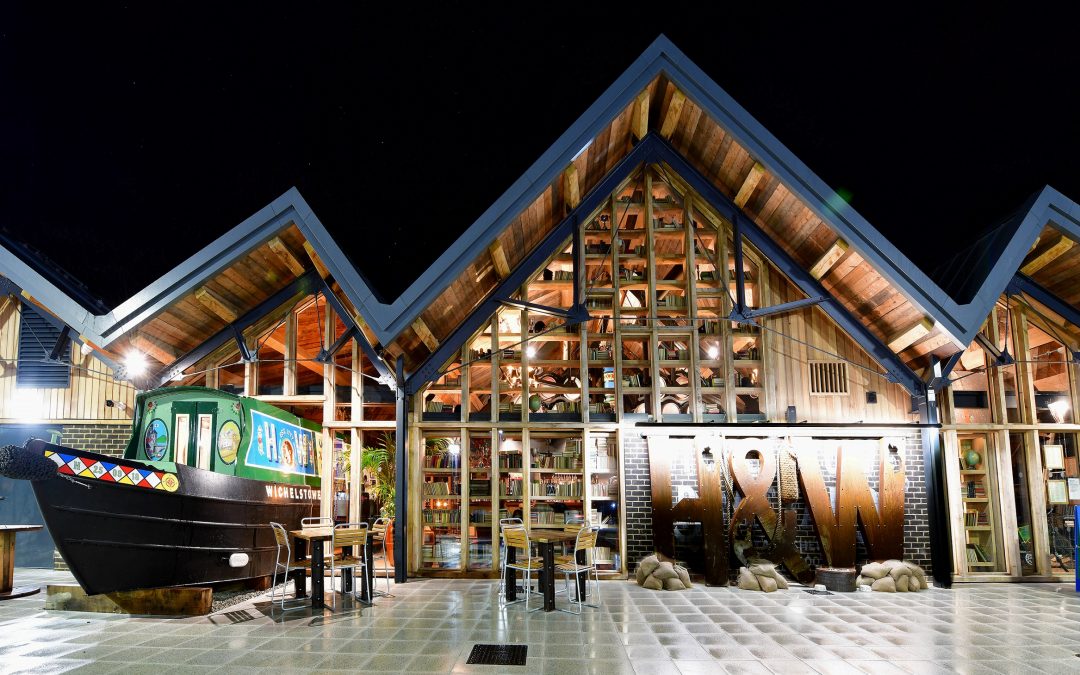
An innovative, purpose-built canal boat named Lady Rose protrudes from the front entrance of the building. It contains self-serve beer pumps in sectioned booths that can seat up to 20 people.
Mark James, Property Director at Hall & Woodhouse, said: “It’s important to us to create a welcoming atmosphere that makes guests feel at home. A place where they can relax over a coffee or a meal, or enjoy a drink with friends.
A labour of love
Hall & Woodhouse, Wichelstowe was a real labour of love for our design team. They spent months sourcing unique features to enhance the pub’s iconic appearance. A walk around the pub surrounds you with pieces of Swindon’s history and artefacts conveying our 240 years of brewing heritage.
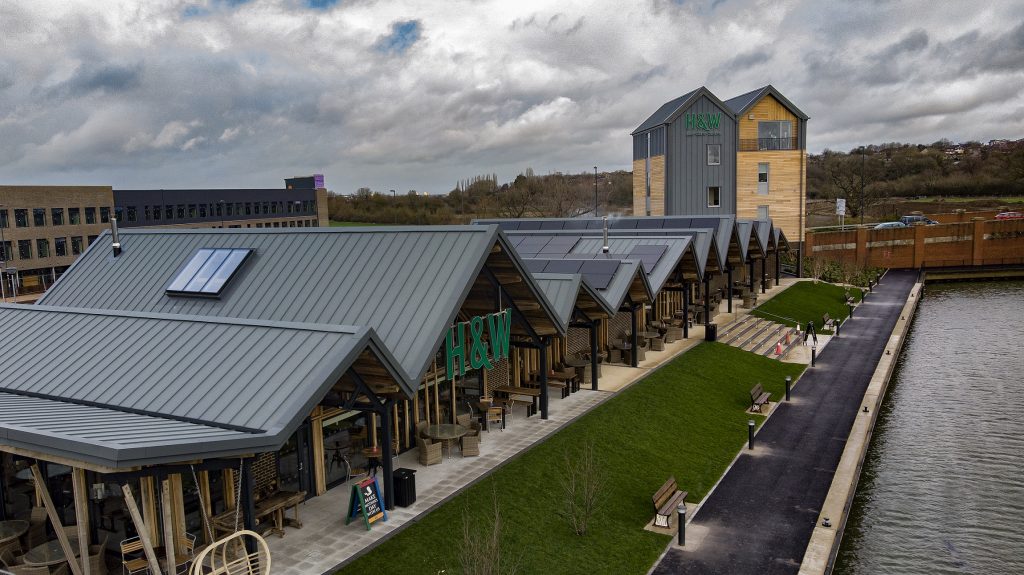
Glazed drinking and dining areas extending along the canal frontage, represent a terrace of traditional boathouses. The gabled roofs opening onto the water’s edge, form an extensive area of covered outdoor space. And the taller accommodation block symbolises traditional canal-side warehouses.
Juxtaposition in the internal decor
The internal décor is a juxtaposition of industrial structure and soft furnishings. The walls are adorned with images of local boatbuilding, the Hall & Woodhouse family and the company’s brewing heritage.
We sourced with care, knick-knacks from all over the country to enhance the building’s atmosphere.
Andrew Davison, chair of CAMRA’s Pub Design Award judging panel, added: “The New Build Award is rarely awarded. It’s a testament to the quality of Hall & Woodhouse at Wichelstowe that it has won.
“The commitment Hall & Woodhouse make to individual, location-specific design is praiseworthy.”
About Hall & Woodhouse
Hall & Woodhouse is an independent Dorset family company. They brew award-winning Badger Ales and run an estate of high-quality pubs in the south of England.