Public Art in Swindon.
I’m somewhat fascinated by the whole idea of public art because, until I moved to Swindon thirty-odd years ago, it was something beyond my experience. In my Derbyshire mining village, we had a couple of ancient village pumps, a cenotaph and a pit winding wheel – but nothing that you’d call public art. I knew sculpture, as in Barbara Hepworth and Henry Moore – but even then only from books and TV. Ergo, when I pitched up here in the early 1990s and encountered The Blondinis in the town centre, Diana Dors at the cinema at Shaw Ridge and the long-gone Kinetic Pencils and Elizabeth Frink’s Running Man at the WH Smith *HQ at Greenbridge, my flabber was somewhat gasted. But it wasn’t until I began writing about it that I learned the term.
*To see images of the kinetic pencils visit this post about the WH Smith building: https://swindonian.me/2021/02/14/12-the-wh-smith-offices/
What is public art?
Before talking about Swindon’s public art and how tremendous it is, I’ll touch on how we define it.
The Tate website carries this definition:
‘The term public art refers to art that is in the public realm, regardless of whether it’s situated on public or private property or whether it’s been purchased with public or private money … ‘
Though, I’m a tad confused as to how that definition considers something on private property, as being in the public realm?
Anyway, let’s move on to Swindon’s astonishing collection of public art. And it IS astonishing.
A forward thinking council – yes, REALLY!
Swindon’s erstwhile Thamesdown council was the first in the country to adopt a percent for art policy. This policy encouraged developers, once their scheme reached completion, to fund a piece of public art. This forward thinking and innovative scheme resulted in Swindon acquiring an unusual, if not unique, cultural landscape. A landscape that has public art scattered the length and breadth of the town.
All, I daresay, installed to great fanfare. And then, in the main, left to rot. Go figure.
So, there’s a LOT – too much to cover here. If I did then this article would be longer than Paradise Lost – and no-one needs that. Besides which, I’ve written about much of it on my blog. So should this overview pique your interest enough to find out more follow this link and have a root: https://swindonian.me/category/public-art-sculpture/
Meanwhile, I’ll cover three of my favourites here.
My top three
1. The West Swindon Sculpture Walk
A topic I return to again and again is the West Swindon sculpture walk. Indeed, this set of seven artworks dotted around West Swindon were the first I wrote about. And it was when I got busy on Twitter, posting out links about them that the term public art came onto my radar. Someone retweeted me with a ‘oh look, someone here writing about Swindon’s public art.’
Thamesdown Borough Council commissioned these pieces in the years between the early 1980s to the early 1990s. Funding for them came, in part from the housing developer’s contributions to the aforementioned Percent-for-Art public realm scheme. They’re an important feature of the town’s cultural make-up yet they’ve not, on the whole, had the recognition or the attention they deserve. The exceptions to this tale of neglect being White Horse Pacified – he’s had a spruce up recently-ish. And on that topic of white horses, there are, as you know, several marked out in chalk and dotted around the Wiltshire/Oxfordshire countryside. But here in Swindon, as Roger Ogle has often commented, we have a three-dimensional version unknown to anyone outside of Swindon and quite probably the majority of people in Swindon – seems a shame.
To find out more about this one go here: https://swindonian.me/2013/07/11/west-swindon-sculpture-walk-part-3-white-horse-pacified/ and also here: https://swindonian.me/2016/06/20/white-horse-pacified-rides-again/
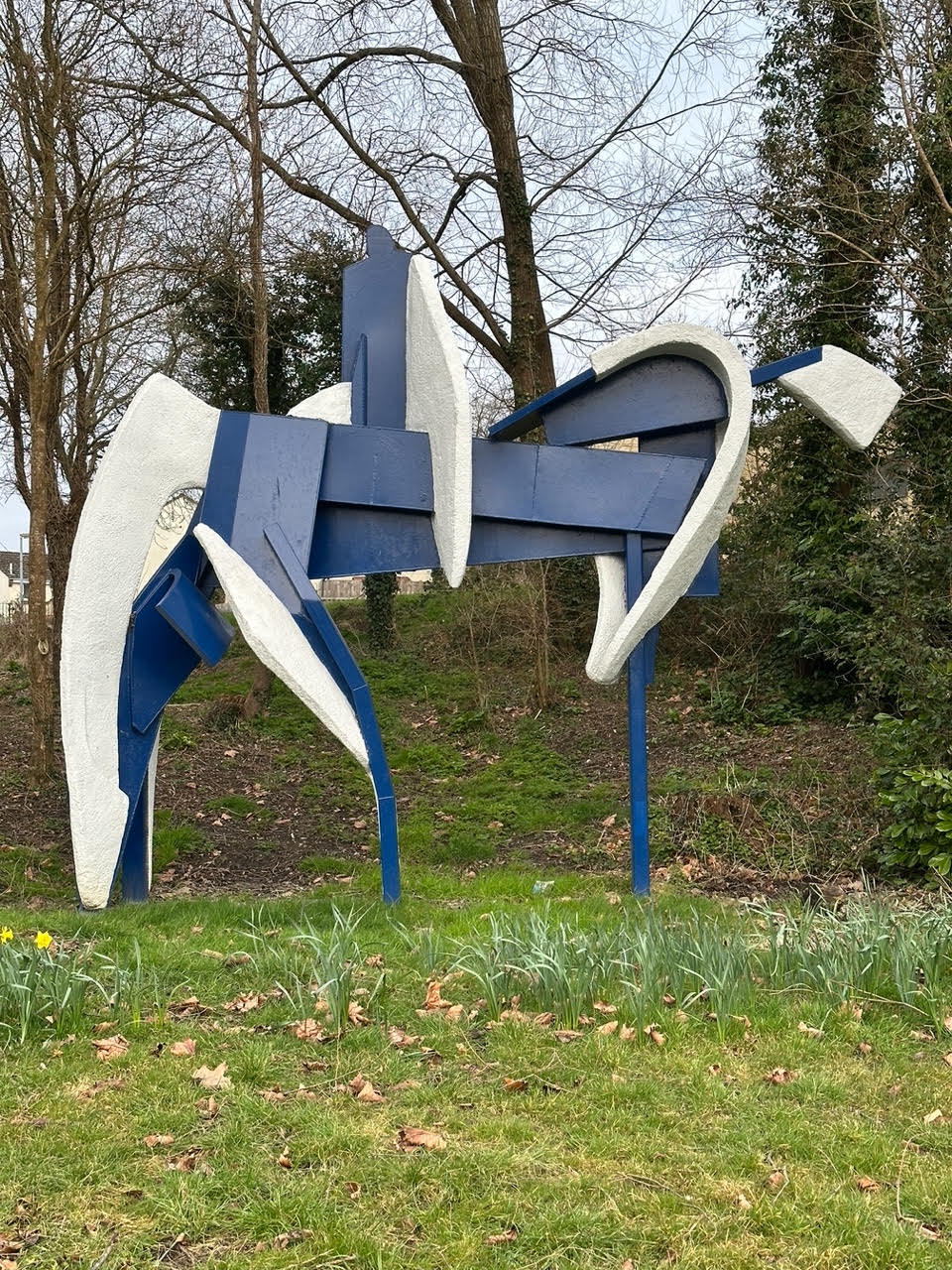
The Watchers
Another one in the collection that comprises the West Swindon sculpture walk that’s had some TLC is The Watchers in Toothill. It suffered some vandalism, so during Covid, the then administration coughed up some cash to get it restored.
Visiting these sculptures does make for a good walk – one you can do in a couple of hours or so. It’s largely flat – a bonus if you’re not inclined to inclines – and mud free. Plus, there’s play parks and pubs along the way offering opportunities for a sit down, refreshments or an all-important toilet stop.
Obvs I’ve written at length about all the sculptures scattered across West Swindon and in my guide book too. Find them all here: https://swindonian.me/category/artscultureheritage/west-swindon-sculpture-walk-artscultureheritage/
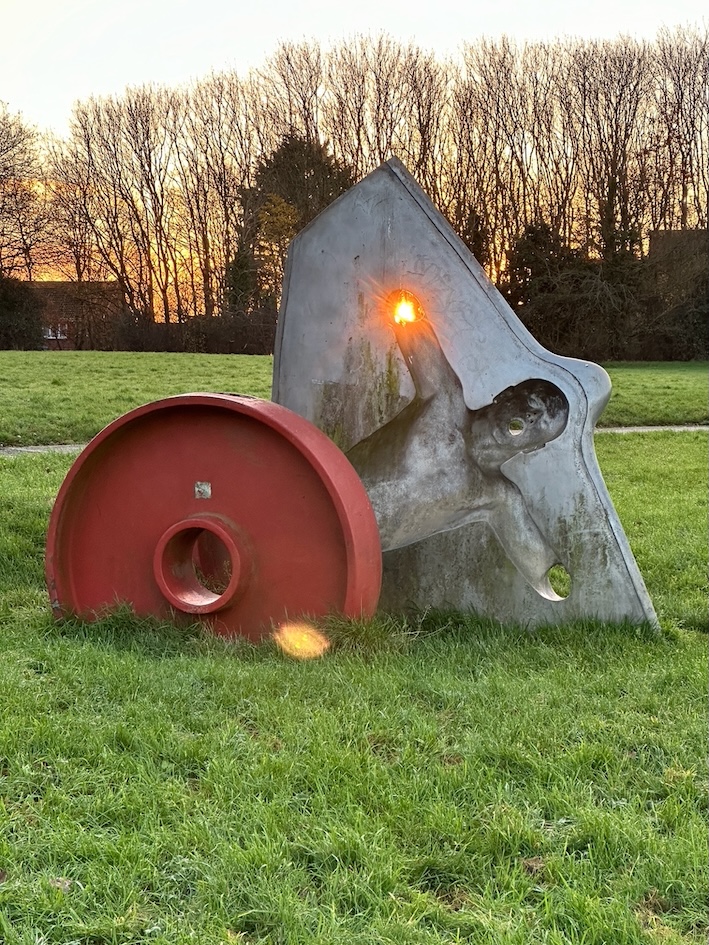
Artist: Tim Sandys-Renton
Cast aluminium and cast iron.
https://swindonian.me/2013/06/24/west-swindon-sculpture-walk-part-2-how-the-mighty-fall/
Photo courtesy of Roger Ogle
You’ll find this one up on Shaw Ridge. All my blog posts have a downloadable map.
2. The Blondinis
I can’t stress enough how much I miss The Blondinis that were once graced the town centre, on Wharf Green. I love this one.
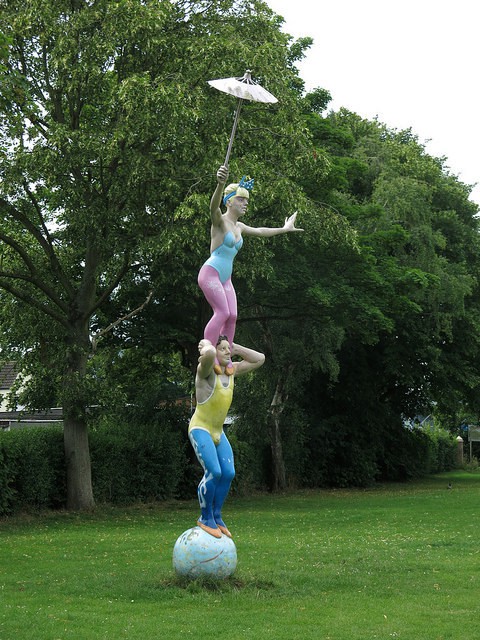
It’s now languishing, languishing I tell you, in St Mark’s park in Gorse Hill. It’s so joyous, this piece.
In 1987 John Clinch (also responsible for Diana Dors) created the sculpture using scraps of aluminium from Swindon’s railway works. Indeed, it’s the last thing ever cast in the Works in No 10 shop – cast in four sections and welded together. On the blog I have a photo, sent by a listener, of it being cast.
Made in association with British Rail craftsmen, the commission came just before the Swindon rail works closed.
Unlike several of the West Swindon sculptures this one has enjoyed better care. Swindon artist Tim Carroll has twice restored this piece. The first time he did it in 2010 in a council yard. And then he repeated the trick in 2017 at St Mark’s park. And yes, you’ve guessed it, I have a blog about the second restoration with a super set of photos showing Tim at work, that Gordon Dickinson let me have. Linda Kasmaty also has an interesting blog featuring the Blondinis and a link to a Barry Leighton article about Diana Dors and the Blondinis – which isn’t universally adored, it’s fair to say. Indeed: ‘Swindon Conservatives leader Mike Bawden fumed: “I wanted a sculpture showing three or four railwaymen at work, but we ended up with this.” Barry went on:
‘One day without warning it was carted off while the area was revamped minus our metallic troupe.’
Some eight years later, following Tim’s initial restoration, it popped up in St Mark’s Rec at Gorse Hill.
3. The Wish Hounds
I have a mantra: ‘If the Number 1 bus doesn’t go there then neither do I’. And it doesn’t go to the Wish Hounds. Thus, I don’t get to see them. If someone cares to pay them a visit and let me know how they’re doing, I’d appreciate that.
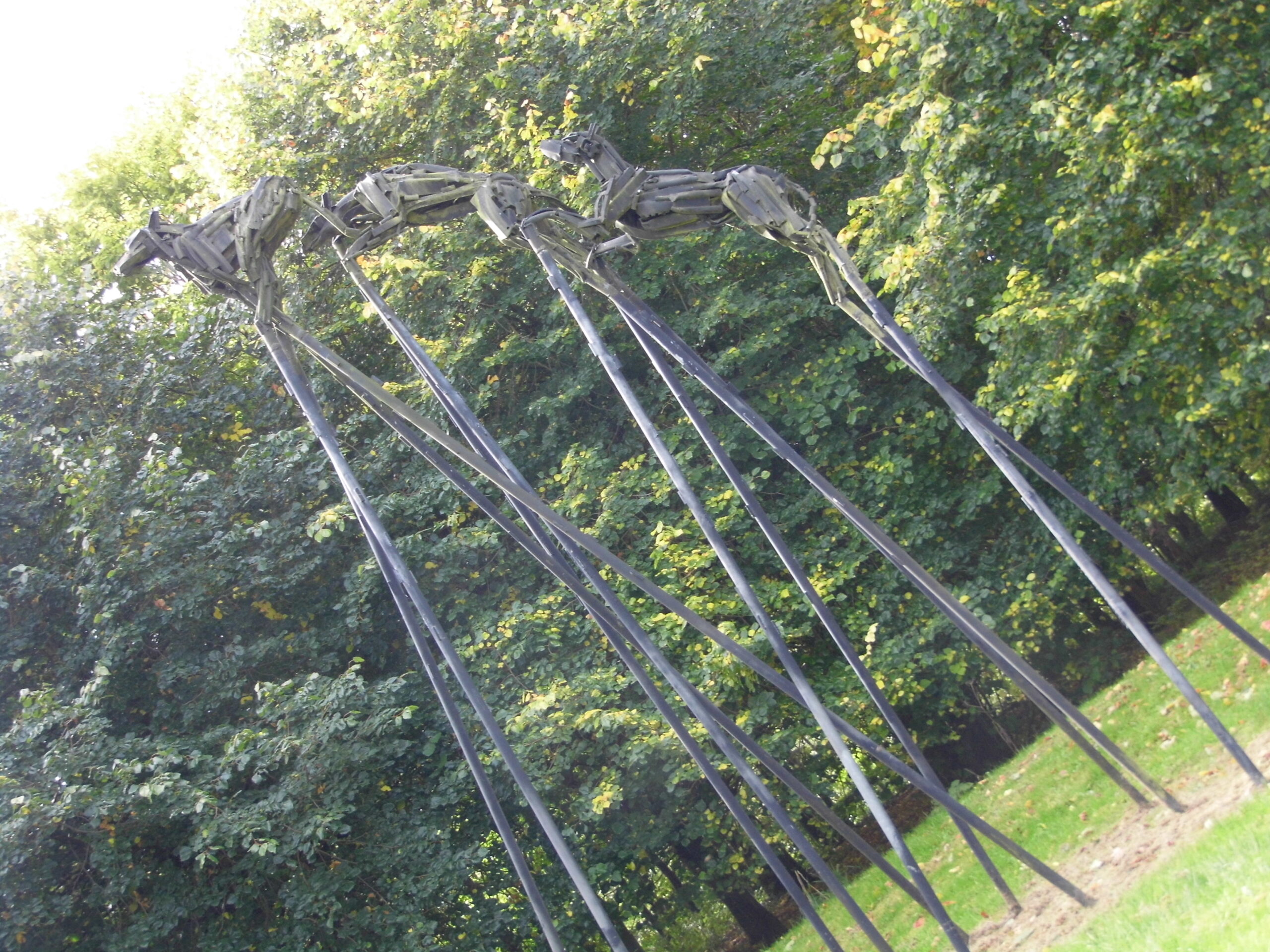
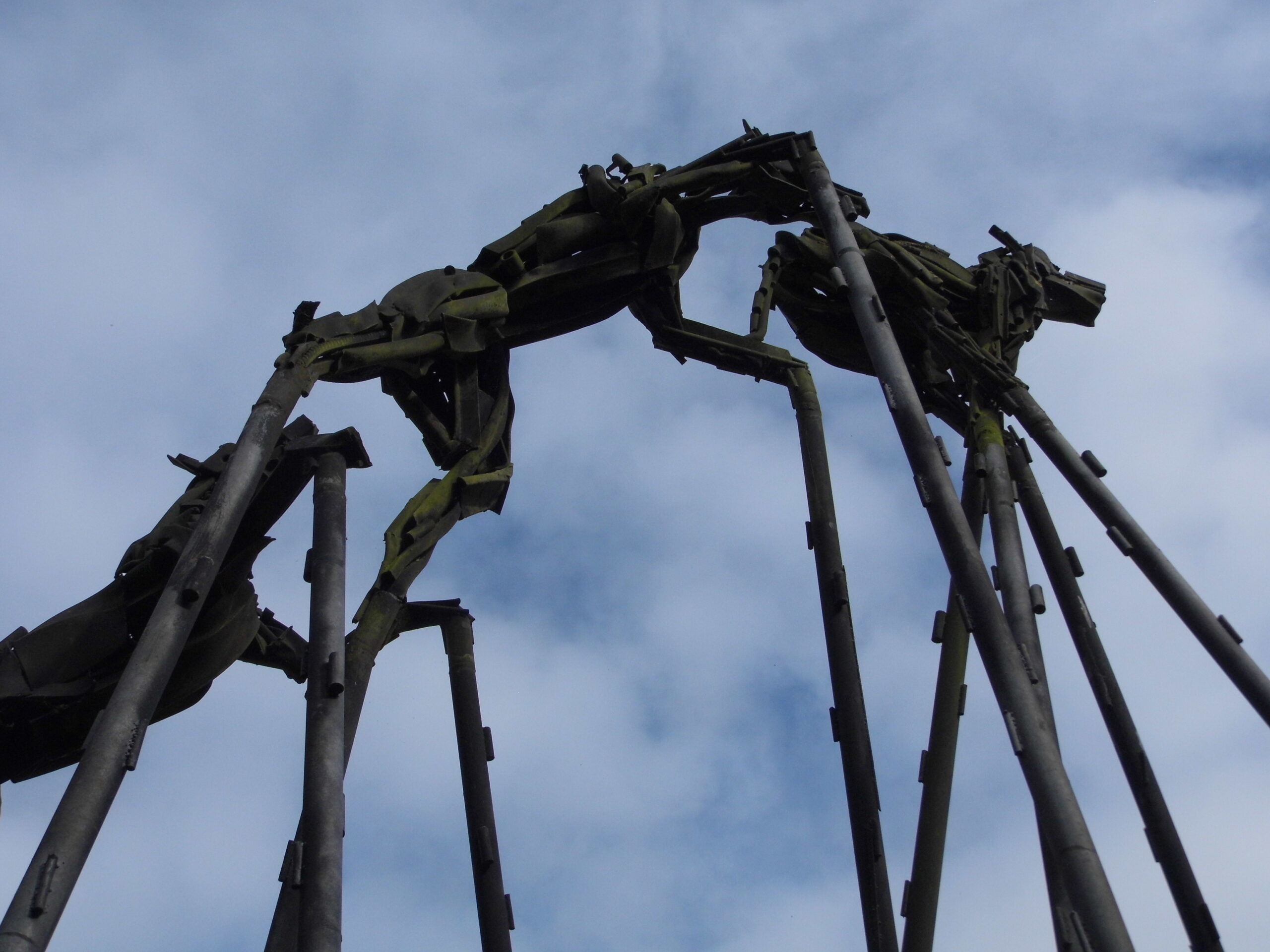
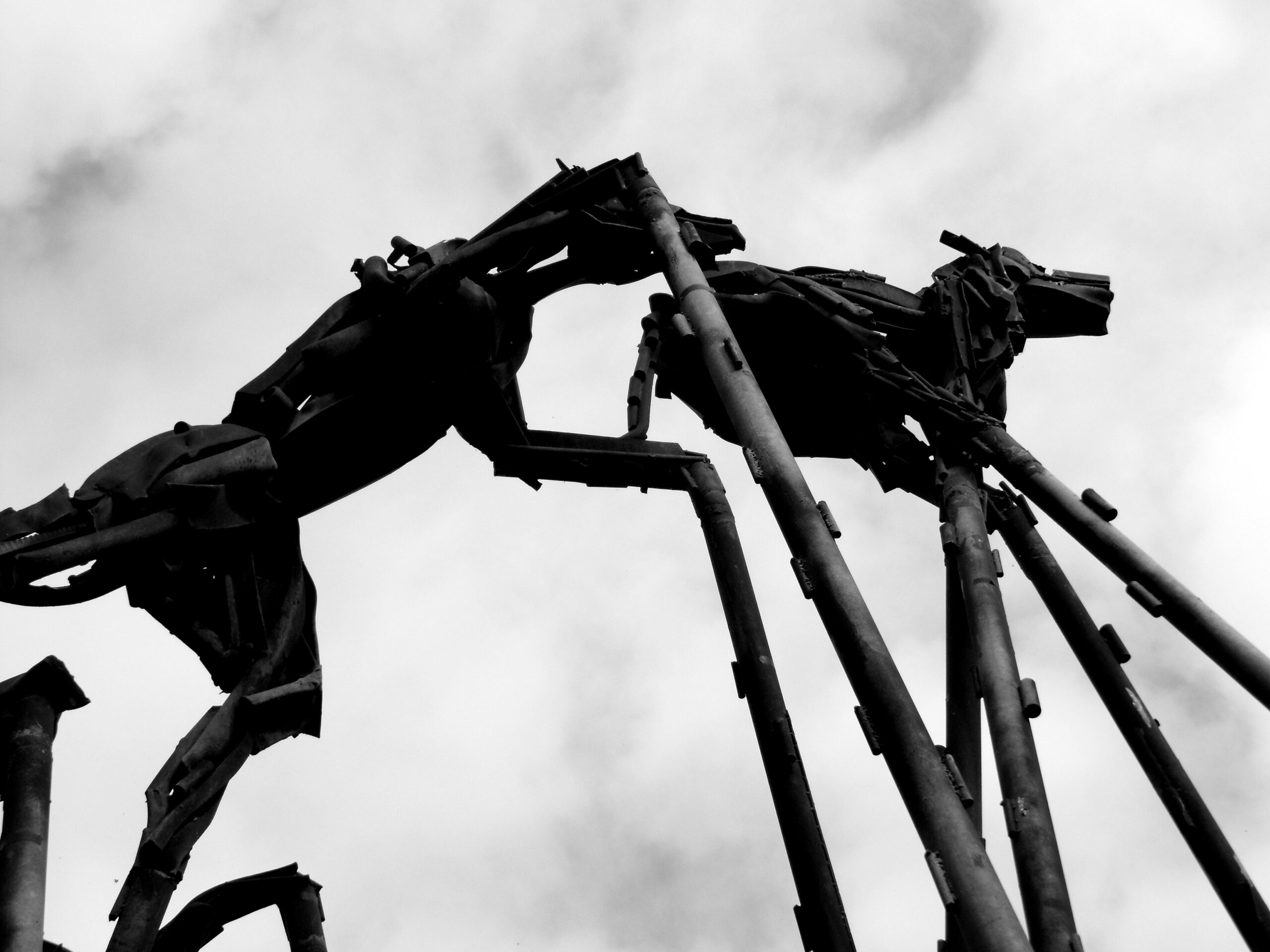
The Wish Hounds is a sculpture in three parts.
- Concrete cast lettering
- Powder coated scap metal and …
- … earthworks in a circle of trees.
They used to be floodlit but when I last saw them, eons ago now, that was all broken. A comment left on my 2015 blog post about this sculpture said:
‘If I remember correctly, the Wish Hounds are on their long legs because they were designed to appear above the tree line for drivers on the M4. They used to look magnificent, leaping over the trees.
But I’m not sure whether it was because of budgetary constraints or forgetting that trees grow but, they were gradually hidden by the ever-growing trees. It’s a shame. They used to provide a great introduction to Swindon art to drivers between J15 and J16.’
The hounds, created in 1994 by Lou Hamilton, have a menacing air about them. It doesn’t take much of a leap of imagination to hear them howling Baskerville-like in the dusk and making mere mortals quake. Perhaps dusk is a better time to see them, to feel their hot breath, see their jowls heavy with saliva…
See more on this one here:
The one that got away
To round this article off, for the craic, I thought I’d look at one that got away. . A sculpture that almost happened but didn’t.
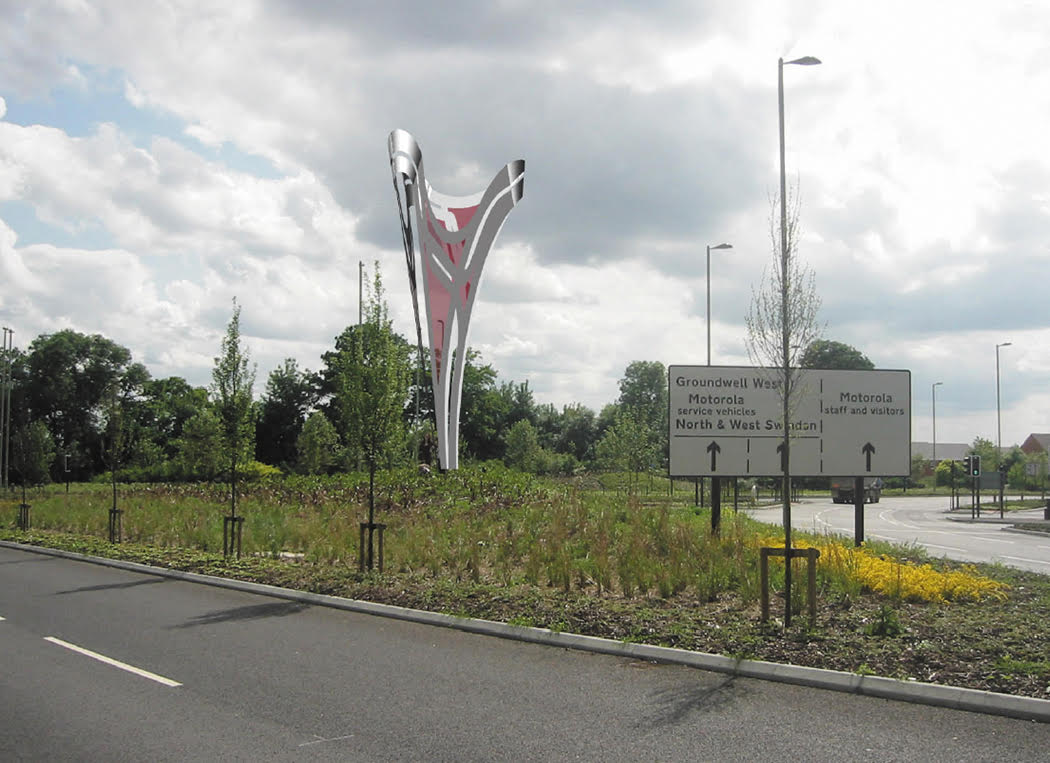
An extract from a 2003 Swindon Link article at the time this was being mooted:
‘A giant panorama of North Swindon taken from a balloon at the beginning of June with other aerial pictures of the area will be on display at the Haydon Centre and the North Swindon library.
Alongside will be an exhibition for a proposed sculpture to create a northern gateway to the town exclusively revealed in the August Link.
This will stand some forty feet high at Junction 1 on Thamesdown Drive, on the corner with Cricklade Road.
Funded entirely by the developers in the process of building the 5,500 houses at Priory Vale and commissioned by Swindon Borough Council within its Per Cent for Art Policy, the internally lit steel and aluminium structure will be a visually striking landmark as drivers come to or leave the town …’
Could this have been our Angel of the North? What do you think? A shame it didn’t come to fruition – or have we dodged a bullet?