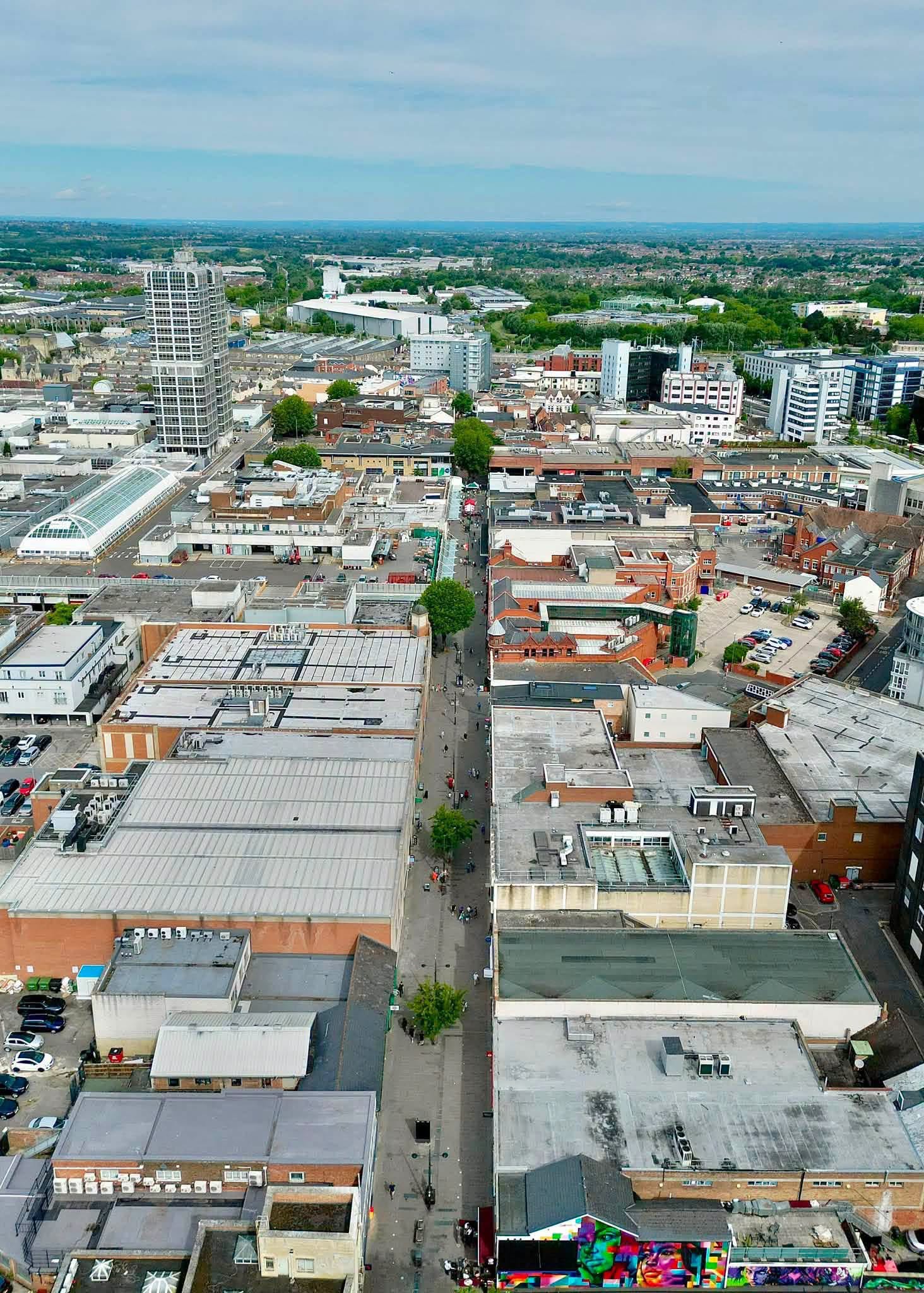
Regent Street Swindon – this is one that WILL NOT be going into Swindon in 25 Streets. As worthy as it might be it’s the old story of having to make difficult choices. All that said, it’s good to have it represented on the blog. So this post comes to you courtesy of Jason Spickett who runs the superb Swindon From the Air Facebook page. I’m indebted to him for letting me share it here.
I’ve edited it for SEO purposes – that aside it’s Jason’s research.
t’s a funny fact that, when locals say they are standing at the bottom of Swindon’s Regent Street, they’re actually standing at it’s northern most end. Because, when you look on a map the street actually runs northwest to southeast. But we can forgive the good people of Swindon for this as. And that’s because the street is on a gentle slopes downward from the southeast end at 113m above sea level to the northwest end at 108m above sea level. One day a question about this might come up in a pub quiz, and you’ll be thanking me.
To get to the history
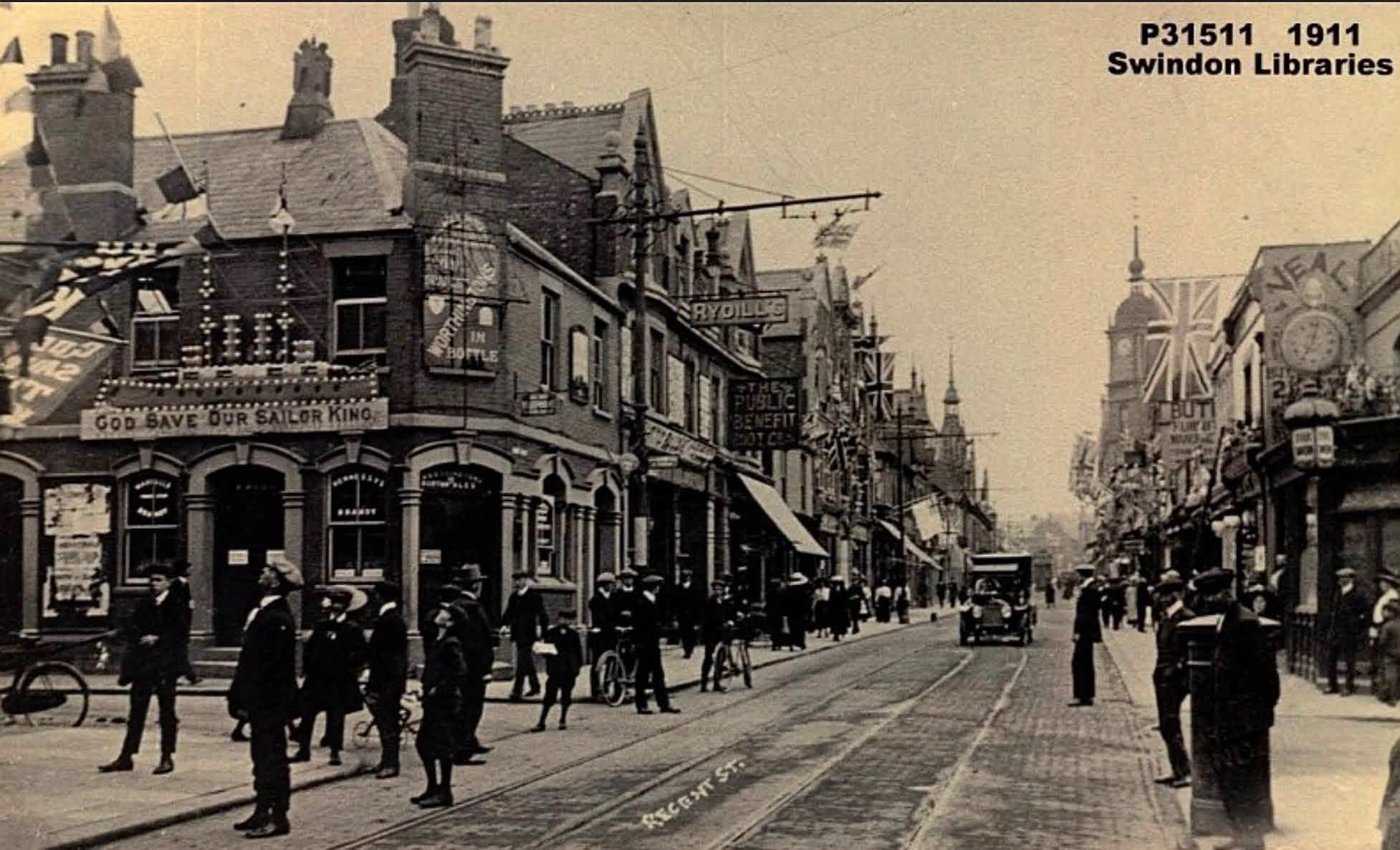
Now the historical bit. If you were standing at the lower end in an early 1800s winter you’d be questioning your choice of footwear. Because you’d be standing on a muddy track, surrounded, in the main, by fields.
If you were looking towards the Town Hall end of Regent Street you’d have your back to the Wilts & Berks Canal and a small wooden bridge, constructed in 1807, that crossed the canal into Bridge Street. Or would you? In fact – you wouldn’t! That’s because Bridge Street didn’t exist then, it was again a muddy field with a track called Bridge Lane. And although we know it today as Regent Street you were at the time standing on Brick Kiln Lane! And then to make matters worse there was a toll house that would have fleeced you for a few quid just to pass by.
As the years rolled by the area evolved and land was sold in 1848 to build a chapel – one of the street’s first permanent buildings. Workers cottages were built and the area renamed to Regent Street. (Named after the famous London street) – Or was it? It’s more likely that Regent Street takes its name from the Prince Regent aka Albert – hubby of Queen Victoria.
Then came the railway
The railway saw more people come to the area and some of the houses became shops. Regent Street became even busier when the GWR paid to build a new iron bridge over the canal in 1870. The famous Golden Lion Bridge.*
*Now the gospel according to Royston Cartwright says: yes the GWR built the Golden Lion Bridge. But public donations paid for it after the old wooden one became unsafe to cross with a horse and cart. It appears that most of the money came from business men in Old Town who were desperate to get a shop opened in the new town as that’s where the money was. And we’ve seen that from my piece about Emlyn Square when Old Town business opened branches on what was then called High Street.
Going from strength to strength
Anyway! Regent Street went from strength to strength. And more salubrious, larger shops came to the area such as Mcllroy’s. That opened in 1875 as a drapers shop but at length became a large department store that traded for many years.
As the years passed, the trackway became a road. Horses, carts and carriages were in use and in 1904 shared the street with the latest in technological advancements: the electric tramway. Regent Street was quite narrow, so the tramway’s design bore that in mind and it became the narrowest in the UK with a 42 inch gauge.
Skip forward to September 1911 and Marks & Spencer began trading at 90 Regent Street. And in 1914 Woolworths opened their doors at 23-25 Regent Street.
1967 saw Swindon become only the third town in the UK to have a vehicle free pedestrianised main shopping street as Regent Street closed on Saturdays but only for 8 hours a day. In 1973 it became a seven-day-a-week pedestrian zone and closed to all traffic.
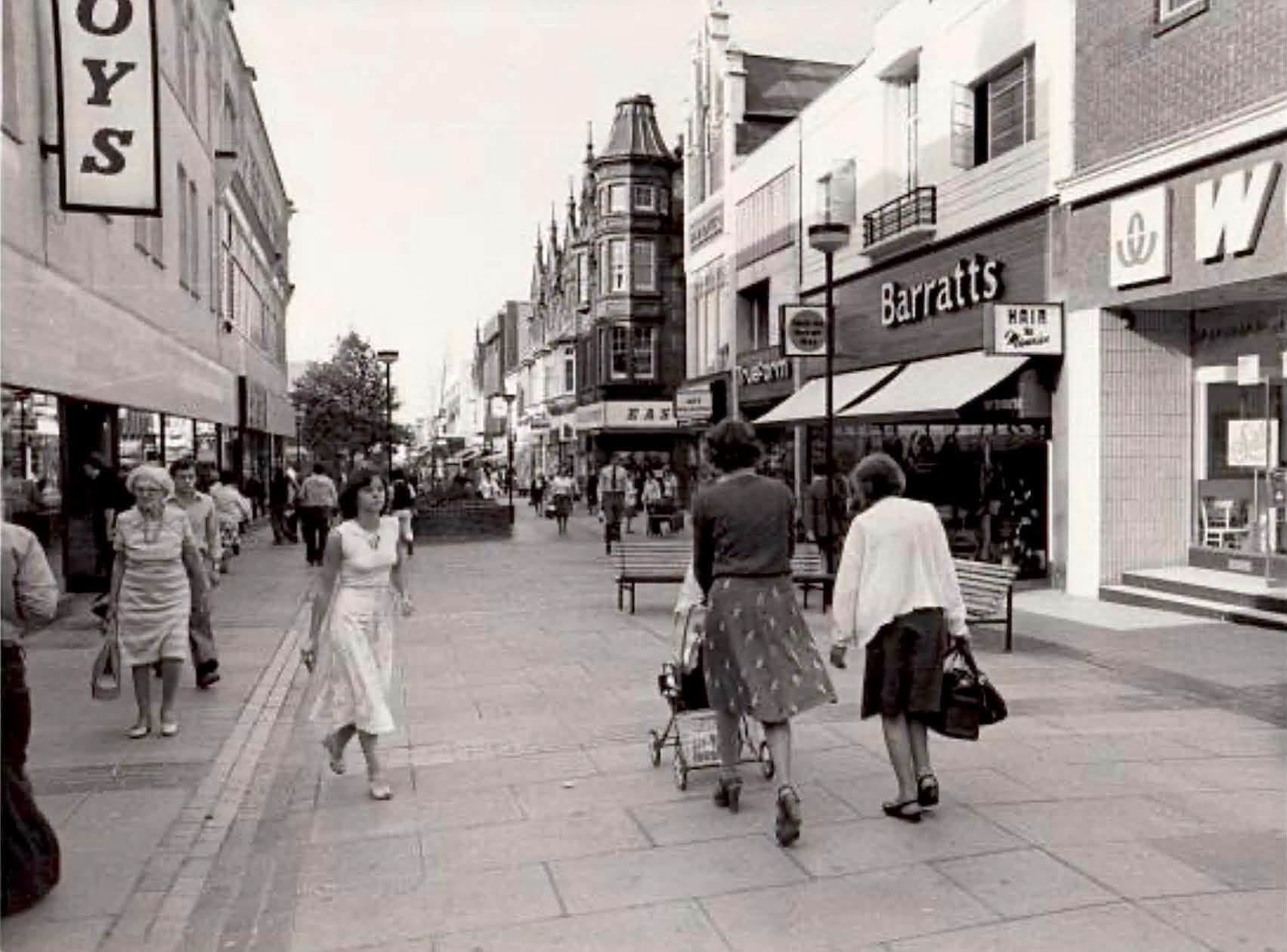
Over the following years Regent Street became the go to place for shopping in and around the town. More shops opened in the neighbouring streets as the old cottages fell to the wrecking ball for what was then the height of modern retailing in the UK.
I’m not going to get into the politics of the town centre as it stands today, other than to say that pretty much all the big names have gone. But then they’ve gone from everywhere.
The last word
Comes from Royston:
Many people do not realise just how high Swindon is. So think on this for a moment or two, the platform on Swindon Station is the same height above sea level as the top of the roof of St Paul’s in London. then walk up the hill to Old Town. And then Walk up Liddington Hill and you will see why we had so much trouble taking the motorway over one of the highest roads in England. I think I am right in saying only Shap is higher.