
Swindon Artist Leslie Cole.
I don’t use Twitter (it’s still Twitter to me) much these days – it’s all rather grim. But there’s a couple of local folk I follow on there so I pop on from time to time to engage with them. In a recent chat with them, the topic of Swindon in 50 Artists arose. I posited that, were one to write such a thing (and no I’m not), the challenge would lie not finding 50 artists, but in stopping at 50. One member of the conversation disputed that there’d be so many. So, in the space of three tweets, and off the top of my head, I came up with close to twenty-five. My point was made.
I’m not going to list all 25, fear not. But I will give you, and these are in no particular order, your starter for 10. They are:
- Tim Carroll
- Ken White
- Harold Dearden – deceased
- Frank Quinton – deceased
- David Bent
- Leslie Cole – deceased
- Peter Waldron – deceased
- Henry Orlik
- John Webb – deceased
- Caroline Day
But it’s Leslie Cole I want to focus on here, being as how Museum and Art Swindon currently have on a Leslie Cole exhibition: Leslie Cole: Recording Conflict. Find out more about it here – but better still go and see it.
First – an observation
Before I get on with talking about Cole, an observation. Over the years, Swindon art college has been a darn good breeding ground of successful artistic talent. Through its doors have passed, that I know of, Peter Waldron (Swindon-born, 1941), Ken White, Leslie Cole and Henry Orlik. I mean, one world-class artist passing through would be quite something. But four? That’s surely quite something else entirely?
Now, I can’t comment on the merits or otherwise of the current art departments. But it’s safe to say there once was a time when Swindon’s school of art had scale in its ambition. And out of that ambition came the artists mentioned here. Amongst many I daresay.
Anyway! Back to R Leslie.
Leslie Cole and his war artistry
There’s a reason for MAS naming the exhibition Leslie Cole: Recording Conflict. While other artists used the war as their subject matter, Cole (born 1910) became an official war artist. One of only thirty in the country, this is something to celebrate I feel.
From Swindon art college, Cole progressed to London’s Royal College of Art gaining a diploma in mural decoration, fabric printing and lithography before going into teaching art at Hull’s art college in 1937. Then, in 1939, came the Second World War.
With the outbreak of war, Sir Kenneth Clark, then director of Great Britain’s National Gallery, launched a scheme to get the nation’s artists involved in the war effort. The War Artist’s Advisory Committee (WAAC) resulted and started recruiting. In 1940 a willing and able Cole applied, without success, for enlistment. So, instead, he followed fellow students into the RAF, though the start of the war saw him discharged on health grounds.
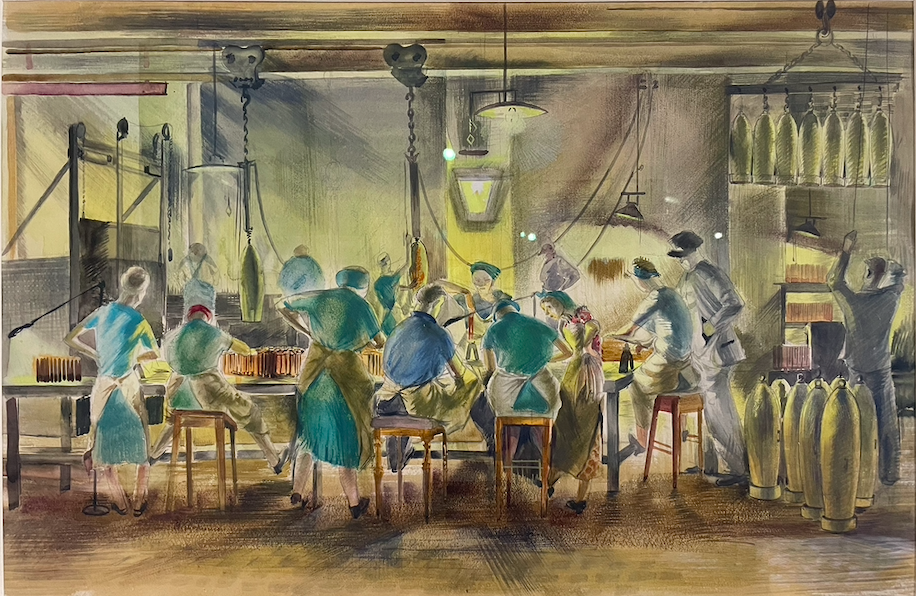
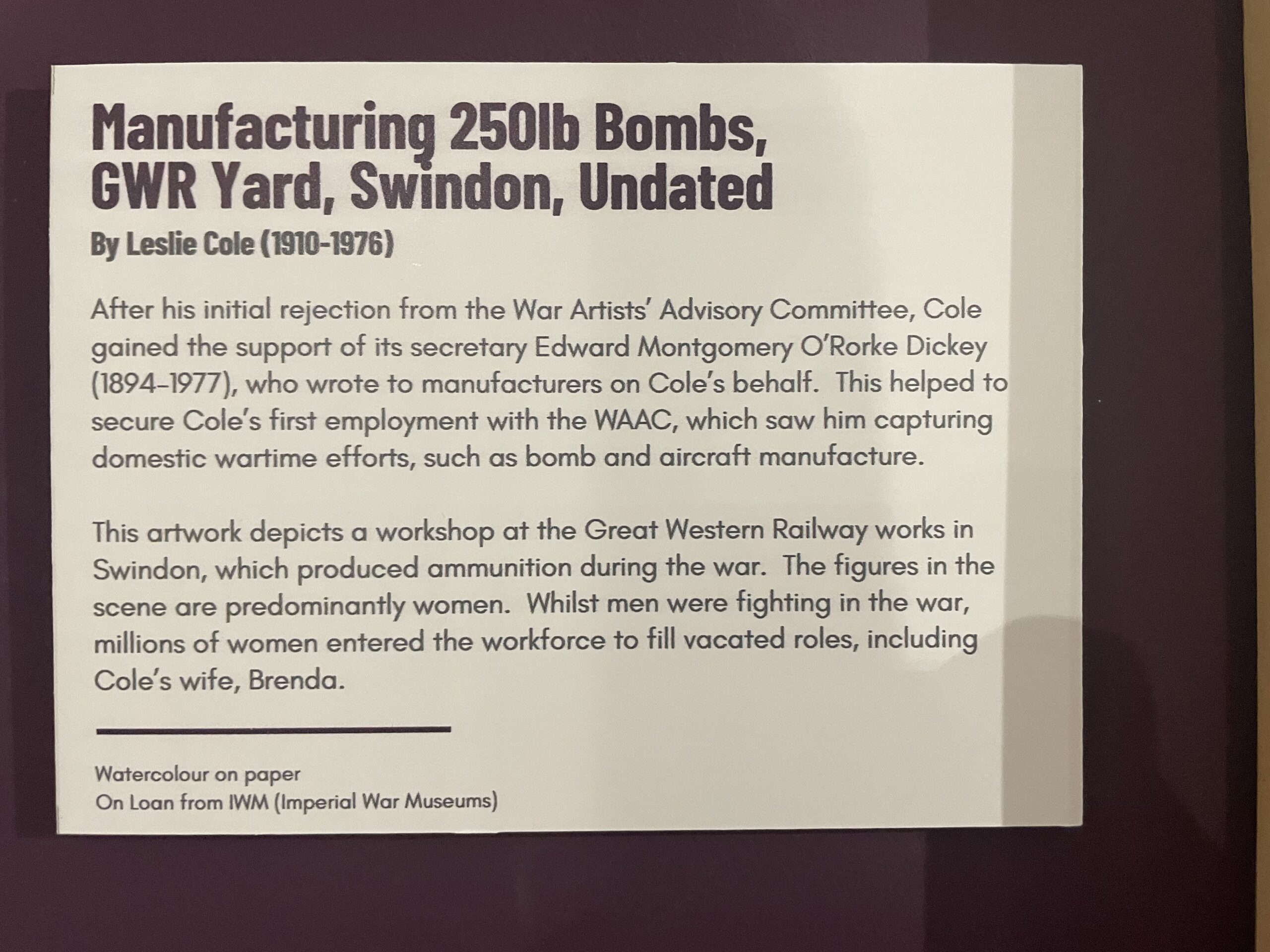
Yet the RAF’s loss became the art world’s gain. Cole now made a second attempt to become a war artist. This time the examples he submitted of his figurative lithographs, reflecting both Swindon and Hull’s war situations found favour with the committee. The work he sent to them included a 1941 painting showing a team assembling a landing craft – the setting for which must have been the Swindon Works? He also painted women working on aircraft wings – most likely at a factory in the Swindon area. It’s interesting to observe that Cole’s pre-war paintings and drawings featured railway workers in Swindon – one of which is a lithograph of furnace workers in 1939.
Recognition
With his talents now recognised, he gained acceptance as a salaried worker with the commissioned rank of Captain (honorary) in the Royal Marines. He obtained permission to record the war effort at home and the damage Britain sustained from enemy action.
In his determination to witness the events of WWII and to use his paintings to record them, Cole covered the theatres of war.
Cole’s first posting was to Malta. Here he recorded the island’s siege coming to an end. He covered too, the Allie’s invasion of Italy, fighting in Greece, the defence of Gibraltar and, following D-Day in 1944, the Normandy offensive. Later he visited Burma and Singapore.
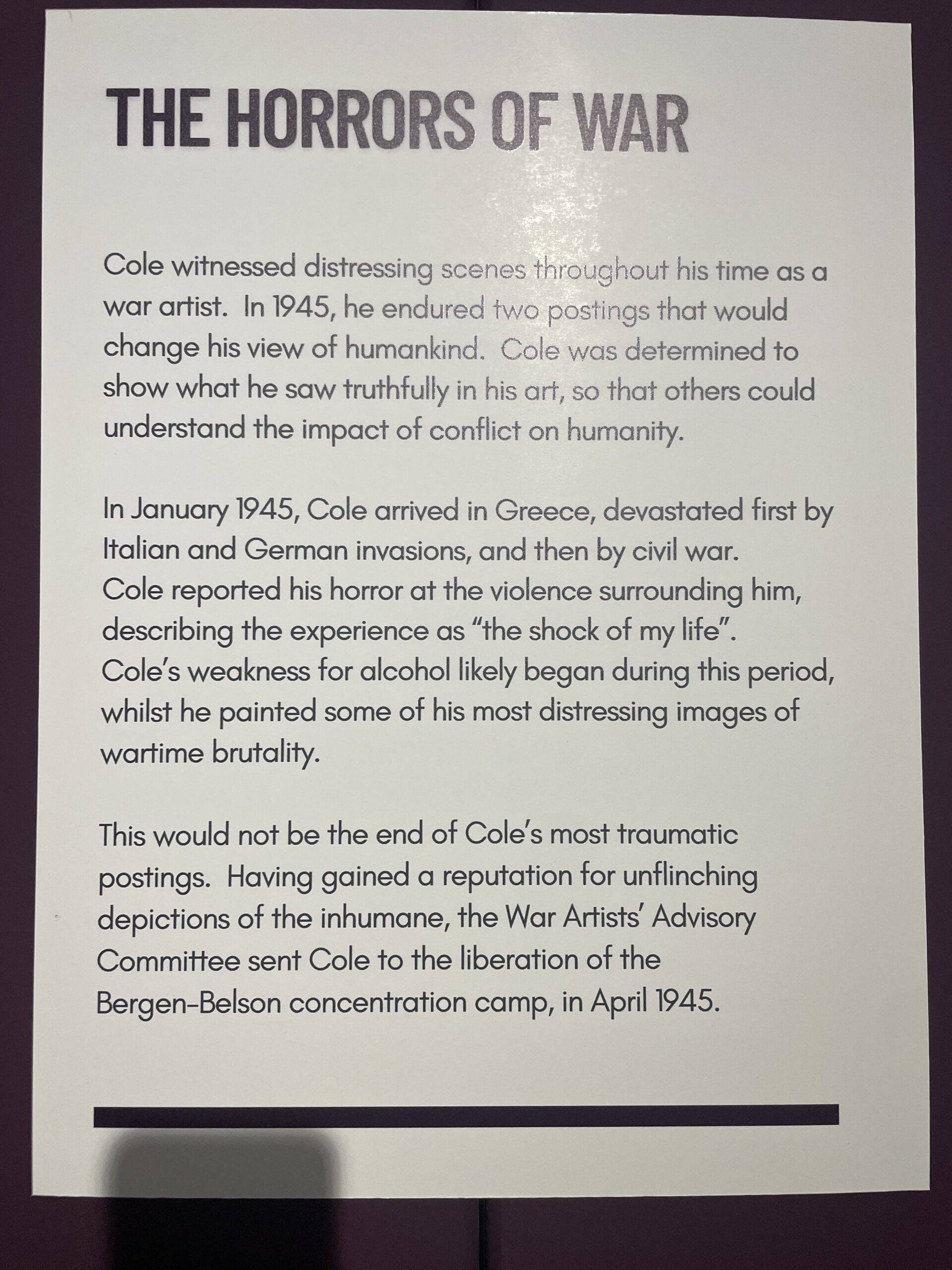
Credited with an unflinching approach* to his subject matter, Cole became one of four official artists selected to attend the first liberation of a major Nazi concentration camp. The images he produced are explicit and chilling. He captured in every detail the hellish conditions he saw – including the deaths of those for whom the Allied liberation was a fraction too late.
A second commission with the Royal Marines command in Cairo came in 1944 followed by a transfer to the War Office.
Post war, Cole continued painting and teaching – though there’s some evidence to suggest that he struggled with his wartime experiences. A struggle that led him to drink heavily leading to a slow decline and an early death in 1976 aged only sixty-six. Yet, during the 1950s he produced some brilliant work and two paintings from that era, both showing pub scenes turned up on the Antiques Roadshow when it visited Bodnant Garden, North Wales.
*Visit the exhibition at MAS and you’ll see eyeball-searing examples of his unflinching approach.
Where to find Cole’s works
The Swindon collection holds – not necessarily a comprehensive list:
- Leslie Cole: A self-portrait
- Mary: Young girl with a doll – one my faves is this one
- Seated figure – the artist’s wife, Brenda Cole
- Boy with a bird
- Blind Woman
- Shove half-penny
London’s Imperial War museum holds twenty-five of his works, many of them painted during his Maltese sojurn. There’s a further seventy in private collections and five are in the government art collection. Further, the National Maritime Museum in Greenwich holds three and there’s one at the British Council.
The alternative history of Leslie Cole
Now we come to something that has nothing to do with Cole’s art and everything to do with salacious gossip – and who doesn’t enjoy a bit of that? It’s the somewhat surprising story of Leslie Cole’s marriage.
Some years before Cole married his bride in August 1938, she was the star witness in a sex scandal in which one Harold Davidson, the Rector of Stiffkey (apt place name), a sleepy Norfolk coastal village, stood accused of immorality. The Bishop of Norfolk accused him of liaison with prostitutes in London’s Soho – behaviour for which he was found guilty and subsequently defrocked.
Brenda Harvey – real name Barbara Price – instigated the trial by sending the Bishop a fourteen-page letter full of ‘helpful’ detail. She gave evidence for three days then quietly disappeared – to resurface as Brenda Harvey when she met and married our man Cole.
As for the transgressing rector, he came to a suitably sticky end. Sounding like a stanza from Stanley Holloway’s The Lion and Albert, the poor unfortunate suffered a fatal mauling by a lion in a Skegness fairground.




I lived in Swindon from birth until we moved with my job in 1979. This article makes me realize how little I know about the town of my birth. I had heard of Ken White but none of the others.
Fascinating. Thank you
David – thank you for your message. I appreciate that.
As for Swindon – it’s ever surprising and interesting. Thus I began this blog about a decade ago now. And have thus far published 5 books telling aspects of Swindon’s story – No 6 coming soon!
In fact, it was when I was writing the first one, Secret Swindon, that Leslie Cole came onto my radar. So did some hasty rejigging to make space to say something about him in that book.
David – if you didn’t find it – Harold Dearden is worth knowing about: https://swindonian.me/2024/12/05/harold-dearden-unsung-swindon-son/
I was working in Swindon at the Civic Hall last Wednesday and had the opportunity to see this exhibition. It’s shows such a variety of Cole’s work, it’s easy to see what an impact the war had on his work. I highly recommend people visit if they get the chance.
It’s lovely to red this and find out just a little more about Cole’s life.
Thank you for engaging Barbara. It’s always lovely to get a positive comment.
I’m glad you enjoyed the exhibition.
Kind regards
Angela