
Ferndale Road Swindon. Okay, I know, doesn’t sound too exciting a topic eh? But stay with me – it’s more interesting than it sounds. Honest!
Welcome to Swindon in 25 Streets.
The reason for my interest in this long, long street is this: I’ve got a contract with Amberley Publishing to produce Swindon in 25 Streets by the back end of next year. So yesterday myself and my chum Chris Eley, having been given the nod that this eponymous street could be a candidate for inclusion, went there for a bimble.
Much as I did with the Swindon in 50 More Buildings project, I’ll use the blog as a repository for research and then, later, pull it together into a book.

The long and not very winding road
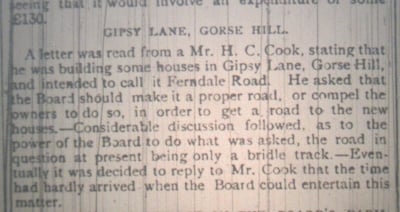
It’s arguable that the story of Ferndale Road – as Ferndale Road rather than its earlier name of Gypsy Lane – began with Welsh steel men recruited to build and run the new rolling mill that made railway lines – it being the one job that the Swindon Works couldn’t, at the time, do for itself. At first, they found accommodation in the barracks in the railway village. At length they got new houses near the railway village – a settlement they called Cambria Place – Cambria being the Roman name for Wales.
As the men received promotion and better pay they moved further away from the smoke and grime of the railway village to a new street. I’ve heard it said they named the road Ferndale after the Rhonnda Valley village from which most of them came. But is that correct?
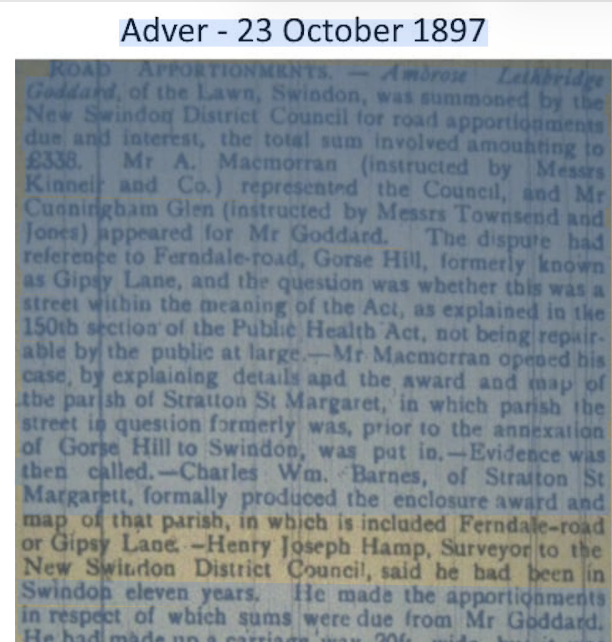
On the 23rd October 1897, the Swindon Advertiser carried an article entitled Road Apportionments. The editorial reports that one Ambrose Lethbridge Goddard had received a summons from the New Swindon District Council for road apportionments due with interest to the tune of £338. The dispute had reference to Ferndale Road, Gorse Hill – the erstwhile Gypsy Lane.
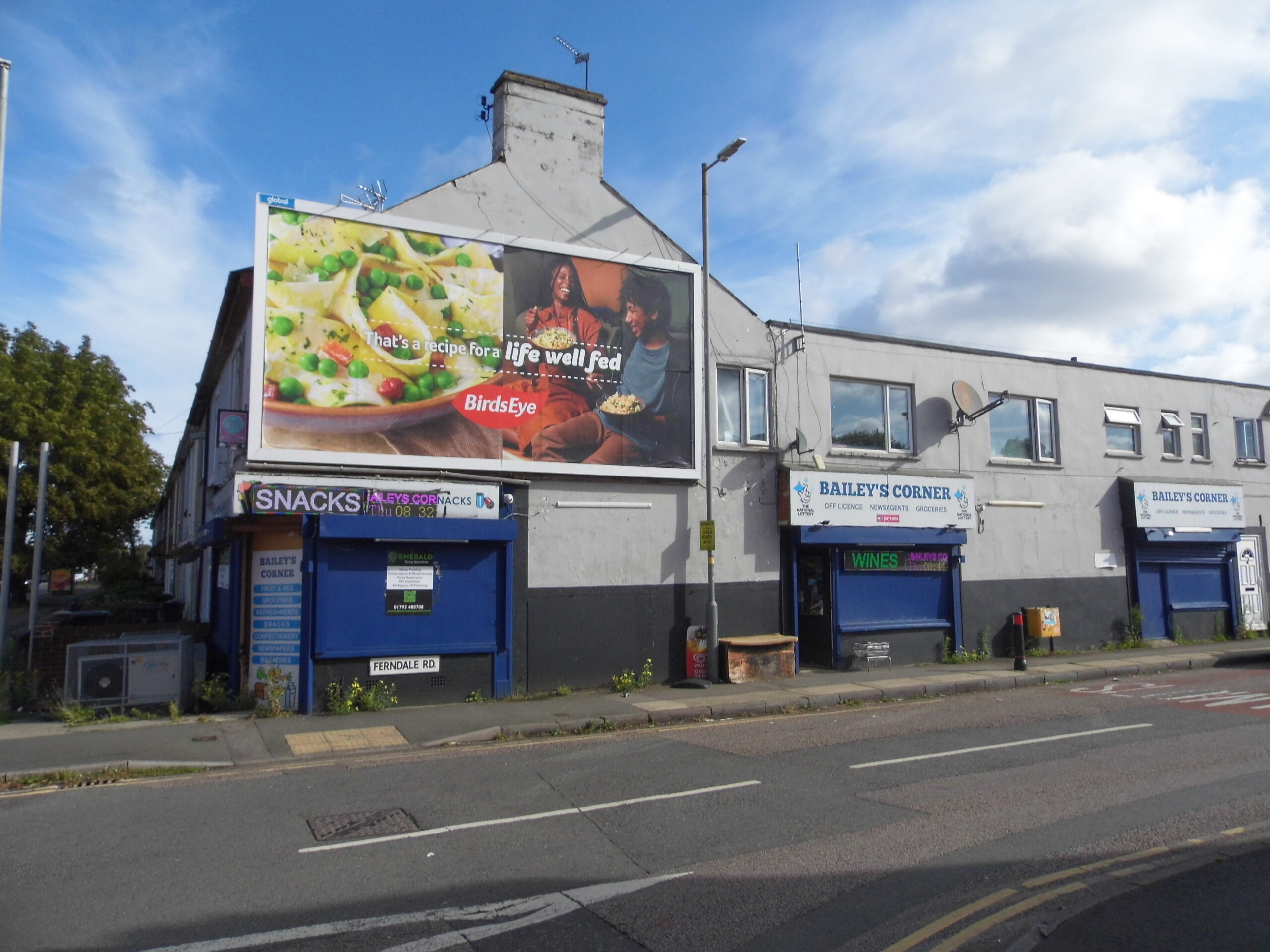
In Victorian times, the road was far shorter than it is now. That changed in 1902 when one Edwin Bradley, a building contractor, began building houses along the road. Now I’m assuming that Bradley’s Corner – see image below – takes its name from this man who built so much of the street. Local Studies informs me that Edwin’s brother, listed on the 1911 census, lived on Ferndale Road. He had a builder’s yard out the back and his wife, Ellen, ran a draper’s shop.
Today this long and not very winding road, (there are a few little wiggles) connects Gorse Hill at one end with Cheney Manor at the other. It’s a very, very, very long (around 630 houses) street comprised largely of unbroken runs of terraced housing. Before the building of the Great Western Way, Ferndale Road served as the key east to west road, covering the width of the GWR Works.

On the topic of corners, on the Cheney Manor end of Ferndale Road is Bailey’s Corner. Taking its name from the shop, this fronts onto Cheney Manor Road. The Local Studies photograph shows Alfred Bailey’s shop in 1934. The location became synonymous with the Bailey’s name. Thus, although Alfred Bailey is long gone his name lives on.


School Days
Ferndale Road boasts a lovely and-still-in-use school building dating back to 1907. At first built as separate infant and junior schools, the expansion of Swindon north of the railway line, necessitated a large site on the road in 1905. The new infant school opened in 1907 and in 1946 the complex underwent reorganisation into separate junior and secondary schools.
In 1999 the school began to share its site with Oxford Brookes University who offer the chance to study for an adult nursing degree.

Then came WWII
It’s something of a mystery how the GWR Works managed to escape obliteration by Nazi bombs. Could it be possible that it was luck? Or might it have been that the Works comprised a factory that Germany wanted to save for when they occupied Britain – which they expected to do? Ergo, despite it being a strategic target, Hitler saved it.
It’s a not unreasonable theory – given that Germany razed Coventry and Sheffield to such devastating effect. But it’s perhaps more likely that the Swindon Works blackout saved it. Following the 1941 defeat of the Luftwaffe, Germany changed tactics and moved from daytime bombing to night time bombing. They’d have found it difficult to follow train lines from 20,000 feet and to spot the Works in the dark.
Whatever the ins and outs of all that, August 17th, 1942, brought the worst bombing that the town experienced. Two separate incidents killed between them, ten people in Kembrey Street and nineteen on Ferndale Road. Four people died at 475 Ferndale Road. And there were also deaths at numbers 257, 386, 465, 467, 469 and 471.
In total, twenty-five people died on Ferndale Road at the hands of enemy bombs.
With this knowledge in mind, walk up and down Ferndale Road and it’s not hard to spot where the bombs hit. Because you’ll come across a set of houses that stand out like the proverbial sore thumb. They’re obviously more modern and built in a totally different style.

Other points of interest
Tucked away, on the left-hand side, as you walk in the direction of Gorse Hill, you’ll see the Edward’s fairground yard. Now there’s a whole long story in itself there. So I’ll stick to mentioning that, in 1933, Robert Edwards & Sons, showmen of Swindon, acquired the latest thing in Fairground roundabouts. This being an all-electric Noah’s Ark ride to travel with their Victorian, steam-powered galloping horse roundabout. There’s a long story about the fate of Edward’s gallopers that you’ll find here: https://www.fairground-heritage.org.uk/exhibits/edwards-gallopers/
On the opposite side of the road from the fairground yard is the old Ferndale Road Club. It’s been closed for some years now but the building and the stone sign on its frontage remain. Anecdotally, there were a pair of houses built from steel – now long gone – next door to the club.


The rather lovely-looking facade on the right-hand image once was a branch of the New Swindon Industrial Co-operative Society Ltd – and, although the lettering is gone you can still pick out that name.
It continued as the Oxford and Swindon Co-operative Society Ltd until c.1980. Then, c.1984, became the cycling centre. It’s likely that the launderette dates from around that time too.
A notable name associated with Ferndale
A Swindon Advertiser piece about the area tells of a Swindon Town football star by the name of George Hunt. He began his playing as an amateur for Ferndale Athletic before signing for STFC in 1947.
Hunt made his first senior appearance against Exeter in September 1948. He played for the town for over eleven years, making an impressive 328 appearances – including twenty-four cup matches. The player retired in 1958 and as a qualified coach assisted the club’s back room staff. He also returned to work at the GWR Locomotive Works. Sadly he contracted Mesotheliona – also known as ‘The Swindon Disease’ and that led to his death in 1987.
A bit about the Ferndale area
Ferndale then, is a residential area of Swindon, about a mile from the town centre. It is home to one of (the???) Swindon’s oldest pubs, the Southbrook. The erstwhile Grade II listed Southbrook farmhouse-turned-public house lies tucked away in a corner of Ferndale on Southbrook Street. It once was the only building in the area but the 1908 expansion of Swindon brought it, and the land surrounding it.
The area took the name Ferndale post the building of Ferndale Road.
See also – in the vicinity:



Welsh workers brought iron forging skills with them from the Welsh valleys of South Wales , notably from Ferndale .. and the housing for these workers in the long road provided for its name of Ferndale Road.
Annie
Thanks for that – that’s super interesting. I’m sure there’s more I can learn about this street for when I start work on the book properly.
Think it was Arthur Bailey before he sold to the Hollick family, then Dave Tapliss took it on in the 1970s.. also the pic you showed was Gordon (Dilly) Hiils chemist, who was a noted amateur football referee into his late 50’s .. l could literally write a book on the history and characters of Ferndale Road PeggyGoddard, George Watt, Eric Frampton , George Hunt and Brian, Sammy Venton, Ray Steer, Charlie Hunt, Mrs Bradfield, Bill Pinnell, all business owners in the street ..
John – thanks for all this.
So – I’ve got muddled up with the corners have I? Thanks for the clarification.
I mention George Hunt in the blog post. But when I come to the book, it sounds like I should mention the football referee.
The Welsh steel men were recruited to build and run the new Rolling Mill that made railway lines, it was the only job the Swindon works could not do at the time they were housed in the Barracks on Faringdon road but it was auful there so they built new houses for them and called it Cambria Place cambria being the Roman name for Wales, as the men got promoted and got better pay they moved futher away from the smoke and the grim and named the road they had built Ferndale after the village in the Rhonnda Valley where most of them came from, one house in that road is still called the Ferns and I believe it is a retirement home now. you may like to make a note of my new email address
Hi Royston
Thanks for all that. Most of it I knew but I didn’t know the Welsh contingent later moved to Ferndale. That’s so interesting.
Will DM you ref your new email.
Cheers Roy.
pm me on faceook for my new email address
Please don’t forget to mention S Barnabas church, at the Gorse Hill crossroads. Lots of interesting activities there.
Mary – I did write about St Barnabas in Swindon in 50 Buildings. This has to be about this street – not the area. But I agree that St Barnabas with its paintings is fabulous.
Hills chemist was on Bradley’s corner. Pinell’s shop (also Bradley’s corner) sold oil for heaters- I remember that smell very well.
The “scrapyard” you show is the home of a fun fair family dating back many years. Opposite there is what was Ferndale Working Men’s Club. Next door I can remember two houses built from steel (no longer there).
Hi Pauline
Yes, since writing this post I’ve learned that the scrapyard is actually the home of Edwards funfairs. I’m going to have to update the post. 🙂
Thanks for commenting.