So. My first book, Secret Swindon, had a gorgeous launch event at Swindon central library on the 28th July. I’ve been meaning to post about it since then but stuff got in the way. Namely some security stuff being done on the blog which was affecting access. So I figured I’d hold on until that was done. And now the lovely Linda Kasmaty has beaten me to it with her super blog on Gardens, Galleries and Walking Around. So I reckon I might as well share that, a few photos and one or two rather lovely reviews and job done.
First up is Linda’s lovely blog post here. She has thoughtfully included a photo of me having a sip of wine so now you’ve all got exactly the right impression of me!
Now for a few photographs:
Secret Swindon in the library shop – Secret Swindon Book Launch
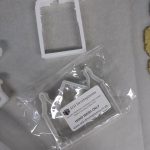
Cutters made by SED developments
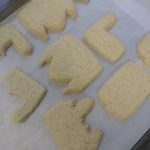
biscuits on baking tray
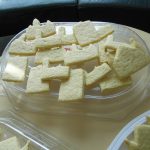
Swindon biscuits
Me, Sam Whittingham and Kris Allen
Me with Mariadele Boccardi – UWE
David Bent, Chris Barry and Pradeep Bhadwari
The Swindon-building shaped biscuits were super scrummy. Baked by Sam Whittingham with cutters created by SED Developments. The cutters are on sale in the library shop in the central library. You can choose from: the Locarno, the town hall, the Mechanics’ Institution and the David Murray John Tower.
‘ … Angela’s style is witty, snappy and easy to read, weaving information with a conversational tone reminiscent of her origins as a successful blogger.
The content is a lovely mix of old and new on a multitude of topics that goes to the heart of the character of the town. The images reflect the content and complement the text well. …’
‘I thoroughly enjoyed this read, gaining knowledge of many aspects and artistic properties of Swindon I could’ve driven past and only causally pondered their history. From the wonderful mural on the side of the house near Lion Bridge, which I pass, like, but seldom aspire to seek any knowledge of its artist or background, to the thought process of the contemporary architecture which Swindon holds, with all its 1970s futurism; the Meccano-fashioned “Renault” building, or the curvaceous landmark David John Murray tower. All of these popular sites of Swindon are featured and detailed, with fascinating facts you never thought to ask about. And yeah, the Magic Roundabout is covered too!’
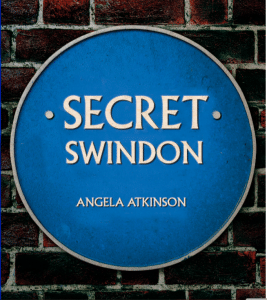
Hello listeners! I can’t lie. I can barely sit still for the excitement! The reason? I’m soon to be a published author for the first time. ‘Secret Swindon’, via Amberley Publishing, is due for release in the middle of July 2018.
But the story of how I got to this point has its roots 25 years ago – which is when I came to Swindon.
A new life in Swindon
Now, prior to moving to Swindon I’d visited the place several times and found it to be a perfectly pleasant place. So, when the opportunity arrived to move here I arrived with no negative perceptions. In fact, the converse was true. By the time I moved here my part of the world on the Derbyshire/Nottinghamshire border had been devastated by the wholesale pit closures of the 1980s. My family were at the heart of that – indeed my daughter’s first word was ‘Picket’. By the time I came to Swindon in the early 1990s I left behind nothing. And I mean – NOTHING. A pretty enough part of the country for sure – the village I lived in featured in the Domesday book. It was attractive and in the middle of a rural area. Albeit the atmosphere was akin to a very thick gravy. What with the pit muck and the quarry dust.
A visit to a C&A required two buses and a tortuous trip across two counties. We had no good transport connections, no work, no prospects, no nowt. Well slag heaps, emphysema and mass unemployment. We had that.
So! I came to Swindon. Within days I found work. Actual proper, full-time work. This one thing was little short of a miracle. I bought a house in Grange Park – a fifteen-minute walk from Shaw Ridge leisure park. Here we (my then 12-year-old daughter and I) found:
A swimming pool
An ice rink
A bowling alley
A cinema and oh joy of joys to a pre-teen daughter:
I truly felt I’d pitched up in the land of milk and honey. And y’know what? I still think that. I still think Swindon is the land of milk and honey. The southwest equivalent of the Klondike for opportunity.
So that listeners is my arrival in Swindon. I settle into full-time employment and building a life. I’m content with where I’m living, I like it perfectly well, it becomes home. But the real love affair with Swindon doesn’t begin then. To get to the igniting of that flickering fire of fondness into a truly, madly, deeply red hot love we have to go all Dr Who (the David Tennant incarnation) and do some wibbly wobbly timey wimey stuff and fast forward about 16 years to when I’m in my early 50s. When compulsory early retirement comes my way. AAAAAARGGGHHHH!!!!
Fast Forward two more years. I’m now approaching the end of my second year at university and selecting modules for my final year. A travel writing module called “Moving Words’ piques my interest.
I have a conversation with the module leader Professor Robin Jarvis:
‘Me: Robin, I’m interested in taking the Moving Words module but, at risk of sounding a bit daft, I don’t do any travelling.
Robin: Angela, the last thing I want landing on my desk is yet another account of a gap year in Thailand. Tell me what you see when you walk to your Tesco Express.
Me: PING – classic lightbulb moment. Why? Because what I see on my walk to my Tesco Express is a piece of public art. Not that I knew that term then. Nor did I know that it formed part of a ‘thing’ called the West Swindon Sculpture Trail. I knew of one or two other sculptures but not the entire collection. So I decided that, over that summer, I’d start blogging about Swindon with a view to amassing material that might – just might – make useful source material for portfolio pieces for this module.’
And that listeners is how Born again Swindonian became to be …well … born. And, as I progressed with what largely started as a means to an end, and as I learnt more and more about Swindon and all it has to offer – that’s when I truly fell in love with the place.
I often liken Swindon to a stripper. Take the time to get to know her, make the effort to cultivate a relationship with her, and she will draw back those layers. Slowly but surely, she will reveal herself and she’ll get under your skin. She’s got under mine.
It’s now around five years and 600 posts since I started blogging as Born again Swindonian. I’m still at it because there’s so much to tell.
Late last year (2017) someone left a message on my blog. That someone was a commissioning editor for a Gloucestershire based publishing house called Amberley. They have a series of local history books called Secret XXXXXX. Would I be interested in writing Secret Swindon?
Hell yes!
Which brings us bang up to date and me about to be a published author and flogging a book. Wow!
Secret Swindon is due for publication in mid-July 2018.
Where can you get it?
After it’s been launched at the end of July it will be available in the library shop in the central library. You’ll also be able to buy it directly from Amberley and even, maybe, in local bookshops.
John Richard Jefferies (1848-1887): is best known for his prolific and sensitive writing on natural history, rural life and agriculture in late Victorian England. But, a closer examination of his career reveals a many-sided, enigmatic author.
For much of his adult life, he suffered from tuberculosis, and his struggles with the illness and with poverty also play a role in his writing. Jefferies valued and cultivated an intensity of feeling in his experience of the world around him, a cultivation that he describes in detail in The Story of My Heart (1883).
This work, an introspective depiction of his thoughts and feelings on the world, gained him the reputation of a nature mystic at the time. But it’s his success in conveying his awareness of nature and people within it, both in his fiction and in essay collections such as The Amateur Poacher(1879) and Round About a Great Estate (1880), that has drawn most admirers.
Walter Besant wrote of his reaction on first reading Jefferies:
“Why, we must have been blind all our lives; here were the most wonderful things possible going on under our very noses, but we saw them not.”
The Richard Jefferies Society
Much of the above comes from the website of the Richard Jefferies society. Founded in 1950, they describe the man as an authority on agriculture and rural life. They go on say that, though Jefferies was best known for his nature writing he was also an essayist, novelist and mystic.
‘Will Self, Monty Don, Tony Robinson, Jeff VanderMeer and the National Trust nature specialist, Matthew Oates. A disparate collection of people. Yet there’s a common connecting thread between them all. How so? Because they all confess to a love of, and respect for, Jefferies’ writings.
If I now hear ‘Richard who?’, I’m not surprised. It’s fair to say his fame is somewhat greater in Surbiton, whose library celebrates him with a wooden plaque, than Swindon. Yet those who know Jefferies’ writings find inspiration in him. Forgotten by most he may be – but that doesn’t mean he wasn’t good and isn’t worthy of our appreciation. Indeed, gardener and broadcaster Monty Don describes him as a great laureate of the English countryside, one not heralded nearly enough. Something to ponder on when next you’re mulching the rose beds. Not that it was always the case in Swindon – there used to be memorial days to him.’
As a youth, Jefferies spent much time walking the countryside around Coate and along the Marlborough Downs. He also often visited Burderop woods and Liddington Hill – near his home. The latter his favourite haunt. That location was beloved too by Alfred Williams.
The Richard Jefferies Museum
Jefferies came into the world at the farmhouse by Coate Water that is now the Richard Jefferies museum. Back then the farmhouse sat in the north Wiltshire countryside, on the outskirts of Swindon. There his family farmed a forty-acre smallholding.
Located at Coate between the Swindon to Marlborough road and Coate Water Country Park, the Richard Jefferies Museum and garden is a tranquil delight. The mulberry tree that Jefferies knew as a boy still stands and still bears fruit that sometimes gets turned into jam.
Mike Pringle and the team running the museum have wrought wonders with it – increasing visitor numbers by a dramatic amount. Sitting there on a sunny, summer Sunday afternoon with a scone and a cuppa is a most agreeable way to pass the time. In particular when, as is often the case, there’s a musician of some sort performing.
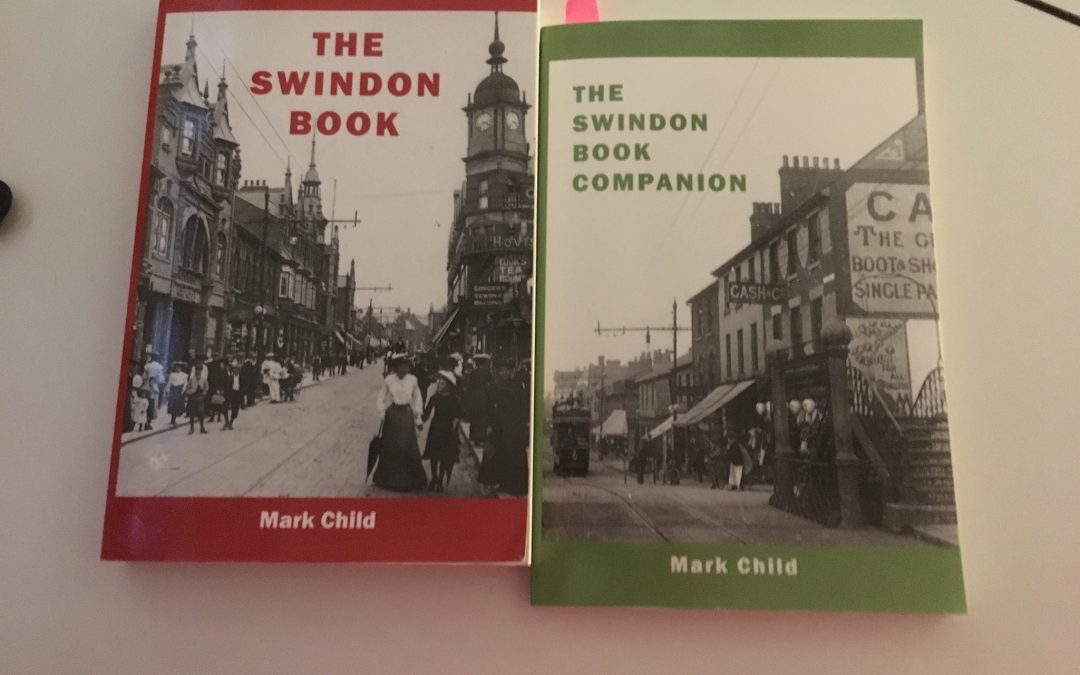
At last! I’ve managed to get my copy of The Swindon Book by Mark Child, from the tourist information desk at the central library. As the back cover says, the book is:
‘The story of Swindon, from the earliest times to the present day, is here encapsulated in an alphabetical compendium of people who have influenced its development, places that have given character to its landscape and important events that have punctuated its history. The SWINDON BOOK, written by an eminent local historian, and writer on history, topography and architecture, is a unique and readable distillation of the centuries’.
Hmmm, well, I won’t lie – a bit of plain English wouldn’t have come amiss on that back cover. In other words, the book comprises a collection of bite-sized titbits arranged in alphabetical order. So don’t let the somewhat purple prose on the back put you off . Because it is – as it says – readable.
Here you’ll find a labour of love stuffed full of all sorts of wonderful nuggets of information that the author has been squirreling away for years.
I haven’t had time to have a thorough browse yet. Reading that David Putnam unveiled the statue of Diana Dors outside the Shaw Ridge cinema complex piqued my interest. That’s a pretty cool thing I think. As is the book as a whole.
It’s really very informative and a ‘must have’ for anyone with any interest in Swindon’s history.
The Swindon Book and the Swindon Book Companion
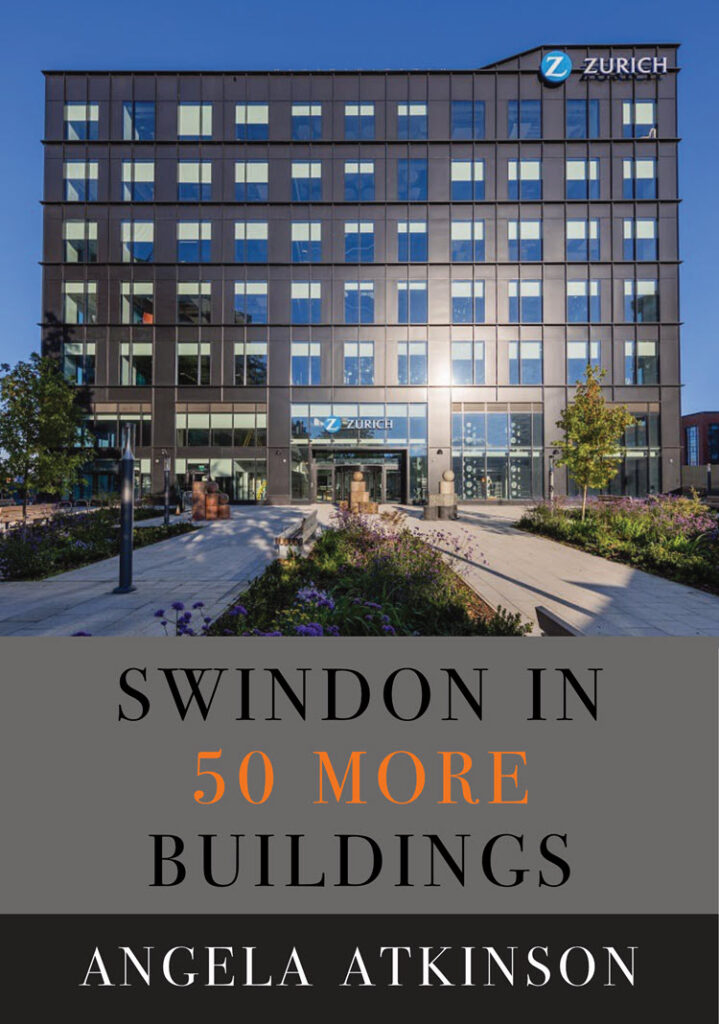
Of course, other people’s writings are a useful source/resource for one’s own. I used these books and others for reference when writing Secret Swindon.And again for Swindon in 50 Buildings.