Eggciting Easter Customs make Easter Cracking Easter, like any other, is a festival synonymous with many symbols and customs.
It’s a mish-mash of the resurrection of Christ, chocolate eggs, painted hard-boiled eggs, Maundy money and a rabbit all rolled into one. So a festival as muddled as any other on the British and global calendar then. And it’s a moveable feast at that.
So let’s get the latter point out of the way.
Calculating when Easter Day/Easter Sunday will fall
For Christians, the actual point of Easter Sunday is not eating your bodyweight in chocolate eggs but celebrating the resurrection of Jesus Christ. But why does it change every year? I won’t lie, I’m always confused by this.
Time and Date.comtells us that: ‘According to the Bible, Jesus’ death and resurrection occurred around the time of the Jewish Passover – celebrated on the first full moon following the vernal equinox.’ By the end of the 2nd century there were some churches celebrating Easter on the day of the Passover and others celebrating it on the following Sunday. Not all that helpful.
So, in 325CE (common era) the council of Nicaea (now known as Turkey) established that Easter would be held on the first Sunday after the first full moon occurring on or after the vernal equinox. And so, from that day to this, the date of Easter depends on an ecclesiastical approximation of March 21 for the vernal equinox. Hence there’s a 35-day span for celebrating a one-time event. If that’s still as clear as mud and it is a long and complex tale, try this article from Christianity Today.
So that’s the reason for the season and the confusion over the timing dealt with. Now to crack open a few other Easter traditions and aspects – starting with the name: Easter.
What’s in a name?
Similarly to the modern Dutch ooster and the German Ostern, Easter came from an Old English word: Eastrun. Or Estru. Or Estre and Eostre. Take your pick.
There’s an accepted theory that it’s derived from the name of a goddess mentioned by Bede, the 7th-8th century English monk. But it is only a theory. Chances are this was mere speculation on Bede’s part because there’s no firm evidence of such a goddess existing.
Maundy Thursday: Show me da money
Maundy Thursday is the Thursday before Good Friday – the day that Christ died on the cross. Or did he? This article from the Huffington Post with the snappy title ‘The Day Christ Died – was it on a Thursday or a Friday?’argues otherwise.
An aside: Good Friday – doesn’t this seem an odd name for a day that someone was crucified on? The chances are it was once ‘God’s Friday’ or even Holy Friday. Makes sense huh?
Be that as it may, Christians remember Maundy Thursday as the day of the Last Supper. It was then that Jesus washed the feet of his disciples and established the ceremony known as the Eucharist.
The word ‘Maundy’ has its origins in the French word, “Mande,” meaning “command” or “mandate”. It’s taken from the command given by Christ at the Last Supper, “love one another as I have loved you.”
In Britain, the Queen takes part in the Ceremony of the Royal Maundy. Something that dates back to Edward I. And this is where the money comes in. Well now it does. Once upon a time our monarchs did the foot bath thing but now avoid that and simply dole out purses. Can you blame them? Not me.
Maundy Money is distributed to deserving senior citizens – one man and one woman for each year of the sovereign’s age. They’re usually chosen for service to their community. They’re given two ceremonial stringed purses: one white and one red. The white one contains your normal British currency and the red one contains Maundy coins. Minted for the occasion, the amount given corresponds in pence either to the Queen’s current age or her length of time on the throne. There’s conflicting information on this. In either event, the longer the reign or the older the monarch – the bigger the booty.
Palm Sunday
Before moving on to the non-Christian elements of Easter a quick mention of Palm Sunday. It would be rude not to after all. Easter week begins on Palm Sunday. Why Palm Sunday? Well because, in Roman times it was the custom to welcome royalty by waving palms. A bit like ticker-tape if you like. Hence, when Jesus pitched up in Jerusalem on what’s now known as Palm Sunday, he arrived to a carpet of palms on the streets and people waving them.
The Eggcellent part of the Easter festival
Easter eggs were not always made of chocolate. They were once actual eggs. Specially decorated they were given out to celebrate the Easter festival.
It’s alleged that this custom began in Mesopotamia where they stained eggs red to commemorate the blood of Christ and the crucifixion. When cracked open they symbolized the empty tomb.
Though note that eggs have been used as symbols long before Jesus was on the scene. So I guess then they were simply…. eggs?
The Easter Bunny
It’s an odd one this – given that the Easter Bunny might actually be a hare. Yup – that long-eared bundle of fluff associated with being jugged is your actual deliverer of the Easter eggs. Still I imagine that, as a symbol of fertility, the hare is as suitable as the rabbit as a fertility symbol being a prolific breeder itself.
It’s possible that the bunny as an Easter symbol originated in Germany. Mentioned in German writings in the 16th century, the hare was an alleged companion of the ancient Moon goddess and of Eostre. Yes, the one who probably never existed. Not even as a ‘mythical’ goddess. I’m detecting a theme here.
Put on your Easter Bonnet
There was a time when Easter was a traditional day to tie the knot. Which may explain why it’s common to dress up for Easter in one’s best bib and tucker. Thus the Easter bonnet, any new or fancy hat worn at Easter, likely stems from the tradition of wearing new clothes at Easter. And most folk of a certain age have got the term and the notion ‘Easter Bonnet’ fixed in their collective consciousness by Irving Berlin using the American Easter Parade as his frame of reference.
Get your buns out
I refer of course to Hot Cross Buns. Traditionally eaten on Good Friday, a hot cross bun is a sweet, spiced bun made with currants or raisins and marked with a cross on the top. For reasons that ought to be obvious by now. Or, if you prefer an Easter biscuit, Health4All have a recipe for Easter biscuits that counts cassia oil as an ingredient. Cassia being significant here because it’s probable it was used in embalming Christ’s body.
Of course, if you’re making biscuits then a biscuit cutter could come in handy. SED Developments have biscuit/cookie cutters in all manner of designs. This is their website: https://sed-developments.co.uk/home/designs/
And on the topic of baked goods, the simnel cake is now the traditional way of breaking the Lenten fast. Yet, did you know that the simnel cake was once associated with Mothering Sunday?
The obscure and the odd
Of course, Britain wouldn’t be Britain without a smattering of weird and wonderful Easter traditions mixed into the festival.
So aside from dying, or painting and exchanging eggs, or hiding them for an egg hunt, there’s rolling hard-boiled eggs down hills. Why? I mean – why?! But it gets wackier.
This BBC America article cites 5 surprising Easter traditions. Maundy Thursday we’ve covered but Bottle Kicking, Egg Jarping and the Britannia Coconutter’s Dance are new to me. And if you don’t believe me – here’s the proof:
Blaylock’s Shoe Shop Old Town It’s a mildly curious thing that Swindon’s Old Town has, within a few yards of one another, three long-established family businesses. On Wood Street there’s Deacon’s Jewellers, founded in 1848 and now in its sixth generation as a family business. Then there’s Gilbert’s furniture store on Newport Street. This business was established in 1886, becoming a fixture on its present location from the early 1870s.
Then there’s the subject of this blog post:Blaylock’s shoe shopOld Town on the corner of Bath Road.
Blaylock’s is a youngster compared to the other two, being started in 1920 when the senior Blaylock – Robert – opened a shoe repair business in Swindon’s Gorse Hill. This brilliant business remains one of the south of England’s leading independent shoe businesses, with a wide range of shoe brands for adults and children.
I lOVE this shop and I do buy most of my footwear from it. It’s what I call a proper shoe shop – with shelves in the shop itself stacked with boxes and boxes of shoes. Going in there is a great nostalgia trip – with some good old fashioned service.
Mr Blaylock’s grandson
The business is now directed by Robert’s grandson David, and managed by David’s son Mark. In this 2014 feature in the Wiltshire Business Online News, David said:
‘In terms of how we run the business, we have tried to maintain the same principles. We believe people come to us because of our stock, our staff and the service we offer.
We still endeavour to give personal service and carry a range of stock you wouldn’t find in a normal High Street store.”
NB: When Robert Blaylock’s business moved to Old Town in 1928, it was first situated in what is now Pizza Express in Bath Road before it later moved to where it stands today.
With a nod to The Swindon Book
Now with a nod to Mark Childs, The Swindon Book here’s a potted history of this wonderful Swindon business:
Established by Robert Blaylock (1896-1955 – from Bowness, on Windermere in Westmoreland), this Old Town shoe store is four generations old.
When a youngster, young Blaylock contracted rheumatic fever. The condition left him with heart problems and medical warnings that he should do nothing manual. Warnings that he appeared not to heed, given that the age of 15 saw him apprenticed to a local boot and shoe repairer.
WWI
WWI brought Robert to Swindon and a billet at the Chiseldon Camp where he repaired army boots. Come the end of the war, he remained in Swindon and opened a boot repair workshop at 254 Cricklade Road. In his spare time Robert was an active lay preacher at Florence Street Mission Hall. There he met Lilian Skinner, whose father, Daniel Skinner, ran the mission. The couple wed in 1921, moved into 158 Cricklade Road and produced seven children. One wonders if they were the worst shod …. ?
By 1928 Robert moved his business to No 5 Bath Road, Old Town. There, at the rear of the premises, the operated a shoe repair business.
The landlord of No 5 refused to give Robert Blaylock a lease, though Randolph Pollard, gent’s outfitter next door at No 3, had a long lease. When No 5’s landlord decided to sell, Pollard bought it and moved his business in. He then transferred his lease at No 3 to Robert Blaylock.
Failing health
By 1949, Robert Blaylock had failing health and not one son willing to take on the business. Yet, his son Robert Arthur resigned from his position in the National Provincial Bank to take it on. Shades of ‘It’s a Wonderful Life’ there methinks!
Thus, when the property came up for sale, Robert Arthur bought it and the adjacent property on the corner of Devizes Road. He also bought a little lock-up called the Corner Cabinet which sold antique glassware. In so doing, he expanded the business.
Robert Arthur’s son, David John Blaylock, was also not inclined to follow in his father’s footsteps. Yet, like his father, he too relinquished his clerical work with Swindon council to keep the business going. (More George Bailey heroism!) He ran it from 1988, and in 1997 his son, Mark Adam Blaylock joined him.
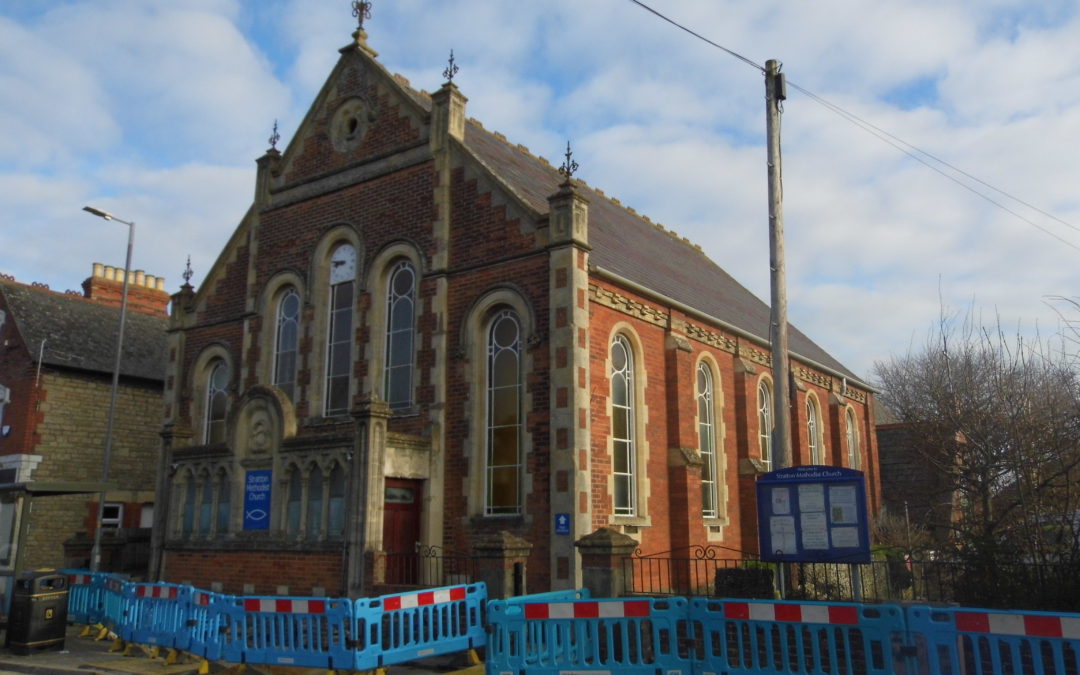
For this post in the Swindon in 50 More Buildings series I’m keeping with the Stratton area. The previous post covered Upper Stratton Baptist Church – and in this one LowerStratton Methodist Church. So one way and another I’ve got Methodism north of the railway well-covered!
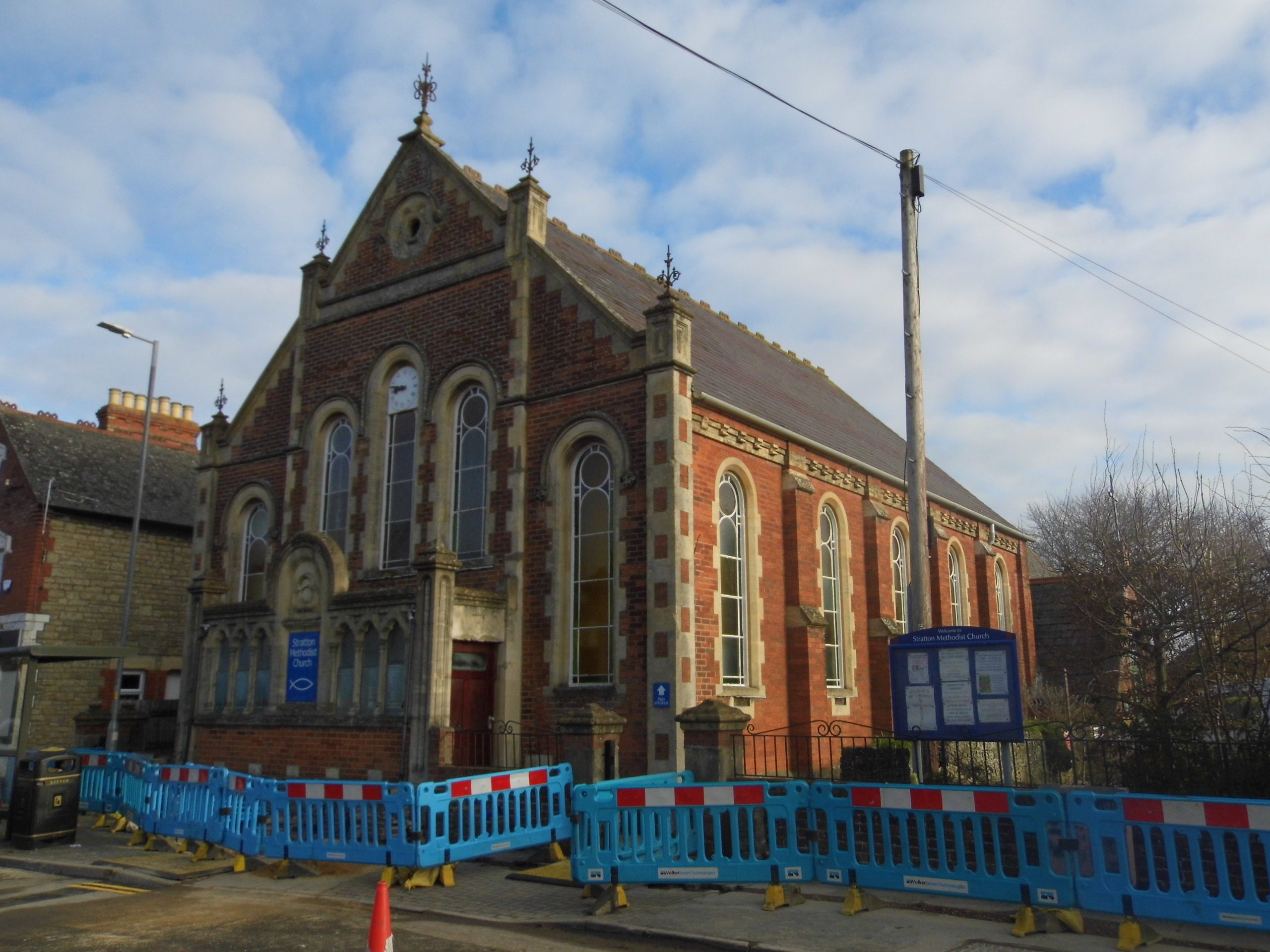
The Methodist Church in Lower Stratton
The Lower Stratton Methodists, it seems, began to worship together in 1825. For around five years they met in a wheelwrights shop at Stratton Park crossroads. 1830 saw the erection of their first chapel in Swindon Road. But the congregation grew resulting in it being enlarged in 1842. But then, following the Swindon circuit revival campaign of 1880-8, they decided to have a larger chapel – the one we’re concerned with here.
The firm of Thomas Colbourne, a church member, built this and other chapels in the district. His name crops up a lot when one starts to look at Swindon’s buildings. It cost £1,600 and stands on the site of a blacksmith’s shop. The school hall followed in 1893 or 1897 – depending what you’re reading. The 1930s saw the addition of the clock on the outside and 1938 the installation of the organ.
On the north side there exists a pathway – a bare two-yards wide. A short-walled pathway on the south side and the wall of outbuildings attached to the schoolroom was the boundary on that side. The church didn’t then own the land that now forms the car park and the site of the Manse. That belonged to a Mr Freeth of Elborough Farm. The house stands still south of the chapel.
In the mid-1920s one of the church trustees negotiated to buy from Mr Freeth, a piece of land that now comprises the car park on the site of the Manse.
Following completion of the sale the church established a bowling green and tennis court. The bowls club they established flourished for many years.
Levi Lapper Morse: 24 May 1853 – 10 September 1913
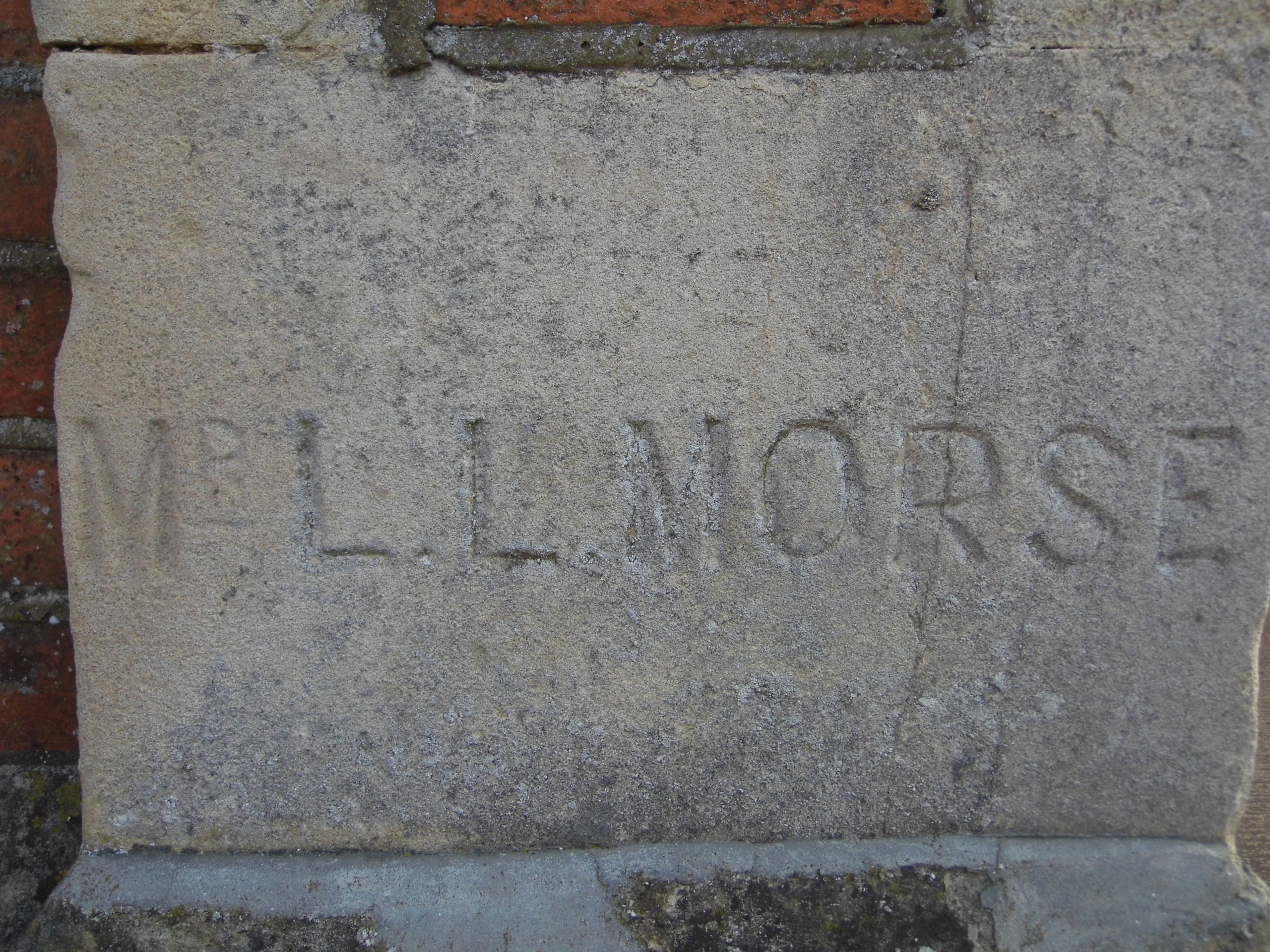
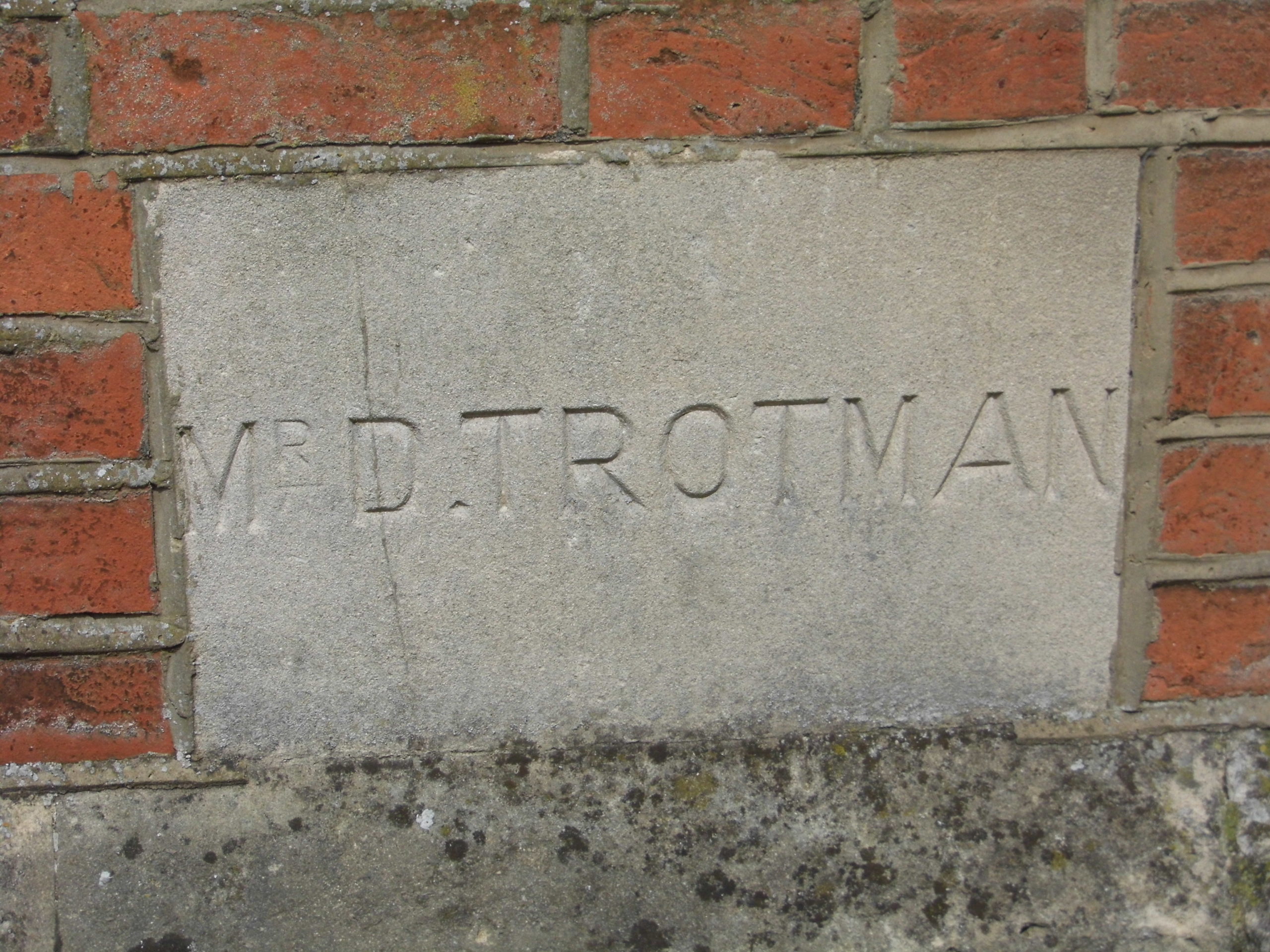
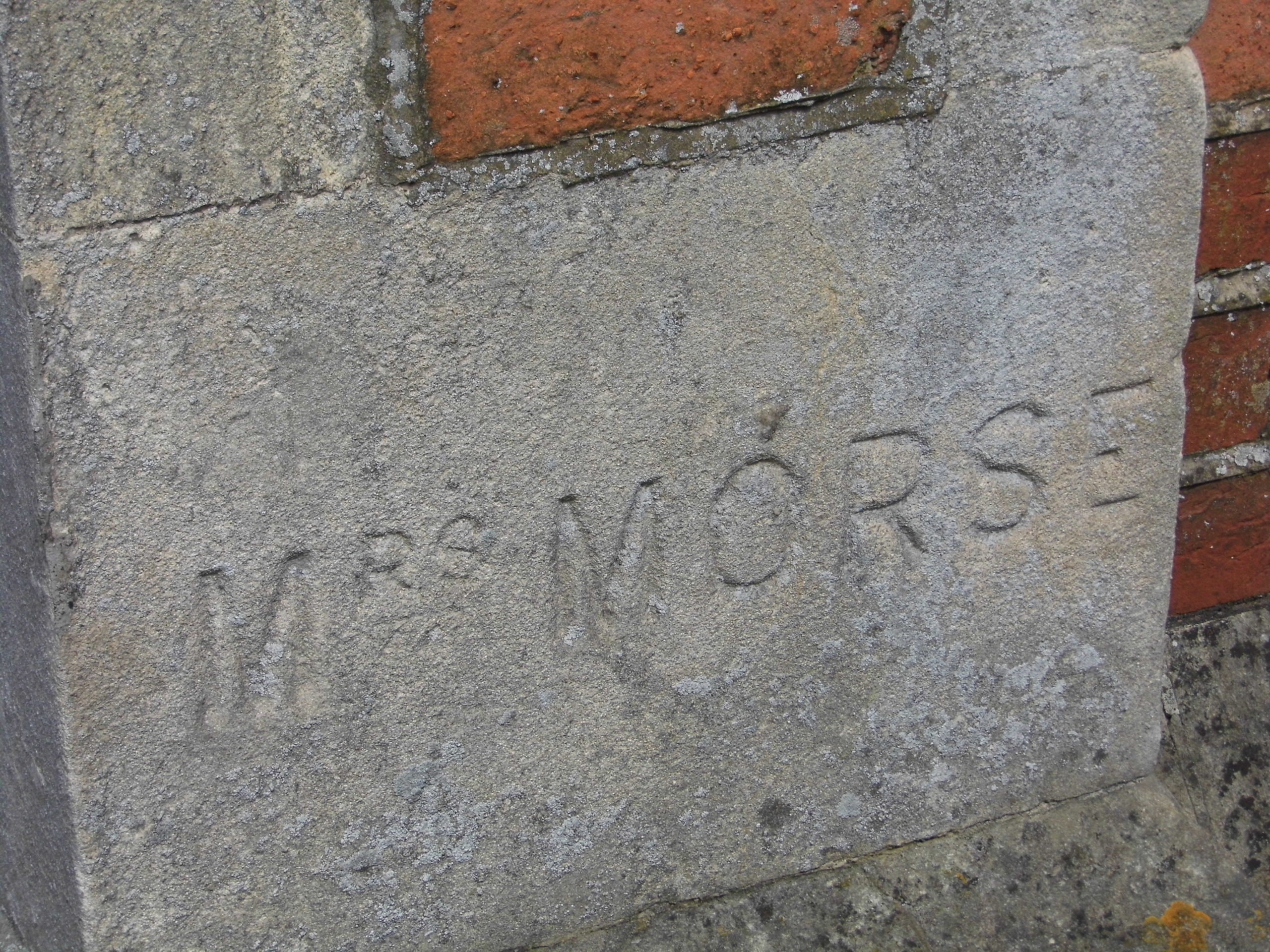
All the above is fine and dandy and it’s an attractive building for sure. But the thing that imbues it with particular significance is the associations the church has with Levi Lapper Morse and the Morse Family. For he is literally the cornerstone of the church.
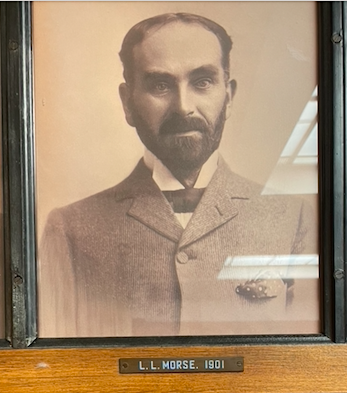
Levi Lapper Morse cornerstone on Stratton Methodist church.Levi Lapper Morse in 1901
Levi Lapper Morse – son of Charles Morse of Purton – became a business and political giant in Swindon and the area. Morse’s department store, along with McIRoy’s, remains lodged in Swindon’s cultural fabric despite being long-gone.
Educated at the High School, Swindon Lapper Morse married Winifred. Between them they produced two sons and four daughters. Both Levi and his son, William Ewert Morse (1879-1952) were devout Primitive Methodists.
Levi served as Swindon mayor in 1901-1902. Between 1906 and 1910 Levi Lapper Morse indulged his political interests as a Liberal MP for Wilton while his son, William, represented Bridgewater for the Liberals between 1923 and 1924. Further, son and father both were Wiltshire county councillors, Justices of the Peace, and Swindon Town councillors.
LL Morse died at his home, The Croft, Swindon on 10 September 1913 aged 60 years. He lies in Radnor Street Cemetery, Swindon.
Swindon helped to bounce back thanks to £19.5m for town centre regeneration projects
Swindon has succeeded in its bid for a share of the Government’s Towns’ Fund. If you’ve been following Swindon’s Historic England Heritage Action Zone activities you’ll understand how big a deal this is.
The majority of this money will go to HAZ projects:
1. £5.5m for the next phase of the Carriage Works 2. £5m for the Health Hydro on Milton Road 3. £3m HAZ Streets & Spaces – improvements to Station Road and the Bristol St and Sheppard St tunnels.
Ultra-exciting news
The great thing about this funding coming Swindon’s way is that it can’t fail to accelerate and maximise the HAZ objectives of revitalising the Railway Village.
The GWR Railway Village – Photo credit Martin Parry
The town enjoyed selection from one of 101 places that put forward submission. It’s now official that Swindon has secured funding for six projects as follows:
Health Hydro refurbishments: embedding community and leisure uses in the heart of the Railway Village
Redevelopment of units of the Carriage Works. This includes completing Phase 3 of our rejuvenation of the former Carriage Works. Then redeveloping three units as well as part of the building fronting onto London Street.
Install Create Studios at the Carriage Works. This involves fitting out the new space to support Swindon’s digital economy and upskilling residents.
Brunel Centre Market. Introducing new town centre uses, complementing the High Street and bringing a new experience.
Heritage Action Zone Streets and Spaces. This includes public realm and improvements to walking and cycling routes. This is vital to tie together Swindon’s heritage-led regeneration projects and connect the Designer Outlet and North Star to the town centre. This in particular is crucial. As it is, the Railway Village and the GWR Workers’ tunnel are all but cut off from the town centre. To get from the RV to the Health Hydro you either dodge traffic or you have to do a 3-point zig-zaggy road crossing manoeuvre. It’s fragmented and it isolates the RV & the GWR Park from the town.
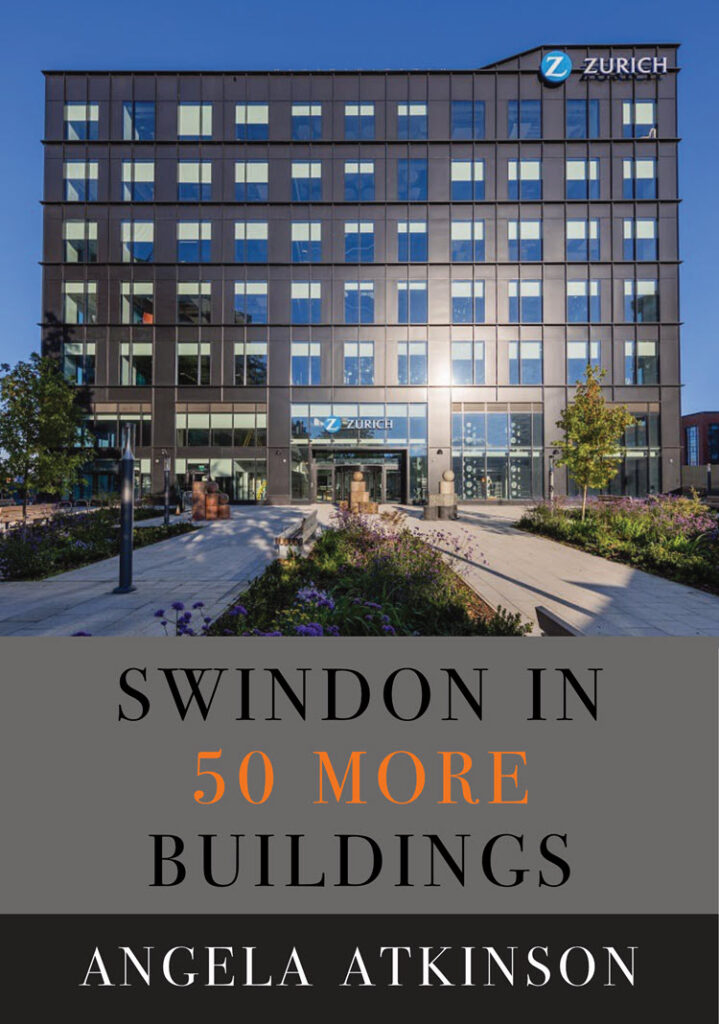
Kimmerfields Enabling Infrastructure. Delivering enabling infrastructure to make land ready for new homes and offices on the next phase of Kimmerfields. That’s next to Zurich’s new flagship building.
Pulling it together
The Independent Swindon Town Deal Board will now pull together online business cases for the funded projects.
Many people in Swindon have rightful concerns about what will happen to The Oasis. I do hope that SBC will not see this as an either/or sort of thing. What we don’t want to see is a ‘we’ve saved the Health Hydro, it’s iconic, what more do you want?’ dialogue happening.
Milton Road Baths ARE absolutely of the utmost importance. They’re value is immeasurable both for the building itself and what took place there. The Medical Fund Society and its influence on the NHS are embedded in every brick and every Victorian glazed tile. Not to the mention the the Turkish baths there being the oldest extant Victorian Turkish Baths in the WORLD.
But let’s be clear.The Oasis is also iconic – for very different reasons for sure. But iconic and important it absolutely is. And besides that, it’s the only fully-accessible leisure facility the town has. We live in an age of equality and accessibility – thank goodness – so no-one can ignore that fact.
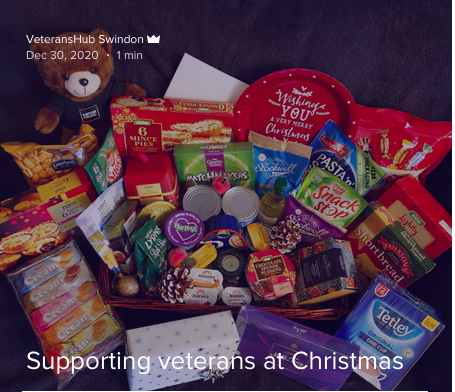
The veteran’s hub Swindonexists to do what is says in the title of this post. How needed support for veterans is can’t be underestimated. For it’s severely lacking in places where it should exist. At Swindon’s veteran’s hub they understand that. They know all to well the support that veterans need – and how big a difference the smallest amount of support can and does make.
Founded in 2019, the people behind the hub are determined to have a positive effect on their community.
Co-operation and collaboration
To achieve their aims the veteran’s hub works in partnership with a number of organisations – strength in numbers and all that eh? Amongst the people the hub works with are:
Should you be wondering why this support is necessary then take a look at this piece on the BBC news website that talks about the suicide crisis for British veterans. ‘Military charities say they are not coping with the increased demand for mental health support.’ It seems that, according to campaigners, 2019 saw 58 veterans take their own lives. Further, this 2020 piece from The Week reports on the surge in suicides by UK veterans of the Afghan war. In it they report that: ‘More than 70 former and serving personnel took their lives in 2018 and at least 50 suicides occurred last year. Fourteen former and serving personnel are thought to have taken their own lives in the past two months alone.’ Why? Well, Research suggests that delayed-onset post-traumatic stress disorder can arrive a decade or more after the event in question.
It’s clear that, somehow or other, and this is not the place to go into that, veterans are simply not getting the support they need. And that’s where the veteran’s hub Swindon comes in.