Church Art in Swindon – a little look at some of what you can enjoy in Swindon’s churches.
Church art, or Sacred Artwork is, by its definition, art that is set apart from the mundane. We find it in uses and places that command deep respect. From a Christian perspective, the term sacred artwork, is best applied to works that are either:
- Intended for liturgical settings or are …
- … appropriate for liturgical settings
Common types of church art
There are four common varieties of church art – most of us will have encountered some if not all of them at some time in our lives – either at home or abroad.
- Stained glass – letting glowing, colourful light into a church interior, stained glass windows tell stories – often of the Bible and saints. But they’re not restricted to that. They can be geometric patterns, they can tell an allegorical story or they can be a tribute to a significant person. Or to local industry – see below.
- Frescoes and wall paintings: these are large paintings on church walls and ceilings often using bright colours. I’ll argue that the ceiling of the Sistine Chapel in Rome is the go big or go home version.
- Altarpieces: carved or painted wooden and stone panels placed behind the main altar.
- Icons – Sacred wooden panel paintings used, in the main, in Eastern traditions, these pieces are rich with deep symbols.
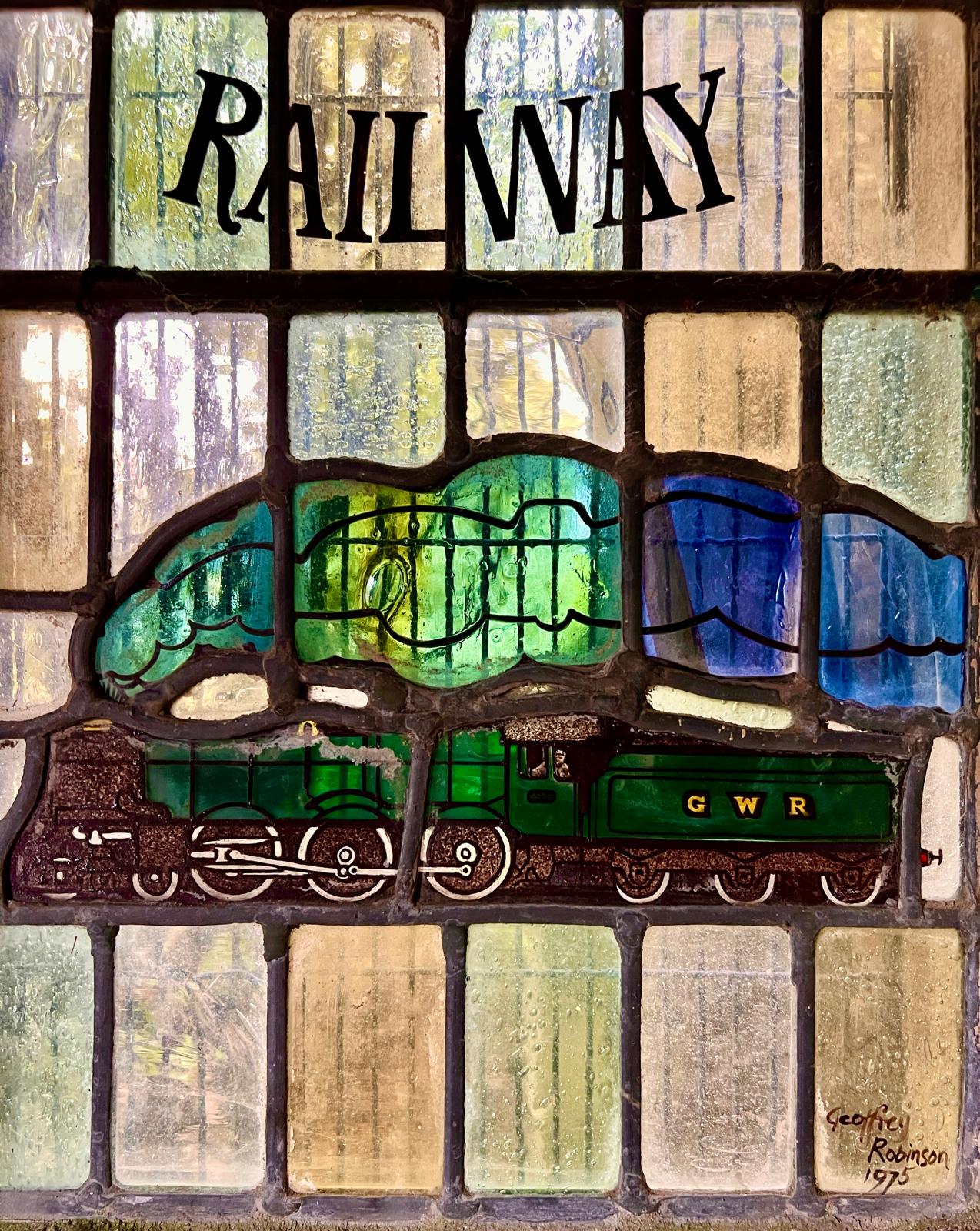
Often unnoticed, tucked away in the south porch of Christ Church is this gorgeous stained-glass window featuring a GWR locomotive.
Local bell ringer Nancy Davis donated the window in 1975.
Christ Church has deep ties to the GWR. The company’s chief engineer, George Jackson Churchward has his resting place there.
So, what’s Swindon got in the way of sacred art?
Well quite rather a lot actually. And some of it is quite astonishing. I obvs can do more than give an overview here of some it I know. And that I miss I beg your pardon – to paraphrase a V old song about an English country garden!
I do hope though that this will whet your appetite and encourage you to visit the churches mentioned here and others in the town, to see what they might have in the way of church art. And then tell me about it – because what I talk about here is about the extent of my knowledge.
St Mary’s church in Lydiard Park
Right then! To kick off our whistle stop tour of some of Swindon’s church art we’re visiting St Mary’s at Lydiard. In 1999, writer and historian Simon Jenkins featured this church in his book England’s Thousand Best Churches. In it he stated that, were the chancel to be moved to the Victoria and Albert Museum, lock, stock and barrel, it would cause a national sensation. And not a lot of people know that. Thus, I included that rather fabulous fact in Secret Swindon. But, we’re not concerned here with the Golden Cavalier nor the tremendous polyptych. No. Instead we’ll concentrate on the wall paintings at St Mary’s. These remarkable survivals offer a rare insight into how much different the church would have looked to the mediaeval worshiper. For they would have offered their prayers to God surrounded by walls covered in brilliantly coloured patterns, foliage and action figures.
The 16th century saw all St Mary’s wall paintings defaced and covered up when the new Protestant doctrine forbade the use of sacred images and the worship of saints. Some enjoyed a brief moment in the sun when the Victorians temporarily exposed them, 300 years later. They uncovered them from layers of lime-wash during 1901 renovations.Now though, they’re in better shape than ever. And it’s all thanks to extensive conservation work undertaken in a £1million conservation project (2018-2021). The programme involved twenty-four trainee conservators from different countries under the professional guidance of Jane Rutherford & Associates.
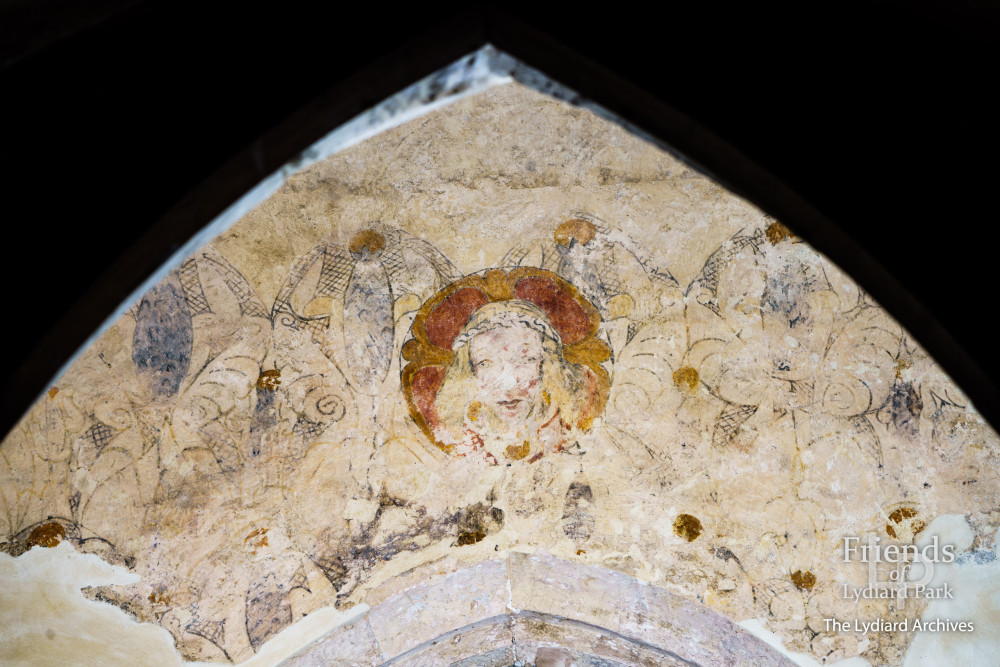
You can explore the wall paintings (and more) by browsing the Lydiard archives here: https://thelydiardarchives.org.uk/collection/wallpaintings but as a teaser there’s one below. What you see here is an unusual depiction of Christ with long blonde, wavy hair surrounded by a pomegranate design.
Dating from the 15th century it’s part of a set of once brightly-coloured wall paintings introduced by Margaret Beauchamp (c1410-1482) and her husband Oliver St. John – pronounced Sinjun or Sinjin. The couple are credited with enlargements and improvements to the church that took place in the 1400s. Their work included the addition of the south porch – where you’ll find this painting.
Inglesham church, St John the Baptist – 13th century
Keeping with ancient wall paintings and bouncing out into the wider borough we’re now paying a visit to Inglesham, described as ‘an ancient painted wonder saved by William Morris.’ That’s he of Kelmscott Manor not the Swindon Advertiser. I mention it because confusion does arise.
The church website describes the paintings there as follows:
‘An amazing series of paintings, from the thirteenth to the nineteenth century, cover the walls often with one painted over another, in places seven layers thick. While it is not always easy to puzzle out the subjects, you can see fifteenth-century angels above the chancel arch, an early fourteenth-century doom on the east wall of the north aisle, and several nineteenth-century texts, as well as a thirteenth-century masonry pattern throughout the chancel.’
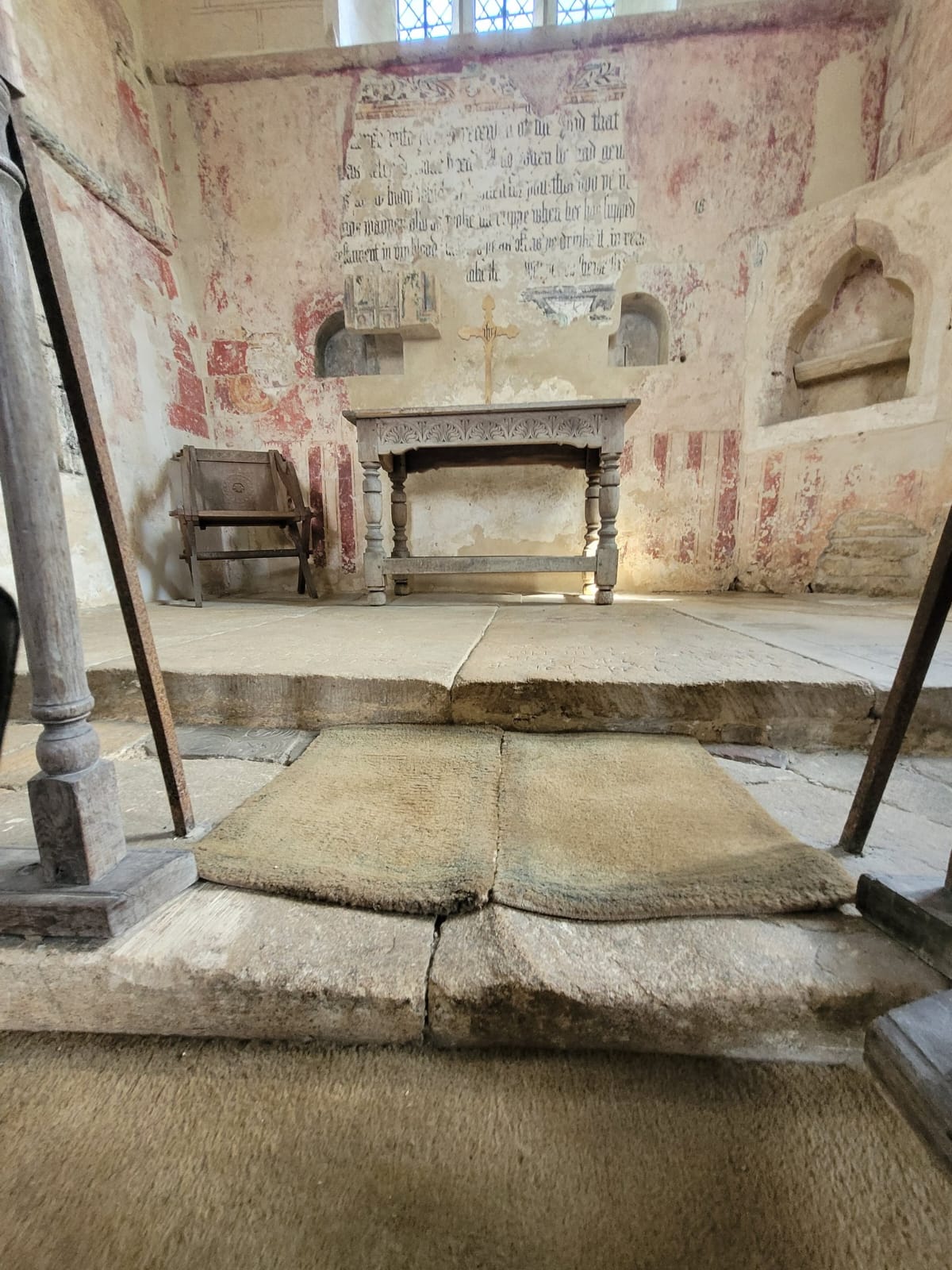
I confess that, despite including this one in Swindon in 50 More buildings, I haven’t actually visited it. It would be good to see it for myself. For a bit more about Inglesham church and a few more photos, I happen to have a blog post, here.
And now for something completely different
The church art tour bus now comes back into Swindon, to Rodbourne. Here we’ll pay a visit to St Augustine’s, one of the four so-called railway churches, built to meet the spiritual needs of the ever-growing GWR workforce. The other’s being, in no particular order) St Mark’s (by the railway village), St Barnabas (Gorse Hill) and St Luke’s at Broadgreen.
Anyway, as you go through the doorway of this modest, red-brick, railway church prepare yourself for shock and awe as you’re greeted with the simply stunning apse ceiling you see in this image.
Back in 1987, discussions began about a new work of art for the apse at St Augustine’s. Funding it were several members of the Done family, in memory of Winifred Done. A much-loved member of the congregation, Winifred had died in March of that year.
Now a young artist seeking work, Fleur Channer, had approached the clergy. They commissioned her to prepare sketches for a painting in the early Christian style. They wanted something resembling that which St Augustine himself might well have seen in Rome. Adaption’s to the sketches followed. By the time the final drawings received approval the figures were of a later period than at first intended. They now showed the influence of Italian, Greek and Venetian artwork.
You can find out more about this artwork and others in the church by the same artist on the website here: https://staugustines-swindon.co.uk/history/church-artwork/
But better still, visit it. It’s a lovely church, one of which I am rather fond.
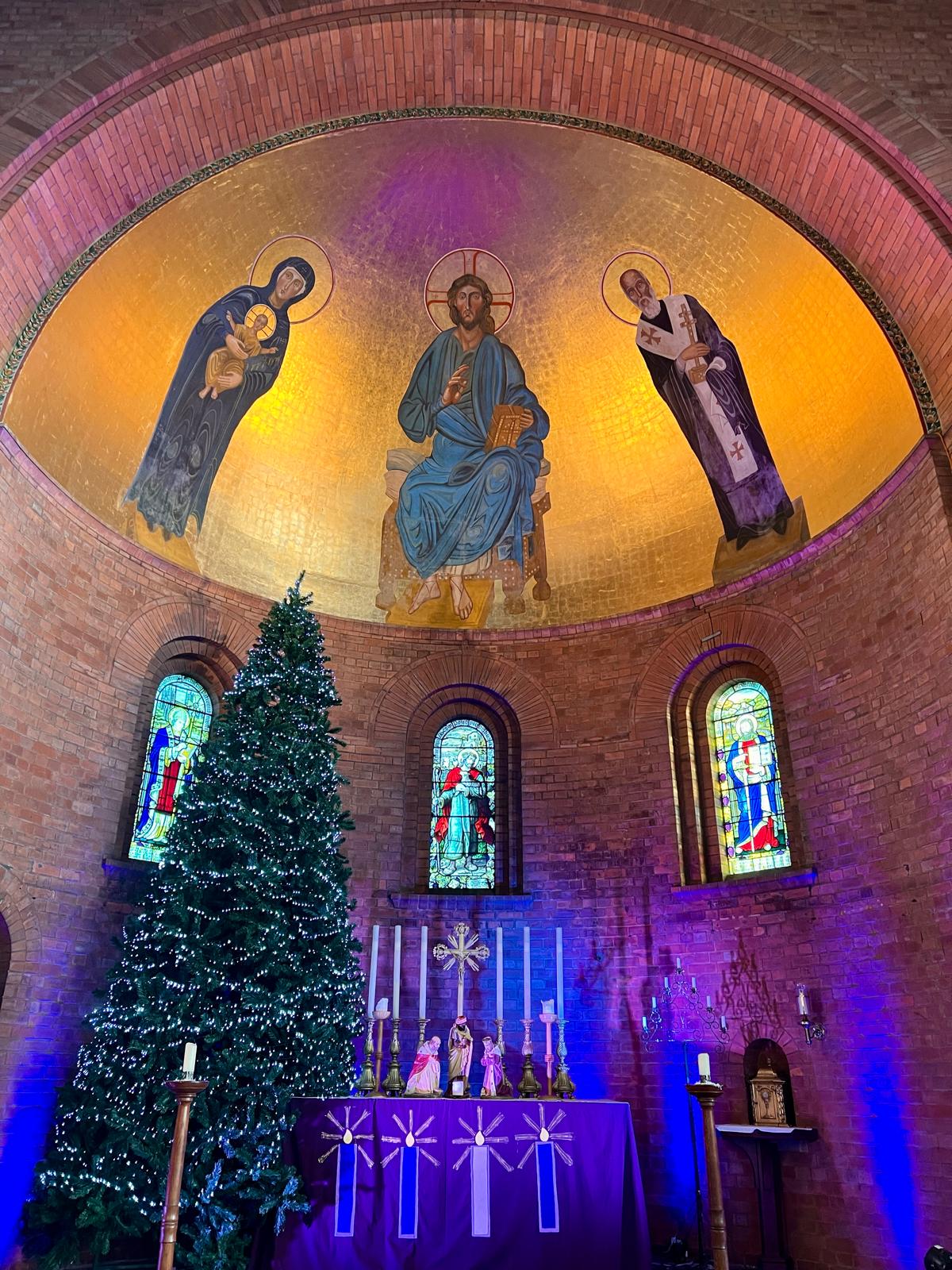
The Byzantine-style apse ceiling in St Augustine’s painted in the 1980s by a young artist called Fleur Channer.
The church also boasts some super mosaics on the floor – pictures of them here: https://swindonian.me/2020/02/08/st-augustines-church-swindon/
I am Alpha and Omega, the beginning and the end, the first and the last.
Revelation 22:13
St Barnabas’ Gorse Hill
Continuing with the theme of tales of the unexpected, our next and final stop on this trip takes us to another railway church, St Barnabas in Gorse Hill. Now, I’ve written about St Barnabas and its marvellous mural paintings before on this forum so I’ll not go on too much them. But in case you missed that one or need a reminder here’s an overview.
The mural paintings are the work of the Rev. John (Jean) Perret, sometime Rector of Stanton Fitzwarren, near Swindon. The Rev. Basil Minchin encouraged their execution and they comprised a thank you offering on the part of the artist for recovery to health. Painted in the years 1946, 1947 and 1948, the artist prepared the walls with lead and canvas.
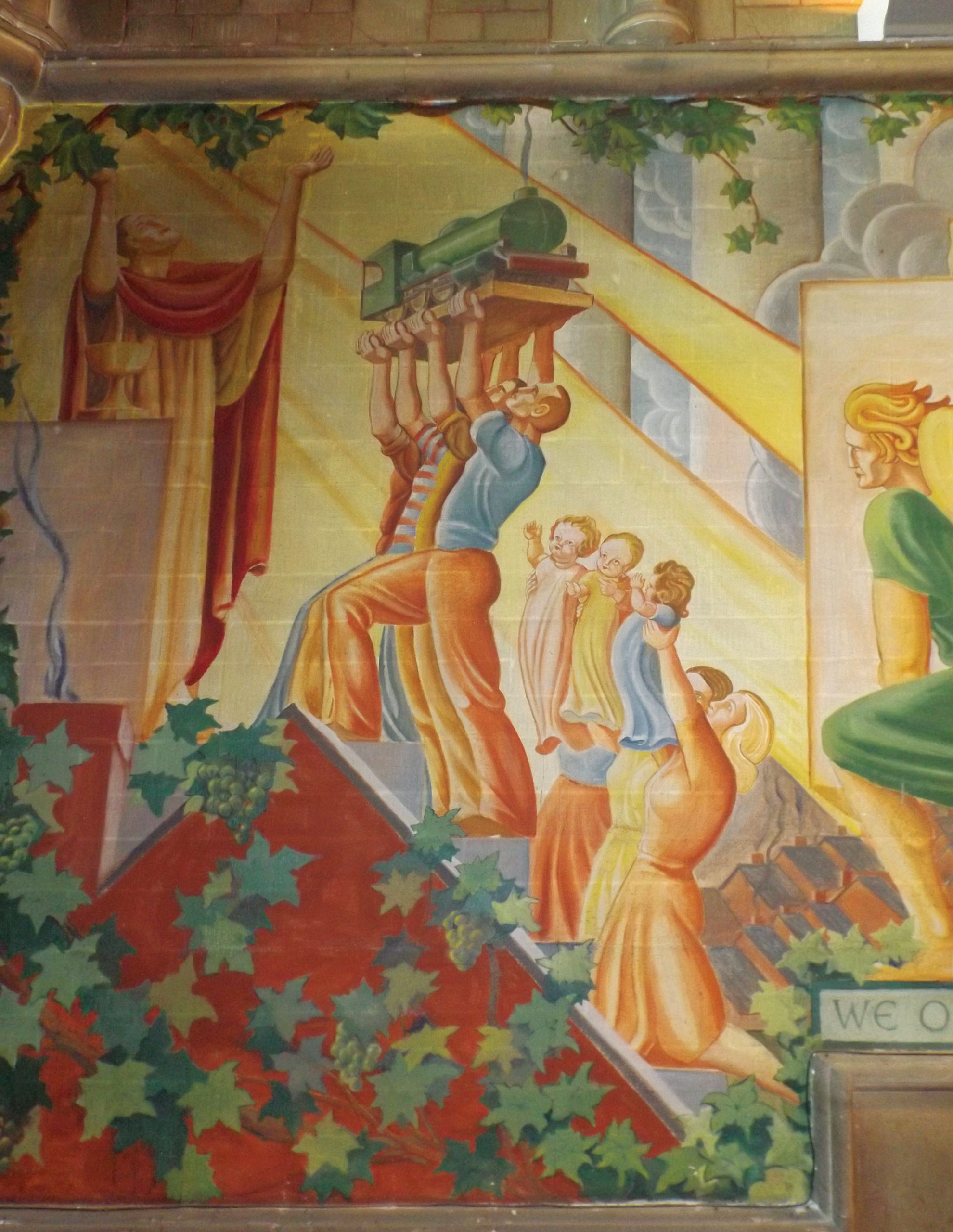
There’s a full history and explanation of the paintings here: https://allsaintsstbarnabas.org.uk/the-story-of-the-mural-paintings/ and even a link to my own blog post about them.
So, there you have it – an overview of a small sample of Swindon’s sacred art. I trust it’s tickled your metaphorical taste buds and that you’re now energised and enthused enough to visit them for yourself.
See also: