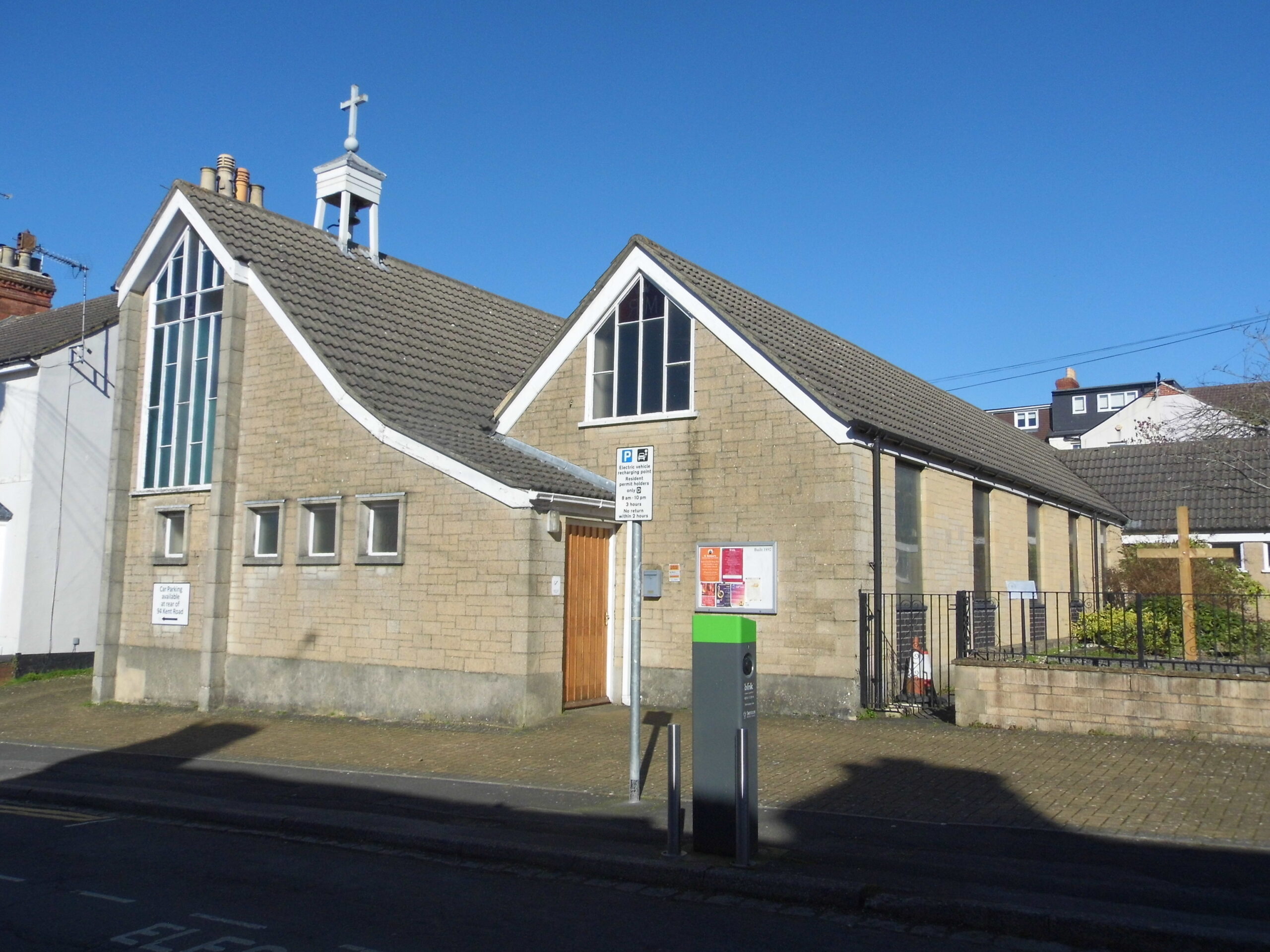
St Saviour’s Church, Ashford Road: 1890.
To talk about St Saviour’s we need first to talk about Swindon’s railway churches. Swindon has four so-called railway churches – all built to meet the spiritual needs of the burgeoning New Swindon.
St Mark’s church, opposite the GWR park came first, in 1845. Then there came:
- In 1885 St Barnabas at Gorse Hill – see also Swindon in 50 Buildings
- St Luke’s, a daughter church of St Mark’s at Broadgreen first opened in 1903 – see as above
- And finally, St Augustine’s in Rodbourne followed in 1907.
So that’s them then. Except it’s not. St Mark’s church has another daughter church.* One that’s thus far escaped my attention. It would have been good to get it into Swindon in 50 More Buildings – but to be honest I didn’t think about it. And if I had – well there isn’t a building that I’d have wanted to substitute. So here we are.
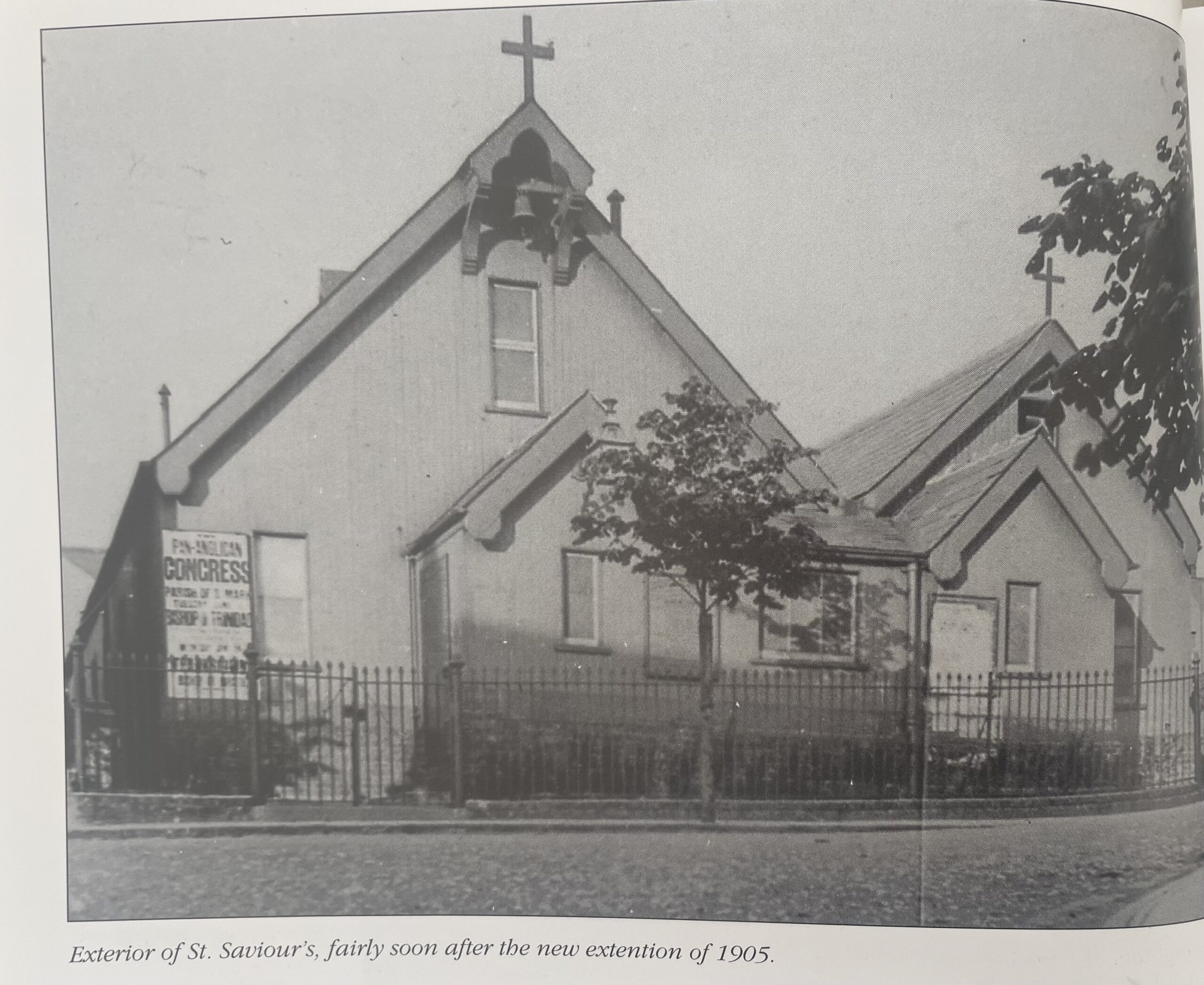
The church in question is St Saviour’s on Ashford Road. What makes this church interesting isn’t its architecture or stained glass or a particularly fine font. Rather than being famous-architect-designed like St Mark’s and Christ Church, the men of the GWR built this one from wood.
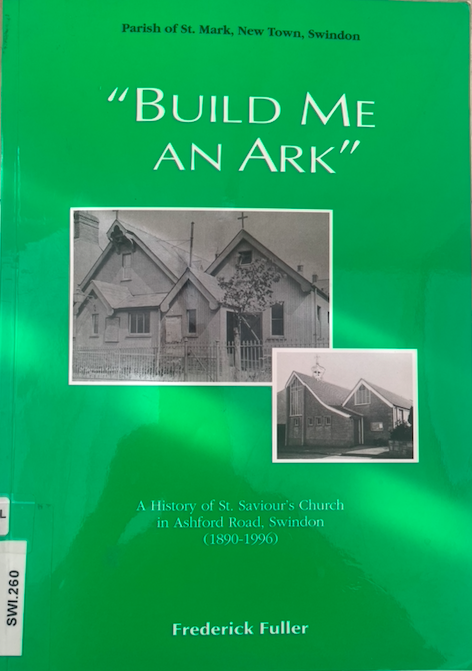
NB: I’m told by John Stooke that St Mark’s had yet another daughter church in Aylesbury Street – St John the Evangelist.
Poetry in motion
One-time Poet Laureate, Sir John Betjeman wrote of S. Saviour’s:
‘Up a steep hill going out of the New Town winds Old Swindon, there is a church built of wood and called St. Saviour’s. That was erected in 1889-90, in six months, by S. Mark’s men, mostly railway workers.’
‘When you consider that they did this in their spare time and for nothing. And that some of them sacrificed their holidays and that their working hours were from 6am to 5.30pm. In those days, you can imagine the faith that inspired them to go out after a long day’s work and build a church.
‘I would sooner be on my knees within the wooden walls of S. Saviour’s than leaning elegantly forward in a cushioned pew in an Oxford college chapel. That is to say if I am to realise there is something beyond this world worth thinking about.’
Meeting the needs of a growing population
In 1881 the population of New Swindon stood at nearly 20,000 and was rising fast. A mere forty years after the arrival of the GWR Works, building had spread out of the railway village. Along Westcott Place in the first instance and then beyond the railway line to the north of the town.
With this rapid increase in population, the parish church of St Mark’s found itself struggling to service the spiritual needs of its ever-growing congregation. The need for another church was paramount. But the cupboard, as it were, was bare.
Not one to let a little thing like an empty bank account deter him, one Canon Ponsonby stepped into the pulpit on June 9, 1889 – Whit Sunday. There he delivered a rousing sermon – a call to arms of a kind. Taking as his text, Genesis chapter 6, verse 14, he implored his congregation to ‘build me an ark’. And they did – they built a wooden church.
Make thee an ark of gopher wood; rooms shalt thou make in the ark, and shalt pitch it within and without with pitch.’
*Before I go any further, I should state that St Saviour’s is no longer a daughter church of St Mark’s. And the same goes for St Luke’s. The parish became a Team Ministry and with that, to all intents and purposes, these three churches became ‘equal’. For many years now, the parish has come under the jurisdiction of the Diocese of Bristol under the episcopal care of the bishop of the Bishop of Oswestry’.
Getting on with the job
Following a couple of meetings, a band of sixty volunteers stepped forward and were soon organized into work groups. Work began at once on a plot of land donated by local landowner William Sheppard – his name crops up a lot when one starts digging into Swindon stuff. Along with a few others – Levi Lapper Morse for instance. But I digress.
The Rev Charles John Corfe kicked things off by lifting the first sod of earth. And, on August 12th, 1889, Miss Ethel Dean, the daughter of the chief mechanical engineer at the Works, William Dean, laid the foundation stone. She used the words:
‘In the faith of Jesus Christ, we place this stone in the name of God the Father, God the Son and God the Holy Ghost’.
You can see the stone inside the church porch and an inscription: ‘To the glory of God this stone was laid by Ethel, daughter of W Dean, Esq on August 12th, AD 1889.’
Work continued on the church every evening and Saturday afternoons. The volunteers worked throughout the GWR Christmas shutdown. Thus, within a mere six months, St Saviour’s church was ready to open its doors for worship.
They came bringing gifts
Gifts included 1,000 bricks donated by local builder George Wiltshire. And also wood, of which there was a considerable amount, given by an anonymous “Welsh Churchman.” Among others who made donations were the Verschoyle sisters, daughters of Crimean veteran Henry William Verschoyle and his wife, the former Lucy Clarissa Goddard.
Granddaughters of the Goddard clan, Sybil and Kathleen, each gave eight chairs and their sister, Theresa, supplied the altar cross.
1904 and an extension becomes needed
At length, so busy did this little wooden church become that a feeling arose that the time had come for a replacement for this temporary church – a larger church with the capacity for 1,000 worshippers on the present site. The general opinion though came out against that notion. And the parochial verdict came down in favour of enlarging the existing church.
Thus, early in 1904 one Gerald Thompson, at the behest of the Rev. A G G Ross obtained drawings showing that enlargement was possible. The scheme set out in those drawings got approval as being possible by a Mr Townsend – he’d supervised the 1889 erection of the church.
Various committees made reports – who knew eh? – until, at last, at a meeting held on 25th May 1904, came the unanimous decision to go ahead with the enlargement. One hundred men volunteered for the work. This time though, many of them were regular worshippers at St Saviour’s. There were also young men involved who’d helped with the original church building as children.
More changes to come
But more changes were to come. A Swindon Advertiser article of June 2009 reports that, by the 1950s the St Saviour’s congregation were anxious to protect their ‘temporary’ wooden church. After considering their options they engaged local architect, RJ Beswick to add a new vestry and encase the existing building in stone.
They further state that 1961 saw the rededication of St Saviour’s with the home-made wooden church as last becoming a permanent fixture.