The Baptist Tabernacle. This building, unlike the Corn Exchange which is somewhat demolished by decline, is most definitely in the ‘demolished’ category. It having met its date with the wrecking ball back in 1978.
So, where to start with this one? Well, Mark Child’s Swindon Book states a number of things about this place of worship as was.
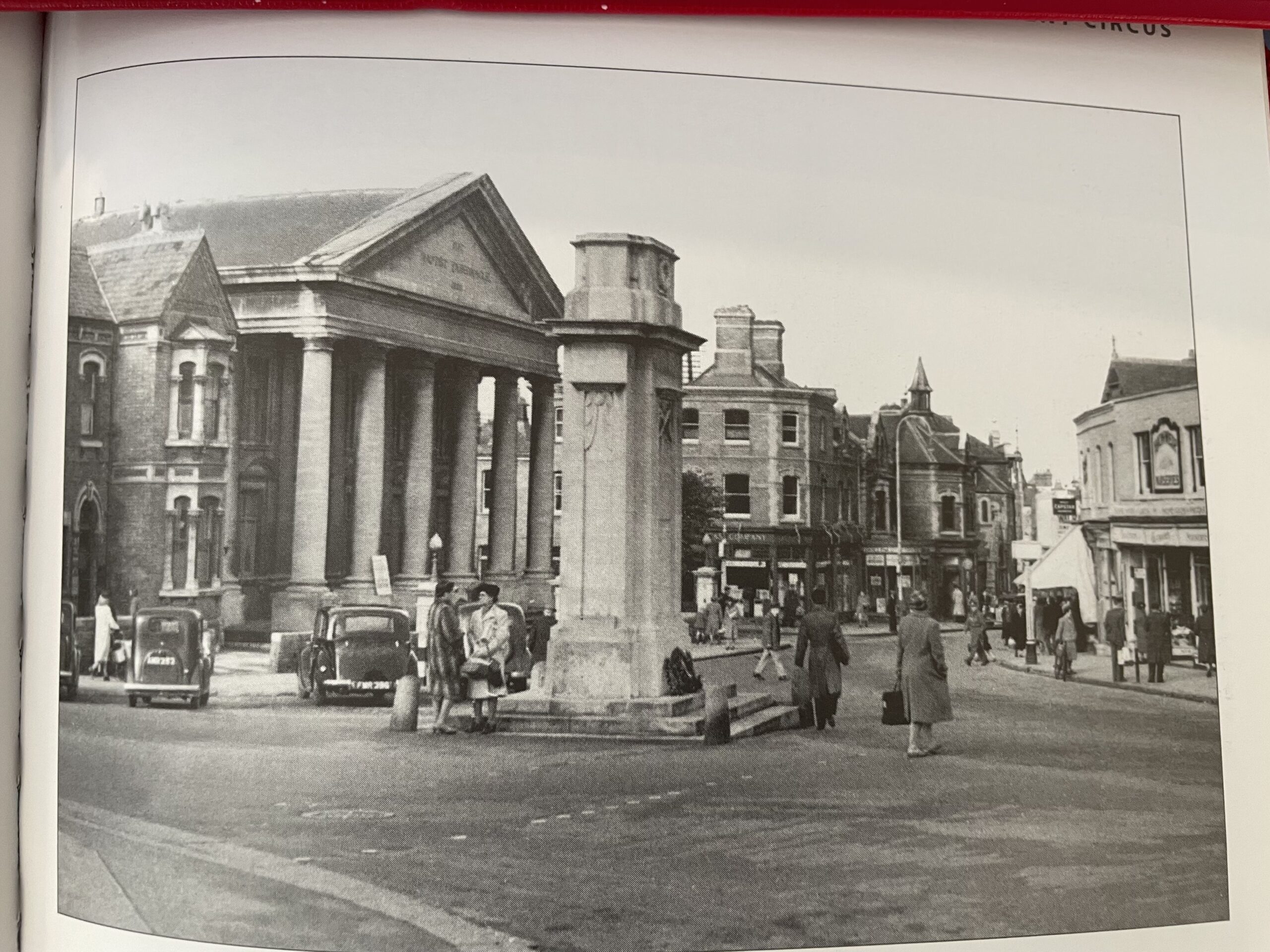
Designed by WH Read, in ancient Roman style and built from Bath Stone, the church cost £6,000 to build. It had iron railings surrounding it – in front of the steps. And also high-panelled plinths carrying Grecian torch-style lamps.
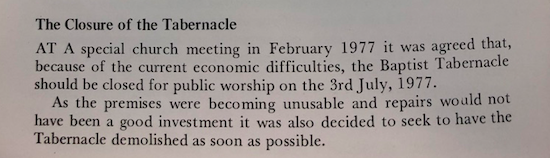
The Tabernacle stood adjacent to Regent Circus. And much furore erupted amongst the townspeople of Swindon back in 1978 when the bulldozers rolled in. According to Mr Child, they saw the action as symbolic of all that ailed the attitude of the town to conservation. And indeed, the passage of forty-odd years has done little to dampen the flames. As frequent outbursts on Facebook will testify. But note this extract from a history of the tabernacle produced by the Baptists themselves. It’s clear from this that it had to go. And it’s clear that diminishing congregations were, at least in part, to blame for the lack of money.
So the thought occurs does it not, that, had all the souls that have bemoaned the loss of this building, from that day to this, actually been in the congregation – it might have escaped demolition? At least at that time. ‘Cos the thing is this: we can’t keep buildings in aspic. They have to pay their way. And it’s evident that this one wasn’t.
Location, location, location
When the Baptists bought the site in 1885 it was something of an isolated spot. BUT Regent St was developing and the site more or less lay where the roadways between new and old Swindon met. So it offered potential. Behind it, to the south, lay only fields and allotments before the break in the landscape that was the Wilts and Berks canal.
The Tabernacle’s interior hall had a 1,000-soul capacity and it featured a gallery supported on iron columns with an ornamental front. Its entrance lay behind a colonnade* of six Tuscan columns beneath a large pediment. A flight of stone steps ran the entire width of the front.
*I have it on good authority, from a Swindonian that, that colonnade often stank of urine.
John Betjeman
Now we come to our friend, the poet, John Betjeman. As it happens Swindon has him to thank for the continued existence of the railway village. Yes indeed – David Murray John had a notion to raze the thing. But Betjeman campaigned for its saving. Thank goodness for that eh? He also, it seems, compared the architecture of the Tabernacle to that of London’s St Martin’s in the Fields. And I guess, as far as the front portico/colonnade goes I can see what he meant. But I do think we should note that the aforementioned church was built in 1726. So a good hundred years earlier. Ergo – might our church not be just a little out-of-date?
After the demolition squad
Following demolition, sections were, it seems, held for a time in the grounds of Abbey nursery at Malmesbury. At length, artist Stanley Frost bought the portico but failed to get planning permission (why didn’t he think of that first one wonders?) to set it up at Bell Farm in Brokenborough where he lived. So – in 2002 Frost sold it to business park owner Neil Taylor. He also failed in his plans to re-erect the columns, bases, façade wall, door frames and window surrounds into his new country home.
Then, in 2006, SBC entered negotiations to buy back the remains (why!?), with the prospect of rebuilding them into some future regeneration project in the town. At length they were brought back to the town in 2007 at a cost of £360,000. Of tax payer’s money one supposes.
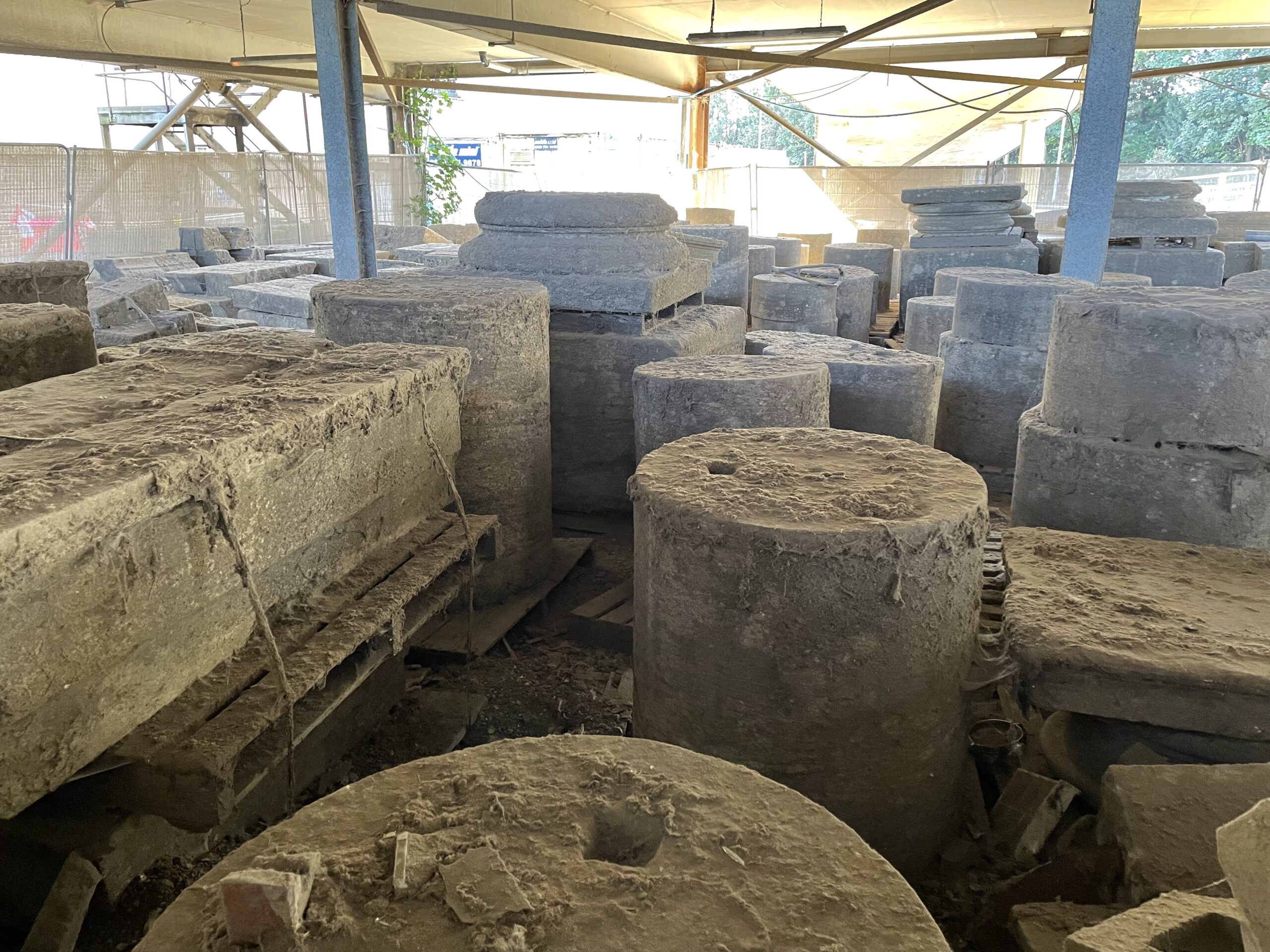
Between those two points, in 2004, someone discovered 260 tons of Swindon’s ex-tabernacle stone on a wooden pallet in a field in Northamptonshire. The hows and whys of that I do not know.
They were stored at the science museum in Wroughton for a time. But they now reside under the raised platform at the recycling centre – aka the tip.
A remote visit from a well-known evangelist
What do I mean by that? Well this article from the Swindon Advertiser reports that the famous American evangelist, Billy Graham, was visiting Manchester. ‘ … but Swindon people learned they would be able to hear him without travelling north. A live radio feed was to be relayed through to the Baptist Tabernacle in the town centre, with everybody welcome to come along and listen.’
Did that actually happen? I’m not sure. If I find out for certain I’ll update this post.
Returning to my question
At the beginning of this piece I asked the question ‘so where to start with this one?’ The reason? I have mixed feelings about the thing. I hear all the discourse about what a beautiful building it was and of course if people liked it then fair enough. Though of course I appreciate that Swindonians who remember it have a huge amount of affection for it. But … I personally don’t get it.
I’m not mad for symmetry and classical architecture for a start. Not even when it’s the real thing. And the Tabernacle wasn’t the real thing. It was Victorian pastiche of a Roman temple. And therein lies the rub for me – I dislike pastiche. Suburban houses with mock Tudorbethan beams on the outside – not for me. Modern houses dressed to look like country cottages – not keen on those either. You get the idea. But hey – each to their own eh? But I’d much rather well-designed, contemporary architecture … or at least a 1980s semi-detached that looks exactly that. Or some Victorian red-brick work like Milton Road baths or the old technical college.
When I think of buildings that Swindon has lost I feel sorrow about a few – the brick and glazed market hall being a good example. That was something authentic and, to the best of my knowledge, didn’t need to be demolished. How wonderful it would be to still have that.
And what the endless lamentation fails to consider is how much more the Pilgrim Centre, the Tabernacle’s replacement, offers to the community. No – it’s not as striking as was the Tabernacle. But the Pilgrim Centre is a well-built and attractive modern ecumenical building that serves the community in a way that the original building, magnificent as many see it as, could never have done. The members of Central Church, Swindon, are rightly proud of the centre with its Roundabout Coffee House, its befriending service for the homeless and its facilities for a wide range of meetings of social, charitable and secular bodies. Indeed, the Big Breakfast Plus Swindon operates from it seven days a week.
So the stones then
The CGI you see here is what fronted the tabernacle – which, the colonnade/portico aside, was nothing more than a brick rectangle.
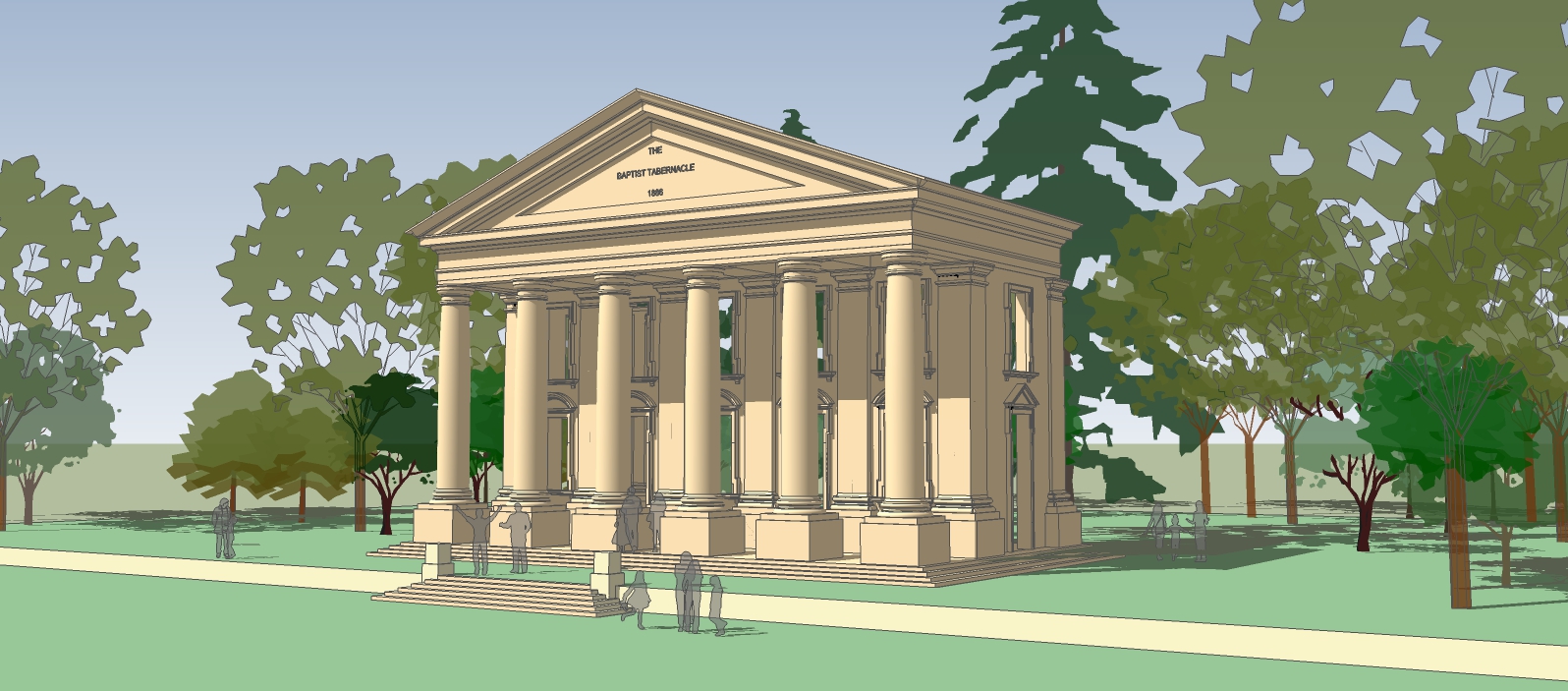
Putting the stones somewhere is not as easy as one might think. One can’t, for instance, install them by the lake at Lydiard Park because that would destroy the integrity of that which makes Lydiard what it is. And that applies to most any location one might think of.
Then there’s ICOMOS – the international council of monuments and sites. As a source of guidance for the conservation of historic buildings their charters have only some relevance to the stones because the building is demolished already. And, in England there’s an emphasis against restoration. And, because reconstruction of the portico would count as a restoration, a primary principle of conservation is broken at the outset. Ergo, any reconstruction must be of an intact portico, unaltered or changed to suit present-day fashion so as to retain authenticity.
So … all-in-all I think what we’re left with is a white elephant? I fear that the best, indeed the only, thing that can be done with them, is to build a brick rectangle and stick them on the front ….