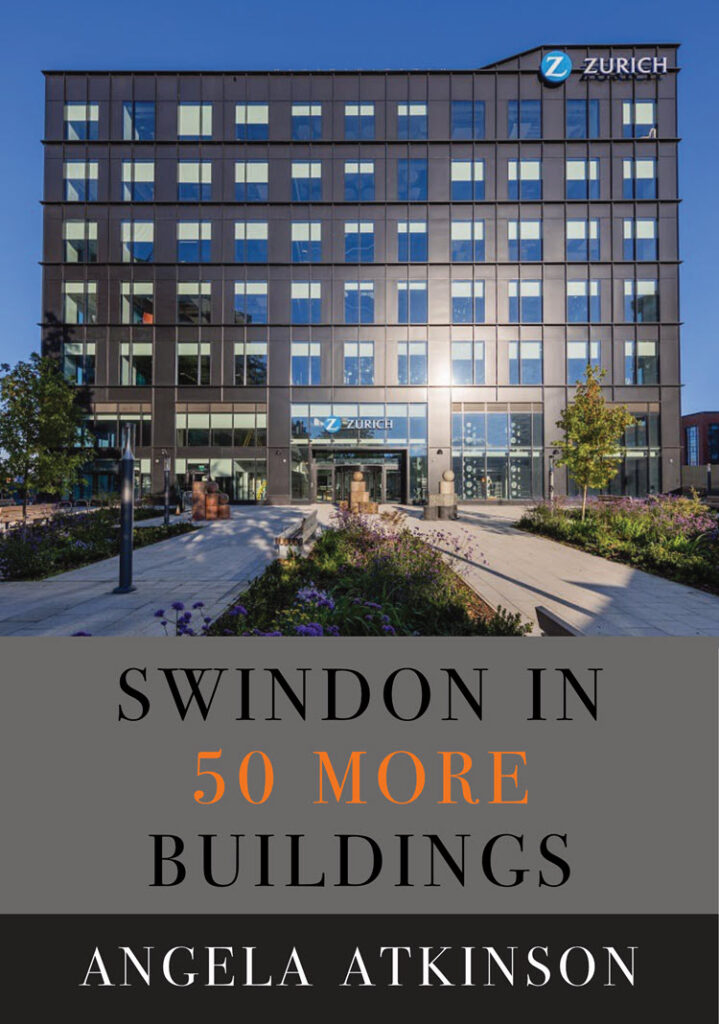
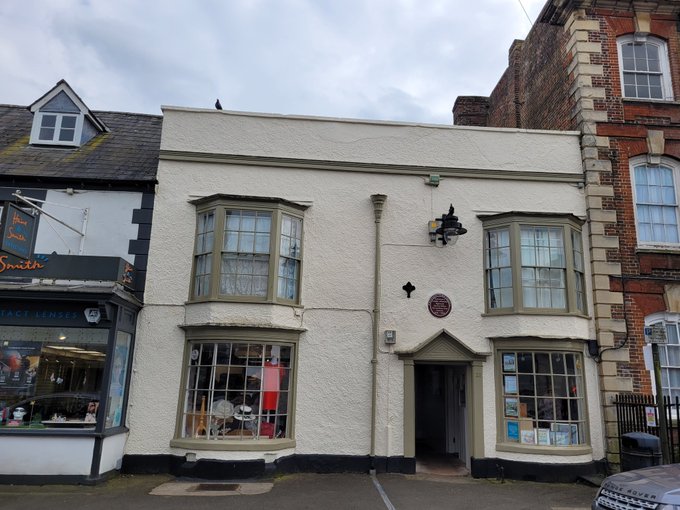
The Old Post Office, Highworth – 23 High Street SN6 7AG
The Historic England entry for 23 High Street Highworth tells us that this Grade II* listed early C18 building bears evidence, in its physical fabric of an earlier C16 structure. The latter was, it’s most probable, timber-framed, of at least two bays on a double burgage plot. Surviving features include an original closed wattle and daub roof truss.
HE further opines on the existence of documentary references pointing to an inn on this site in the C17 and C18. It would seem that, in 1738, No 23 and the adjoining Inigo House were owned by a merchant, Thomas Hewer. When the inn closed it became a shop and a bakery. As for the post office, that appears to have existed from 1918 at least.
And it’s for the post office – or rather a postmistress, Mabel Stranks – that you find this building within this Swindon in 50 More Buildings series. For it holds within its fabric an astonishing tale of an astonishing woman.
If the reason for including in this series, at least some of the buildings that I have, is because of the stories they tell, then this one is the ubiquitous no-brainer.
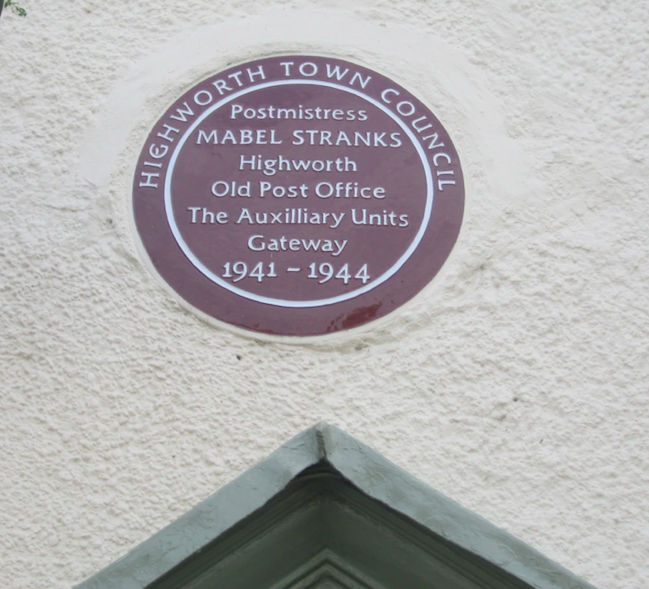
Who was Mabel Stranks?
Who indeed? Well, Mrs Stranks served as Highworth’s postmistress, sending telegrams and sorting stamps for over half-a-century. But what no-one who entered that post office knew – indeed even her closest family didn’t know. Was that this woman, who looked like anyone’s grandma, was a key figure in Winston Churchill’s guerrilla army. And that as such she became a name on Hitler’s hit list. *
*Mabel Stranks is not the only Swindon, female figure to have a wonderful wartime background. We also had a secret code breaker in the form of Mary Ratcliffe.
British Resistance Archive
This blog from the British Resistance Archive has a photograph of Mabel . You’ll see what I mean about her looking like anyone’s grandma – how grandmas looked back then at least.
So, as the aforementioned blog explains, in the dark days of 1940, Britain had the Nazis poised across the channel. During this time the country set up a secret resistance force. As part of this process, dozens of volunteers worked in roles considered vital for the war effort. So the gov asked them instead to undertake what was, in essence a suicide mission. Should an occupation happen that is.
And who would suspect a postmistress? A pillar of the community surely?
It’s hard now to imagine sleepy Highworth and its grey-haired postmistress having involvement in top secret, dangerous shenanigans. But involved they were. Not that the town knew at the time that, between 1941 and 1944, Mabel assisted in the secret recruitment of the Auxiliary Units.
I’m not going to reproduce the whole of the British Resistance Archive blog here. You can follow the link and read it for yourself. AND – visit the old post office and read the information board there. See below.
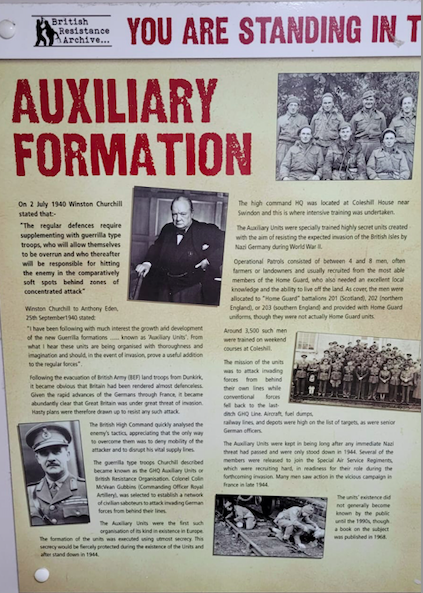
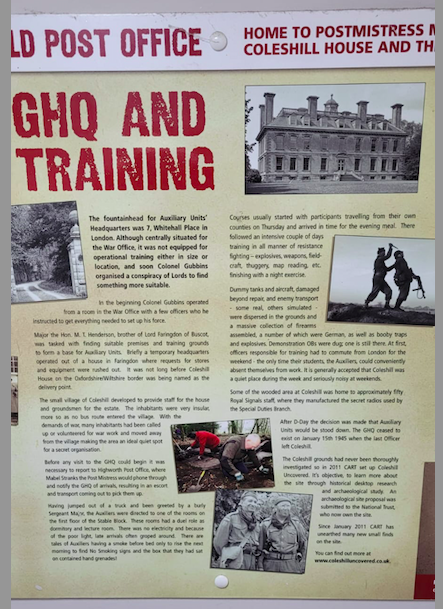
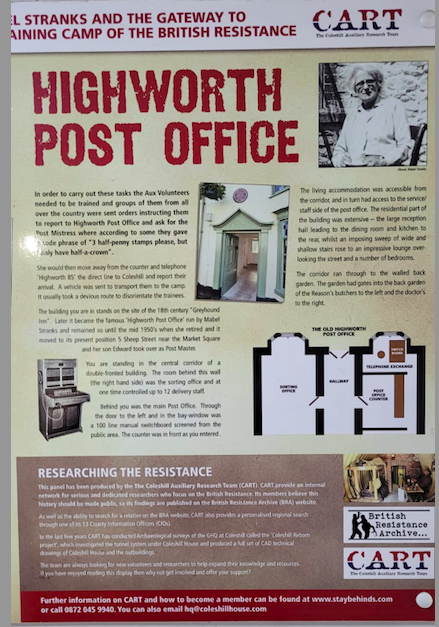
But – as Tom Sykes, founder of CART said. ‘This is a remarkable story of an incredible woman and the part she played in one of the most secretive organisations of WWII.
We can’t underestimate the bravery of Mrs Stranks. The life expectancy of an Auxiliary Unit member was just 14 days. And Mabel was all too aware of the reprisals that had been meted out by the Germans to anyone found to be resisting or helping those that were. She never accepted recognition for her part in this secret operation. And, like many of those she screened, she never talked to anyone about her role until her very last days.’
About CART
About CART & The British Resistance Archive.
The Coleshill Auxiliary Research Team (CART) publishes its findings on the British Resistance Archive (BRA) website.
CART also provides an internal network for serious and dedicated researchers. These researchers focus on the British Resistance and agree with CART’s core value of making the research public.
- CART is made up of select volunteer historians and published writers known as County Information Officers (CIOS) and also public members.
- CART is not a business or an academic body of professional researchers.
- CART is non-profit making and has no financial support from any company or organisation. It’s funded solely by donations and the revenue it makes from the sale of various items sold in the shop.
- Since CART’s birth in June 2009 the website has seen over 110,000 unique visitors. Further it’s attracted TV, Radio and national press attention.
See also:
Churchill’s secret army in Coleshill
http://news.bbc.co.uk/local/wiltshire/hi/people_and_places/history/newsid_8516000/8516010.stm
‘….
Hidden away in the countryside near Swindon, thousands of civilians were trained to form a lethal army of guerilla fighters ready to thwart any German invasion.
All these stories and more are bound up in Coleshill, an estate in the Cotswolds that was the secret HQ of Britain’s guerrilla army during WWII….’