Pavey’s Mill (also known as Woodhams’s mill) Wroughton is a welcome addition to this Swindon in 50 More Buildings series. That’s because, with my original Swindon in 50 Buildings book the brief didn’t allow me to cover any buildings in the wider borough. Thus I’m seizing the opportunity with this blog series to write about at least a couple.
Now, before I go any further I must give mention of the Wroughton history group – had I not chanced upon their website I would have remained ignorant of Pavey’s Mill. Well, to be fair, not only this building but a host of other interesting stuff. Their website has a downloadable leaflet that takes you on a circular walk round the village from the Ellendune centre and back. I did it with a friend last summer and it’s a most agreeable activity. I had no idea at all that of how interesting Wroughton is – my bad for sure.

An extract from the aforementioned walk:
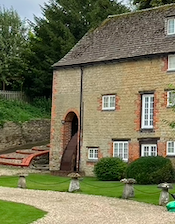
‘At the end of The Pitchens, turn right into Baker’s Road, keeping the large white house – Woodham House – on your left. Just past the house peep round the corner into Woodham Mill. Known also as Pavey’s Mill the present building dates from 1771. That said, documentary evidence exists of a mill on the site as early as 1649 with the miller being Richard Sadlers.
The third of seven mills sited along the stream, this one ground flour and bones.
The overshot well remains in place – though it’s now frail so is fixed in place. The remains of the ponds and leets lie behind the building.’
The general opinion is that the mill used something like 1026-1250 gallons of water per minute to drive two pairs of stones. In 1810, one Mary Pavey was the miller – thus the mill’s name.
A lucrative trade
I had a dig around in Local Studies in the central library for info on this building. They have a collection books written by Wroughton history group covering a wide range of aspects of Wroughton’s rich history. From them I’ve managed to glean that the size of the building combined with the elegant Woodham’s House is suggestive of milling being a most lucrative enterprise indeed.
In the first instance water powered, it seems that the mill became independent of a water supply with the installation of a steam engine. Mary Pavey herself bears this assumption out. The deeds of 1869 lists a 12 horse power steam engine and boiler.
By 1960s, it seems that, although still lived in, Woodham House was in dire need of repair and the mill lay derelict.
A local builder applied for planning permission to clear the site and build bungalows. But, fortuitously, a newcomer to the village by the name of Harold Rushden happened to be a restoration builder. He saw the site’s potential and bought the mill.
In 1964 he embarked on the painstaking restoration works and saved the mill. He also bought Woodham House and restored that to its former glory.