ROMAN COIN HOARD DISPLAY OPENS TO THE PUBLIC TEN YEARS AFTER BEING DISCOVERED
Athelstan Museum Coining It
Over 1,200 Roman coins found ten years ago in a field near Malmesbury are on public display at the town’s Athelstan Museum.

The Malmesbury coin hoard has spent the last seven years undergoing professional conservation. A group of committed volunteers led by trained archaeologist and museum trustee Maria Marsh have been cataloguing them. The museum will unveil the hoard to the public on Friday 8th April. But first specialists need to build an environment-controlled display cabinet to showcase the hoard.
Maria said: It’s amazing to see the coins together with the pot, on display in the museum at last. The volunteers I’ve worked with have been amazing in their commitment to prepare the hoard for display a few miles away from where they turned up.
‘It’s my belief this is one of the few times that something as big as this has returned to a local museum so close to where it went into the ground in the first place.
Mimzy
One of the volunteers who’s worked on the hoard is the man who found the hoard while metal detecting ten years ago.
Anthony Mims, known to all as Mimzy, got the bug for metal detecting in childhood but his army career left little time for his hobby. He left the army at the age of 41 and became a truck driver. That career change gave him more time. Then a chance conversation with a farmer which led to the piquing of his interest.
He told me that four metal detecting guys from Swindon had been visiting one of his fields in Milbourne, on a regular basis, over a four year period. I thought that was curious, you wouldn’t keep going back if you weren’t finding anything. He offered me the opportunity to do the same and I took it.
‘I’d never before found a hammered coin yet within three paces I found my first one – a medieval silver coin. In 2006 I found several Roman coins, then I found more over the next few years.
‘It was in 2012, in a higher level of the field, that I came across the hoard, though I didn’t realise what I’d found. I moved the earth around it as best I could, took the whole hoard and put it on my waterproof coat and wrapped it all up. As soon as I could I took it to Chippenham Museum.’
Treasure Trove
Examination saw the hoard declared as treasure trove. That means a thing has historical value, museums can express interest in it and the treasury puts a value on it.
The value, following purchase of the item, is then split between those who find the treasure and the landowner. In this case, Mimzy and the farmer, who has since passed away, did receive an amount of money.
‘It wasn’t as much as people think,’ Mimzy said. ‘It wasn’t a fortune.’ But I don’t do it for that. I’m a genuine lover of history and the hoard, its location and the other items found on the site give us clues to the past which I find fascinating.’
No one knows why the coins became buried in the Wiltshire field – the exact location of which is a secret. Though both Maria and Mimzy wonder if it was some kind of religious offering.
Owning the hoard
The Athelstan Museum bought the hoard in 2015, in a bid led by Maria Marsh. Then followed cataloguing of the hoard and fundraising for a safe display for it.
In total the project has cost in the region of £50,000. Members of the community contributed towards the overall cost. The museum trustees were also supported by grants from the National Lottery Heritage Fund and the V&A (Victoria & Albert) Purchase Grant.
Sharon Nolan, Chair of the Museum Council and Trustees, said: ‘This is the culmination of a great deal of hard work by a group of committed and interested volunteers. It results in a display that shows the coin hoard to its best advantage. I’d like to thank all my colleagues who invested so much of their time to create this display. And also to Maria for leading this most interesting project.’
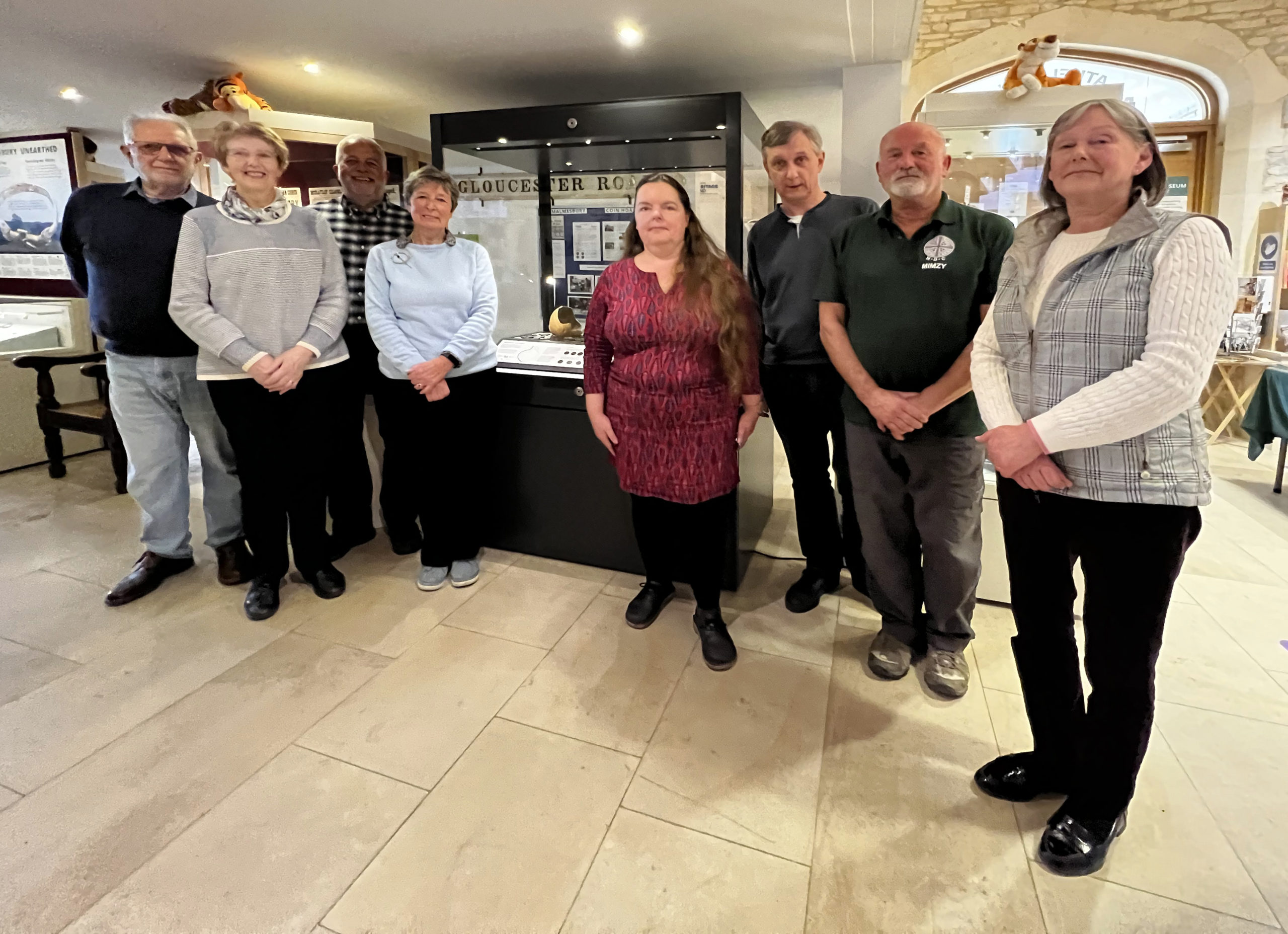
From left to right Graham McDougal, Mike Goodyer, Susan Mockler, Maria Marsh, Alan Taylor, Ruth Sandiford, Mimzy and Anne Goodyer.
Displaying the hoard experienced delays due to the pandemic. But the volunteers kept on with their painstaking work until the recent installation of the cabinet in the museum.
For more information about the museum opening times visit https://www.athelstanmuseum.org.uk