Does Xmas make you cross? What am I talking about? I’m referring here to Xmas the abbreviation of Christmas rather than the event itself. Though you might also find that irksome too – for any number of reasons.
I’m sure you won’t be at all surprised to know that that the usage of Xmas, like so many other linguistic derivations/abbreviations, goes back a long way. At least 1000 years. I’m pretty sure I’ve read somewhere that the famed ancient Greek philosopher and polymath, Aristotle, once opined on there being nothing new under the sun. And if that was true then – it’s surely true now?
This 2004 BBC article, Why get Cross about Xmas?, takes a look at why this particular four-letter word gets people so hot under the collar.
Many people, and I fell into this camp, believe Xmas to be a relatively modern, lazy shorthand born on the high street. After all, as the article points out, Xmas fits neatly onto shop sale signs and into news headlines. Thus, it’s beloved of journalists and store managers. But that’s a mistaken view and we’ll see why shortly.
At the time that article was written the style guides followed by The Times, The Guardian and the BBC website itself ruled out its use where ever possible.
Champion Christian Credentials
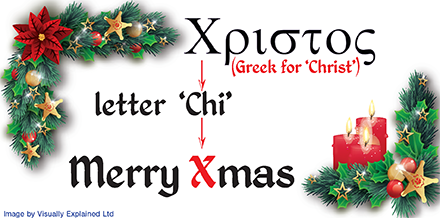
Besides all this, there’s a common belief that ‘xmas’ (pronounced /ˈɛksməs/) is a secular attempt to remove the ‘Christ’ from Christmas. But it’s neither. In fact, as the article points out, far from being an irreligious abbreviation the term appears to have impeccable Christian credentials. And that’s because it’s thought that the ‘X’ represents the Greek letter ‘Chi’ – the first letter of the Greek word for Christ: Christos.
Supporting this view is/was Bill Purdue – an Open University lecturer and author of The Making of the Modern Christmas. Said Bill: ‘I suppose to us it will always look like an abbreviation. But it would first seem to be an abbreviation used by clerics with a good knowledge of ancient languages.’
‘A lot of people disapprove of it or think of it as blasphemous because they think the X stands for anonymity – the ‘Mr X’ sort of idea.’
So – stated earlier that Christmas has been abbreviated for the best part of 1,000 years. Indeed, before Xmas we had XPmas. That’s according to Inge Milfull, assistant editor of etymology at Oxford English Dictionaries (OED). Inge found refences in the Anglo-Saxon Chronicle as far back as 1021. She says it’s probable that the P got dropped later. Further, there may even have been religious reasons for abbreviating Christ as Jehovah was abbreviated in Hebrew.
Whatever – it’s all Greek to me.
A parchment space saver
All the above apart, the term was also a space saver. In a gospel manuscript the word ‘Christ’ would feature a lot. Given that parchment was an expensive commodity anything that saved space on the precious material would be welcome.
But, whatever the ins and outs of the origins of Xmas it was apparently good enough for the poet Samuel Taylor Coleridge who wrote in 1801: ‘On Xmas Day I breakfasted with Davy’. Whoever he was.
A now-retired Diocesan spokesman, Martyn Halsall said that Xmas remained a talking point, among older people in particular and regardless of its Greek meaning. ‘I think that’s a subtlety lost on most of the population,’ he said.
Staying in style
As mentioned earlier, the term has been long unpopular with many editorial style guides. Indeed, on this point, the 1948 Vogue book of etiquette stated that Xmas should never be used in greetings cards. So, if your wish is to be in vogue – then Christmas it must be.
I’m with Vogue.